AI Tools
MeetGeek or Claap in 2026? The Real Difference Starts After the Meeting Ends
MeetGeek and Claap both record meetings, write notes and automate follow-ups, but their products are moving in different directions. MeetGeek is built around company-wide meeting automation; Claap goes much deeper into sales calls, CRM data, coaching and deal intelligence.
MeetGeek vs Claap looks like a straightforward AI meeting assistant comparison until the meeting is over. Both platforms can capture conversations, transcribe them, generate summaries, identify next steps and send information into other business tools, but they are increasingly designed for different operating models.
MeetGeek is the broader meeting platform. It works across sales, customer success, recruiting, product, leadership and internal meetings, combining transcription, AI notes, meeting analytics, cross-meeting search, workflows, AI agents and team knowledge. Claap is increasingly built around revenue conversations: sales-call capture, automatic CRM enrichment, call scoring, coaching, deal qualification, forecasting and structured meeting data that can also feed external AI agents.
Choose MeetGeek when the company wants one AI meeting system across multiple departments. Choose Claap when sales conversations are the main source of business data and the priority is turning those calls into CRM updates, coaching signals and deal intelligence.
That difference matters more than small variations in transcription or summary formatting.
MeetGeek vs Claap at a Glance
MeetGeek vs Claap overlaps heavily at the recording and note-taking level. The platforms separate once a company starts asking what should happen to the meeting data after the transcript has been created.
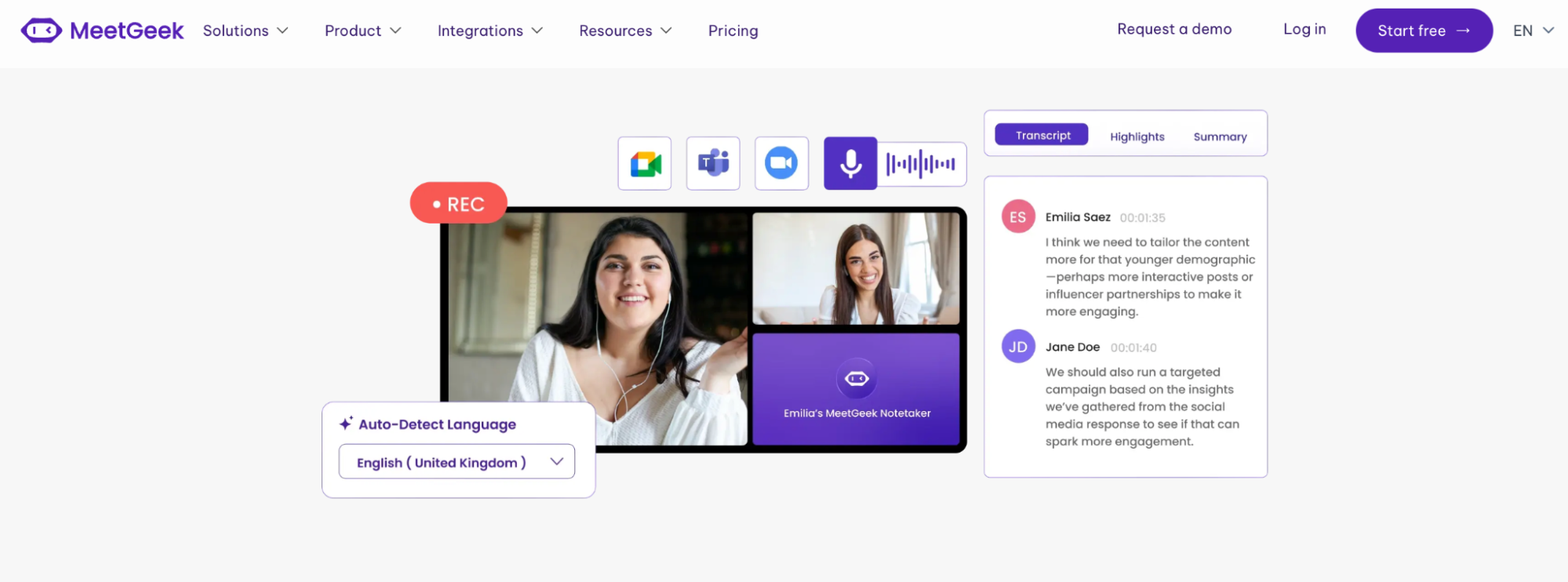
MeetGeek is meeting-first and department-agnostic. Claap is conversation-first but increasingly revenue-specific. That positioning should be the starting point for the MeetGeek vs Claap decision.
| Feature | MeetGeek | Claap |
|---|---|---|
| Primary focus | AI meeting automation and intelligence | Sales and revenue conversation intelligence |
| Meeting recording | Yes | Yes |
| Bot recording | Yes | Business and above in current pricing structure |
| Bot-free recording | Yes | Yes |
| Mobile / in-person capture | Yes | Yes |
| Transcription | 100+ languages | 99+ languages |
| Automatic summaries | Yes | Yes |
| Action items | Yes | Yes |
| Cross-meeting AI chat | Yes | Yes, broader workspace intelligence from Business |
| Meeting analytics | Yes | Yes |
| Sales call scoring | Yes through meeting insights / skills | Major Business feature |
| AI coaching | Available through meeting intelligence | Major sales-focused feature |
| CRM syncing | Yes | Yes |
| CRM field enrichment | Yes through workflows / skills | Major product focus |
| Deal qualification | Possible through skills and workflows | Dedicated MEDDIC, BANT, SPICED-style scoring |
| Deal forecasting | Less central | Enterprise focus |
| AI follow-up emails | Yes | Yes |
| Video highlights | Clips / highlights | Magic Clips |
| AI agents | Yes | Yes |
| MCP | Yes | Yes |
| API | Yes | Yes |
| Free permanent plan | Yes | No standalone free recording plan in current pricing |
| Best fit | Cross-functional meeting automation | Sales and revenue teams |
MeetGeek vs Claap Recording and Transcription
Both MeetGeek and Claap can capture Zoom, Google Meet and Microsoft Teams conversations, but they differ in how much flexibility is available at each price level.
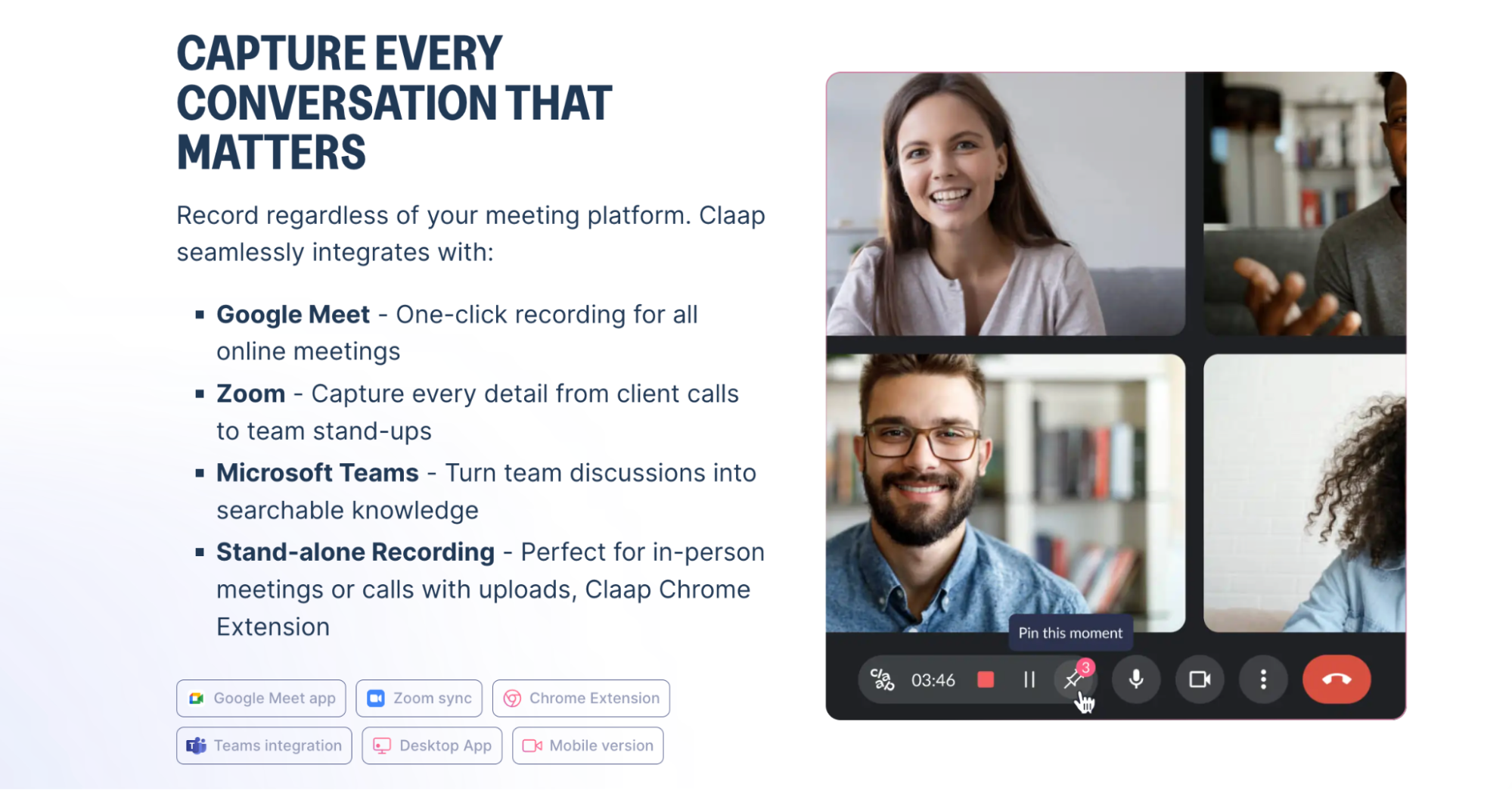
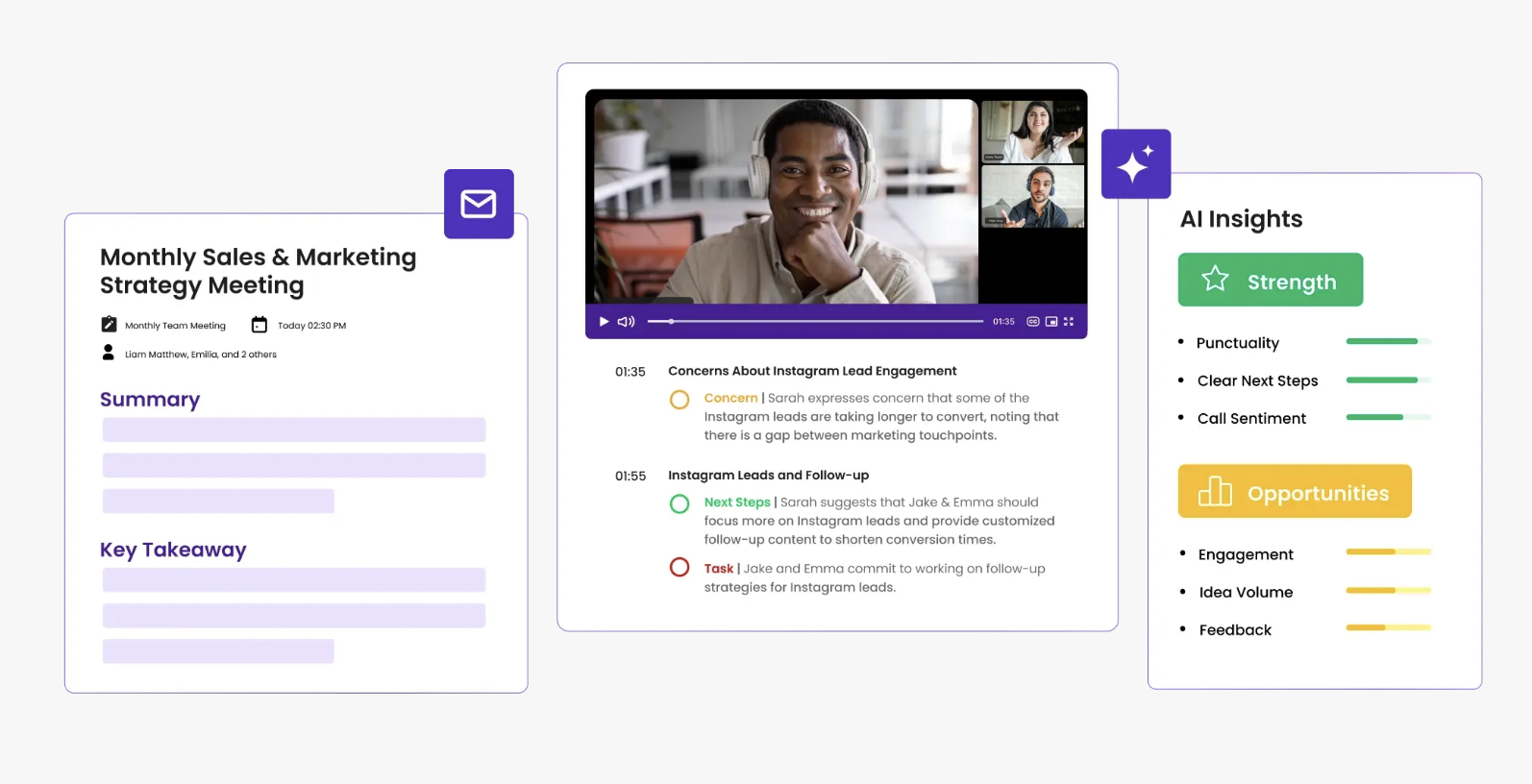
MeetGeek supports both visible meeting agents and bot-free recording through its browser extension and desktop tools. Its free Basic plan already supports Zoom, Google Meet, Teams and other recording methods, alongside mobile capture and uploaded audio or video. MeetGeek currently supports transcription in 100+ languages, automatic language detection and speaker recognition.
Claap also supports multiple capture methods. Its desktop application and Chrome extension can record without placing a visible bot inside the meeting, which can be useful in client calls where an extra participant is undesirable. Claap also supports uploads, in-person capture and major conferencing platforms, with transcription across 99+ languages.
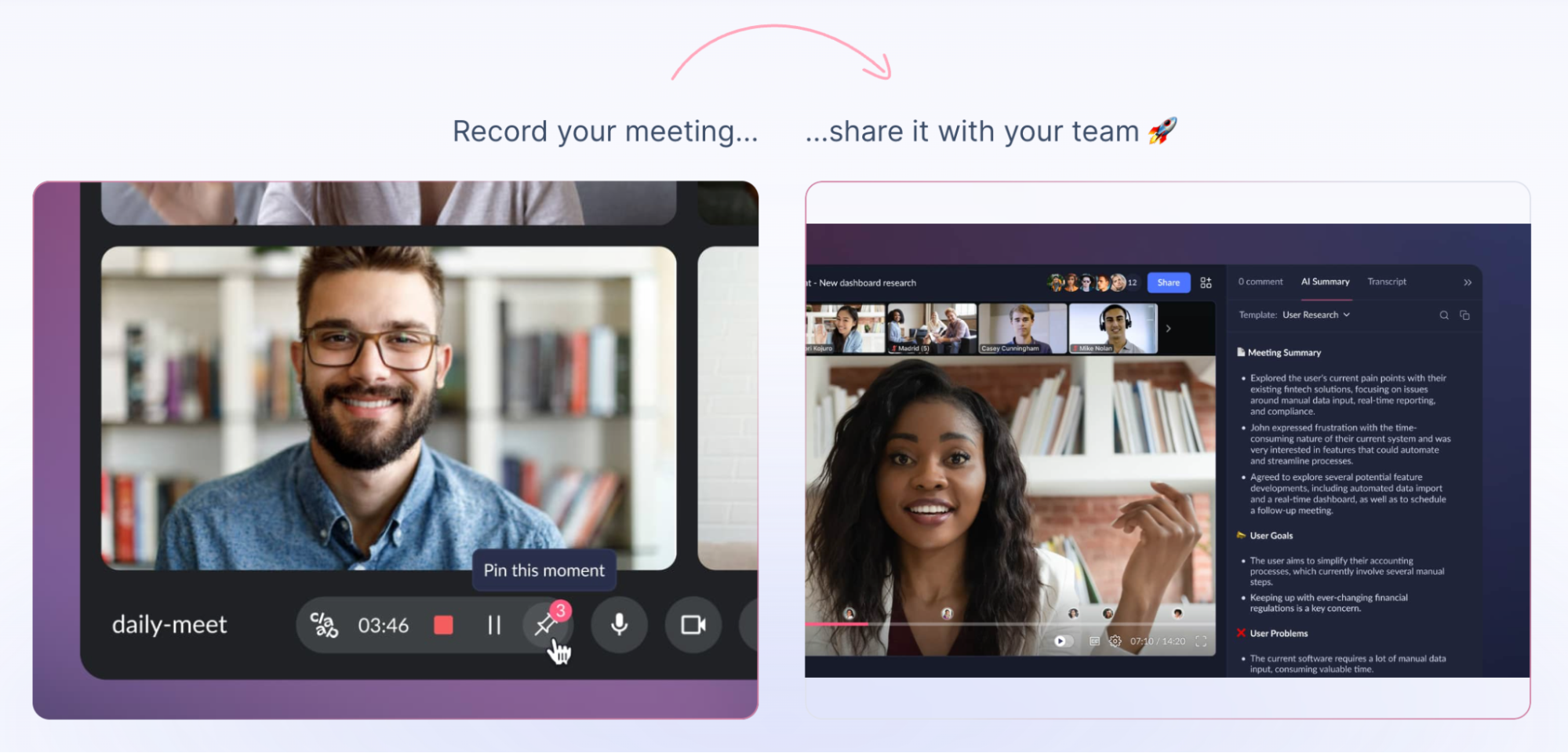
There is an important plan difference. Under Claap's current pricing structure, Pro includes unlimited recording through the desktop app, Chrome extension and audio capture, while the meeting bot for Zoom, Meet and Teams is listed from Business upward. MeetGeek provides bot and bot-free options much earlier.
For a general business user, the recording experience is strong on both platforms. MeetGeek has the advantage when a team wants maximum choice between bot, no-bot, mobile and automated recording without moving immediately into a higher-tier sales plan.
| Recording Need | MeetGeek | Claap |
|---|---|---|
| Zoom | Yes | Yes |
| Google Meet | Yes | Yes |
| Microsoft Teams | Yes | Yes |
| Visible meeting bot | Yes | Business+ in current Claap plans |
| Bot-free browser recording | Yes | Yes |
| Desktop recording | Yes | Yes |
| Mobile / in-person recording | Yes | Yes |
| Upload existing audio/video | Yes | Yes |
| Automatic speaker recognition | Yes | Yes |
| Multilingual transcription | 100+ languages | 99+ languages |
MeetGeek vs Claap AI Notes, Summaries and Meeting Search
MeetGeek and Claap both go well beyond raw transcription. The useful comparison is how much structure each platform adds to the conversation and how easily that information can be reused later.
MeetGeek automatically produces summaries, next steps, key topics, highlights and searchable transcripts. Meeting templates can change how different calls are summarized, so a sales demo does not need the same structure as a hiring interview or internal planning session. MeetGeek also provides AI Chat and search across meeting history, allowing users to query previous conversations rather than reopen transcripts manually.
Claap provides AI summaries, chapters, searchable transcripts, follow-up emails and customizable summary templates. Claap AI can answer questions about individual conversations, while higher plans extend analysis across meetings, deals, companies and contacts.
The important MeetGeek vs Claap difference is context. MeetGeek treats meeting history as organizational memory across multiple types of work. Claap structures that memory increasingly around customers, deals, CRM fields and revenue activity.
For a product manager searching six months of discovery calls or a leadership team trying to recover a past decision, MeetGeek's general meeting-memory model is useful. For a sales manager asking what objections repeatedly appear in late-stage deals, Claap's revenue-oriented structure becomes more relevant.
| AI Output | MeetGeek | Claap |
|---|---|---|
| Meeting summary | Yes | Yes |
| Action items | Yes | Yes |
| Key topics | Yes | Yes |
| Custom templates | Yes | Yes |
| Transcript search | Yes | Yes |
| Cross-meeting search | Yes | Yes |
| AI follow-up email | Yes | Yes |
| Meeting-type detection | Yes | More sales-oriented |
| Search across deals / companies | Via meeting/workflow context | Strong Business+ focus |
| AI-generated CRM data | Yes through integrations / skills | Core sales workflow |
MeetGeek vs Claap Meeting Intelligence and Sales Insights
This is where MeetGeek vs Claap stops being a close feature-for-feature comparison. MeetGeek offers broad conversation intelligence and team meeting analytics, while Claap concentrates much more heavily on sales performance and deal execution.
MeetGeek analyzes individual and aggregated meetings using metrics such as engagement, participation, talk rate, sentiment, punctuality, recurring topics and custom indicators. Its Meeting Analytics dashboard can identify trends, strengths, recurring themes and opportunities across teams. Sales organizations can use those insights for coaching, but the same analytics model can also be applied to recruiting, customer success, leadership meetings and internal collaboration.
Claap's intelligence layer is narrower but deeper for revenue teams. Business adds call scoring and AI coaching, while Enterprise extends the product into deal forecasting, account scoring and contact insights. Claap can score sales calls against frameworks such as MEDDIC, BANT and SPICED, identify missing qualification questions and use recorded conversations as evidence for coaching or pipeline analysis.
MeetGeek provides broader conversation intelligence. Claap has the stronger specialized revenue-intelligence layer.
A Head of Sales evaluating discovery-call quality is more likely to use Claap's native qualification and coaching workflow. A COO comparing meeting effectiveness across sales, HR, product and customer success is more likely to use MeetGeek's wider analytics model.
| Intelligence Feature | MeetGeek | Claap |
|---|---|---|
| Individual meeting analytics | Yes | Yes |
| Team analytics | Yes | Yes |
| Talk-time / participation | Yes | Yes |
| Sentiment / engagement | Yes | Sales-focused analysis |
| Recurring topic analysis | Yes | Yes |
| Call scoring | Custom KPIs / skills | Dedicated sales scoring |
| MEDDIC / BANT / SPICED | Can be implemented through workflows | Native scoring focus |
| AI sales coaching | Available through intelligence workflows | Core Business feature |
| Deal qualification | Customizable | Dedicated product |
| Deal forecasting | Not the primary product | Enterprise |
| Account scoring | Less central | Enterprise |
MeetGeek vs Claap for CRM Automation
Both platforms reduce the administrative work that happens after a customer call, but Claap makes CRM enrichment a larger part of its core sales proposition.
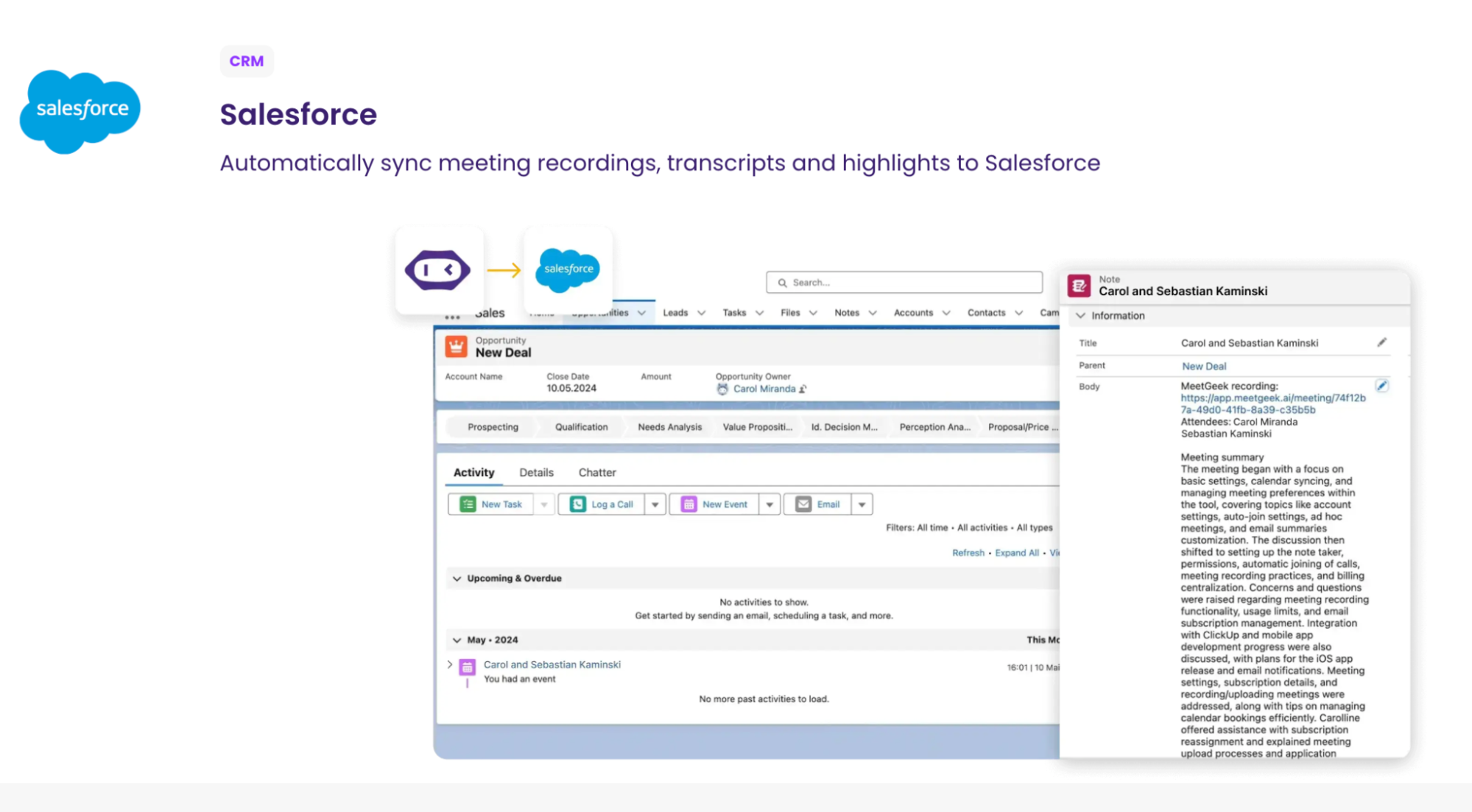
MeetGeek can automatically sync meeting summaries, transcripts, highlights and next steps into CRMs such as HubSpot and Salesforce. Current integrations also cover platforms including Pipedrive, Close, Attio and Zoho, while workflows can turn next steps into tasks and distribute meeting information to collaboration or project-management tools.
MeetGeek's newer Meeting Skills extend this further. A Meeting Skill can read a transcript and then perform an action such as scoring a sales call, drafting a follow-up email, flagging churn risk or sending an insight to another system.
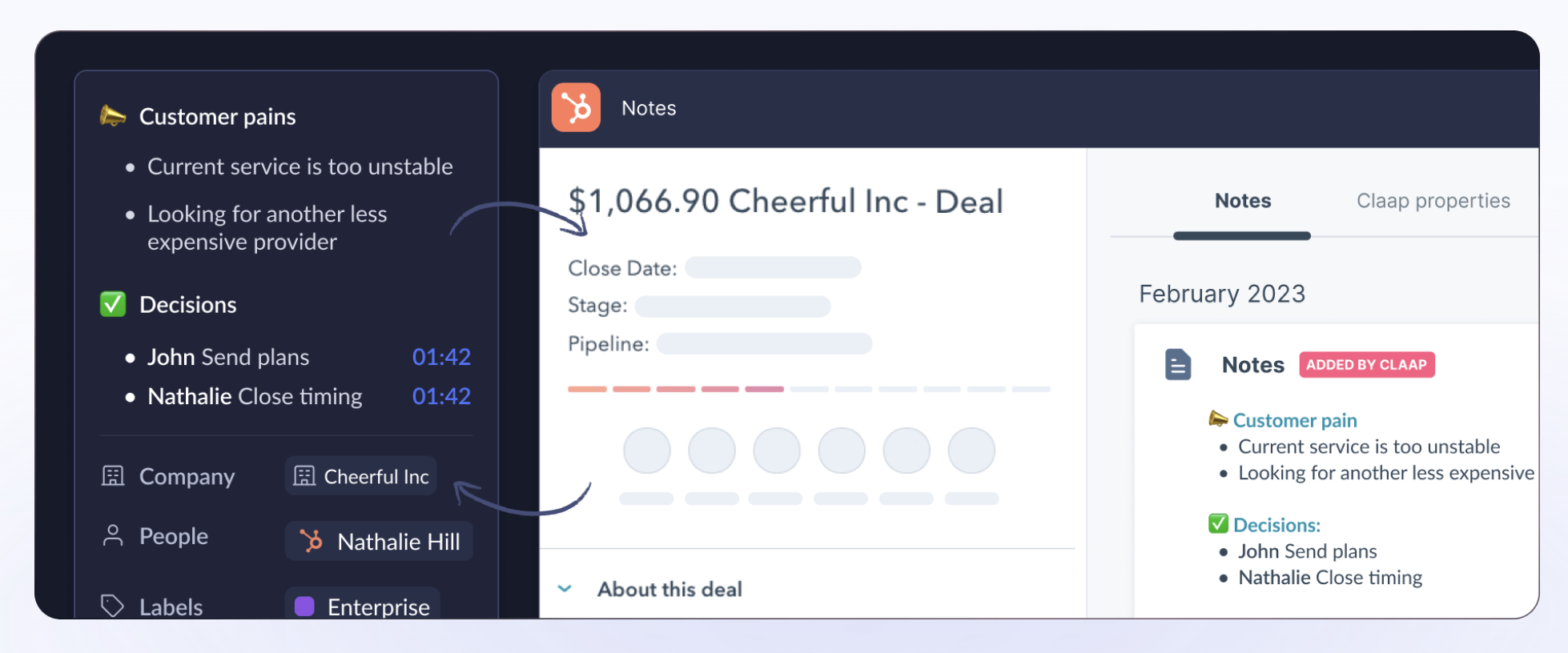
Claap is more explicitly designed around CRM data quality. It can extract information from sales conversations and map it into CRM fields, including custom properties. Current CRM enrichment workflows support platforms such as HubSpot and Salesforce, while the wider integration ecosystem includes Pipedrive and other sales tools.
Claap can turn information such as:
- Next steps.
- Budget.
- Pain points.
- Objections.
- Competitive mentions.
- Qualification criteria.
- Deal information.
into structured CRM data instead of leaving it inside a meeting summary.
The distinction is subtle but important: MeetGeek automates what happens after meetings across many business tools; Claap is particularly focused on turning sales conversations into structured revenue data.
MeetGeek vs Claap Integrations and Automation
MeetGeek has the broader automation story for cross-functional business use. Claap covers the major revenue stack particularly well.
MeetGeek's official pricing page currently references 10,000+ integrations when native connections and automation platforms are included. It works with CRM, collaboration and productivity systems and supports Zapier, Make and n8n. AI Chat can also trigger actions in connected tools, while Meeting Skills and agentic workflows can execute tasks after meetings.
Claap lists 30+ direct integrations, including Google Meet, Zoom, Teams, HubSpot, Salesforce, Attio, Pipedrive, Slack, Notion and Aircall. It also supports Zapier, Make, n8n and webhooks.
If a company wants meeting information flowing into project tools, messaging platforms, CRMs and general business workflows, MeetGeek provides more breadth. If the surrounding stack is heavily oriented around sales, CRM and revenue operations, Claap's narrower focus can be an advantage.
| Integration Area | MeetGeek | Claap |
|---|---|---|
| Zoom / Meet / Teams | Yes | Yes |
| Salesforce | Yes | Yes |
| HubSpot | Yes | Yes |
| Pipedrive | Yes | Yes |
| Attio | Yes | Yes |
| Slack | Yes | Yes |
| Notion | Yes | Yes |
| Zapier | Yes | Yes |
| Make | Yes | Yes |
| n8n | Yes | Yes |
| Public API | Yes | Yes |
| MCP | Yes | Yes |
| Cross-functional automation | Strong | Strong |
| Revenue-specific workflows | Strong | Stronger product focus |
MeetGeek vs Claap AI Agents and MCP
MeetGeek and Claap have both moved beyond conventional “record and summarize” meeting assistants. In 2026, each platform can expose meeting knowledge to AI agents and external workflows.
MeetGeek provides API and MCP access even from its Basic plan. Its newer Meeting Skills act as AI agents that monitor meeting categories and perform specific tasks after a conversation, such as drafting a follow-up, detecting churn risk or updating CRM information. MeetGeek also supports cross-meeting AI Chat and agentic workflows on paid plans.
Claap includes AI agents, MCP and API across its current paid plans. Its MCP integration is designed to expose structured sales-conversation data to systems such as ChatGPT, Claude and other agents. This becomes particularly interesting when CRM information, deal scores and meeting insights need to become context for a wider sales automation stack.
MeetGeek uses agents to automate work triggered by meetings. Claap increasingly positions meeting data as structured context that both its own agents and external AI systems can use.
For most small businesses, this distinction will not determine the purchase. For teams building custom AI workflows, it can become one of the most important MeetGeek vs Claap differences.
MeetGeek vs Claap Video Collaboration
Claap has a stronger secondary identity as an asynchronous video collaboration tool. It combines meeting recording with screen capture, comments, video replies, AI editing and Magic Clips, which automatically extract short moments around topics such as objections, pain points, competitor mentions, budgets or feature requests.
MeetGeek also supports recordings, highlights, clips, comments and shared meeting libraries, but video editing itself is less central to the product. Its emphasis is on turning meetings into searchable knowledge, analytics and automated follow-up work.
This makes Claap particularly useful for sales coaching. A manager can extract the exact moment where a rep handled an objection well and reuse that clip in training instead of asking the team to watch an entire call.
MeetGeek vs Claap Pricing in 2026
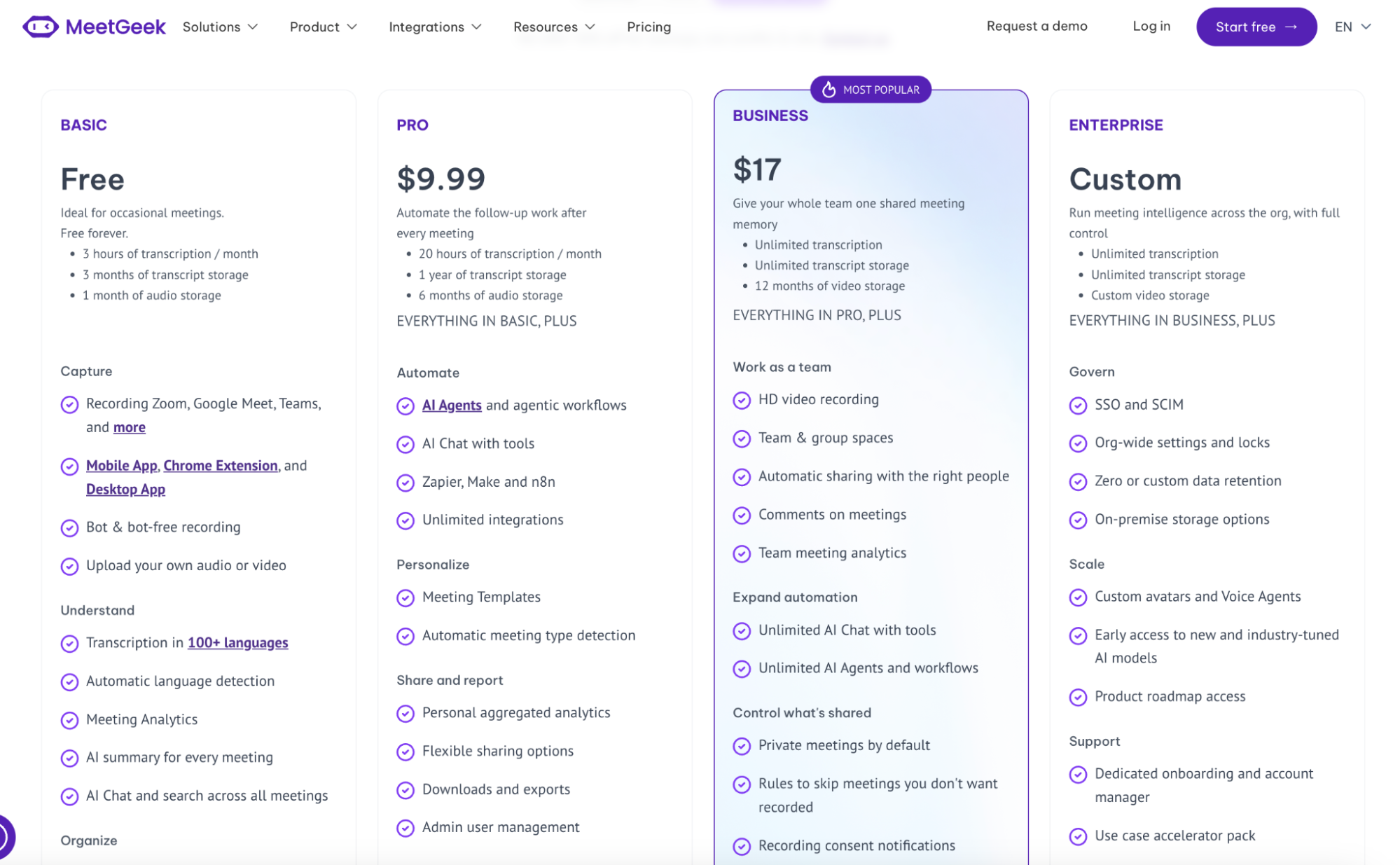
MeetGeek has the much lower entry cost and still maintains a permanent free plan. Claap's current pricing is positioned around revenue teams and starts significantly higher.
MeetGeek currently lists monthly pricing of $15.99 per user for Pro and $27 per user for Business. With annual billing, the displayed equivalent falls to $9.99 and $17 per user per month respectively. Basic remains free, while Enterprise is custom-priced.
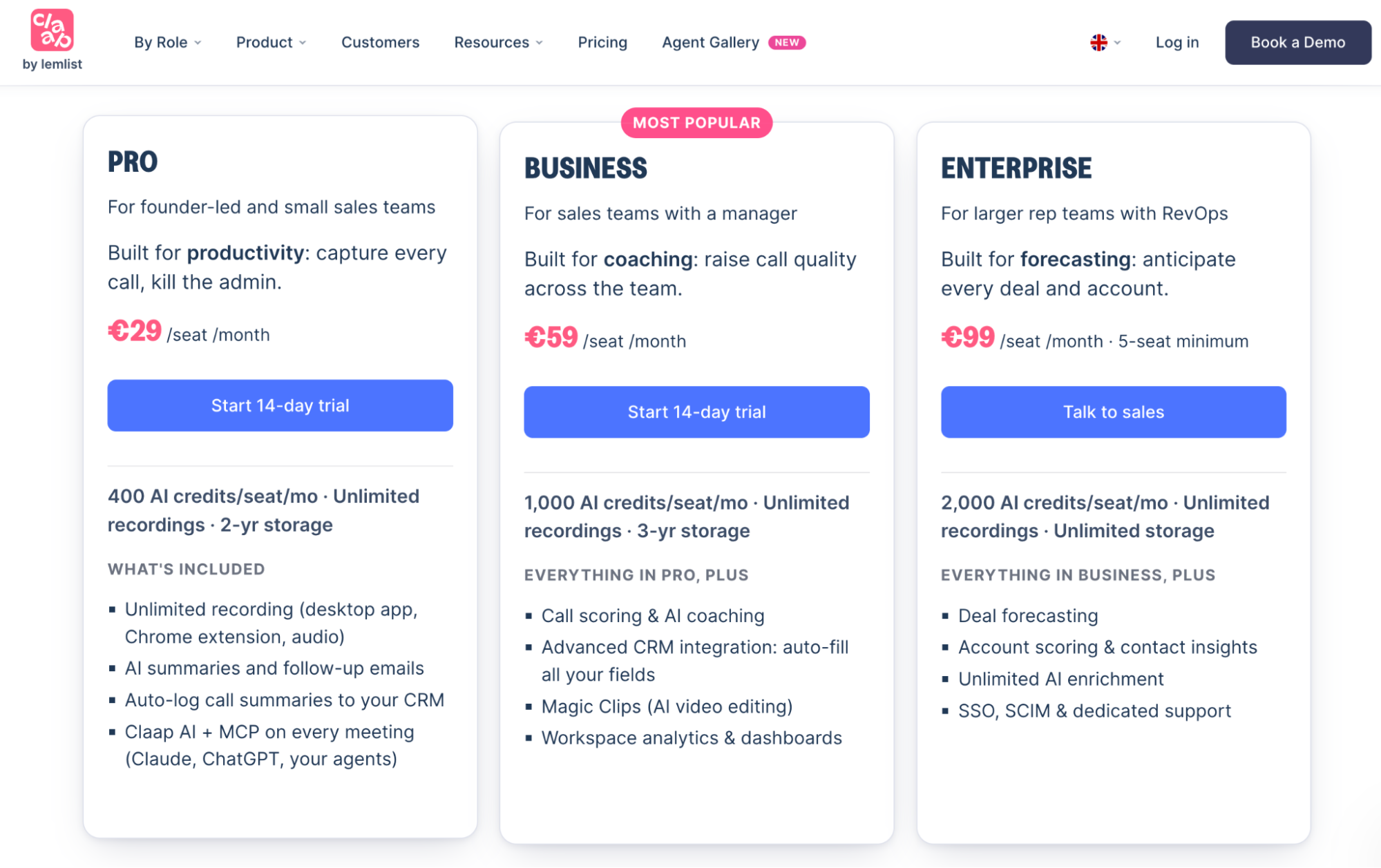
Claap's current pricing page lists €29 per seat per month for Pro, €59 for Business and €99 for Enterprise when billed yearly. Monthly pricing rises to €36, €71 and €119. Enterprise has a five-seat minimum. New users receive a 14-day full-access trial, but the latest pricing structure no longer includes a standalone free recording plan.
MeetGeek Pro is not directly equivalent to Claap Pro. MeetGeek Pro is positioned as a general productivity and automation plan, while Claap Pro already assumes a sales-oriented workflow and includes CRM logging, follow-up emails, Claap AI and MCP.
The more revealing comparison is Business. MeetGeek Business provides unlimited transcription, HD video, team spaces, team analytics, unlimited AI Chat and agentic workflows for $17 per user per month on annual billing. Claap Business costs €59 and adds call scoring, AI coaching, advanced CRM field enrichment, Magic Clips and workspace analytics.
MeetGeek costs substantially less for meeting capture and general team intelligence. Claap charges more because its paid tiers move deeper into sales execution and revenue operations.
| Plan | Price | Main Capacity |
|---|---|---|
| MeetGeek Basic | Free | 3 transcription hours/month |
| MeetGeek Pro | $9.99/user/month annually | 20 transcription hours/month |
| MeetGeek Business | $17/user/month annually | Unlimited transcription |
| MeetGeek Enterprise | Custom | Enterprise governance and retention |
| Claap Pro | €29/seat/month annually | Unlimited recording, 400 AI credits, 2-year storage |
| Claap Business | €59/seat/month annually | 1,000 AI credits, coaching, advanced CRM, analytics |
| Claap Enterprise | €99/seat/month annually | 2,000 AI credits, forecasting, account scoring, unlimited storage |
MeetGeek vs Claap Free Access and Usage Limits
The free-access difference is unusually important in this comparison. MeetGeek Basic is a permanent free plan with three hours of transcription per month, three months of transcript storage and one month of audio storage. It still includes AI summaries, meeting analytics, AI Chat, 100+ language transcription, uploads, bot and bot-free recording, and API/MCP access.
Claap's latest pricing structure has moved away from a permanent free recording tier. New teams can use a 14-day full-access trial, while paid workspaces can add unlimited free Collaborator seats. Collaborators can watch, comment and search meetings but cannot record conversations or use Claap AI themselves.
For an individual consultant, freelancer or small team evaluating an AI meeting assistant slowly, MeetGeek therefore has the lower barrier to long-term use. Claap's trial is more appropriate for a revenue team that wants to test the full product against real calls before making a purchasing decision.
MeetGeek vs Claap for Sales Teams
Claap is the stronger choice when the words “meeting assistant” actually mean “sales intelligence system.” Its Business and Enterprise tiers are specifically organized around call scoring, coaching, CRM enrichment, deal qualification, account signals and forecasting.
Claap can score meetings using methodologies such as MEDDIC, BANT and SPICED, identify questions a rep failed to ask, create coaching recommendations and preserve strong examples as training clips. At Enterprise level, the product adds deal forecasting, account scoring and contact insights.
MeetGeek still covers much of the same territory. Sales teams can automatically sync calls into CRMs, identify objections and risks, analyze talk ratios and other KPIs, generate follow-ups, score meetings through Meeting Skills and use team analytics for coaching. The difference is that these capabilities exist inside a platform designed for many meeting types rather than a product primarily built around the sales organization.
Claap has the advantage for a sales organization that wants the meeting platform to become part of its revenue operating system.
| Sales Need | MeetGeek | Claap |
|---|---|---|
| Record customer calls | Strong | Strong |
| Sales summaries | Strong | Strong |
| Follow-up emails | Yes | Yes |
| CRM sync | Strong | Strong |
| Custom CRM field enrichment | Available through automation | Core strength |
| Objection tracking | Yes | Yes |
| Rep coaching | Yes | Stronger dedicated workflow |
| Qualification frameworks | Customizable | Dedicated MEDDIC/BANT/SPICED tools |
| Deal intelligence | Available through workflows | Core focus |
| Forecasting | Limited compared with Claap | Enterprise |
| Training clips | Yes | Strong Magic Clips workflow |
MeetGeek vs Claap for Non-Sales Teams
MeetGeek has the clearer advantage once the use case moves beyond revenue. The product explicitly supports customer success, HR, recruiting, product, engineering, marketing, finance, leadership and other internal teams.
A recruiting team can use different meeting templates and KPIs from a sales team. Product teams can search customer interviews for repeated feature requests. Customer success teams can trigger churn-risk alerts. Leadership can analyze recurring themes across meetings, while project teams can send tasks and summaries into Notion, Slack or other tools automatically.
Claap can technically record and summarize many of these conversations, and its video collaboration functions can be useful for training or asynchronous work. However, its 2026 product positioning, pricing and most advanced features are increasingly centered around B2B sales and revenue teams.
For a company wanting one AI meeting assistant across several departments, MeetGeek is therefore the more natural fit.
MeetGeek vs Claap for a Five-Person Team
A five-person comparison demonstrates how differently the two products are priced.
Five MeetGeek Business licenses cost the equivalent of about $85 per month on annual billing. Those users receive unlimited transcription, unlimited transcript storage, HD video, team meeting analytics, shared spaces, unlimited AI Chat and unlimited agentic workflows.
Five Claap Business seats cost the equivalent of about €295 per month on annual billing. The higher price includes capabilities aimed specifically at a revenue team, including call scoring, AI coaching, advanced CRM enrichment, Magic Clips and workspace dashboards.
That gap can be justified if the five users are account executives whose recorded calls feed pipeline management and coaching. It is much harder to justify if they are a mixed team of a recruiter, product manager, customer-success manager, founder and marketer who mainly need meeting notes and automation.
MeetGeek has better general-team economics. Claap needs a revenue-specific use case to justify its higher cost.
MeetGeek vs Claap Ease of Use
MeetGeek is easier to deploy as a conventional AI meeting assistant because useful output arrives with relatively little configuration. Connect a calendar, define recording preferences and meetings can begin producing transcripts, summaries, action items and searchable knowledge.
Claap is also straightforward at the recording level, particularly with its bot-free desktop and browser capture. However, the platform becomes substantially more valuable after CRM fields, sales methodologies, account structures, scoring rules and team workflows are configured.
MeetGeek delivers more value immediately as a general assistant. Claap's deeper value increases as more of the sales process is connected to it.
| Setup Task | MeetGeek | Claap |
|---|---|---|
| Connect calendar | Yes | Yes |
| Start automatic notes | Fast | Fast |
| Bot-free recording | Yes | Yes |
| Customize summaries | Yes | Yes |
| Configure CRM | Optional for full value | Important for sales use |
| Set sales methodology | Optional | Important for coaching |
| Build custom CRM fields | Optional | Major value driver |
| Configure team analytics | Useful | Useful |
| Time to basic value | Short | Short |
| Time to full strategic value | Moderate | Higher |
MeetGeek vs Claap Security and Enterprise Controls
Both platforms provide the security foundations expected for business meeting data, including SOC 2 Type II compliance and GDPR-oriented controls.
MeetGeek states that recordings and transcripts are encrypted and offers EU and US data hosting. Its security program includes SOC 2 Type II, GDPR, HIPAA support via BAA and CCPA, and MeetGeek states that customer meeting data is not used to train its models. Enterprise adds SSO, SCIM, organization-wide controls, custom or zero-retention policies and on-premise storage options.
Claap is also SOC 2 Type II certified and GDPR-compliant, with a dedicated Trust Center. Its Enterprise tier adds SSO, SCIM and dedicated enterprise support alongside unlimited data retention.
For regulated or highly sensitive workflows, the final decision should be based on the exact organization's retention, residency, access and contractual requirements rather than a compliance badge alone.
Can MeetGeek Replace Claap?
MeetGeek can replace Claap when the main requirements are meeting recording, transcription, summaries, CRM syncing, follow-up automation, conversation analytics and general sales-call intelligence. Its growing Meeting Skills, AI agents and team analytics significantly reduce the gap for many sales teams.
It is less likely to replace Claap when the organization specifically relies on native sales methodology scoring, deep CRM field enrichment, deal qualification, structured coaching and revenue forecasting.
A small sales team may find MeetGeek sufficient. A mature revenue organization is more likely to use capabilities that are specifically native to Claap.
Can Claap Replace MeetGeek?
Claap can replace MeetGeek for sales-heavy organizations because its recording, transcription, summaries, collaboration and automation capabilities cover the foundation of an AI meeting assistant.
It is less natural as a MeetGeek replacement when the organization wants one meeting platform across recruiting, engineering, product, customer success, finance and general internal meetings. Claap can capture those conversations, but its strongest product investment is aimed elsewhere.
Claap can replace MeetGeek more easily inside a sales department than across an entire company.
MeetGeek vs Claap – Which Is Better in 2026?
MeetGeek is the better fit for most businesses seeking a general AI meeting assistant. It costs less, has a permanent free plan, supports both bot and bot-free recording, transcribes 100+ languages and combines summaries, meeting analytics, AI Chat, workflows, agents and broad integrations without requiring the company to be sales-led.
Claap becomes the stronger option when meetings are primarily revenue conversations. Its value is not simply recording calls – it is converting those calls into CRM data, qualification scores, coaching, deal signals and structured information for sales teams and AI agents.
MeetGeek is the broader AI meeting and automation platform. Claap is the more specialized AI revenue-conversation platform.
The better MeetGeek vs Claap choice therefore depends less on who records meetings better and more on what the business needs those conversations to become afterward.
| If You Need... | Better Fit |
|---|---|
| General AI meeting assistant | MeetGeek |
| Permanent free plan | MeetGeek |
| Lowest paid-plan cost | MeetGeek |
| Cross-department rollout | MeetGeek |
| 100+ language transcription | MeetGeek |
| Bot and bot-free recording on lower tiers | MeetGeek |
| General meeting analytics | MeetGeek |
| Meeting-triggered AI workflows | MeetGeek |
| Sales coaching | Claap |
| MEDDIC / BANT / SPICED scoring | Claap |
| Deep CRM field enrichment | Claap |
| Deal qualification | Claap |
| Revenue intelligence | Claap |
| Deal forecasting | Claap Enterprise |
| Sales-call video highlights | Claap |
| Sales-focused AI-agent context | Claap |
Frequently Asked Questions
- What is the difference between MeetGeek and Claap?
- MeetGeek is a general AI meeting assistant and automation platform for multiple departments. Claap is more heavily focused on sales conversations, CRM enrichment, coaching, qualification and revenue intelligence.
- Is MeetGeek better than Claap?
- MeetGeek is the stronger option for general meeting automation, cross-functional teams and businesses seeking lower-cost transcription, notes and workflows. Claap is stronger for specialized sales and revenue use cases.
- Is Claap better than MeetGeek for sales?
- Claap goes deeper into native sales coaching, qualification frameworks, CRM field enrichment, deal intelligence and forecasting. MeetGeek still offers strong sales-call analytics and CRM automation at a lower price.
- Which is cheaper, MeetGeek or Claap?
- MeetGeek. Its annual Pro rate is currently $9.99 per user per month and Business is $17. Claap's annual pricing currently starts at €29 per seat for Pro and €59 for Business.
- Does MeetGeek have a free plan?
- Yes. MeetGeek Basic is free permanently and includes three hours of transcription per month, AI summaries, meeting analytics, AI Chat and other core features.
- Does Claap have a free plan?
- Claap's current pricing structure no longer includes a standalone free recording plan. It provides a 14-day full-access trial and unlimited free read-only Collaborator seats inside paid workspaces.
- Does MeetGeek record without a bot?
- Yes. MeetGeek supports bot-free recording through its browser and desktop tools in addition to its meeting agent.
- Does Claap record without a bot?
- Yes. Claap supports bot-free capture through its desktop app and Chrome extension. Under its current pricing, the meeting bot is included from Business upward.
- Which supports more transcription languages?
- MeetGeek currently states support for 100+ languages. Claap currently lists 99+ languages across its meeting products.
- Does MeetGeek integrate with Salesforce?
- Yes. MeetGeek can automatically sync recordings, summaries, highlights and meeting context into Salesforce records.
- Does Claap integrate with Salesforce?
- Yes. Salesforce is part of Claap's CRM ecosystem, including advanced CRM field enrichment on higher plans.
- Which is better for HubSpot, MeetGeek or Claap?
- Both integrate with HubSpot. MeetGeek is strong for automatically syncing meeting information and follow-up workflows, while Claap goes deeper into mapping sales-call information into CRM fields.
- Does MeetGeek provide sales coaching?
- Yes. MeetGeek provides conversation intelligence, team analytics, meeting KPIs and Meeting Skills that can score and analyze sales calls.
- Does Claap provide sales coaching?
- Yes. AI coaching and call scoring are major Claap Business features, with support for sales methodologies such as MEDDIC, BANT and SPICED.
- Does MeetGeek have AI agents?
- Yes. MeetGeek supports AI agents, Meeting Skills, agentic workflows and MCP access.
- Does Claap have AI agents?
- Yes. Claap provides its own AI capabilities along with MCP and API access for external AI-agent workflows.
- Can MeetGeek search across meetings?
- Yes. MeetGeek includes AI Chat and search across meeting history, allowing users to retrieve information and patterns from previous conversations.
- Can Claap search across meetings?
- Yes. Claap AI can analyze individual conversations, while higher plans extend querying across meetings, deals, companies and contacts.
- Which is better for non-sales teams?
- MeetGeek is generally the stronger fit because its workflows and analytics are designed for sales, customer success, recruiting, product, engineering, leadership and other meeting types.
- Which is better for a sales manager?
- Claap is particularly strong for sales managers who need call scoring, coaching, qualification and CRM intelligence. MeetGeek can still be sufficient for teams needing lighter conversation analytics and CRM automation.
- Which is better for a five-person team?
- MeetGeek is considerably cheaper for a general five-person team. Claap can justify the higher price when all five users are part of a revenue organization that will actively use its coaching and CRM-intelligence features.
- Can MeetGeek replace Claap?
- Yes for many general meeting and smaller sales-team workflows. It is less complete as a replacement when Claap's native coaching, qualification and revenue-intelligence functionality is required.
- Can Claap replace MeetGeek?
- Yes inside sales-heavy teams. MeetGeek remains the more natural option for company-wide deployment across several non-sales departments.
- MeetGeek or Claap – which should a business choose in 2026?
- Choose MeetGeek for broad meeting capture, notes, analytics and automation across a company. Choose Claap when recorded conversations need to become structured sales data, coaching insights and deal intelligence. Best AI Lead Generation Tools
Written by

Noah KellerOperations data and AI productivity
Noah Keller is a former BI analyst who reviews the research, spreadsheet, dashboard, and meeting tools operations teams actually trust.
Published September 23, 2026