Software
Best AI Tools for Distribution Businesses in 2026 – 10 Ways Distributors Are Automating Work
AI in distribution has moved far beyond writing emails. New tools can identify sales opportunities, forecast SKU demand, process purchase orders, monitor suppliers, answer questions from ERP data, prioritize warehouse work, and flag operational risks before teams spend hours searching for them.
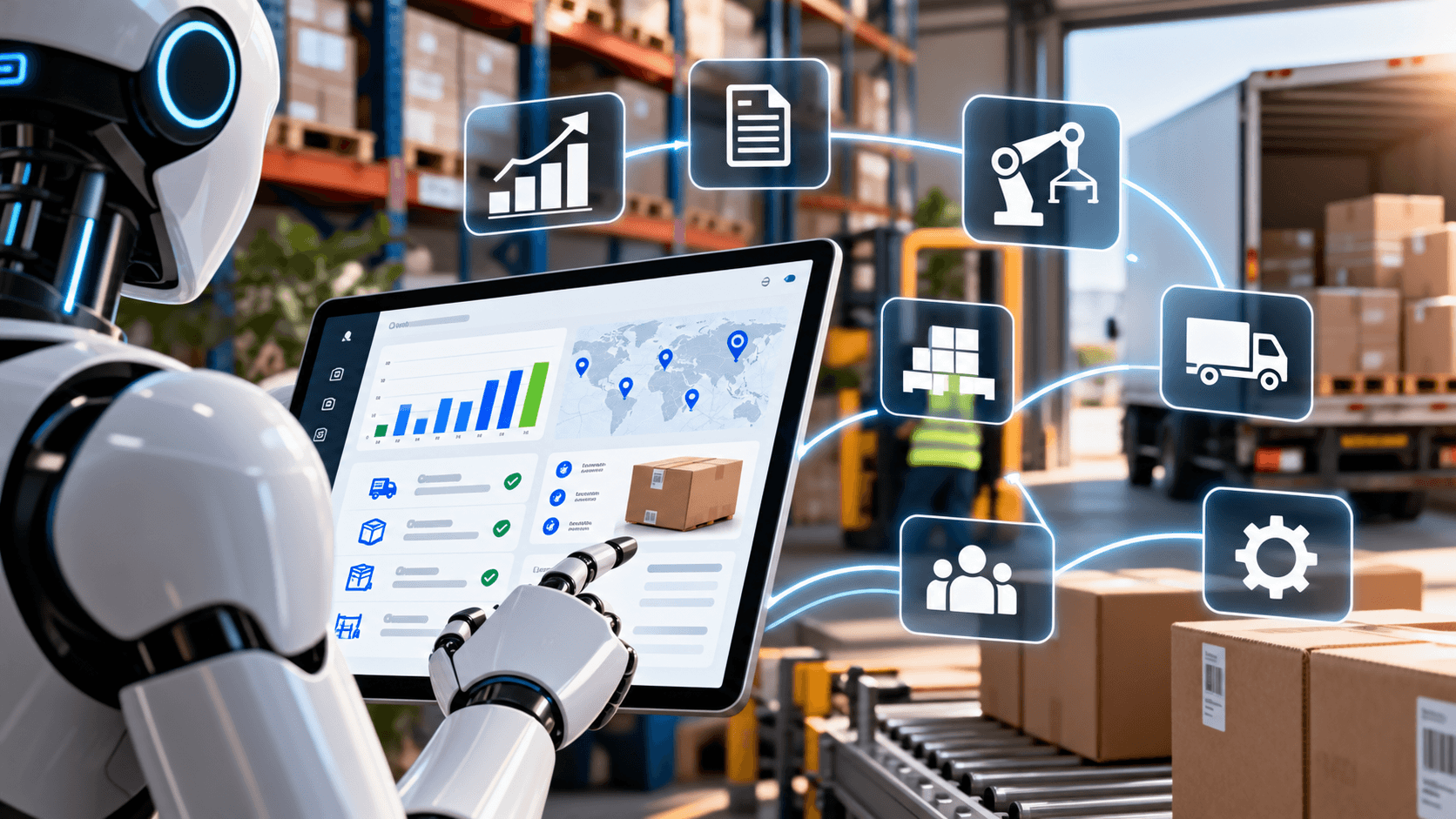
The most useful AI tools for distribution businesses in 2026 are not generic chatbots sitting beside the company’s software. Increasingly, AI is being embedded directly into CRM, ERP, inventory planning, procurement, warehouse management, and supply-chain platforms where it can work with actual customers, SKUs, orders, purchase orders, suppliers, pricing, inventory, and operational history.
That distinction matters. A general AI assistant can draft a customer email, but it does not automatically know that the customer’s usual product has been out of stock for three weeks, that an alternative SKU is available in another branch, or that an open quote expires tomorrow. AI becomes significantly more valuable to a distributor when it understands the business context behind the question.
The best use of AI is therefore not replacing an ERP, CRM, or WMS. It is giving employees a faster way to use the data and workflows that already exist inside those systems.
AI Tools for Distribution Businesses: What They Can Automate Now
The platforms below are not competing for exactly the same job. Proton and White Cup focus heavily on distribution sales, Cin7 on inventory and document automation, Epicor and Infor embed AI in distributor ERP, while Microsoft, Blue Yonder, Manhattan, Oracle, and Acumatica cover broader operational processes.
The best AI tool is usually the one that already has secure access to the distributor’s operational data. Adding another standalone application can provide impressive demonstrations while still forcing employees to manually supply the context required for every useful answer.
| AI tool | Main use for distributors | Best suited to |
| Proton Pronto | Sales account intelligence and rep assistance | Distribution sales teams |
| White Cup Nexus | Revenue intelligence and account analysis | Sales managers and executives |
| Epicor Prism | ERP questions, analysis, workflows, order automation | Prophet 21 distributors |
| Infor GenAI Assistant | Customer, product, vendor, pricing, and order questions | Infor CloudSuite Distribution users |
| Cin7 ForesightAI + AI tools | Demand forecasting, replenishment, PO/document processing | SMB and mid-market product distributors |
| Dynamics 365 AI / Procurement Agent | Supplier communication, PO changes, demand analysis | Microsoft supply-chain environments |
| Blue Yonder AI | Advanced demand, inventory, and supply planning | Large and complex supply chains |
| Manhattan AI agents | Warehouse, labor, receiving, and transportation execution | High-volume distribution centers |
| Oracle AI for SCM | Order, sourcing, procurement, logistics, and supply-chain workflows | Enterprise Oracle environments |
| Acumatica AI Assistant / AI Studio | ERP analytics, anomaly detection, and workflow automation | Growing mid-market distributors |
1. Proton Pronto – AI for Distributor Sales Reps
One of the clearest practical uses of AI tools for distribution businesses is helping sales representatives understand large existing customer accounts. A representative may be responsible for hundreds of customers and thousands of products, making it impossible to remember every purchasing pattern, missed reorder, open quote, available substitute, or cross-sell opportunity.
Proton’s Pronto is built specifically around this problem. The AI agent operates inside Proton CRM and can use ERP information, product data, customer history, and other systems connected to Proton. A rep can ask what to discuss before visiting an account, request alternative products when an item is unavailable, draft a follow-up, log meeting notes, or build a route around upcoming customer visits.
This is much more relevant to distribution than generic lead scoring. The AI is working with the distributor’s own purchase history and product relationships rather than trying to predict sales from a handful of marketing fields.
Proton is most relevant to distributors with substantial existing account data. A company still building its first few dozen customer relationships will gain less from purchasing-pattern intelligence than an established distributor with years of ERP transactions.
| Traditional workflow | AI-assisted workflow |
| Search ERP for order history | Ask for an account summary |
| Check several screens for product history | Ask what the customer normally buys |
| Manually search substitutes | Ask for available alternatives |
| Type notes after a customer visit | Dictate the note |
| Build a follow-up email manually | Generate it from account context |
| Research nearby prospects | Ask for relevant stops around a planned visit |
2. White Cup Nexus – AI for Revenue and Account Intelligence
White Cup Nexus approaches the same distribution problem from a broader revenue-intelligence angle. Launched in June 2026, Nexus combines ERP transactions, CRM activity, BI data, quotes, sales history, and customer information inside a conversational AI interface designed specifically for wholesale distributors.
Instead of opening several dashboards, a sales manager can ask which customers appear at risk, what changed in the pipeline, where a territory is underperforming, or what should be reviewed before an account meeting. Nexus can also create follow-up tasks and update work directly from the conversation rather than stopping after generating an answer.
The important difference is that the AI begins with distributor context already attached. Employees do not have to export ERP transactions into a spreadsheet and then explain every column to a general-purpose chatbot before asking a business question.
identifying declining customer accounts;
preparing representatives for account meetings;
finding missed sales opportunities;
reviewing sales performance;
understanding pipeline risk;
surfacing unusual account activity;
creating sales follow-up tasks;
giving customer-service teams faster access to account history.
This can be particularly valuable for management teams that already have plenty of reporting but still spend too much time navigating it. The bottleneck in many distributors is no longer lack of data – it is the effort required to convert that data into the next decision.
3. Epicor Prism – AI Inside a Distribution ERP
For companies running Epicor Prophet 21, AI is moving directly into ERP rather than being added as an external analytical layer. Epicor Prism is embedded into Prophet 21 and provides conversational access to ERP information, documents, workflows, and business logic.
Epicor expanded Prism during 2026 with a Reasoning Agent capable of interpreting information across ERP data, documents, images, and workflows. Prophet 21 2026.1 also added capabilities such as natural-language business-rule creation and broader workflow automation, making it possible for employees to automate processes without relying as heavily on traditional technical configuration.
This is an important development for AI tools for distribution businesses because ERP contains some of the richest operational context available. Orders, inventory, costs, customers, receivables, purchasing, and warehouse transactions already live there.
AI that can reason over the ERP does not need employees to build another copy of the business first.
A customer-service user may need to understand an order exception. Purchasing may want to investigate inventory and supplier information. A manager may need an explanation of a trend rather than another dashboard.
The AI layer can shorten the distance between the business question and the underlying ERP information. That does not eliminate the need for good Prophet 21 configuration or reliable master data, but it can substantially reduce the number of screens and reports employees need to navigate for routine questions.
Epicor is especially relevant because Prophet 21 is already built specifically around wholesale distribution. For existing users, evaluating Prism is therefore more logical than introducing a completely separate AI platform that needs a new integration with the same ERP data.
4. Infor GenAI Assistant – AI for Customer Service, Products, Vendors, and Orders
Infor has taken a similarly distribution-specific approach inside CloudSuite Distribution. Its GenAI Assistant uses specialized agents that can access customer, product, vendor, order, purchasing, pricing, credit, and other ERP information through natural-language requests.
Current customer agents can retrieve account balances, credit limits, invoice and payment history, orders on credit hold, and sales-order information. Product agents can answer questions about availability, inventory, pricing, purchase orders, transfers, and product sales history, while vendor agents can retrieve vendor performance and purchasing information.
That creates a practical customer-service scenario. Instead of navigating several screens while a customer is waiting on the phone, an employee can ask for account status, product availability, pricing, or an order and receive the relevant information from the system.
A typical distributor inquiry often spans several areas at once:
Is item 8472 available, what does this customer pay for it, do they have any open orders, and is the account on credit hold?
Without integration, four questions can require four screens or several systems. An ERP-aware AI assistant can turn that navigation problem into one conversation.
Infor’s April 2026 CloudSuite Distribution update expanded these agent-based capabilities specifically around distributor workflows. The direction is notable because it focuses less on generating generic text and more on helping users complete operational tasks inside the system.
5. Cin7 ForesightAI – AI for Inventory Forecasting and Replenishment
Inventory is one of the highest-value areas for AI tools for distribution businesses because forecasting errors tie up real cash. Too little inventory produces stockouts and lost orders, while too much creates carrying costs, warehouse congestion, and slow-moving stock that may eventually require discounting or write-offs.
Cin7 ForesightAI analyzes sales history and demand patterns to forecast product demand as far as 24 months ahead. It can recommend reorder quantities, safety stock, and replenishment actions at multiple warehouse locations, and Cin7 says the system uses historical and current data to reduce both stockouts and excess inventory.
The platform also uses AI outside forecasting. Cin7’s current AI functionality includes Intelligent Document Recognition that can read purchase orders and supplier documents, create transactions for review, and reduce manual order entry. Its conversational assistant can answer questions about live inventory and sales data in plain language.
Cin7 is especially interesting for smaller and mid-market distributors because these capabilities are embedded inside inventory software rather than requiring a separate enterprise planning project.
The limitation remains data quality and history. Cin7 recommends at least six months of sales history for stronger forecasting, and no forecasting engine can fully compensate for bad SKU data, one-time project orders, or major demand changes that are not represented in historical transactions.
| AI capability | Distributor problem |
| ForesightAI | What will customers buy next? |
| Smart replenishment | What should purchasing order and when? |
| Intelligent Document Recognition | Can incoming POs be entered without retyping them? |
| AI Assistant | What is happening in inventory and sales right now? |
6. Microsoft Dynamics 365 – AI for Purchasing and Supplier Communication
Purchasing teams spend a surprising amount of time on repetitive communication: checking whether vendors confirmed a PO, asking why an order is late, reading supplier emails, updating dates, and determining which customer commitments will be affected by a change.
Microsoft’s Procurement Agent in Dynamics 365 Supply Chain Management is designed specifically around this workflow. It can identify purchase orders requiring follow-up, generate supplier emails, interpret vendor responses, detect requested changes, and present them to employees for review.
The more advanced capability is impact analysis. When a supplier proposes a date or quantity change, the agent can trace the consequences across inventory, sales orders, production orders, and transfers so the purchaser can see whether accepting the change creates a downstream problem.
This is where AI becomes more useful than simple email automation. Writing “Please confirm delivery” faster saves a few minutes; identifying which customer order will be affected by the supplier delay changes an operational decision.
Microsoft has also introduced generative demand insights in Dynamics 365 Supply Chain Management. The 2026 release added AI analysis of demand patterns, seasonality, trends, correlations, and additional demand signals, moving AI into both procurement and planning.
Microsoft has been careful to keep people in the loop for supplier communications and proposed PO changes. Its own guidance recommends reviewing emails, extracted information, impact analysis, and suggested changes before employees accept them.
That is a useful model for distributors generally: AI should automate investigation and preparation before it is trusted to make financially significant purchasing decisions without review.
7. Blue Yonder – AI for Advanced Demand and Inventory Planning
Blue Yonder operates at a different scale from lightweight inventory forecasting tools. Its current supply-chain planning environment combines demand, supply, inventory, scenario modeling, and financial impact analysis with domain-specific AI agents.
The 2026 releases introduced and expanded Inventory Operations agents capable of working through supply analysis, root-cause analysis, constraints, scenarios, and inventory decisions. Blue Yonder also introduced agentic supplier-ordering functionality that allows planners to review and approve pending orders using natural language.
This is most relevant for distributors where simple historical averages are no longer enough. A large company can have tens of thousands of SKUs across numerous locations, long supplier lead times, uncertain demand, customer-service targets, and millions of dollars tied up in safety stock.
Instead of answering only:
What will sales be next month?
the system can help investigate:
Why did the forecast move?What constraint caused the shortage?What happens if demand rises?How will additional safety stock affect working capital?Which scenario protects service with the least inventory?
Blue Yonder’s 2026 planning platform can also model the financial effects of supply, demand, capacity, and inventory decisions on revenue, margin, EBITDA, and working capital.
For a large distributor, that link between inventory and finance is often more important than a marginal improvement in forecast accuracy. The business needs to understand what the recommended inventory decision does to cash as well as service levels.
8. Manhattan AI Agents – AI for Warehouse and Transportation Execution
Warehouse AI becomes valuable when hundreds or thousands of tasks compete for limited labor, dock space, equipment, inventory, and time. A warehouse manager does not merely need another productivity report at the end of the shift; the real opportunity is adjusting work before the bottleneck creates late orders.
Manhattan’s 2026.2 supply-chain execution release extends AI across warehouse, labor, yard, slotting, and transportation operations. New digital workers automate repetitive tasks in receiving, planning, and transportation while the platform uses connected operational information to improve execution decisions.
That is a very different form of AI from a sales assistant. Warehouse AI is primarily about coordinating physical work against constantly changing constraints.
For a high-volume distributor, an AI-enabled execution layer may help answer questions such as:
Which inbound load needs attention first?
Where is congestion likely to appear?
Which work should be released next?
Does labor need to move between warehouse areas?
Which slotting decision will reduce unnecessary travel?
Which shipment or transportation exception threatens customer service?
A small warehouse with ten employees probably does not need this level of orchestration. Manhattan becomes relevant when facility complexity is high enough that local supervisor knowledge alone can no longer optimize the full operation consistently.
9. Oracle AI for SCM – AI Across Orders, Sourcing, Procurement, and Logistics
Oracle’s current AI strategy for Fusion Cloud SCM uses specialized agents and agentic applications throughout supply-chain workflows rather than concentrating intelligence in one assistant. Oracle lists AI applications across supply-chain planning, procurement, logistics, order management, maintenance, product lifecycle management, and other operational areas.
One particularly relevant example for distributors is the Sales Order Assistant. Oracle expanded the tool in 2026 to support natural-language customer and product discovery, product comparisons, pricing adjustments, and draft-order creation while still applying the validation rules defined in Order Management.
Oracle has also introduced agentic applications around order execution. Its Sales Order Command Center is designed to bring together context when inventory shortages, pricing discrepancies, partial shipments, or other exceptions require coordination across sales, fulfillment, finance, and customer service.
On the purchasing side, Oracle’s Sourcing Command Center uses agentic AI to help procurement teams interpret sourcing information, prioritize work, and make supplier decisions.
Order exceptions are rarely confined to one department. A shortage can require a sales decision, inventory check, alternate fulfillment plan, customer communication, and financial consideration.
AI that sees the complete order context is potentially much more useful than a customer-service chatbot that only knows what the customer typed.
Oracle is therefore most relevant to enterprise distributors already operating substantial Fusion Cloud environments. Introducing Oracle only to obtain the AI functions would be a much larger technology decision.
10. Acumatica AI – AI for Mid-Market ERP Analysis and Workflow Automation
Acumatica provides a more mid-market example of how AI is entering distributor ERP. Its 2026 R1 release introduced AI Studio and AI Assistant functionality designed to work with financial and operational data already inside Acumatica.
AI Assistant allows users to ask natural-language questions about ERP data and return results as text, tables, charts, pivot tables, and widgets. Users can also move from the answer into relevant ERP forms and records rather than treating the AI result as a disconnected report.
AI Studio adds a configurable automation layer, while Acumatica has also expanded anomaly detection and AI-assisted workflows. This is useful for a growing distributor that wants AI inside its existing operational platform but does not have the planning complexity that would justify a Blue Yonder or Manhattan-scale project.
The key benefit is accessibility rather than extreme specialization. Managers can ask questions of ERP data without building every report first, while companies can introduce AI automation around existing workflows instead of creating an entirely separate AI architecture.
The 10 Ways Distributors Are Actually Using AI
Looking across these platforms reveals a more useful picture than simply ranking vendors.
This is the real shift occurring in AI tools for distribution businesses. AI is moving from producing content to reducing the amount of searching, retyping, investigating, and manually coordinating work that happens between transactions.
| Distribution job | What AI is beginning to do |
| 1. Account preparation | Summarize customer history before sales visits |
| 2. Cross-selling | Find products an existing customer may be missing |
| 3. Sales follow-up | Draft emails, notes, tasks, and next actions |
| 4. Demand forecasting | Predict SKU/location demand and explain changes |
| 5. Replenishment | Recommend quantities, reorder points, and safety stock |
| 6. Order entry | Extract information from POs and create draft orders |
| 7. Procurement | Follow up with vendors and analyze PO changes |
| 8. Customer service | Answer pricing, inventory, credit, and order questions |
| 9. Warehouse execution | Prioritize receiving, labor, picking, and transportation work |
| 10. Management analytics | Answer questions across ERP, CRM, sales, and operations |
Document Processing May Be One of the Fastest AI Wins
Not every AI project needs a sophisticated forecasting model. For many distributors, one of the easiest places to demonstrate value is incoming business documents.
Customers still send POs as PDFs, email attachments, spreadsheets, and other semi-structured documents. Employees then read those documents and manually enter customer, SKU, quantity, price, ship-to, PO number, and delivery information into another system.
Cin7 already uses Intelligent Document Recognition to convert incoming purchase orders into draft transactions for employee review. Epicor has also been expanding AI-driven order automation for distributors during 2026 as part of its wider ERP automation strategy.
This is an attractive starting point because the workflow has a clear before-and-after measurement: minutes per order, error rate, number of orders processed per employee, and exceptions requiring human review.
AI Forecasting Should Not Be Treated as a Magic Demand Number
Demand forecasting is one of the most heavily promoted AI capabilities, but distributors should be careful about what the prediction actually represents. Historical sales can contain stockouts, one-time projects, discontinued products, unusual promotions, large customer wins, supply shortages, and other events that distort the relationship between past sales and true demand.
A forecast should therefore show more than one number. Planners should be able to understand patterns, assumptions, unusual changes, and confidence, then override recommendations when real commercial information makes the model incomplete.
Microsoft, Blue Yonder, Cin7, and other current platforms are moving toward explainable forecasting, where AI also helps users understand why demand changed instead of simply generating a new forecast.
Human knowledge still matters. A sales representative who knows that a customer is opening three new branches next month may possess a demand signal the historical model has never seen.
The Most Valuable AI Usually Has ERP Context
A distributor considering AI often begins with the wrong question:
Which AI tool should we buy?
A stronger question is:
Which repetitive decision or workflow already has enough reliable data to automate?
If order history is clean, AI can identify purchasing patterns. If item and supplier data is reliable, it can improve replenishment. If customer activity and quotes are connected, it can identify account opportunities. If warehouse task data is accurate, it can improve operational prioritization.
This explains why Proton connects AI to ERP and CRM, White Cup uses ERP transactions and BI, Epicor and Infor put AI directly into distributor ERP, and Microsoft’s procurement agents work against actual purchase orders and supplier communications.
AI without business context produces plausible answers. AI connected to trusted operational data has a chance to produce useful decisions.
What Distributors Should Not Fully Automate Yet
AI does not need unrestricted authority to produce value. In many workflows, the safest and most practical design is AI prepares – employee approves – system executes.
Purchasing provides a good example. AI can read a supplier email, identify that delivery moved from Tuesday to Friday, trace the customer orders affected, and recommend an action. A purchaser can then approve the actual PO change after understanding the consequence.
The same principle applies to:
Microsoft’s own Procurement Agent guidance explicitly requires review of supplier communications, extracted changes, and downstream impact before users rely on the information for significant actions.
The strongest AI implementation removes low-value investigation while leaving material commercial judgment with people.
| AI can prepare | Human should usually control |
| Customer price recommendation | Major contract-price change |
| Purchase-order draft | Large supplier commitment |
| Substitute recommendation | Safety-critical substitution |
| Credit-risk summary | Credit-limit decision |
| Demand forecast | Major inventory investment |
| Sales email | Sensitive customer negotiation |
| Account opportunity | Strategic account action |
| Warehouse recommendation | Safety-sensitive physical process |
Start With One Workflow, Not an “AI Transformation”
Distributors do not need an enterprise AI strategy before they can automate useful work. In fact, beginning with an abstract objective such as “use AI across the company” often produces more software evaluation than operational improvement.
A better process begins with one repetitive problem.
For example:
Problem: Customer-service employees manually enter 150 emailed POs per day.
Measure how long the process takes, what errors occur, and which exceptions require judgment. Introduce AI document processing, measure the same workflow again, and decide whether the improvement justifies expanding automation.
The next project might be purchasing follow-up, sales account preparation, or inventory forecasting.
The best AI roadmap is usually a sequence of proven operational improvements rather than one enormous technology project.
How to Evaluate AI Tools for a Distribution Business
A distributor should never evaluate AI only from a vendor’s prepared demonstration. Use actual distribution questions and anonymized versions of real business scenarios.
Ask the system to handle tasks such as:
Explain why demand for a specific SKU changed.
Identify customers whose purchasing has declined materially.
Find a suitable substitute for an unavailable item.
Explain the effect of a supplier delaying a purchase order.
Process a realistic customer PO.
Identify excess inventory by warehouse.
Prepare a salesperson for an account visit.
Find open quotes that require follow-up.
Explain an unusual margin change.
Show the source data behind its answer.
Then change one piece of data and repeat the question.
A useful AI system should not merely sound confident. It should be able to show how its answer relates to the distributor’s real data and permissions.
AI Security and Permissions Matter More Than the Chat Interface
AI introduces a new way to access business information, which makes existing permissions even more important. An employee who cannot normally view customer margins, supplier contracts, payroll information, or credit data should not gain access simply by asking the AI assistant a clever question.
Enterprise AI tools increasingly inherit ERP or CRM security, but this still needs to be tested. Companies should verify what information each role can query, whether responses are logged, how sensitive data is handled, which external models or services process information, and whether actions require approval.
A conversational interface should make authorized work easier – not bypass the controls built into the underlying system.
How to Choose Among AI Tools for Distribution Businesses
The shortlist should begin with the distributor’s existing technology stack.
This is why there is no credible single “best AI software for every distributor.” The best system is usually the one that can securely reach the data required for the exact workflow being automated without creating another disconnected source of truth.
| Existing situation | AI tools worth evaluating first |
| Proton CRM already in use | Pronto |
| White Cup CRM/BI | Nexus |
| Epicor Prophet 21 | Epicor Prism |
| Infor CloudSuite Distribution | Infor GenAI Assistant |
| Cin7 inventory environment | ForesightAI + Cin7 AI tools |
| Microsoft Dynamics 365 | Copilot / Procurement Agent |
| Complex planning operation | Blue Yonder |
| High-volume warehouse network | Manhattan |
| Oracle Fusion SCM | Oracle AI for SCM |
| Acumatica ERP | Acumatica AI Assistant / AI Studio |
What AI Will Change Most in Distribution
AI is unlikely to eliminate the fundamental work of distribution. Products still need to be sourced, financed, stocked, sold, picked, shipped, and supported.
What AI is starting to remove is the administrative friction surrounding that work. Employees spend less time finding information, copying data between documents, checking routine exceptions, preparing reports, composing repetitive communication, or manually connecting facts that already exist in the company’s systems.
That can change how distributors scale. A company can process more orders, manage more SKUs, support more accounts, and investigate more exceptions without increasing administrative headcount at exactly the same rate.
The most important competitive advantage may therefore not come from having “AI.” It will come from using AI to make reliable operational data easier to act on.
FAQ
Strong AI tools for distribution businesses in 2026 include Proton Pronto, White Cup Nexus, Epicor Prism, Infor GenAI Assistant, Cin7 ForesightAI, Dynamics 365 AI agents, Blue Yonder, Manhattan’s AI-enabled supply-chain tools, Oracle AI for SCM, and Acumatica AI Assistant.
These tools address different workflows, so they should not be treated as interchangeable. The best choice depends on whether the business is trying to improve sales, inventory planning, purchasing, order processing, ERP analysis, or warehouse execution.
Distributors can use AI to analyze customer purchasing patterns, forecast demand, recommend replenishment, process incoming purchase orders, follow up with suppliers, analyze PO changes, prepare sales representatives for meetings, answer customer-service questions, optimize warehouse work, and analyze management data.
The highest-value use cases usually connect AI directly to ERP, CRM, WMS, or inventory information instead of relying only on manually entered prompts.
AI can help forecast demand, identify stockout or overstock risk, recommend safety stock, and suggest replenishment quantities. Cin7, Blue Yonder, Microsoft, Epicor, and other platforms now provide varying levels of AI-assisted inventory and planning functionality.
Inventory recommendations should still be reviewed where demand is affected by large projects, unusual customer behavior, product transitions, or other information that historical transactions may not capture.
Yes. Modern document-recognition tools can extract information from customer purchase orders and create draft transactions rather than requiring employees to retype every field.
Human review remains useful, particularly for unusual products, customer-specific rules, ambiguous units of measure, pricing discrepancies, or incomplete documents.
AI is better suited to reducing administrative work than replacing the relationship side of distribution sales. It can prepare account summaries, identify purchasing gaps, suggest products, draft follow-ups, log notes, and prioritize opportunities.
Representatives still provide negotiation, technical judgment, customer relationships, local knowledge, and context that may not exist in the system.
Yes, provided the use case matches the business. Smaller distributors may receive faster value from inventory forecasting, document processing, ERP questions, or sales follow-up than from enterprise supply-chain planning platforms.
AI embedded in systems such as Cin7 or Acumatica can make advanced capabilities accessible without requiring a separate data-science team.
Reliable data significantly improves AI usefulness. Duplicate customers, incorrect SKUs, inconsistent units of measure, missing supplier lead times, inaccurate inventory, and poorly maintained pricing can all produce misleading conclusions.
The company does not need perfect data before beginning, but AI should not be expected to repair every underlying data problem automatically.
Automation can be appropriate for tightly controlled, repetitive replenishment scenarios, but large or unusual purchasing decisions should generally retain human oversight. Supplier changes can affect inventory, cash, customer commitments, and operational risk simultaneously.
A strong implementation lets AI identify the issue, gather the relevant context, recommend an action, and then request approval when the financial or customer impact is material.
Start with one repetitive workflow whose current cost can be measured. Purchase-order entry, supplier follow-up, account preparation, demand forecasting, and routine ERP reporting are strong examples.
Measure time, errors, service level, or financial impact before and after implementation. A successful small automation is more valuable than an ambitious AI program with no measurable operational outcome.
Frequently Asked Questions
- What are the best AI tools for distribution businesses?
- Strong AI tools for distribution businesses in 2026 include Proton Pronto, White Cup Nexus, Epicor Prism, Infor GenAI Assistant, Cin7 ForesightAI, Dynamics 365 AI agents, Blue Yonder, Manhattan’s AI-enabled supply-chain tools, Oracle AI for SCM, and Acumatica AI Assistant. These tools address different workflows, so they should not be treated as interchangeable. The best choice depends on whether the business is trying to improve sales, inventory planning, purchasing, order processing, ERP analysis, or warehouse execution.
- How can distributors use AI?
- Distributors can use AI to analyze customer purchasing patterns, forecast demand, recommend replenishment, process incoming purchase orders, follow up with suppliers, analyze PO changes, prepare sales representatives for meetings, answer customer-service questions, optimize warehouse work, and analyze management data. The highest-value use cases usually connect AI directly to ERP, CRM, WMS, or inventory information instead of relying only on manually entered prompts.
- Can AI manage distributor inventory?
- AI can help forecast demand, identify stockout or overstock risk, recommend safety stock, and suggest replenishment quantities. Cin7, Blue Yonder, Microsoft, Epicor, and other platforms now provide varying levels of AI-assisted inventory and planning functionality. Inventory recommendations should still be reviewed where demand is affected by large projects, unusual customer behavior, product transitions, or other information that historical transactions may not capture.
- Can AI enter customer purchase orders automatically?
- Yes. Modern document-recognition tools can extract information from customer purchase orders and create draft transactions rather than requiring employees to retype every field. Human review remains useful, particularly for unusual products, customer-specific rules, ambiguous units of measure, pricing discrepancies, or incomplete documents.
- Can AI replace distributor sales representatives?
- AI is better suited to reducing administrative work than replacing the relationship side of distribution sales. It can prepare account summaries, identify purchasing gaps, suggest products, draft follow-ups, log notes, and prioritize opportunities. Representatives still provide negotiation, technical judgment, customer relationships, local knowledge, and context that may not exist in the system.
- Is AI useful for small distributors?
- Yes, provided the use case matches the business. Smaller distributors may receive faster value from inventory forecasting, document processing, ERP questions, or sales follow-up than from enterprise supply-chain planning platforms. AI embedded in systems such as Cin7 or Acumatica can make advanced capabilities accessible without requiring a separate data-science team.
- Does a distributor need clean data before using AI?
- Reliable data significantly improves AI usefulness. Duplicate customers, incorrect SKUs, inconsistent units of measure, missing supplier lead times, inaccurate inventory, and poorly maintained pricing can all produce misleading conclusions. The company does not need perfect data before beginning, but AI should not be expected to repair every underlying data problem automatically.
- Should AI be allowed to make purchasing decisions automatically?
- Automation can be appropriate for tightly controlled, repetitive replenishment scenarios, but large or unusual purchasing decisions should generally retain human oversight. Supplier changes can affect inventory, cash, customer commitments, and operational risk simultaneously. A strong implementation lets AI identify the issue, gather the relevant context, recommend an action, and then request approval when the financial or customer impact is material.
- How should a distributor start using AI?
- Start with one repetitive workflow whose current cost can be measured. Purchase-order entry, supplier follow-up, account preparation, demand forecasting, and routine ERP reporting are strong examples. Measure time, errors, service level, or financial impact before and after implementation. A successful small automation is more valuable than an ambitious AI program with no measurable operational outcome.
Written by

Noah KellerOperations data and AI productivity
Noah Keller is a former BI analyst who reviews the research, spreadsheet, dashboard, and meeting tools operations teams actually trust.
Published October 13, 2026 · Last reviewed October 5, 2026