AI Tools
Best AI Lead Generation Tools in 2026: 5 Platforms Worth Shortlisting
AI lead generation has moved far beyond buying contact lists. The strongest platforms can now identify ideal prospects, research buying signals, verify contact data, prioritize accounts and launch personalized outreach. We compared five tools that approach that workflow very differently.

The best AI lead generation tools in 2026 do much more than hand sales teams a database of names and email addresses. Modern platforms can translate an ideal customer profile into prospect lists, combine data from multiple providers, research individual companies, detect buying signals, score accounts, verify contact information and prepare personalized outreach without requiring a salesperson to investigate every lead manually.
That broader definition matters because “AI lead generation software” now covers several products that are not direct substitutes. Apollo is designed to combine prospect data and sales execution inside one platform. Clay is closer to a programmable research and enrichment layer. Instantly combines prospect discovery with high-volume cold email infrastructure, while Amplemarket focuses more heavily on signal-driven, multichannel selling. Saleshandy offers a simpler and considerably less expensive route into verified B2B data and outbound campaigns.
Current search results reflect the same split. Apollo and Clay appear consistently in 2026 buying guides, with Instantly frequently shortlisted for cold outbound and signal-led outreach gaining more attention as teams move away from static lead lists. The common theme is that the value is shifting from finding more contacts to identifying better-timed, better-qualified contacts and moving them into action faster.
This comparison focuses on five platforms rather than creating another 20-tool directory. Each product is examined in enough detail to answer the questions that matter before purchase: what the AI actually does, who benefits most, what the pricing model hides, where the limitations appear and what current users are reporting after working with the software.
Best AI Lead Generation Tools in 2026 – Quick Comparison
Apollo is the easiest all-in-one starting point for many B2B teams, while Clay provides much more flexibility for companies building advanced enrichment and signal workflows. Instantly is particularly strong when cold email volume and deliverability matter, Saleshandy offers aggressive value for smaller outbound teams, and Amplemarket is the most ambitious option here for organizations that want signals, prospecting and multichannel execution inside one larger system.
*Pricing reflects the most relevant current entry point for the use case discussed here and may require annual billing. Data credits, contact volume, phone numbers, AI research and additional usage can change the real monthly cost.
This table also explains why selecting AI lead generation software by price alone makes little sense. Clay's monthly subscription is substantially higher than Apollo Basic, but Clay can orchestrate dozens of data providers and custom research steps; Amplemarket costs far more again because it is trying to replace several parts of a mature outbound stack rather than sell access to a prospect database.
| AI lead generation tool | Best for | What AI contributes | Starting price* | Best fit |
|---|---|---|---|---|
| Apollo.io | All-in-one B2B prospecting and sales engagement | ICP matching, research, scoring, prospect search and outreach | Free / $49 user/month | Startups to mid-market |
| Clay | Advanced prospect research and enrichment | Claygent research, multi-source enrichment, custom signals and scoring | Free / about $167 month annually | GTM and RevOps teams |
| Instantly | Lead generation tied to cold email at scale | AI research, enrichment, Sales Agent, email writing and reply handling | $85 month for Starter bundle annually | Outbound teams and agencies |
| Amplemarket | Signal-led multichannel lead generation | Duo Copilot, intent signals, research and personalized sequences | $600 month annually | Mid-market B2B teams |
| Saleshandy | Affordable lead finding plus outbound | Natural-language lead search, waterfall enrichment and outreach | $34 month annually | SMBs and agencies |
What AI Lead Generation Actually Means in 2026
AI lead generation is the process of using artificial intelligence and automation to find, research, qualify and prepare potential customers for outreach. The key difference from traditional list building is that the software increasingly evaluates whether a prospect matches the business and whether there is a reason to contact that person now, rather than simply returning everyone with the correct job title.
A useful AI lead generation workflow therefore has several layers. The platform may begin by finding companies that match an ideal customer profile, identify the right people inside those companies, enrich the records with contact and company information, inspect public or proprietary buying signals, score the prospect and prepare context for outreach. Some products then stop and hand the lead to another sales system, while others continue through email, LinkedIn, calls or automated follow-up.
Clay describes modern AI lead generation in similar terms: sourcing, researching, qualifying and personalizing new leads at scale rather than simply purchasing a list. That is also why 2026 search results increasingly separate static contact databases from AI systems that can reason over fit and timing.
| Lead generation stage | What AI can do |
|---|---|
| Prospect discovery | Translate an ICP into matching people and companies |
| Data enrichment | Find missing emails, phone numbers, company details and technology data |
| Research | Investigate websites, hiring, funding, news and other contextual signals |
| Qualification | Compare leads with fit criteria and exclude weak matches |
| Intent detection | Identify job changes, site activity, competitor interest and other buying signals |
| Prioritization | Rank leads or accounts by fit, intent or expected value |
| Personalization | Turn research into lead-specific messaging |
| Activation | Push leads into CRM, sequences, calls or multichannel outreach |
How These Five AI Lead Generation Tools Were Selected
The shortlist favors platforms that can materially reduce the work between defining a target customer and producing a lead that a sales team can actually contact. A product did not make the list merely because it can write outreach messages or attach an AI chat box to an existing database.
The comparison focuses on five practical dimensions:
No vendor can guarantee that every contact record is correct, and vendor-published database sizes should never be treated as proof of accuracy for a specific target market. A smaller verified sample from the exact geography, industry and seniority level a company sells to is much more useful than a headline database number.
| Criterion | What matters in practice |
|---|---|
| Prospect coverage | Whether the system can find the people and companies the business actually targets |
| Data quality | Verification, freshness and ability to combine multiple sources |
| AI research | Whether AI discovers useful context rather than simply rewriting database fields |
| Qualification and signals | How well the system identifies the leads worth contacting now |
| Activation | Whether qualified leads can move easily into email, CRM, calls or another sales workflow |
| Pricing transparency | Whether buyers can understand what happens when usage scales |
| User experience | Whether salespeople can use the product without turning RevOps into a full-time troubleshooting function |
1. Apollo.io – Best AI Lead Generation Tool for an All-in-One B2B Workflow
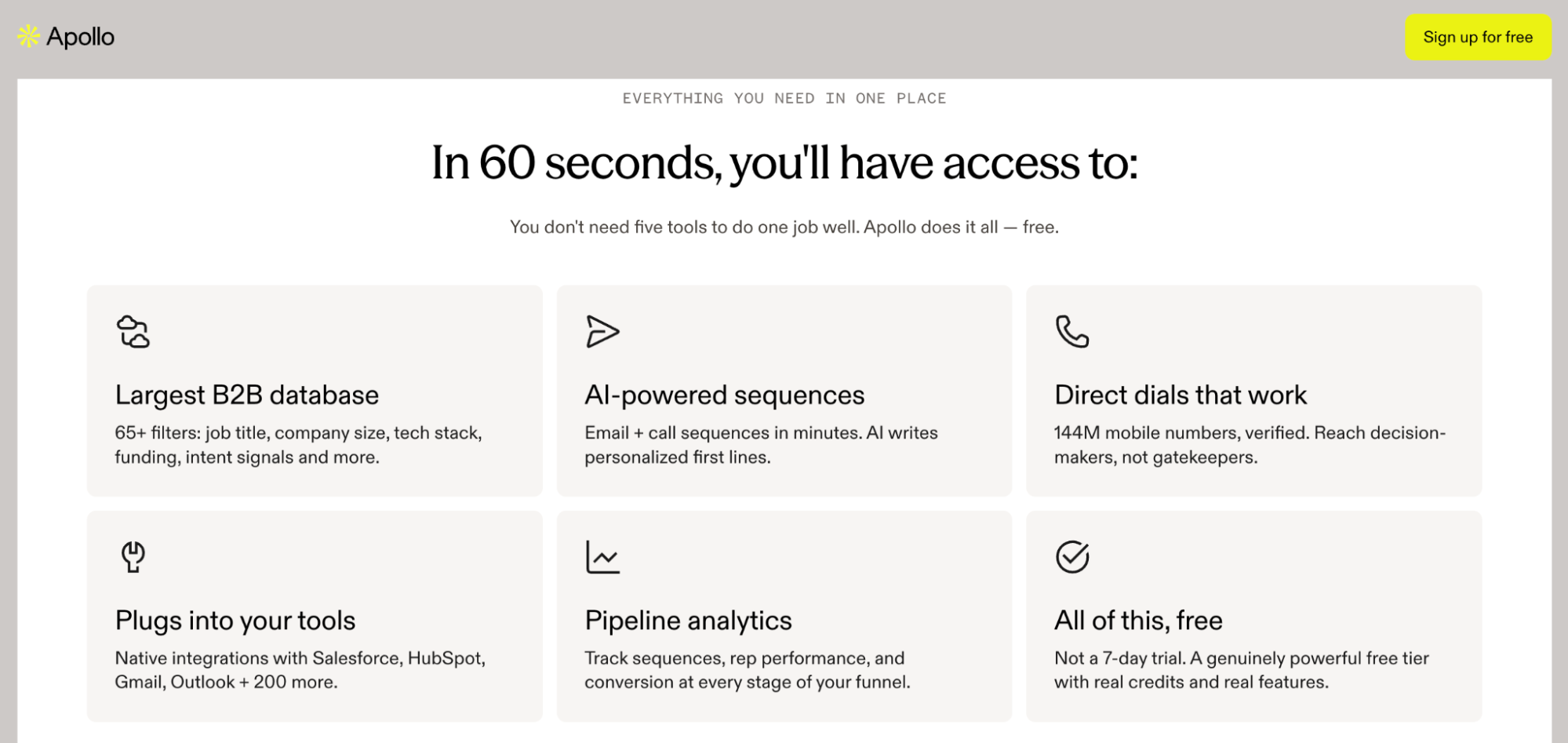
Apollo.io is the strongest starting point for teams that want prospect discovery, contact data, AI research and sales engagement without assembling several separate products. It combines a large B2B database with search, enrichment, lead scoring, sequences, CRM connections, calling and an increasingly capable AI Assistant, which makes it unusually easy to move from “who should we target?” to an active sales workflow.
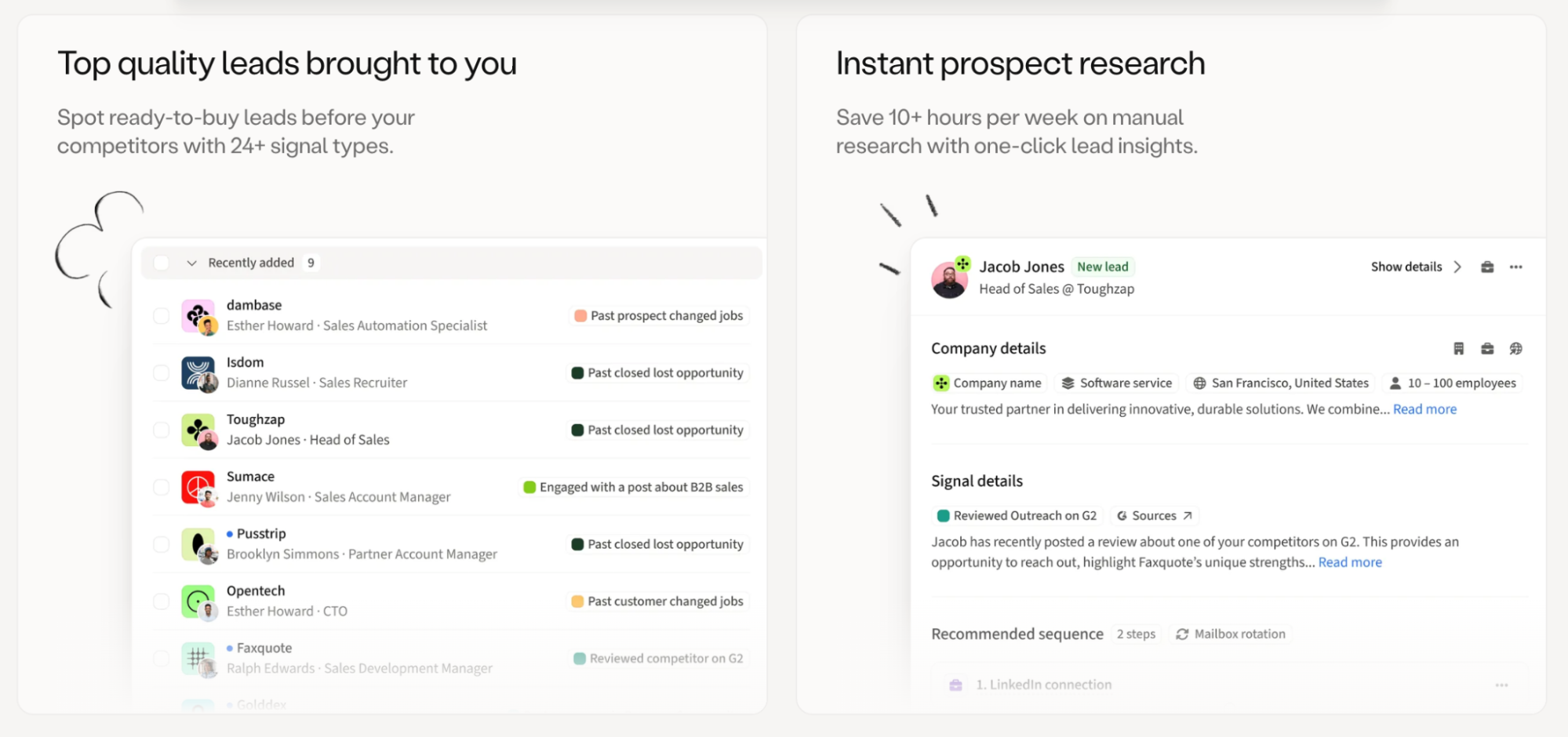
Apollo's AI Assistant can now help users find people and companies, generate prospects that match an ideal customer profile, score or qualify leads, summarize important account information and save the strongest matches into lists. Web-powered targeting can add additional context when standard database filters do not capture the characteristic a sales team is looking for.
That matters because conventional prospecting filters work best when the desired customer can be defined through structured fields such as industry, company size and title. Many real-world ideal customer profiles are more complicated: a company may want businesses launching a particular type of product, expanding into a new region or showing evidence of a problem that does not exist as a clean database column.
What Apollo's AI Lead Generation Workflow Can Do
Apollo combines the data and execution layers more tightly than most of the other tools in this comparison. A sales representative can identify a target account, find the right contacts, enrich missing information, run AI research and move the prospect into a sequence without exporting the record into several applications.
Current capabilities include AI-assisted prospect search, ICP matching, lead qualification, scoring, web research, data enrichment and outreach automation. Professional also adds AI research, automated workflows and a U.S. dialer, while Organization extends the platform with international dialing, additional mailboxes and more enterprise controls.
The credit model is important to understand before rollout. Apollo uses credits for activities such as accessing verified contact details, enrichment and AI research, so two teams on the same seat plan can have very different usage patterns and total costs.
Who Apollo Is Best For
Apollo is particularly well suited to startups, SMBs and mid-market B2B teams that would otherwise need separate subscriptions for prospect data, enrichment and sales engagement. Founder-led sales teams can begin on Free, while growing SDR organizations can move into Professional once automated workflows, deeper AI research and calling become important.
The product is less compelling if a company already has high-quality specialist systems for each stage of the workflow. An organization using an enterprise data provider, a mature sequencing platform, sophisticated enrichment and a well-configured CRM may not gain enough from consolidation to justify migration.
Apollo also works best when the buyer values speed of deployment. Teams can build filters and sequences relatively quickly, while a system such as Clay typically rewards more time spent designing the underlying research workflow.
Apollo Pricing in 2026
Apollo currently offers Free at $0, Basic at $49 per user per month with annual billing, Professional at $79 and Organization at $119 with a three-user minimum. Basic includes 30,000 annual credits per user and unlimited sequences, Professional increases the allowance to 48,000 and adds AI research and automated workflows, while Organization provides 72,000 credits plus higher-level administrative and calling features.
The plan price is therefore only half of the purchasing question. A team doing heavy enrichment or AI research should model expected credit consumption before assuming that the published seat price represents its complete lead generation cost.
What Apollo Users Say
Apollo has by far the largest independent review base among the five platforms in this comparison, with G2 currently showing a 4.7 out of 5 average across more than 9,800 reviews. Users consistently praise ease of use, prospect search, lead generation and the benefit of bringing data and sales engagement into one platform.
The recurring criticism is data consistency. G2's review summary notes that some users encounter outdated or inaccurate contact information, and recent reviews also mention that the credit system can initially be confusing. That is an important limitation because no large contact database has equally strong coverage across every geography, seniority level and industry.
Apollo is the easiest of these five platforms to treat as a complete lead generation starting point. It does not provide Clay's flexibility for custom data workflows or Amplemarket's signal-driven sophistication, but it covers enough of the process in one product to make it a strong first shortlist candidate for many B2B companies.
| Pros | Cons |
|---|---|
| Prospect data and engagement in one platform | Contact accuracy varies by segment |
| Strong AI prospect search and qualification | Credit model requires monitoring |
| Free plan available | More advanced AI research requires Professional |
| Native CRM integrations | Broad feature set can feel overwhelming initially |
| Calling and sequences built in | Specialist tools may go deeper in individual areas |
2. Clay – Best AI Lead Generation Tool for Custom Research and Enrichment
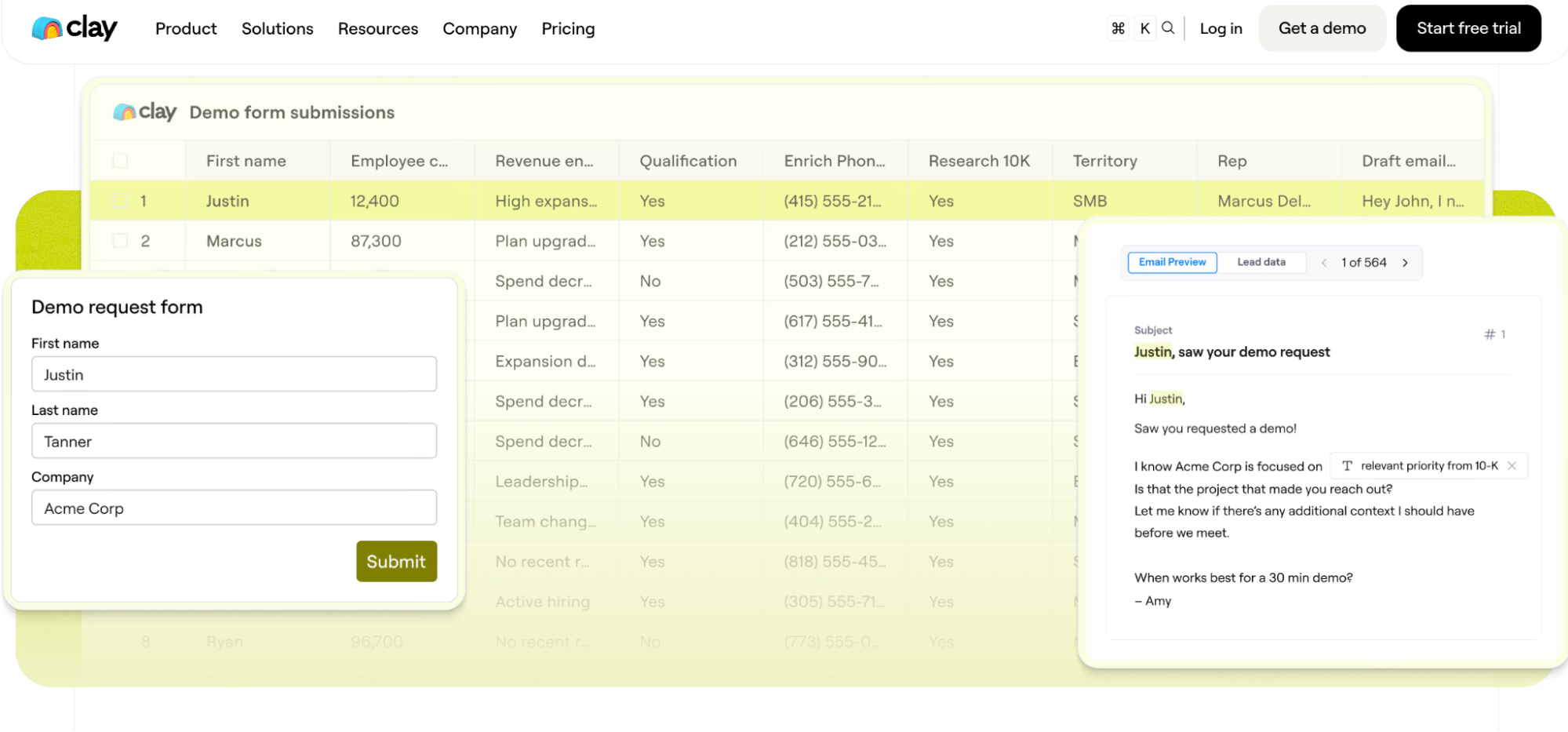
Clay is the strongest option in this shortlist for teams that want to design their own lead generation logic rather than accept the fields and scoring model offered by a single database. It combines data from more than 150 providers with enrichment waterfalls, signals, AI research and programmable workflows, creating something closer to a GTM operating layer than a conventional prospect list.
The centerpiece is Claygent, an AI research agent capable of investigating the web and generating custom information for each account or person. Instead of asking only for standard firmographic information, a team can instruct Claygent to determine whether a company's website mentions a particular initiative, whether recent hiring suggests expansion, whether a product matches a technical criterion or whether a prospect fits a nuanced qualification rule.
That changes the type of lead list a sales organization can build. Rather than filtering for “VP Sales, SaaS, 100–500 employees,” the workflow can incorporate a combination of company data, live web research, hiring events, technology usage, funding and proprietary CRM information.
What Clay Does Differently From a Traditional Lead Database
Clay's main advantage is orchestration: it can ask several providers for the same type of data, use AI to research what those providers cannot supply and decide what happens next based on the result. Multi-provider waterfall enrichment helps improve coverage because the workflow can keep checking sources until it finds the required information rather than accepting one vendor's missing field.
Clay also separates basic platform activity from paid external data. Its current model uses Actions to meter workflow execution and Data Credits for marketplace data and AI, while users can connect their own API keys when they already maintain subscriptions with external providers.
Signals add another layer. Launch includes job changes, promotions, new hires, company news and other events, while Growth expands into web-intent signals, CRM synchronization, warehouse connections and webhook automation.
Who Clay Is Best For
Clay makes the most sense for GTM engineers, RevOps teams, agencies and sophisticated outbound organizations that already know which information improves their targeting. A team can build far more specific workflows than it could with a static contact database, but that flexibility only creates value when someone knows what the research process should accomplish.
It is therefore not always the best first AI lead generation tool for a small company. A founder who simply needs a reliable list of 500 decision-makers may reach a working campaign more quickly in Apollo or Saleshandy, while Clay becomes more attractive once the business wants to combine several signals or create highly customized qualification.
The product is also especially useful when data providers have different strengths. Instead of committing the entire lead generation program to whichever source has the best average coverage, teams can combine them within a waterfall.
Clay Pricing in 2026
Clay still offers a free tier, while Launch currently starts at approximately $167 per month with annual billing, or around $185 on the month-to-month structure reflected in its current plan documentation. Launch includes 15,000 monthly actions, prospecting workflows, phone enrichment, signal tracking and data credits, while Growth increases usage and adds deeper CRM, data warehouse, API and intent capabilities.
Clay's pricing is more complicated than a simple seat license because both workflow volume and paid data matter. The platform explicitly distinguishes Actions from Data Credits, and advanced AI models may use variable pricing based on actual model consumption rather than a fixed credit amount.
That flexibility is useful but requires discipline. A custom web-research prompt that seems inexpensive on 20 test prospects can become a meaningful expense when applied to 50,000 records.
What Clay Users Say
Clay currently holds about 4.6 out of 5 on G2 across more than 230 reviews on the current Clay.com profile. Users frequently praise the ability to combine data providers, automate enrichment and build highly customized outbound workflows, which aligns closely with the platform's main differentiator.
The same flexibility creates the recurring drawback: Clay has a larger learning curve than an ordinary database. Buyers also need to understand credit usage and workflow design well enough to prevent an unnecessarily expensive enrichment process.
Clay is one of the best AI lead generation tools when the company has outgrown ordinary database filters. Its value comes from letting a business define what a good prospect means in its own terms rather than relying entirely on the vendor's predefined fields.
| Pros | Cons |
|---|---|
| 150+ data providers available through one workflow | Steeper learning curve |
| Powerful Claygent AI web research | More expensive than simple databases |
| Custom qualification and signal logic | Credit and action pricing needs management |
| Multi-provider waterfall enrichment | Requires thoughtful workflow design |
| Excellent for complex personalization | Can be excessive for basic list building |
3. Instantly – Best AI Lead Generation Software for Cold Email at Scale
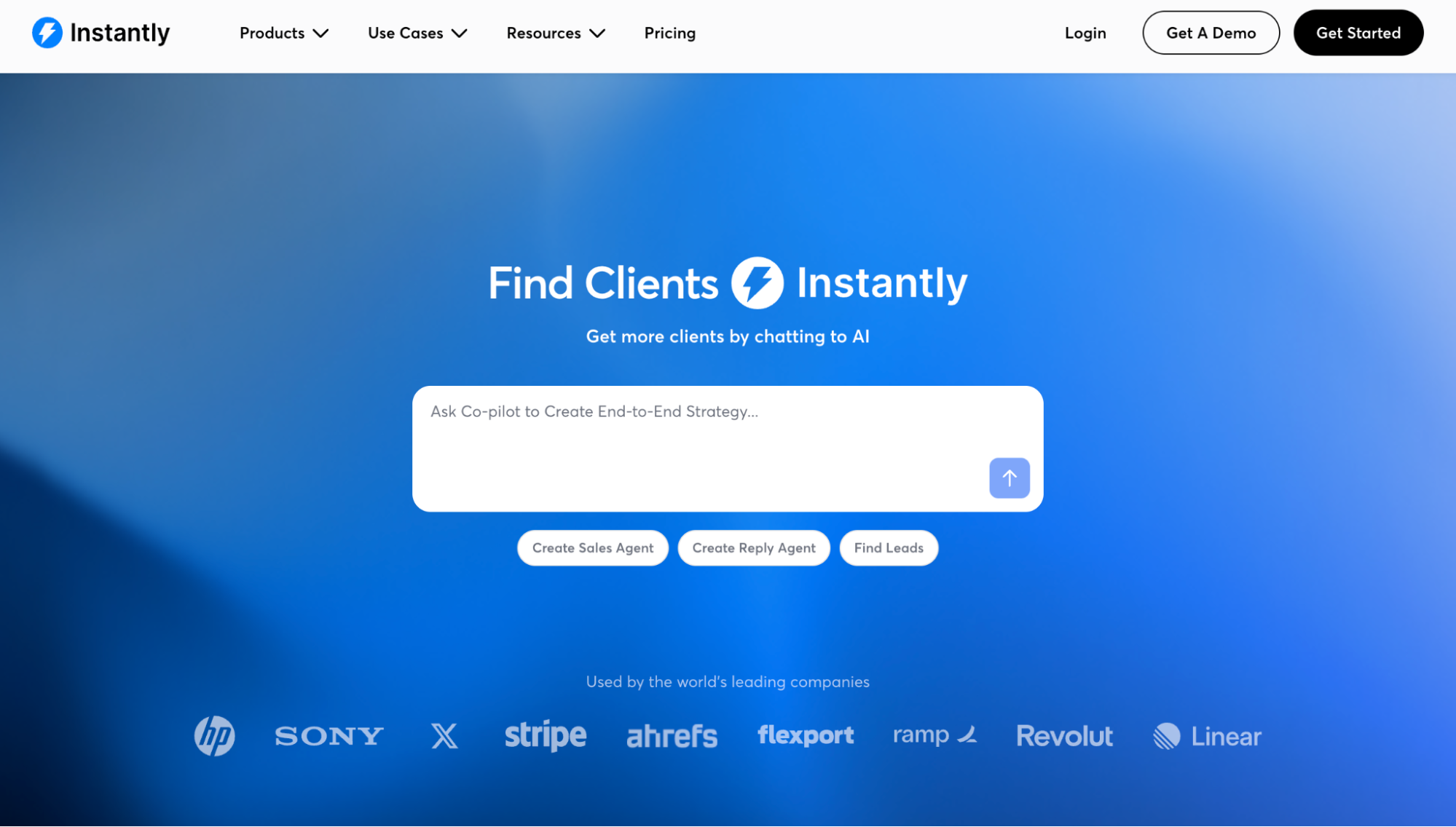
Instantly is the strongest choice among these five when lead generation is tightly connected to scaled cold email. The platform has expanded beyond sending and warm-up into prospect discovery, enrichment, AI research, campaign creation and reply handling, which means teams can increasingly build a lead list and activate it without leaving the same ecosystem.
Its current lead database is marketed at more than 450 million B2B leads, while the credit platform includes waterfall work-email enrichment, company information, job-posting data, news, technology and funding research. Instantly also provides an AI Web Researcher, AI Email Writer and Sales Agent functions that can use several major model providers.
The distinction from Apollo is where the product's center of gravity sits. Apollo starts from a sales intelligence database and expands into engagement, whereas Instantly remains deeply optimized around cold email infrastructure, mailbox management and deliverability.
How Instantly Uses AI in Lead Generation
Instantly can take a prospect from database search through research and into a scaled outbound campaign, with AI operating at several points in that workflow. SuperSearch helps narrow the market, enrichment adds context, the Web Researcher can investigate accounts, AI can generate email messaging and higher-level bundles include agents for sales and reply handling.
Signals are becoming more important as well. Recent G2 users explicitly mention newer AI features that help identify opportunities, reflecting the broader industry shift from static prospect lists toward event-driven outreach.
The deliverability layer remains one of the biggest reasons to choose the product. Teams can connect multiple sending accounts and use automated warm-up and reputation features rather than attempting high-volume outreach through one normal mailbox.
Who Instantly Is Best For
Instantly is best suited to outbound agencies, B2B service providers and sales teams that already know cold email is an effective acquisition channel. Its economics become particularly attractive when the organization needs many sending accounts, because the outreach plans support unlimited email accounts rather than charging for every mailbox.
The product is less suitable when the business still does not know who it should target. Automating thousands of messages against an uncertain ICP usually magnifies a targeting problem rather than solving it.
Companies running multichannel sales motions also need to compare Instantly with Amplemarket or another broader engagement system. Instantly's DNA remains heavily email-oriented even as the surrounding AI and data capabilities continue to expand.
Instantly Pricing in 2026
Instantly has several parallel pricing tracks, which is the main thing buyers need to understand before comparing it with simpler per-seat tools. Standalone Outreach Growth currently costs $47 per month, while annual pricing lowers the effective rate. For teams that want the database, credits and AI alongside outreach, the Starter bundle is currently about $85 per month with annual billing and includes 1,500 monthly credits, 5,000 emails per month and the AI Sales Agent.
Scale costs around $175 per month on annual billing and increases outreach to 100,000 emails per month, 25,000 uploaded contacts and 5,000 Instantly credits while adding the AI Reply Agent and more advanced deliverability functionality. Agency rises to approximately $500 per month annually with significantly larger usage allowances.
This makes Instantly cheap if a buyer looks only at Outreach Growth and potentially much more expensive if the intended workflow also depends heavily on lead data, research and AI agents. The relevant number is the full bundle required to generate and activate the leads, not the cheapest plan displayed on the pricing page.
What Instantly Users Say
Instantly currently has one of the strongest review signals in this comparison, with G2 showing about 4.8 out of 5 across more than 4,100 reviews. Users consistently praise ease of use, fast setup, email automation and deliverability features, while newer reviews also highlight SuperSearch and the convenience of finding leads without maintaining several separate tools.
The criticism is more operational. Reviewers mention data quality, user-interface issues and the complexity of pricing once outreach, credits and additional components are combined. Those concerns become more important as the company moves from a simple cold-email tool into a broader GTM system.
Instantly is one of the best AI lead generation tools for companies that measure success through cold-email conversations. Its strongest advantage appears when prospecting, research, mailbox infrastructure and campaign execution need to scale together.
| Pros | Cons |
|---|---|
| Lead database and cold email in one ecosystem | Pricing split across outreach, credits and bundles |
| Strong deliverability infrastructure | Email-heavy compared with broader multichannel tools |
| AI research and email generation | Data accuracy still needs validation |
| Unlimited sending accounts on outreach plans | Heavy AI usage requires additional credits |
| Very large independent review base | Easy to scale poor targeting if ICP is not proven |
4. Amplemarket – Best AI Lead Generation Tool for Signal-Driven Multichannel Sales
Amplemarket takes the most ambitious approach in this five-tool shortlist because it tries to identify who is likely to care now and then coordinate outreach across several channels. Its Duo Copilot analyzes buying signals, performs account and lead research and helps generate personalized multichannel sequences instead of asking reps to work through an undifferentiated contact list.
The signal layer is the main reason Amplemarket deserves a place in a lead generation comparison. Duo can work with events such as job changes, company developments, website activity, social engagement and other contact- or account-level signals, then use those signals to surface prospects and prepare context for outreach.
That is a different sales motion from exporting 5,000 contacts matching a title filter. A signal-driven workflow may generate fewer immediate names, but the goal is to give reps a stronger reason for contacting each person at that particular moment.
How Amplemarket's AI Lead Generation Works
Duo combines target-market information, CRM context and external signals to recommend potential buyers and prepare personalized outreach. The platform also includes its own contact data, multichannel sequences and deliverability features, which means the recommended lead can move directly into execution instead of being exported into another engagement product.
Amplemarket's analytics can track how many AI-recommended leads were generated, sequenced or dismissed, then connect those leads to replies, meetings, pipeline and revenue. This is useful because it gives management a way to test whether AI recommendations are actually producing business outcomes instead of merely creating more activity.
The current Startup plan includes AI Intent Signals, Duo Copilot, multichannel sequences and tens of thousands of contacts. Growth and Elite add broader capacity and organizational support rather than changing the platform into an entirely different product.
Who Amplemarket Is Best For
Amplemarket is most appropriate for established B2B teams that want to consolidate data, intent, lead research and multichannel outbound into one system. It is particularly relevant when sales leaders are trying to move away from high-volume activity metrics and toward reaching prospects after an identifiable signal.
The pricing makes it harder to justify for a founder experimenting with outbound for the first time. Apollo, Instantly or Saleshandy provide a much cheaper route into prospecting, while Amplemarket becomes more rational when it replaces several existing subscriptions or reduces substantial SDR research work.
The platform can also appeal to organizations that already know the signals associated with successful deals. AI cannot invent a reliable buying signal strategy if the company itself has no idea what separates a strong account from an irrelevant one.
Amplemarket Pricing in 2026
Amplemarket's Startup plan currently costs $600 per month on an annual term and includes two users, lead generation data, multichannel engagement, AI Intent Signals and Duo Copilot. Growth and Elite use tailored pricing, with higher plans designed around larger teams and more complex sales operations.
That means the product should not be compared with Apollo Basic on sticker price. The more relevant question is whether Amplemarket replaces an existing database, sequencing platform, signal provider and deliverability system, because that consolidation is central to its economic argument.
What Amplemarket Users Say
Amplemarket currently holds about 4.6 out of 5 on G2 across approximately 675 reviews. Recent reviewers specifically praise precise targeting, automated lead generation and signals around job changes, company news and relevant engagement, while broader review summaries highlight automation and the benefit of consolidating multichannel prospecting.
The critical feedback is useful as well. Some users mention setup or learning requirements, occasional limitations in filtering and cases where AI-generated messaging does not fully fit the prospect context. That reinforces the need to treat AI personalization as a draft informed by signals rather than assume every generated sequence should be sent unchanged.
Amplemarket is the most compelling option here for teams that believe timing is as important as fit. Its value is not primarily having another large contact database, but using AI signals to decide which potential buyer deserves attention now.
| Pros | Cons |
|---|---|
| Strong intent and signal-based prospecting | $600/month entry price is high for small teams |
| Duo Copilot combines research and personalization | More platform than many early-stage companies need |
| Multichannel outreach included | AI messaging still needs quality control |
| Lead generation and execution live together | Higher-tier pricing is custom |
| Strong independent user feedback | Requires clear ICP and signal strategy |
5. Saleshandy – Best Value AI Lead Generation Tool for Smaller Outbound Teams
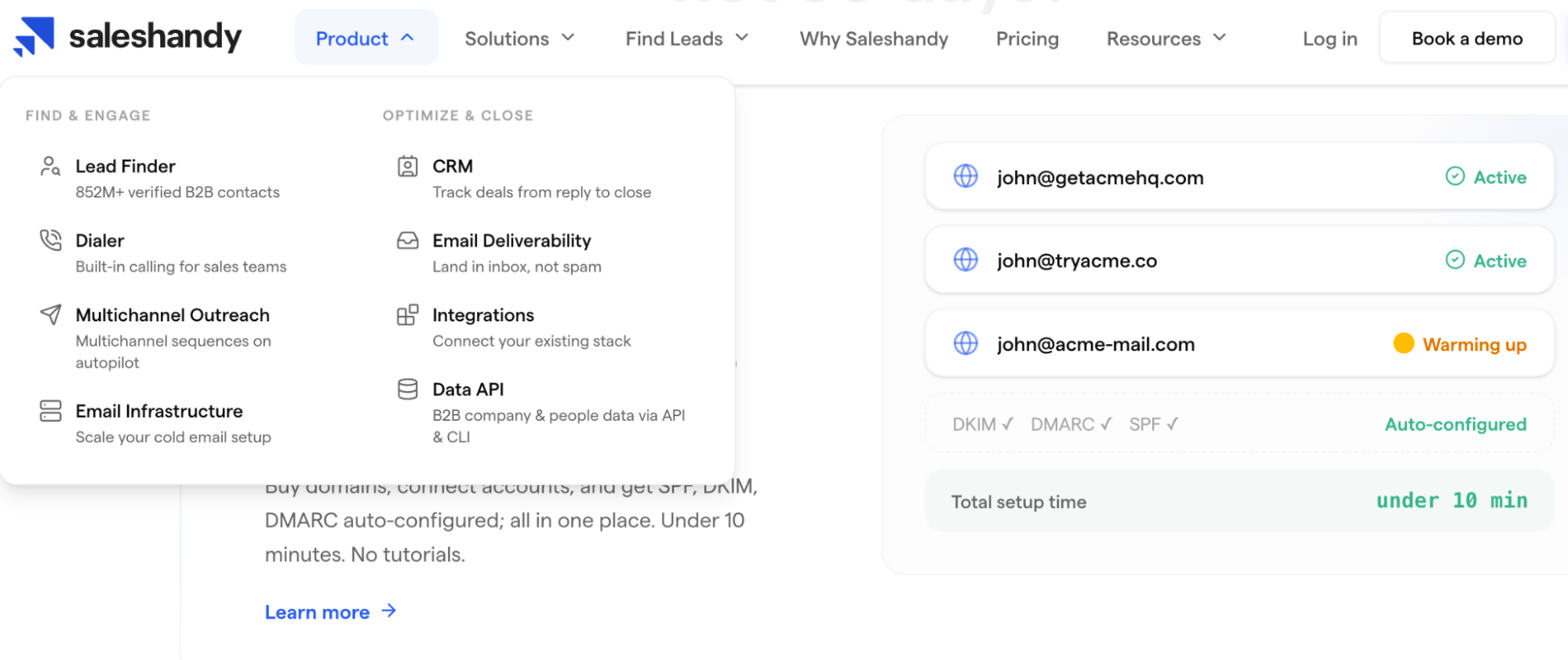
Saleshandy offers one of the most aggressive price-to-function combinations in this shortlist by bundling lead discovery, verified contact data and outbound execution into plans starting at $34 per month. Its current platform combines a very large B2B database, waterfall enrichment, real-time verification, multichannel sequences and natural-language lead search rather than requiring separate Lead Finder and outreach subscriptions.
The company currently advertises access to more than 852 million contacts and 42 million company profiles. Those figures should be treated as vendor-published coverage rather than proof of accuracy, but the combination of multiple enrichment providers and real-time email verification is more relevant than the raw database number alone.
The natural-language search layer is particularly useful for smaller teams that do not want to learn dozens of filters before creating a first prospect list. A user can describe the customer profile in plain English, then move the resulting contacts directly into outreach.
How Saleshandy Handles Lead Generation
Saleshandy combines people and company search with waterfall enrichment across multiple providers, then verifies contact details before delivering them to the user. Current platform plans include credits for Lead Finder, with one credit used for a verified work email and higher usage required when phone data is also requested.
The same subscription supports multichannel sequences across email, calls, WhatsApp and tasks, although CRM integrations and broader automation become available from Pro rather than the Starter tier. Unlimited connected email accounts are included, which can make Saleshandy attractive to agencies or teams managing several sending identities.
AI is more supportive here than autonomous. Saleshandy includes natural-language search and AI functionality around outbound, but buyers looking for sophisticated signal-driven agents should compare Amplemarket, Clay or Apollo before choosing primarily on price.
Who Saleshandy Is Best For
Saleshandy makes the strongest case for small outbound teams, agencies and service businesses that need verified leads and campaign execution without a large monthly software bill. A single user can begin on Starter and access both the database and outreach features instead of paying for several subscriptions.
Pro is more realistic for a sales team because it adds up to 10 team members, CRM integrations, no-code connections and much larger active-prospect and sending allowances. The platform can therefore scale beyond founder-led outreach without immediately moving into enterprise pricing.
Its main limitation is depth. Businesses that want highly customized web research, sophisticated intent signals or a complex RevOps data layer will eventually find more flexibility in Clay or Amplemarket.
Saleshandy Pricing in 2026
Starter costs $34 per month with annual billing or $41 monthly, Pro costs $76 annually billed per month or $99 monthly, and Scale costs $149 annually billed per month or $189 monthly. Starter currently includes 1,500 Lead Finder credits per month, Pro 4,000 and Scale 8,000, alongside progressively larger outreach allowances.
The current plans also make the lead-data economics relatively easy to understand. Saleshandy states that one verified work email costs one credit and that its provider waterfall plus verification is included in that result rather than charged as several separate enrichment steps.
What Saleshandy Users Say
Saleshandy currently holds about 4.6 out of 5 on G2 across more than 800 reviews. Users frequently praise the ease of building prospect lists, verified contact discovery, campaign automation and the convenience of keeping Lead Finder and outreach inside the same product.
The complaints concentrate around credit consumption, occasional outdated records and limitations that only disappear on higher tiers. Recent reviewers are particularly useful here because they describe both sides of the same trade-off: a large accessible database saves research time, but the business still needs to validate whether coverage is strong enough for its own niche.
Saleshandy is the strongest budget-conscious option among these five AI lead generation tools. It will not satisfy every enterprise RevOps requirement, but it offers enough prospecting and activation capability to make a separate data provider unnecessary for many smaller teams.
| Pros | Cons |
|---|---|
| Very competitive starting price | Less advanced signal intelligence |
| Lead data and outreach in one subscription | Some contacts may still be outdated |
| Waterfall email enrichment and verification | Credit use matters for phone data |
| Unlimited sending accounts | CRM integrations require Pro |
| Strong fit for agencies and SMBs | AI layer is less sophisticated than Clay or Amplemarket |
What Users Say About These Five AI Lead Generation Tools
The review data shows a surprisingly consistent pattern: users value consolidation and time savings, while data accuracy, credits and complexity appear repeatedly in the negative feedback. That matters because all five platforms promise some version of “less manual prospecting,” but the operational cost can return in another form if the team constantly has to verify data or monitor usage.
The ratings should not be used as a simple ranking. Apollo has tens of times more reviews than Clay, while Instantly is primarily evaluated by outbound users and Amplemarket serves a higher-budget customer profile, so the same star score does not describe the same buying experience.
| Tool | Current G2 signal | What users often praise | Recurring concern |
|---|---|---|---|
| Apollo.io | ~4.7/5, 9,800+ reviews | Ease of use, broad prospecting features and all-in-one workflow | Data freshness and credit complexity |
| Clay | ~4.6/5, 230+ reviews | Flexible enrichment and custom research | Learning curve and usage management |
| Instantly | ~4.8/5, 4,100+ reviews | Cold-email workflow, setup and deliverability | Pricing layers and some data-quality issues |
| Amplemarket | ~4.6/5, 675 reviews | Signals, automation and multichannel prospecting | Cost, setup and occasional AI-message quality |
| Saleshandy | ~4.6/5, 800+ reviews | Lead finding, outreach and affordability | Credits and occasional outdated records |
Which AI Lead Generation Tool Is Best for Your Sales Model?
The sales motion is a better selection criterion than company size alone. A 20-person agency running 100,000 outbound emails per month may need a very different tool from a 100-person SaaS company that sells into a narrow enterprise market using trigger-based account research.
This is also why the article deliberately avoids assigning one score to all five platforms. A tool can be stronger in its intended workflow while being a significantly worse purchase for another team.
| Lead generation need | Tool to test first |
|---|---|
| One platform for prospecting and engagement | Apollo.io |
| Advanced enrichment and custom research | Clay |
| High-volume cold email lead generation | Instantly |
| Signal-driven multichannel outbound | Amplemarket |
| Affordable verified leads plus outreach | Saleshandy |
| Founder-led sales with limited budget | Apollo Free or Saleshandy |
| GTM engineering and complex RevOps workflows | Clay |
| Agency managing many outbound mailboxes | Instantly or Saleshandy |
| Mature SDR organization targeting intent | Amplemarket |
Apollo vs Clay: Which AI Lead Generation Tool Should You Choose?
Choose Apollo when the priority is getting an outbound process running quickly; choose Clay when the priority is controlling how prospect data is researched, enriched and scored. Apollo already combines the database and engagement layer, while Clay is more valuable when a business wants to create its own data logic.
Apollo requires less configuration for a conventional sales team. A rep can search for prospects, enrich them and place them into a sequence without designing a data workflow first.
Clay has the higher ceiling for unusual targeting. If the sales strategy depends on several providers, company-specific qualification criteria, live web research and custom buying signals, the additional complexity can become a competitive advantage rather than a drawback.
For some mature outbound teams, Apollo and Clay are not substitutes at all. Apollo may provide part of the source data while Clay orchestrates enrichment and qualification before qualified records move into another engagement platform.
Instantly vs Saleshandy: Which Is Better for Cold Lead Generation?
Saleshandy is easier to justify when cost and verified prospect discovery are the priorities, while Instantly becomes more compelling as email infrastructure and sending scale become more complex. Both combine lead data and outbound execution, but they place different emphasis on the surrounding system.
Saleshandy's $34 annual-billing entry point is much lower and includes a useful volume of Lead Finder credits. Instantly's standalone outreach is also affordable, but the complete AI lead generation proposition becomes more expensive once database credits, AI research and agents are added.
Instantly has the stronger identity around cold-email infrastructure. Saleshandy feels more straightforward for a smaller agency or business that wants to find a lead, verify the contact and begin outreach without building a large sending operation.
When Is Amplemarket Worth the Higher Price?
Amplemarket becomes easier to justify when the alternative is already a stack of several sales tools and substantial SDR research time. A team paying separately for contact data, intent signals, engagement, deliverability and AI research should compare the total cost of that stack with Amplemarket's $600 monthly Startup plan rather than compare it only with a $49 Apollo seat.
The signal layer is also more valuable in narrow markets. If there are only 2,000 accounts the business could realistically sell to, generating more names has limited value; knowing which decision-maker has recently changed roles, interacted with a relevant topic or shown another buying signal can matter much more.
For a new company with no tested sales motion, the same sophistication can become unnecessary overhead. AI signals improve a defined go-to-market strategy; they do not substitute for knowing why customers buy.
How Much Do AI Lead Generation Tools Really Cost in 2026?
The category is increasingly moving away from one simple monthly subscription because data and AI have variable costs. Buyers may pay for user seats, verified emails, phone numbers, enrichment providers, AI research, workflow actions, contacts or email-sending capacity, depending on the platform.
This makes cost per usable lead a more useful metric than subscription price. A $34 platform that returns weak contact coverage can be more expensive than a $167 workflow that produces far fewer but much more qualified records, while an expensive signal platform can be economically rational if one correctly timed enterprise opportunity is worth tens of thousands of dollars.
| Cost model | Tools where it matters | What increases spend |
|---|---|---|
| Per user | Apollo | Sales team size |
| Actions + data credits | Clay | Workflow volume, enrichment and AI research |
| Outreach + separate credits | Instantly | Sending volume, research and AI-agent use |
| Bundled platform subscription | Amplemarket | Team and required sales capacity |
| Plan + Lead Finder credits | Saleshandy | Contact reveals and prospecting volume |
Do You Need One AI Lead Generation Tool or a Stack?
Most smaller teams should begin with one platform and add another only when they can describe the limitation they are trying to solve. Buying Apollo, Clay and Instantly simultaneously because all three appear in comparison articles is likely to create duplicate data, overlapping AI features and another RevOps project before the company knows whether the original outbound strategy works.
A common maturity path is to begin with an all-in-one platform such as Apollo or Saleshandy, then introduce a specialist system only after the sales process reveals a repeatable constraint. A team may add Clay because basic filters cannot identify the right accounts, or move more sending into Instantly because mailbox management has become the operational bottleneck.
At larger scale, a multi-tool stack can be completely rational. Clay itself describes a lean outbound architecture as an enrichment and list-building layer, a sending tool and a CRM, which reflects the reality that one vendor does not always need to own every stage of the lead generation process.
What AI Lead Generation Software Cannot Fix
AI can automate prospect research much more effectively than it can repair an unclear go-to-market strategy. A company that targets the wrong industry, has no meaningful differentiation or sends an offer buyers do not need can use excellent data and still generate poor pipeline.
The same applies to personalization. An AI tool can discover that a company recently raised funding or hired a new VP, but referencing that fact does not automatically make the email relevant. The sales message still needs to connect the signal to a credible business problem and explain why the recipient should care.
Data quality is another unavoidable limitation. Every product in this comparison combines information from sources that can become outdated, and current user reviews across Apollo, Saleshandy and other platforms still mention incorrect contact records. AI can improve the process of finding and evaluating data, but it cannot make the underlying B2B world stop changing.
How to Test an AI Lead Generation Tool Before Buying
A real test should use the same target market across every shortlisted platform so the team can compare the quality of the leads rather than the quality of the demo. The most useful pilot focuses on a relatively small, known sample where the sales team already understands which companies and contacts should appear.
- Define the ICP before opening the software. Write down the industries, company characteristics, locations, roles, exclusions and buying signals that matter so every platform is judged against the same criteria.
- Build the same prospect sample in each tool. Compare whether the platforms identify the accounts and people the team already knows should be included.
- Verify contact data manually. Check a meaningful sample of emails, phone numbers, titles and employers instead of trusting a “verified” badge automatically.
- Test the AI research. Ask the platforms to answer several questions whose correct answers can be confirmed independently and compare usefulness rather than output length.
- Measure qualification quality. Review how many AI-recommended leads an experienced salesperson would actually pursue.
- Run a controlled outreach test. Use similar messaging and audience segments so reply and meeting results can be compared fairly.
- Calculate the cost per usable lead. Include credits, enrichment, AI research, sending and the employee time still needed to review the output.
- Review what the tool removes from the workflow. Keep the platform only if it eliminates meaningful manual work without introducing an equivalent amount of data checking or administrative complexity.
A good AI lead generation trial should therefore produce more than a long export. The outcome should be a smaller set of contacts that the sales team trusts more, understands better and can activate with less manual research.
Data Accuracy Matters More Than Database Size
Large database numbers are useful for understanding potential coverage, but they are a poor substitute for testing the segment a company actually sells to. Apollo's current G2 profile references more than 275 million contacts, Saleshandy advertises more than 852 million, Instantly lists more than 450 million B2B leads and Amplemarket states more than 200 million verified contacts, yet none of those numbers tells a buyer how many CFOs at 50–200-person German manufacturing firms have a current direct dial.
The correct comparison is coverage within the actual addressable market. Buyers should create a benchmark list of known contacts, compare email availability, phone coverage, title freshness and employer accuracy, then measure whether waterfall enrichment or AI research improves the missing records.
This is also where Clay's provider-orchestration model differs from single-database products. A waterfall can improve the chance of finding an answer because several providers are checked, but it also makes pricing and workflow design more important.
AI Lead Generation and Compliance Still Require Human Ownership
AI does not change the legal and reputational obligations attached to prospecting. A system may make it technically possible to identify and contact tens of thousands of people, but the business remains responsible for applicable privacy, marketing, telemarketing and platform rules in every market where outreach occurs.
The risk also changes by channel. Finding public company information is different from processing personal contact data, while sending email, making automated calls and using social-network automation can each introduce separate compliance requirements.
AI agents make these boundaries more important rather than less important. A salesperson manually reviewing 20 prospects can notice something unusual before contacting them; an autonomous system working through thousands of records needs explicit rules about who may be contacted, what claims can be made and when a human must approve the action.
Best AI Lead Generation Tools in 2026 by Buying Priority
The five platforms become much easier to choose once the company identifies which part of lead generation needs the biggest improvement. The most powerful tool on paper is not automatically the one that removes the most work from a specific sales organization.
Apollo is the most straightforward starting point when a company wants one platform to cover the majority of the workflow. Clay has the strongest case when targeting requires custom research and multi-source data. Instantly becomes particularly attractive when lead activation happens through high-volume cold email, while Amplemarket is built for teams prepared to pay more for signals and multichannel execution.
Saleshandy occupies an important place at the other end of the market. A smaller company does not need an enterprise intent platform to benefit from AI lead generation if its immediate problem is simply finding verified decision-makers and contacting them efficiently.
| Priority | Platform to shortlist |
|---|---|
| Best all-in-one prospecting and engagement platform | Apollo.io |
| Best for custom AI research and enrichment | Clay |
| Best for cold-email lead generation at scale | Instantly |
| Best for signal-driven multichannel prospecting | Amplemarket |
| Best value for smaller outbound teams | Saleshandy |
Frequently Asked Questions
- What are the best AI lead generation tools in 2026?
- Apollo.io, Clay, Instantly, Amplemarket and Saleshandy are five of the strongest options for B2B lead generation in 2026. They serve different purposes, ranging from all-in-one prospecting to custom enrichment, cold email, signal-based selling and lower-cost lead discovery.
- What is the best AI lead generation tool overall?
- Apollo is one of the strongest all-in-one options because it combines prospect search, enrichment, AI research and engagement at an accessible starting price. Clay may be the better choice when custom research and data orchestration matter more than convenience.
- What is the best AI lead generation tool for small businesses?
- Apollo and Saleshandy are particularly suitable for smaller businesses because both have relatively accessible entry points and cover more than one part of the workflow. Apollo has a free tier, while Saleshandy starts at $34 per month with annual billing.
- What is the best AI tool for finding B2B leads?
- Apollo is strong for direct prospect search, while Clay is more flexible when leads must be assembled from several providers and evaluated against custom conditions. Saleshandy also offers a large searchable B2B database with natural-language prospect search.
- What is the best AI lead generation tool for cold email?
- Instantly is particularly strong for businesses running cold email at scale because lead discovery, AI research, sending infrastructure, warm-up and reply automation can live in the same ecosystem. Saleshandy is a lower-cost alternative for smaller campaigns.
- Is Clay better than Apollo for lead generation?
- Clay is better for custom enrichment, research and complex qualification logic, while Apollo is easier to deploy as an all-in-one prospecting and engagement system. The right choice depends on whether the team needs flexibility or speed.
- Is Instantly an AI lead generation tool or only an email tool?
- Instantly now covers substantially more than email sending. Its current platform includes a B2B lead database, enrichment, AI web research, AI writing and sales-agent capabilities alongside its cold-email infrastructure.
- What does Amplemarket do differently from Apollo?
- Amplemarket places more emphasis on intent and contact-level sales signals, using its Duo Copilot to surface prospects and prepare contextual multichannel outreach. Apollo offers a lower-cost all-in-one prospect database and engagement platform with broader self-service accessibility.
- Is Saleshandy good for lead generation?
- Saleshandy is particularly attractive for SMBs and agencies that want contact discovery, verification and outreach in one affordable platform. Its AI and signal capabilities are less advanced than Clay or Amplemarket, but its pricing is substantially lower.
- Are free AI lead generation tools good enough?
- Free plans are useful for testing search quality and workflow fit, but meaningful prospecting volume typically requires paid data or credits. Apollo and Clay both offer free entry points that can help buyers validate the product before committing.
- How accurate are AI lead generation tools?
- Accuracy varies by data source, geography, industry and job level. Buyers should independently test a sample of emails, phone numbers, job titles and company information in their own target segment rather than rely on database-size or accuracy claims.
- Can AI generate qualified leads automatically?
- AI can find prospects that match defined criteria, research them, identify signals and score or prioritize them. The quality of those leads still depends heavily on how accurately the company has defined its ideal customer and buying conditions.
- Can AI lead generation replace SDRs?
- AI can automate large parts of sourcing, research, enrichment, first-draft personalization and routine outreach. Human salespeople remain important for nuanced qualification, relationship building, discovery and commercial decisions.
- How much do AI lead generation tools cost?
- Entry-level products can start free or around $34–$49 per month, while advanced enrichment systems can cost $150–$500 or more and signal-led sales platforms can begin around $600 monthly. Data credits and usage can materially increase the final cost.
- What is the difference between lead enrichment and lead generation?
- Lead generation finds potential customers, while enrichment adds missing or more useful information to records that already exist. Modern AI lead generation software increasingly combines both functions so a raw account can become a qualified, contactable prospect inside one workflow.
- Do AI lead generation tools work for inbound leads?
- Some do, but the five platforms in this comparison are strongest around B2B prospecting and outbound workflows. Companies whose primary challenge is converting anonymous website traffic or inbound form leads may need a different type of lead-generation platform.
- What should businesses measure when testing AI lead generation software?
- The strongest metrics are verified-contact coverage, cost per usable lead, time spent on manual research, reply rate, qualified meetings and the percentage of AI-recommended leads that salespeople would genuinely pursue. Raw list size is much less useful than lead quality and conversion.
- Is one AI lead generation platform enough?
- For small teams, often yes. Larger or more mature outbound organizations may combine a prospect database with Clay-style enrichment, a specialized sending system and a CRM once each layer has a clearly defined role.
- Which AI lead generation tool offers the best value?
- Saleshandy has one of the lowest paid entry points, while Apollo provides unusually broad functionality at $49 per user on Basic. Value ultimately depends on how many verified and genuinely relevant prospects the system produces rather than the subscription price alone.
- What is the biggest mistake when buying AI lead generation software?
- The most common mistake is automating before the ideal customer profile and offer are proven. AI can dramatically increase research and outreach capacity, but it can scale weak targeting just as efficiently as strong targeting.

Written by
Marcus Hale
Marcus Hale coached enterprise AE teams on conversation intelligence, pipeline hygiene, and sales-engagement tooling.
Last reviewed September 23, 2026