AI CRM
Which AI CRM Is Actually Worth Paying for in 2026? We Compared 12 Serious Platforms
The best AI CRM in 2026 is not necessarily the platform with the most AI features. Some excel at autonomous sales agents, others at pipeline management, data enrichment or meeting intelligence. This guide compares 12 serious options by the way businesses actually use them.
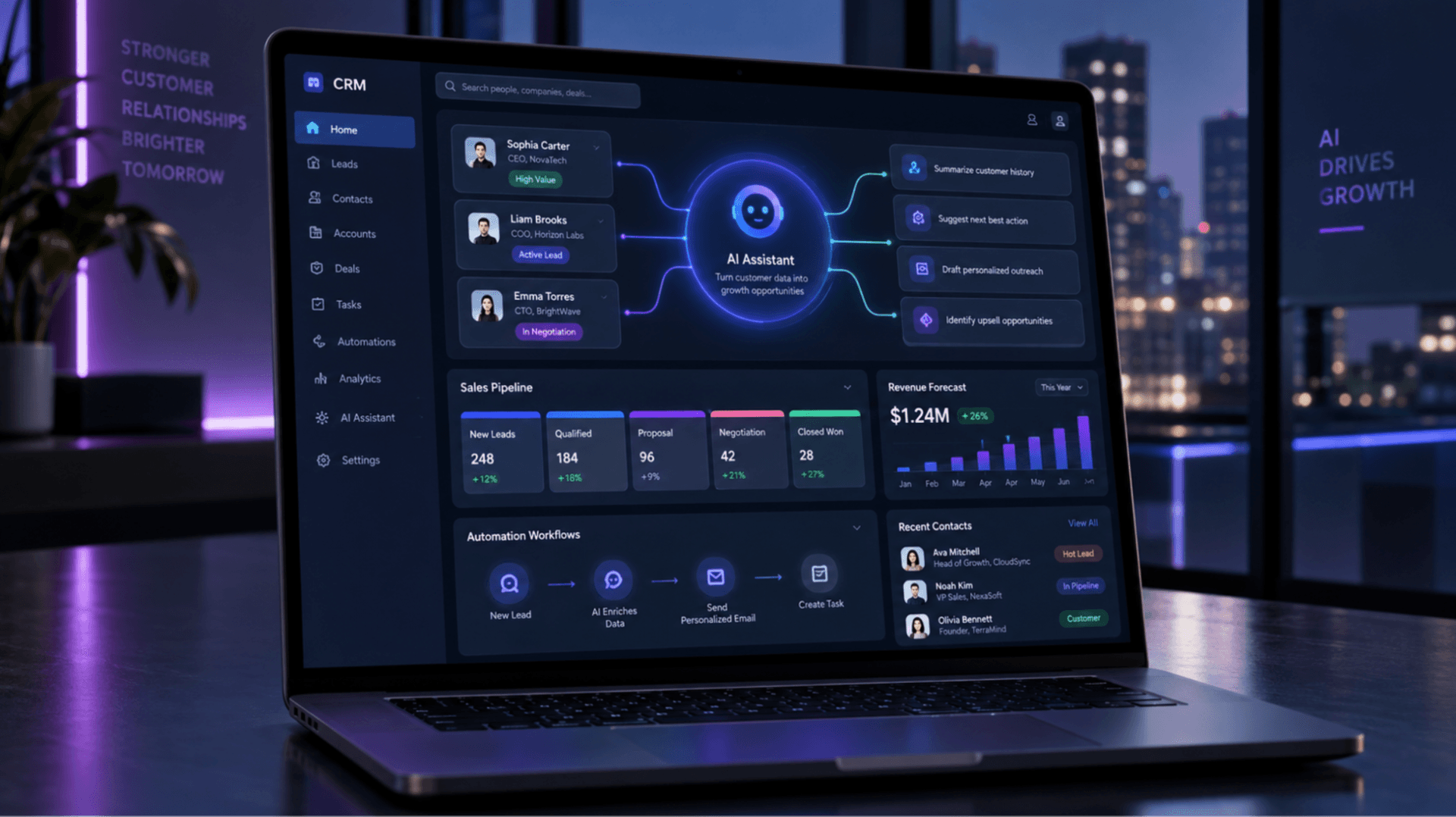
The market for AI CRM software changed noticeably in 2026. The basic question is no longer whether a CRM has artificial intelligence. Most major platforms do. The useful question is how deeply AI is connected to customer data, what work it can perform without manual intervention, and how much that intelligence costs once a team begins using it at scale.
Some AI CRM tools still concentrate on familiar tasks such as drafting emails, summarizing meetings and predicting deal outcomes. Others now deploy agents that can research prospects, call leads, qualify opportunities, update records and trigger workflows. At the enterprise end of the market, CRM vendors are moving toward systems in which human employees and AI agents share access to the same business processes.
That makes comparisons more complicated than they were even a year ago.
A $14-per-user CRM may include useful AI in the subscription. Another vendor may charge separately for AI credits, conversations or completed actions. A third may look inexpensive at the seat level but require a much higher plan before its best AI tools become available.
For this guide, the 12 platforms were evaluated as actual CRM systems, not merely software that can send a message or enrich a contact list. The shortlist includes HubSpot, Salesforce, Microsoft Dynamics 365 Sales, Zoho CRM, Pipedrive, Freshsales, monday CRM, Attio, Creatio, Close, Nutshell and Capsule.
Pricing and product details were checked against current vendor information in September 2026.
Best AI CRM Tools in 2026 at a Glance
The 12 best AI CRM tools fall into very different categories. Salesforce, Dynamics 365 and Creatio are built for complex organizations; HubSpot, Zoho and monday CRM cover broader business workflows; Pipedrive, Freshsales and Close stay closer to the daily sales process; Attio, Nutshell and Capsule appeal to teams that want less CRM overhead.
*Prices generally reflect annual billing where offered and can exclude AI credits, usage fees, telephony, add-ons or implementation costs.
The table is useful for narrowing the field, but starting price alone tells very little about the real cost of AI CRM software. Salesforce, HubSpot, Dynamics, Creatio and other vendors increasingly meter at least part of their AI usage separately, while platforms such as Zoho or Pipedrive include more capabilities within the subscription tier.
| **AI CRM** | **Strongest use case** | **Notable AI capability** | **Starting price*** | **Best fit** |
|---|---|---|---|---|
| **HubSpot Smart CRM** | Unified sales, marketing and service | Breeze Assistant, AI agents, customer-data context | Free / $15 per seat | SMB to mid-market |
| **Salesforce** | Complex enterprise CRM | Agentforce, predictive and generative sales AI | $25 per user | Enterprise and complex teams |
| **Microsoft Dynamics 365 Sales** | Microsoft-centric organizations | Copilot, sales agents, opportunity intelligence | $65 per user | Mid-market and enterprise |
| **Zoho CRM** | Feature-rich CRM at lower cost | Zia, predictions, agents, anomaly detection | Free / $14 per user | SMB and mid-market |
| **Pipedrive** | Visual deal management | Meeting intelligence, AI reports, scoring | $14 per seat | Sales-led SMBs |
| **Freshsales** | Affordable sales CRM | Freddy AI, deal insights, scoring | $9 per user | Startups and SMBs |
| **monday CRM** | Flexible CRM and workflow automation | AI lead sourcing, calling and custom agents | $12 per seat | Flexible sales teams |
| **Attio** | Modern, highly configurable CRM | Research agent, AI workflows, call intelligence | Free / $35 per user | Startups and growth teams |
| **Creatio** | Agentic CRM and process automation | AI agents across sales and workflows | From platform + product pricing | Mid-market and enterprise |
| **Close** | Outbound and inside sales | Chloe voice agent, AI CRM actions, summaries | $9 per user | Outbound sales teams |
| **Nutshell** | Practical SMB CRM | Lead research, scoring, summaries, AI agents | $13 per user | Small and midsize sales teams |
| **Capsule** | Simple CRM with useful AI | Meeting prep, enrichment, summaries | Free / $18 per user | Small businesses |
What Changed in AI CRM Software in 2026?
AI CRM tools are moving from suggestion engines to action systems. The most important development in 2026 is not better email generation – it is the ability of AI to operate inside the CRM with controlled access to records, workflows and communication tools.
Older CRM automation was largely rule-based. If a deal moved to stage three, the system could create a task. If a form was submitted, it could assign the lead.
Modern AI CRM software adds interpretation.
An AI agent can examine the account history, understand what happened during a call, decide which information matters, identify missing fields and determine which approved action to take next. Depending on the platform, that might mean drafting an email, changing a field, creating a follow-up task, finding a new prospect or initiating a customer conversation.
Salesforce Agentforce, Microsoft sales agents, monday CRM's new agents, Zoho's Zia agents, HubSpot's Agent Hub and Close's Chloe all reflect this move toward action-oriented CRM.
There is also a second change buyers need to understand: AI is becoming a separate unit of cost.
Some vendors still bundle most AI into the plan. Others sell credits, actions, conversations, resolutions or sessions. This means a CRM that appears expensive per user can occasionally be cheaper at real-world usage, while an attractive base plan may become costly once AI agents are heavily deployed.
How to Choose the Best AI CRM for Your Business
Start with the sales process, not with the AI feature list. The right AI CRM should remove a recurring bottleneck in the way the company already sells, markets or supports customers.
A useful buying framework asks six questions.
• Where Does The Team Lose Time? Prospect research, CRM updates, meeting notes, follow-ups, lead qualification and support requests are very different problems. • How Complex Is The Sales Process? A five-stage SMB pipeline does not need the same architecture as a global enterprise with territories, partner sales, approvals and custom objects. • Where Does Customer Data Live? AI becomes more valuable when it can safely access reliable email, meeting, product and CRM data. • Does The AI Recommend Or Act? Suggestions may be enough for one company, while another needs agents that actually update records or contact leads. • How Is AI Billed? Check credits, sessions, actions, conversations and other usage charges. • Will The Team Actually Use The CRM? The most advanced platform fails if reps avoid it because the workflow is too complicated.
That last question is particularly important. CRM adoption is still a more basic problem than artificial intelligence for many companies. A simpler AI CRM that keeps itself updated can deliver more value than an enterprise system that employees treat as mandatory paperwork.
Enterprise AI CRM Tools for Complex Organizations
Enterprise AI CRM software has a different job from the tools built for small sales teams. These platforms need to handle multiple departments, complex permissions, custom processes, large datasets and extensive integrations while giving AI enough context to work safely across the organization. Salesforce, Microsoft Dynamics 365 and Creatio all approach that problem differently, but each is designed for businesses where CRM is part of the company's operational infrastructure rather than simply a place to track deals.
Salesforce – AI CRM for Companies That Need Maximum Control
Salesforce remains one of the deepest AI CRM platforms for enterprises that need extensive customization, large integration ecosystems and granular control over sales processes. Its advantage is not simplicity; it is the ability to model complicated organizations and then apply AI across those workflows.
Salesforce's current sales lineup starts with Starter Suite at $25 per user per month and Pro Suite at $100. The newer Core, Advanced and Max plans are priced at $195, $395 and $550 per user per month respectively when billed annually. Max includes the broadest AI package, while Agentforce can also be purchased through separate usage or per-user models.
Agentforce is the part that makes Salesforce especially relevant to an AI CRM comparison in 2026.
Instead of limiting artificial intelligence to summaries and predictions, Salesforce allows organizations to build customer-facing and employee-facing agents capable of performing actions inside connected business processes. Flex Credits are consumed when agents execute defined actions, and Salesforce also offers conversation-based and flat-fee options.
Salesforce makes the most sense when the CRM needs to support complex account structures, territories, forecasting, partner processes, large sales organizations or extensive custom development.
A company with an experienced Salesforce administrator, a mature RevOps function and a complicated go-to-market model can use that flexibility.
A 10-person company that mainly needs a contact database and pipeline can easily end up paying for complexity it does not need.
Salesforce can do more than most CRMs, but getting value from that flexibility usually requires more configuration, governance and administrative work.
Agentforce also adds another economic layer. Buyers should calculate not only licensing costs but also the likely volume of AI actions, employee-agent access and implementation.
For enterprises, that can be justified. For a small sales team, it may be unnecessary.
Microsoft Dynamics 365 Sales – AI CRM for Microsoft 365 Organizations
Dynamics 365 Sales becomes particularly compelling when a company already works heavily in Outlook, Teams, Microsoft 365, Power Platform and Azure. Its AI advantage comes from connecting CRM context with the broader Microsoft work environment.
Sales Professional costs $65 per user per month when paid yearly. Enterprise is $105, while Sales Premium costs $150 per user per month and includes 1,000 Copilot Credits per user each month.
Copilot can summarize leads and opportunities, prepare sellers for meetings, summarize email threads, draft replies and provide natural-language interaction with sales records. Sales Premium adds advanced sales intelligence, recommended actions and AI-powered data enrichment.
Microsoft is also moving beyond Copilot assistance into specialized agents, including Sales Qualification, Opportunity, Research and Close agents. Some remain subject to credit usage or preview status.
Dynamics is especially attractive when salespeople already spend most of their day in Outlook and Teams.
The reduction in context switching can matter more than one additional AI feature. CRM information can surface in tools employees already use, while Microsoft Graph and connected productivity data give the sales assistant broader context.
Companies already standardized on Microsoft infrastructure should usually evaluate Dynamics before adding an unrelated CRM stack.
Dynamics is not a lightweight CRM.
Deployment, customization and data architecture can require specialist skills. Advanced agent usage can also introduce Copilot Credits and Power Platform billing considerations.
For organizations that already operate in Microsoft's ecosystem, that complexity may be manageable. For a small independent sales team, simpler tools will usually reach value faster.
Creatio – AI CRM for Agentic Workflows and No-Code Automation
Creatio is one of the more distinctive AI CRM platforms in 2026 because it combines CRM, no-code process automation and AI agents in the same architecture.
The platform lets companies automate sales, marketing and service processes while building applications and workflows without conventional software development.
Creatio's current pricing structure combines a platform license with individual CRM products. The Growth platform is listed at $33.75 per user per month and Enterprise at $61.25, while the Sales product adds $11.25 per user per month. New customers are also subject to a $10,000 annual minimum under the current pricing model.
AI usage is packaged separately through credit bundles. The Start package includes 500,000 AI credits for $5,000 per year, while larger packages rise substantially for more intensive enterprise deployments.
Creatio treats the CRM process itself as something organizations can redesign.
AI agents can support data updates, lead scoring, customer-profile enrichment and other sales tasks, while the platform's no-code layer lets companies connect those actions to custom business processes.
This is particularly useful for companies whose CRM requirements extend far beyond a standard sales pipeline.
Creatio is most relevant to midsize and enterprise companies that want significant workflow customization without building everything from scratch.
It is much less attractive to a five-person sales team simply looking for a clean pipeline and email synchronization.
All-in-One AI CRM Platforms for Growing Companies
Growing companies often reach a point where separate sales, marketing and operations tools create more friction than flexibility. All-in-one AI CRM platforms aim to reduce that fragmentation by keeping customer data, automation and everyday team workflows in a shared environment. HubSpot, Zoho CRM and monday CRM are especially relevant here because each can expand well beyond a basic sales pipeline without immediately requiring enterprise-level infrastructure.
HubSpot Smart CRM – AI CRM for a Unified Customer Platform
HubSpot is one of the strongest AI CRM choices for companies that want sales, marketing and service to operate on the same customer data.
Its Smart CRM has a free tier, Starter begins at $15 per seat, Professional starts at $50 per seat and Enterprise at $75 per seat under the current CRM packaging. More advanced products and hubs can raise the total cost substantially.
Breeze Assistant is included with HubSpot subscriptions and works with CRM records, meetings and connected workspace information. HubSpot also offers specialized and custom agents through Agent Hub and Agent Builder.
HubSpot Credits are used for some AI actions. Additional credits are currently priced at $0.01 per credit, either through capacity packs or pay-as-you-go billing.
HubSpot's advantage is context.
Sales, marketing, service and customer records can live in the same environment, so AI does not have to work from a narrow slice of the relationship.
A prospect's marketing activity, contact history, meetings, deal records and service interactions can all contribute to the picture available to the system.
The entry point is attractive, but the long-term cost can change significantly as a company moves into advanced automation, additional hubs, larger databases and more AI usage.
Buyers should price the system they expect to need after growth, not merely the free CRM they can start using today.
Zoho CRM – AI CRM With Broad Features at a Lower Seat Price
Zoho CRM is one of the strongest value propositions among established AI CRM tools, particularly for companies that need a broad feature set without Salesforce-level per-user pricing.
Zoho CRM offers a free edition for up to three users. Standard is $14 per user per month when billed annually, Professional $23, Enterprise $40 and Ultimate $52.
Its AI assistant, Zia, spans data management, productivity, analytics, alerts, customer engagement and predictions. Zoho has also expanded into agentic AI, allowing agents to be triggered by CRM events and operate with defined data context and actions.
Ask Zia can retrieve insights, provide guidance and perform actions such as creating modules, configuring workflows, generating summaries and building reports. One current limitation is that Ask Zia supports English only.
Zoho works well for SMBs and mid-market companies that want strong customization, automation and a broader software ecosystem without paying enterprise CRM prices.
It becomes even more attractive to organizations already using other Zoho applications.
Not every Zia capability is available at every tier, and some predictive functions also require enough historical CRM data to produce meaningful results.
For example, Zoho documents minimum record requirements for some predictions, which is an important reminder that AI cannot discover a reliable pattern in a database that has barely any history.
monday CRM – AI CRM for Teams That Want Flexible Workflows
monday CRM has shifted aggressively toward an AI-first position in 2026, combining its familiar flexible boards with agents that can source leads, call prospects, prepare meetings and automate CRM work.
Basic starts at $12 per seat per month with annual billing, Standard at $17 and Pro at $28. Standard and higher plans include AI credits.
The new AI layer is unusually visible.
monday CRM lists an Outreach Caller Agent that can call and qualify leads, a Lead Sourcer Agent that finds and enriches prospects, a Meeting Prep Agent and tools for building custom agents.
The product can suit organizations that never loved rigid CRM structures.
Teams can build boards, views and automations around their own process, while AI agents handle specific jobs inside that flexible framework.
That combination is particularly useful when sales work overlaps heavily with project management, account delivery or operations.
Flexibility can become a weakness if every team builds a different process.
Companies need clear ownership of CRM structure, fields and reporting before encouraging broad customization.
The AI also uses credits, so buyers should ask for realistic usage estimates rather than assuming every agent action is unlimited.
Sales-First AI CRM Tools
Not every business needs an all-in-one customer platform. Some teams simply need a CRM that helps salespeople find the next opportunity, follow up faster and spend less time updating records. Sales-first AI CRM tools keep the deal pipeline at the center of the product and use artificial intelligence to remove repetitive work around meetings, prospecting, communication and account management.
Pipedrive – AI CRM for Teams That Live in the Pipeline
Pipedrive remains one of the clearest options for companies that primarily want salespeople to move deals through stages without turning CRM administration into a separate job.
Its current lineup starts with Lite at $14 per seat per month billed annually, followed by Growth at $39, Premium at $59 and Ultimate at $79.
AI is increasingly embedded even at the lower end.
Lite includes AI-powered report creation and meeting intelligence. Pipedrive's Nova meeting tool can prepare briefs, create call transcripts and suggest CRM updates. Premium adds custom scoring and company-data enrichment.
Pipedrive's biggest advantage has never been having the most modules.
It is the clarity of the sales workflow.
A rep can see deals, activities and next actions without navigating a large customer-platform ecosystem. AI features now strengthen that core experience rather than replacing it.
Pipedrive is less suited to companies that want one platform to become a deep marketing, customer-service and operations system.
Its data enrichment also uses an external provider, Surfe, and feature availability depends on the plan.
For pure sales execution, that may not matter. For companies building a broader customer-data architecture, it does.
Freshsales – AI CRM With a Very Low Entry Price
Freshsales offers one of the lowest paid entry points among established AI CRM tools, making it particularly interesting to startups and smaller sales teams.
Growth costs $9 per user per month billed annually, Pro $39 and Enterprise $59.
The base CRM includes contact stages, email, chat, phone and basic workflows. Pro adds contact scoring, deal insights, territory management and sales sequences, while Enterprise adds forecasting insights and stronger administration.
Freddy AI Agent is sold separately at $49 for 100 sessions after the initial allowance. Freshworks currently gives paid accounts 500 sessions as a one-time allocation for trying its chatbot capabilities.
Freshsales makes sense for companies that want an affordable sales CRM but do not want to assemble calling, email and basic lead management from several unrelated products.
It can also be a logical choice for companies already using Freshworks products.
The $9 price is attractive, but many of the functions sales teams actually search for when comparing AI CRM software – scoring, deal intelligence and sales sequences – begin on Pro at $39 per user.
The AI Agent also introduces session-based pricing.
So the realistic comparison should be based on the plan and AI volume the sales team actually needs, not simply the lowest advertised number.
Close – AI CRM Built Around Outbound Selling
Close is one of the most specialized AI CRM tools in this list because it was built around the work of sales teams that call, email and message prospects all day.
Solo starts at $9 per user per month billed annually, Essentials at $35, Growth at $99 and Scale at $139. Every plan includes AI credits, ranging from 500 per user on Solo to 2,000 on Scale.
The centerpiece is Chloe.
Chloe can answer questions about the pipeline, enrich CRM fields, recommend next actions, summarize conversations and, through Voice Agents, place outbound calls, qualify prospects and book meetings.
Close makes the most sense for inside sales, agencies, B2B SaaS, insurance, financial services and other companies where rapid outbound follow-up drives revenue.
Calling, email and SMS live directly inside the system, reducing the need for a separate sales dialer.
Chloe Voice currently works only in English and can call U.S. and Canadian numbers. Voice agents are outbound-only.
AI processing also consumes credits, while phone calls generate separate telephony charges.
For North American outbound teams, those limitations may be acceptable. For global teams, they can be decisive.
Modern AI CRM Tools for Leaner Teams
Smaller and faster-moving teams usually have a different CRM problem: they need enough structure to stay organized without creating another administrative system to manage. Newer AI CRM platforms increasingly focus on automatic data capture, flexible workflows and simpler interfaces rather than adding more menus and modules. Attio, Nutshell and Capsule show three different ways to make CRM intelligence useful without turning implementation into a project of its own.
Attio – AI-Native CRM for Startups and Flexible Data Models
Attio takes a different approach from older CRM products. It is designed as a flexible, modern data system in which companies can model relationships, objects and workflows around the way they actually operate.
A free plan supports up to three seats and includes real-time contact syncing and automatic enrichment. Plus costs $35 per user per month billed annually, while Pro costs $79.
Attio's AI features include a Research Agent, AI-powered automations and call intelligence. The Research Agent can help qualify leads, support product-led growth motions and monitor churn risks, while AI workflows can classify, enrich and summarize records.
Attio is particularly appealing to startups, venture-backed companies, product-led businesses and teams that dislike fitting unusual sales motions into a conventional CRM structure.
Its flexibility can also support partnerships, investor relations or other relationship-management use cases beyond classic sales.
Attio is newer than Salesforce, HubSpot or Zoho, so buyers should compare ecosystem depth and enterprise requirements carefully.
Its credit structure also matters. Plans include both seat-level and workspace-level credits, with additional capacity available for purchase.
It is a modern product, but modern does not automatically mean cheaper at scale.
Nutshell – AI CRM for SMB Teams That Want Predictable Simplicity
Nutshell combines a straightforward sales CRM with increasingly useful AI research, meeting and account tools.
Foundation costs $13 per user per month with annual billing, Growth $25, Pro $42, Business $59 and Enterprise $79. Every plan includes unlimited contacts and storage, plus an AI chatbot, forms and an AI Agent Marketplace.
Nutshell distinguishes between AI assists and AI outcomes.
AI assists – such as note transcription, smart reports and email suggestions – are unlimited. Larger AI outcomes, including lead research, scoring and meeting summaries, draw from a monthly allowance that grows with the plan.
Nutshell avoids making artificial intelligence feel like a separate product.
A rep can use it for lead research, meeting summaries or next-step guidance while staying inside a relatively conventional CRM workflow.
Its newer AI Agents also work conversationally from the CRM sidebar and can help with tasks such as pipeline design, objection coaching and lead research.
Some adjacent functions are paid add-ons.
Marketing, omnichannel engagement, SMS and prospecting can add to the base CRM subscription.
That is not unusual, but it reinforces the need to calculate the complete stack rather than the seat price alone.
Capsule – AI CRM for Businesses That Want Less Complexity
Capsule is one of the simplest AI CRM platforms in this comparison, and that is precisely why some businesses will prefer it.
Its free tier supports two users and 250 contacts. Starter costs $18 per user per month billed annually, Growth $36 and Advanced $54.
Starter includes an AI Pipeline Generator. Growth adds AI business enrichment, contact enrichment, summaries and meeting preparation.
Capsule's AI features solve routine CRM problems rather than trying to automate an entire sales organization.
AI Summaries can condense the last 50 activities on a contact, opportunity or project. Meeting Prep surfaces notes, history, risks and opportunities before a call. Contact enrichment can fill missing job-title, seniority, LinkedIn and contact details.
For an owner-led company or a small service business, that may be exactly enough.
The strongest AI capabilities begin on Growth rather than the $18 Starter plan.
Capsule also has less depth for high-volume outbound selling and complex enterprise administration.
That is the trade-off: it prioritizes ease of use over maximum configurability.
How AI CRM Pricing Really Works in 2026
Comparing AI CRM prices has become much harder than comparing monthly seat fees. Two platforms can advertise similar starting prices while producing very different bills once AI credits, agents, enrichment, calls or additional automation are included. Buyers therefore need to compare the cost of the actual workflow they plan to run rather than the cheapest plan displayed on a pricing page.
The biggest pricing change in AI CRM software is that many vendors now charge for intelligence separately from the CRM seat.
This matters because two platforms with nearly identical seat prices can have very different total costs.
Consider a company with 25 salespeople.
One CRM may charge $30 per rep and include the relevant AI.
Another may charge $20 per rep but also require a paid intelligence add-on and usage credits.
A third may charge more upfront but automate enough work to eliminate one or two other software subscriptions.
Compare total operating cost, not just CRM license cost.
| **Pricing model** | **Examples** | **What changes the bill** |
|---|---|---|
| **Mostly bundled by tier** | Zoho CRM, Pipedrive, Capsule | Higher plan requirements |
| **Per seat + AI credits** | HubSpot, Close, monday CRM | Number of AI actions |
| **Per seat + sessions** | Freshsales | AI customer sessions |
| **Per seat + Copilot credits** | Microsoft Dynamics | Agent usage |
| **Per seat + action credits** | Salesforce | Agentforce activity |
| **Platform + CRM + AI package** | Creatio | Users, products and AI volume |
| **Seat + workspace credits** | Attio | AI and enrichment usage |
| **Seat + outcome allowance** | Nutshell | Larger completed AI tasks |
Best AI CRM Tools by Company Size
Company size changes what “best AI CRM” actually means. A startup may care most about speed and simplicity, while a mid-market company needs stronger integrations and reporting, and an enterprise may prioritize governance, permissions and process control. The same platform can therefore be an excellent choice for one stage of growth and unnecessarily complicated for another.
Best AI CRM Tools for Startups
Attio, Freshsales, Capsule and HubSpot are among the first platforms a startup should evaluate, but they serve different types of startup.
• Attio works well when the company wants a flexible modern data model. • Freshsales offers one of the cheapest paid sales-CRM entry points. • Capsule prioritizes simplicity. • HubSpot is attractive if the company expects sales, marketing and service to grow around one customer platform.
The wrong startup decision is often buying an enterprise CRM early because the founders assume they will eventually need it. A startup should generally optimize for speed of adoption and clean data, not theoretical complexity five years in the future.
Best AI CRM Tools for Small Business
For established small businesses, Zoho CRM, Nutshell, Capsule, Pipedrive and Freshsales offer particularly practical combinations of cost and functionality.
• Zoho provides unusual depth for its price. • Pipedrive is strong when sales follows a clear pipeline. • Nutshell combines approachable CRM management with useful AI assistance. • Capsule is the easiest of the group to keep simple. • Freshsales becomes attractive when built-in communication is important.
Best AI CRM Tools for Mid-Market Companies
HubSpot, monday CRM, Zoho CRM, Dynamics 365 and Creatio become more relevant once multiple teams, automations and data sources need to work together.
This is the point where the cost of poor integration often exceeds the difference between CRM subscriptions.
A midsize company should pay more attention to permissions, APIs, workflow controls, reporting consistency and integration architecture than a five-person business does.
Best AI CRM Tools for Enterprise
Salesforce, Microsoft Dynamics 365 Sales and Creatio are the strongest enterprise-focused options in this shortlist.
• Salesforce offers enormous extensibility and ecosystem depth. • Microsoft becomes particularly logical inside a Microsoft-centric organization. • Creatio offers a distinctive combination of no-code process design and AI agents.
At this level, implementation cost, governance and internal expertise matter at least as much as the advertised license price.
Best AI CRM Tools by Sales Model
The way a company sells is often a better CRM selection criterion than headcount. An outbound sales organization, an inbound SaaS company and a consulting firm may all employ 20 people but need completely different workflows. Matching AI CRM software to the actual sales motion usually produces a much shorter and more useful shortlist.
There is no reason a law firm, SaaS startup, manufacturing company and outbound agency should all end up with the same CRM.
The best AI CRM tools are becoming more specialized, not less.
| **Sales model** | **AI CRM tools worth testing** |
|---|---|
| **High-volume outbound** | Close, monday CRM |
| **Traditional B2B pipeline** | Pipedrive, Nutshell |
| **Inbound-led growth** | HubSpot |
| **Complex enterprise sales** | Salesforce, Dynamics 365 |
| **Highly customized processes** | Creatio |
| **Budget-conscious SMB** | Zoho CRM, Freshsales |
| **Startup / product-led growth** | Attio |
| **Small service business** | Capsule |
| **Sales plus flexible operations** | monday CRM |
Which AI CRM Features Are Actually Worth Paying For?
AI features are now common enough that their mere presence says very little about the quality of a CRM. The valuable ones are usually those connected directly to recurring work – preparing for meetings, researching accounts, updating records, identifying stalled deals or completing clearly defined actions. Features that look impressive in a demo but save no measurable time are much harder to justify once usage-based charges begin.
The most useful AI features are the ones attached to work that happens every day.
Email generation is now a commodity. A CRM should not win a purchase simply because it can write a follow-up email.
Higher-value capabilities include:
• Automatic meeting transcription and summaries. • Reliable CRM-field updates after calls. • Lead and account research. • Identification of stalled or high-priority deals. • Data enrichment. • Next-action recommendations. • Automated qualification. • Forecasting based on CRM history. • AI agents that execute tightly controlled tasks. • Natural-language querying of CRM data.
The important word is reliable.
An AI agent that saves 10 minutes but introduces incorrect customer data is not automation. It is a new quality-control task.
AI CRM vs AI-Native CRM vs Agentic CRM
These terms are increasingly used interchangeably in marketing, but they describe different levels of capability.
An AI-powered CRM is usually an existing CRM with artificial-intelligence features added to the workflow.
An AI-native CRM is designed with automation, structured data access and AI interaction as a more central part of the platform.
An agentic CRM goes further by allowing AI agents to execute approved actions rather than merely providing suggestions.
Attio explicitly positions itself as AI-native, while Salesforce, Microsoft, Creatio, monday CRM and Close are all expanding agentic capabilities in different ways.
None of these labels guarantees a better product.
A business may get more value from excellent meeting intelligence and automatic data entry than from an autonomous agent.
Five Mistakes to Avoid When Buying AI CRM Software
Most AI CRM buying mistakes do not come from choosing a bad product. They come from solving the wrong problem, underestimating implementation or buying capabilities the team is not ready to use. A short checklist before signing an annual contract can prevent a technically impressive CRM from becoming an expensive system employees avoid.
Most expensive CRM mistakes happen before implementation, not after it.
• Buying AI Without Fixing The Data. Predictions and recommendations are only as good as the records they use. • Comparing Only Starting Prices. AI credits, agents, add-ons and communication costs can materially change the bill. • Ignoring Adoption. A technically superior CRM has little value if salespeople do not maintain it. • Paying For Autonomous Agents Without A Clear Task. Start with a measurable workflow instead of deploying AI because the feature exists. • Migrating For One AI Feature. If the current CRM works, an integration or specialist tool may be less disruptive than replacing the whole system.
The final point matters more in 2026 because CRM migrations remain expensive while AI capabilities change rapidly.
A company should be very certain that the core CRM is wrong before replacing years of workflows and customer history just to access a new AI feature.
How to Test an AI CRM Before Signing an Annual Contract
Use the trial to reproduce actual sales work rather than simply exploring the interface. A useful test should include 20–50 realistic contacts, several active and completed opportunities, connected email and calendar accounts, and at least one real or simulated meeting. The goal is to see how the CRM behaves when it has to process the same kind of data and activity your team handles every day.
During the trial, test the specific AI functions that influenced your shortlist:
• Import realistic customer data. Check whether contacts, companies and opportunities are mapped correctly and whether the AI can work with that information without producing duplicates or confusing fields. • Connect email and calendar. Make sure conversations and meetings appear in the right records and that the system can use this context in summaries and recommendations. • Run a real sales scenario. Move an opportunity through several stages, add notes, send emails and hold a meeting so the CRM has enough activity to analyze. • Test AI summaries and updates. Ask the system to summarize the account and verify whether it captures the important points accurately and updates the correct CRM fields. • Check prioritization and recommendations. See whether the AI can identify deals that need attention and whether the suggested next actions make sense to an experienced salesperson. • Test one automation or agent workflow. Use a workflow that resembles something the team would genuinely automate after purchase rather than a demo-only scenario. • Review the output manually. Compare AI-generated updates, scores, summaries and actions with what a team member would have entered or recommended.
A CRM deserves to stay on the shortlist only if the trial answers three practical questions: Does it save meaningful time? Does it preserve data accuracy? Will the team realistically use it every day? If the answer to any of those is no, adding more AI features is unlikely to solve the underlying problem.
AI CRM Security, Privacy and Governance
The more useful AI becomes inside a CRM, the more sensitive the access it needs. A system that can summarize private correspondence, update customer records or execute workflows may be extremely productive, but it also requires clear controls around permissions, retention and third-party processing. Security should therefore be evaluated alongside automation capabilities rather than after the product has already been selected.
Giving AI access to a CRM means giving it access to some of the company's most sensitive business information.
That can include private emails, pricing, contracts, customer identities, meeting transcripts, sales notes, account strategy and financial details.
Before enabling AI, buyers should examine:
• Whether customer data is used for model training. • Which external AI providers process the data. • Data-retention policies. • Role-based access. • Audit logs. • Encryption. • Data residency. • SSO and identity controls. • Permission boundaries for AI agents. • Whether individual AI capabilities can be disabled. • How autonomous actions are reviewed.
The more capable an AI agent becomes, the more important its permissions become.
A CRM agent that can update data is more useful than one that only answers questions – and also carries more operational risk if access is poorly controlled.
The Best AI CRM Tools in 2026 by Buyer Priority
A single overall ranking is rarely the best way to choose CRM software. Buyers usually get a more useful answer by starting with the one capability that matters most – enterprise control, pipeline simplicity, flexible automation, outbound calling or ease of adoption – and comparing the strongest platforms for that specific requirement.
This is a better way to shortlist than looking for a universal winner.
CRM software becomes valuable in context. The product that fits a 500-person enterprise may be an awful purchase for a 12-person agency, even if it has objectively more features.
| **Priority** | **Platform to investigate** |
|---|---|
| **Broadest customer platform** | HubSpot |
| **Deep enterprise customization** | Salesforce |
| **Microsoft ecosystem** | Dynamics 365 Sales |
| **Feature value per dollar** | Zoho CRM |
| **Straightforward sales pipeline** | Pipedrive |
| **Lowest-cost serious sales CRM** | Freshsales |
| **Flexible workflows with AI agents** | monday CRM |
| **Modern AI-native startup CRM** | Attio |
| **No-code enterprise processes** | Creatio |
| **Outbound calling and inside sales** | Close |
| **Simple SMB sales CRM with AI** | Nutshell |
| **Ease of use for small teams** | Capsule |
Final Take on the Best AI CRM Tools in 2026
The strongest AI CRM tools in 2026 are separating into three groups: enterprise platforms building governed AI agents, sales CRMs adding intelligence directly to daily selling, and newer systems designed around automation from the start.
Salesforce, Microsoft Dynamics 365 and Creatio lead with breadth, control and complex process support.
HubSpot, Zoho and monday CRM make more sense for companies that want a wider operational platform without necessarily entering traditional enterprise CRM territory.
Pipedrive, Freshsales and Close keep the center of gravity closer to selling.
Attio represents the newer AI-native approach, while Nutshell and Capsule show that smaller businesses do not need to sacrifice usability to gain practical AI.
There is no reason to choose a CRM because it produces the most impressive AI demo.
Choose the system that reduces the most repetitive work, keeps customer data trustworthy and fits the way the team already sells.
That is what will matter long after the novelty of another AI feature disappears.
FAQ About the Best AI CRM Tools in 2026
What are the best AI CRM tools in 2026?
HubSpot, Salesforce, Microsoft Dynamics 365 Sales, Zoho CRM, Pipedrive, Freshsales, monday CRM, Attio, Creatio, Close, Nutshell and Capsule are all serious AI CRM options in 2026. The right platform depends on company size, sales process, budget and required level of automation.
What is the best AI CRM for small business?
Zoho CRM, Nutshell, Capsule, Pipedrive and Freshsales are strong options for small businesses. Capsule is particularly simple, Freshsales has a low entry price, and Zoho offers a large feature set at relatively modest per-user pricing.
What is the best AI CRM for startups?
Attio is particularly interesting for modern startups because of its flexible data model, automatic enrichment and AI workflows. HubSpot, Capsule and Freshsales are also worth evaluating depending on how complex the sales motion is.
What is the best AI CRM for enterprise companies?
Salesforce, Microsoft Dynamics 365 Sales and Creatio are built for more complex enterprise environments. They offer stronger customization, governance, workflow automation and agent capabilities than most SMB-focused systems.
What is the best AI CRM for sales teams?
Pipedrive is a strong choice for straightforward pipeline-driven selling, Close for high-volume outbound sales, Nutshell for smaller B2B teams and HubSpot for organizations where sales and marketing share the same customer data.
Which AI CRM has a free plan?
HubSpot, Zoho CRM, Attio and Capsule currently offer free entry options, although limits on users, records and AI capabilities vary substantially by platform.
Which AI CRM is cheapest?
Freshsales Growth and Close Solo both start at $9 per user per month with annual billing among the paid platforms in this comparison. Their features and additional AI costs differ significantly, so headline price should not be the only factor.
Which AI CRM has the best lead scoring?
There is no universal answer because scoring methods and available data differ. Salesforce, Dynamics 365, Zoho, Pipedrive, Freshsales and other platforms all offer some form of scoring or predictive intelligence at specific plan levels.
Can AI CRM software make sales calls?
Yes. Some platforms now support AI-driven outbound calling. Close's Chloe can place and qualify outbound calls to U.S. and Canadian numbers, while monday CRM also lists an AI Outreach Caller Agent on supported plans.
Can an AI CRM replace sales reps?
Not completely. AI CRM software can automate research, data entry, summaries, lead prioritization, routine qualification and some communication, but complex negotiation, judgment and relationship management still require human involvement.
Is AI CRM software worth the extra cost?
It can be when AI replaces a measurable volume of recurring work. The value is easier to justify when the CRM reduces research time, improves data quality, automates meeting administration or handles high volumes of routine customer interactions.
What is an AI-native CRM?
An AI-native CRM is designed around AI-enabled data access, automation and workflows rather than treating AI as a separate feature added later. Attio explicitly positions its product as an AI-native CRM.
What is an agentic CRM?
An agentic CRM allows AI agents to perform approved actions inside business workflows, such as updating records, researching customers, qualifying leads or triggering other processes. Salesforce, Microsoft, Creatio, monday CRM and several other vendors are moving in this direction.
How much does AI CRM software cost?
Entry-level paid AI CRM plans in this comparison begin around $9–$18 per user per month. Enterprise systems can cost well above $100 per user each month, and AI credits, sessions, agents, implementation and communication charges can increase total cost substantially.
Should a company switch CRM just to get better AI?
Usually not unless the current CRM has become a broader business limitation. If the core system still works, it may be cheaper and less disruptive to add an AI tool or wait for the existing CRM vendor to expand its own AI features.
What should be tested before buying an AI CRM?
Use real customer data in a controlled trial and test meeting summaries, data updates, lead research, recommendations, automation and reporting. The goal is to measure time saved and accuracy rather than simply confirming that an AI button exists.
Canva or VistaCreate in 2026

Written by
Elena Vargas
Elena Vargas is a RevOps consultant who implements CRM and forecasting stacks for B2B teams moving off spreadsheets.
Last reviewed September 21, 2026
More in this topic
- Best Distribution Software for Wholesalers
Compare the best distribution software platforms for order management, purchasing, inventory, and multi-warehouse operations.
- Best Inventory Management Software for Distributors
Find inventory management tools that improve stock accuracy, replenishment planning, and service levels for distribution businesses.
- Best Warehouse Management Systems for Distributors
Compare top warehouse management systems for receiving, putaway, picking, packing, and outbound accuracy in distribution operations.