AI Tools
Claap or Spiky.ai? One Analyzes the Deal While the Other Coaches the Rep Live
Claap and Spiky.ai both turn sales conversations into data, coaching and CRM insights, but they intervene at different moments. Claap builds intelligence around calls and deals; Spiky.ai puts far more emphasis on guiding reps while the conversation is still happening.
Claap vs Spiky.ai is a close comparison because both products have moved far beyond basic meeting transcription. They can capture sales conversations, generate AI summaries, analyze rep behavior, connect meeting data with CRM records and help managers understand what is happening across their revenue teams.
The biggest difference is timing. Claap has developed a deep post-call and deal-intelligence layer around CRM enrichment, qualification scoring, coaching, pipeline activity and deal analysis. Spiky.ai puts much more of its product directly inside the live sales conversation, where its Real-Time Coach, Battlecards, Playbooks, Call Momentum and Spiky Whisper can guide the rep while the prospect is still on the call.
Choose Claap when the priority is turning every customer conversation into structured CRM, coaching and deal intelligence. Choose Spiky.ai when the priority is changing rep behavior during the conversation itself, not only analyzing it afterward.
Both platforms overlap heavily, but this difference shapes almost every other part of the Claap vs Spiky.ai comparison.
Claap vs Spiky.ai at a Glance
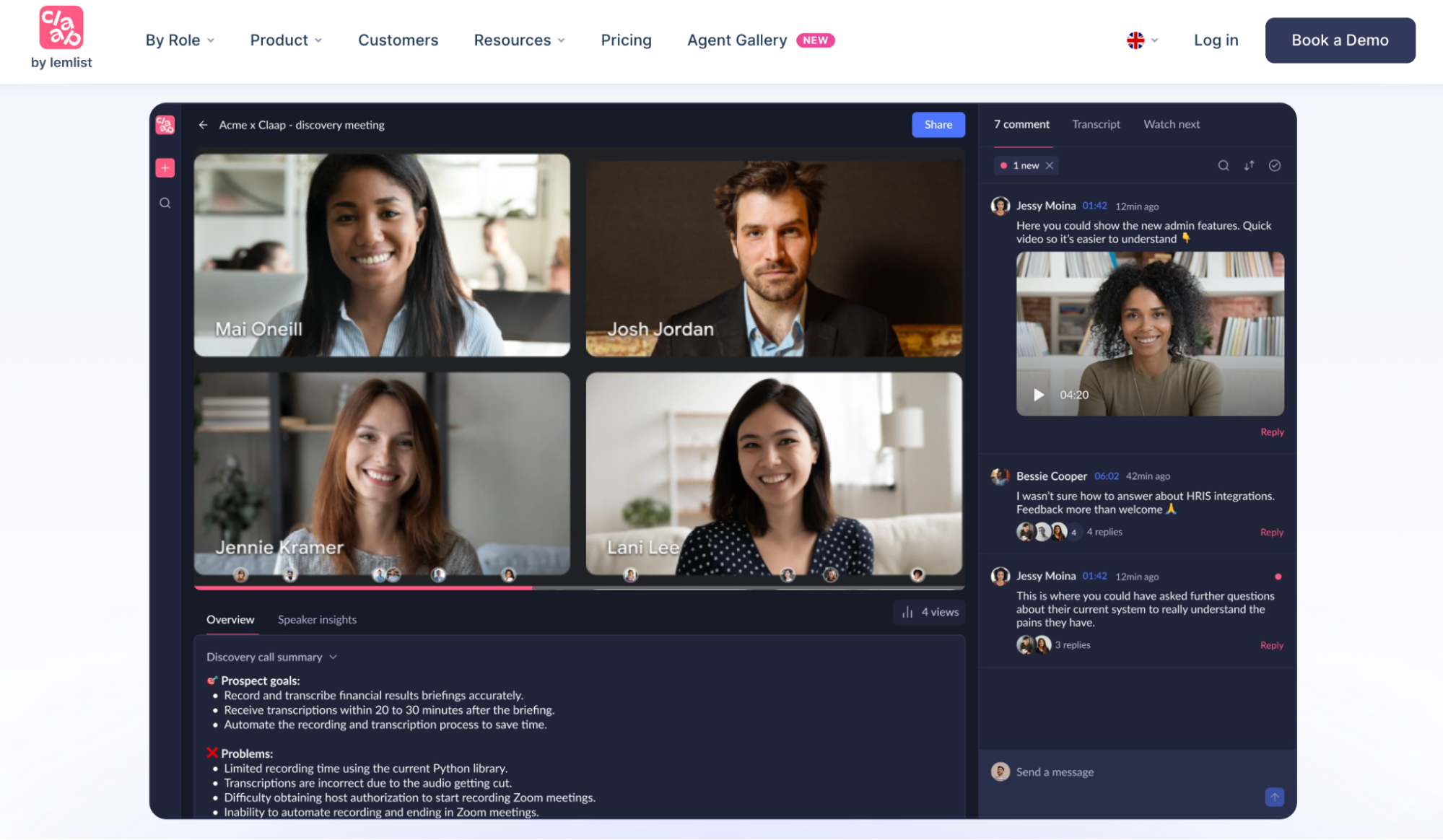
Claap vs Spiky.ai becomes easier to understand when recording and transcription are treated as baseline capabilities rather than the main product. The real comparison is between Claap's revenue-intelligence workflow and Spiky.ai's real-time coaching environment.
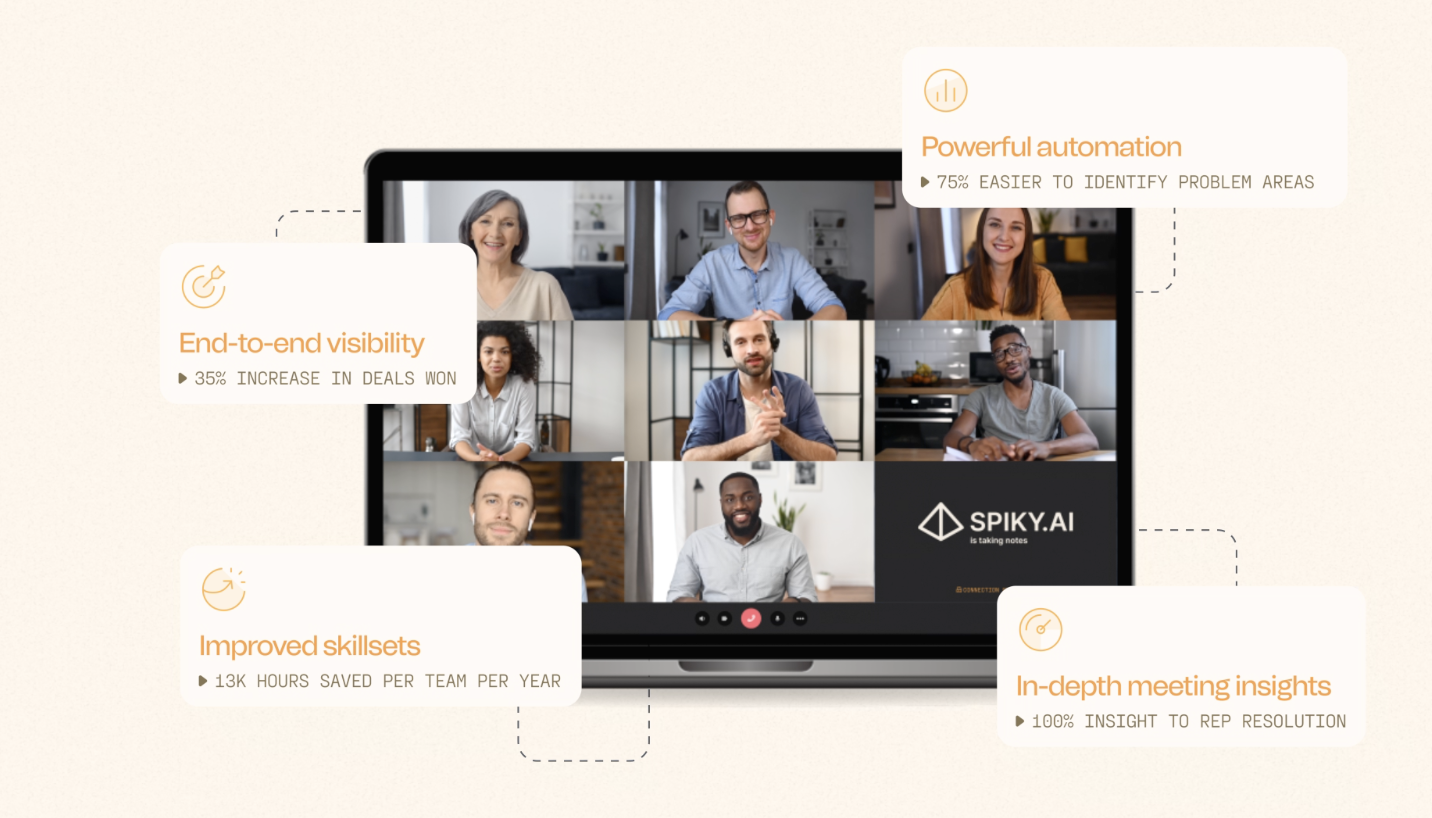
Claap spends more of its product depth on what conversations reveal about the deal. Spiky.ai spends more of its product depth on what the rep should do while the conversation is happening.
| Feature | Claap | Spiky.ai |
|---|---|---|
| Primary focus | Conversation + revenue intelligence | Real-time sales coaching + conversation intelligence |
| Meeting recording | Yes | Yes |
| Transcription | 99+ languages on current pricing page | 30+ languages |
| AI summaries | Yes | Yes |
| Action items | Yes | Yes |
| Call scoring | Yes | Yes |
| AI coaching | Yes | Yes |
| Real-time coaching | Yes | Major product strength |
| Live talk-ratio guidance | Available within coaching stack | Yes |
| Call Momentum | Not comparable as a dedicated feature | Yes |
| Real-time Battlecards | Playbook / coaching tools | Major Premium feature |
| Real-time Playbooks | Yes | Major Premium feature |
| MEDDIC / BANT / SPICED | Yes | Yes, plus MEDDPICC and custom frameworks |
| CRM synchronization | Yes | Yes |
| Custom CRM enrichment | Strong | Strong |
| Deal intelligence | Strong | Yes |
| Deal forecasting | Enterprise | More behavior / pipeline oriented |
| Customer and deal views | Strong | Deal tracking and CRM context |
| Video clips | Magic Clips | Reels / snippets |
| AI agents | Yes | Spiky Agent |
| MCP / external AI | Yes | Available in current integration ecosystem |
| Free plan | No permanent recording plan | Yes – 3 meetings/user/month |
| Best fit | Revenue intelligence and CRM-heavy teams | Teams prioritizing live execution and coaching |
Claap vs Spiky.ai Before, During and After a Sales Call
The clearest Claap vs Spiky.ai difference appears when both platforms are mapped across the full call lifecycle.
Claap is particularly strong after the conversation, when unstructured dialogue has to become CRM fields, qualification data, coaching material and pipeline intelligence. Spiky.ai has built more functionality into the live phase of the call itself.
For a sales manager, the distinction is practical. Claap is designed to answer questions such as “What did the prospect actually say, how qualified is this opportunity, what is missing from the CRM, and which deals are becoming risky?” Spiky.ai is particularly strong at “What should the rep change right now to keep this call on track?”
| Sales Stage | Claap | Spiky.ai |
|---|---|---|
| Before the call | Deal history, previous calls, CRM context | CRM context, playbooks, preparation |
| Record the meeting | Yes | Yes |
| Live participant analysis | Yes | Strong focus |
| Live talk-time guidance | Available | Yes |
| Live question tracking | Available through coaching | Yes |
| Live sales playbook | Yes | Strong |
| Live objection support | Real-time playbook / coaching | Battlecards + coaching |
| Call momentum | No comparable named tool | Yes |
| Post-call summary | Yes | Yes |
| Qualification scoring | Yes | Yes |
| CRM enrichment | Strong | Strong |
| Coaching after the call | Strong | Strong |
| Deal / pipeline analysis | Strong | Yes |
| Forecasting | Enterprise feature | Less central than real-time execution |
Claap vs Spiky.ai for Real-Time Sales Coaching
Spiky.ai has the more explicit real-time coaching system in the Claap vs Spiky.ai comparison. Its current Real-Time Coach evaluates the conversation while it is happening and exposes several behavioral and deal signals instead of waiting until the meeting has ended.
The live system includes Monologue Tracker, Call Momentum, talk ratio, question counts, participant insights and Playbooks. Spiky.ai can also monitor language positivity, prospect questions and other signals while the rep is speaking. Premium adds Real-Time Coaching, customizable Playbooks and Battlecards, while the newer Spiky Whisper desktop assistant brings checklists, topic tracking and AI-generated coaching cards directly into a live session.
Battlecards are particularly important. A team can configure information around competitors, objections, pricing or product capabilities, then connect each card to trigger keywords. When one of those topics appears during the call, Spiky surfaces the relevant guidance automatically rather than requiring the rep to search an internal knowledge base.
Claap also offers AI coaching, real-time playbooks and call analysis, and its sales-coaching product supports methodologies such as MEDDIC, SPIN, BANT and SPICED. The difference is emphasis: Claap connects coaching much more tightly with recorded calls, qualification, CRM and ongoing manager review, while Spiky.ai makes live behavioral intervention one of the central experiences of the product.
Spiky.ai has the clearer advantage when coaching must happen before the call ends. Claap becomes more compelling when coaching needs to connect with qualification, pipeline context and the manager's broader revenue workflow.
| Live Coaching Feature | Claap | Spiky.ai |
|---|---|---|
| Live coaching | Yes | Yes |
| Talk-time analysis | Yes | Yes |
| Monologue monitoring | Conversation metrics | Dedicated Monologue Tracker |
| Prospect question tracking | Available through analysis | Dedicated real-time metric |
| Call momentum | No dedicated equivalent | Yes |
| Live playbook | Yes | Yes |
| Battlecards | Coaching/playbook ecosystem | Dedicated keyword-triggered Battlecards |
| Live objection guidance | Yes | Strong |
| Desktop coaching assistant | Desktop app | Spiky Whisper |
| Main coaching emphasis | Call quality + methodology | In-call rep execution |
Claap vs Spiky.ai for Sales Playbooks
Both Claap and Spiky.ai support structured sales methodologies, so teams already using MEDDIC or another framework do not need to abandon their existing process.
Claap can score calls against MEDDIC, SPIN, BANT, SPICED or a custom methodology. It detects whether important qualification elements appeared in the conversation, identifies missed questions and uses the results for coaching and deal analysis.
Spiky.ai supports BANT, MEDDIC, SPIN and MEDDPICC in its real-time Playbook and can also adapt to SPICED and customized internal frameworks. The important difference is that Spiky can display the active playbook during the live conversation, allowing the rep to see which qualification topics have or have not yet been covered.
For teams that primarily want managers to evaluate calls against a framework, both products are competitive. Spiky.ai becomes more distinctive when the methodology needs to guide the rep during the live discovery or qualification call itself.
| Use Case | Claap | Spiky.ai |
|---|---|---|
| BANT | Yes | Yes |
| MEDDIC | Yes | Yes |
| MEDDPICC | Customizable | Yes |
| SPIN | Yes | Yes |
| SPICED | Yes | Yes |
| Custom framework | Yes | Yes |
| Post-call methodology scoring | Yes | Yes |
| Live framework tracking | Yes | Strong product focus |
| CRM sync of framework data | Yes | Yes |
| Manager coaching from framework | Yes | Yes |
Claap vs Spiky.ai for CRM Enrichment
CRM automation is one of the strongest areas of overlap in Claap vs Spiky.ai. Both platforms can take information that would normally remain buried inside a transcript and push it into structured CRM records.
Claap's CRM Enrichment can extract meeting information and map it directly into CRM fields. Current official documentation specifically supports field mappings for HubSpot and Salesforce, while Claap's broader integration ecosystem also includes systems such as Pipedrive and Attio. The platform can capture qualification criteria, pain points, next steps, objections and other deal information and use custom templates based on methodologies such as MEDDIC or SPICED.
Claap's current plans make the depth explicit. Pro includes CRM auto-fill with more than 10 fields, Business increases enrichment to 50+ fields, and Enterprise includes unlimited AI enrichment. The Business tier also expands Claap AI across meetings, deals, companies and contacts rather than limiting intelligence to a single call.
Spiky.ai also connects conversation data with CRM records. Its integrations include Salesforce, HubSpot and Pipedrive, while current official materials also describe Zoho workflows. Spiky can sync summaries, action items and deal context and map sales-playbook information such as BANT, MEDDIC, SPIN or MEDDPICC into CRM notes and fields. Premium adds Custom Field CRM Integration, making the CRM workflow substantially more flexible.
The difference is less about whether CRM integration exists and more about what sits around it. Claap turns enriched CRM data into a wider deal-intelligence system. Spiky.ai connects CRM data more directly with coaching, playbook execution and rep behavior.
| CRM Capability | Claap | Spiky.ai |
|---|---|---|
| HubSpot | Yes | Yes |
| Salesforce | Yes | Yes |
| Pipedrive | Yes | Yes |
| CRM note sync | Yes | Yes |
| Action items | Yes | Yes |
| Qualification data | Yes | Yes |
| Custom field enrichment | Strong | Premium |
| Methodology-based CRM fields | Yes | Yes |
| CRM-driven deal intelligence | Major focus | Yes |
| Auto-update from meetings | Yes | Yes |
Claap vs Spiky.ai for Deal and Pipeline Intelligence
Claap has the stronger dedicated deal-intelligence environment. Its 2026 product has expanded beyond call-level conversation intelligence into Deals, Companies and Contacts, allowing sales teams to inspect customer activity and AI insights in a pipeline context.
Claap's Deals view combines meetings, recordings, emails, contacts and AI-generated analysis around each opportunity. Instead of opening individual transcripts, managers can inspect recent progress, stakeholder involvement, deal momentum and potential risks. Enterprise adds formal deal forecasting, account scoring and contact insights.
This is important because conversation intelligence and deal intelligence answer different questions. A conversation tool can show that pricing was discussed. A deal-intelligence layer tries to determine what that pricing discussion means for the opportunity when combined with the rest of the account history.
Spiky.ai also connects meeting data to deals and can use Spiky Score, CRM information, playbook completion, participant behavior and other signals to track progress. Its positioning, however, remains more heavily centered on behavior and execution than on becoming a standalone forecasting layer.
For managers who want a structured view of every opportunity after multiple customer interactions, Claap currently has the stronger dedicated deal workflow. For managers who want to improve what reps do inside those interactions, Spiky.ai is more differentiated.
Claap vs Spiky.ai for Call Scoring and Coaching Managers
Both platforms automate the review work that sales managers would otherwise have to perform manually. Instead of sampling a small number of calls, a team can apply consistent criteria across a much larger volume of conversations.
Claap Business includes Call Scoring and AI Coaching. Managers can evaluate calls according to an existing sales methodology, track metrics such as talk time, silences, objection handling and relationship-building, and use clips from successful conversations as coaching material. Magic Clips can extract useful moments from longer calls for training or review.
Spiky.ai Pro already includes AI-based coaching, while Premium adds customized Playbooks, Key Moments, sentiment reporting and real-time coaching. Team performance can be analyzed through dashboards and behavioral metrics such as talking speed, patience, talk ratio, positivity and questions.
Claap is particularly useful when managers want coaching connected to deal context and a searchable library of successful sales conversations. Spiky.ai is particularly strong when managers want the same coaching standards enforced while calls are happening, not only reviewed later.
| Coaching Need | Claap | Spiky.ai |
|---|---|---|
| Score every call | Yes | Yes |
| Custom sales framework | Yes | Yes |
| Talk-time analysis | Yes | Yes |
| Objection analysis | Yes | Yes |
| Key moments | Magic Clips / insights | Key Moments |
| Sentiment / emotion | Conversation signals | Dedicated reporting |
| Manager dashboards | Business | Premium |
| Rep trend analysis | Yes | Yes |
| Coaching after the call | Strong | Strong |
| Coaching during the call | Yes | Stronger emphasis |
Claap vs Spiky.ai for Conversation Intelligence
At the conversation-intelligence level, Claap and Spiky.ai analyze many of the same raw signals but organize them differently.
Claap records and transcribes sales conversations, identifies highlights, produces summaries, tracks objections and relationship signals, and lets teams query individual meetings or broader customer and pipeline data with Claap AI. Current documentation states transcription support across roughly 99+ to 100+ languages, depending on the product page.
Spiky.ai transcribes in 30+ languages and analyzes conversations using multiple behavioral and commercial signals. Its product can track topics, sentiment, buyer interest, question patterns, voice and language signals, objections and other participant behavior. Spiky Scribe and Ask Scribe then make that information searchable after the conversation.
For international organizations, Claap has the clear transcription-language advantage. For teams prioritizing behavioral analysis inside the live call, Spiky.ai uses that conversation layer more aggressively.
| Intelligence Area | Claap | Spiky.ai |
|---|---|---|
| Transcription | 99+ languages | 30+ languages |
| AI summary | Yes | Yes |
| Topics | Yes | Yes |
| Action items | Yes | Yes |
| Objections | Yes | Yes |
| Talk time | Yes | Yes |
| Sentiment / positivity | Yes | Yes |
| Buyer signals | Yes | Yes |
| Qualification scoring | Yes | Yes |
| Cross-call analysis | Yes | Yes |
| Deal-level context | Strong | Yes |
| Real-time behavioral signals | Yes | Major strength |
Claap vs Spiky.ai Pricing in 2026
Spiky.ai has the lower entry price and a permanent free tier, while Claap's plans begin higher and bundle more revenue-team infrastructure into each paid seat.
Claap currently prices Pro at €29 per seat per month when billed annually, Business at €59, and Enterprise at €99 with a five-seat minimum. Monthly billing increases those prices to €36, €71 and €119 respectively. Pro includes unlimited recording through desktop, Chrome and audio, 400 AI credits per seat, summaries, follow-up emails and CRM auto-logging. Business adds the meeting bot, call scoring, AI coaching, deeper CRM enrichment and workspace analytics, while Enterprise adds forecasting, account scoring and contact insights.
Spiky.ai currently has a permanent Free plan with 3 meetings per user each month. The annual-billing prices displayed on its pricing page are $15 per user for Plus, $24 for Pro and $40 for Premium. Monthly rates are $18, $29 and $49. Plus supports 30 meetings per user; Pro keeps the 30-meeting limit and adds CRM, Slack, Playbooks and AI coaching; Premium removes the meeting limit and adds the full real-time coaching stack.
The closest functional comparison is not Claap Pro versus Spiky Pro. A sales organization specifically buying live Battlecards, customizable Playbooks and full real-time coaching needs Spiky Premium, while a team buying Claap primarily for coaching and advanced CRM enrichment will normally need Claap Business.
Spiky.ai is substantially cheaper for a team whose main requirement is coaching and live conversation intelligence. Claap's higher tiers become easier to justify when the same system is also expected to manage richer deal intelligence and CRM enrichment.
| Plan | Price | Main Difference |
|---|---|---|
| Spiky.ai Free | $0 | 3 meetings/user/month |
| Spiky.ai Plus | $15/user/month annually | 30 meetings, Spiky Agent, keywords, team management |
| Spiky.ai Pro | $24/user/month annually | CRM, Slack, Playbooks, AI coaching |
| Spiky.ai Premium | $40/user/month annually | Unlimited meetings + full real-time coaching |
| Claap Pro | €29/seat/month annually | Unlimited recording, AI summaries, CRM auto-log |
| Claap Business | €59/seat/month annually | Coaching, call scoring, meeting bot, advanced CRM |
| Claap Enterprise | €99/seat/month annually | Forecasting, account scoring, unlimited storage |
| Enterprise / custom | Available | Organization-specific requirements |
Claap vs Spiky.ai Free Access
Spiky.ai has a straightforward advantage for teams that want to test conversation intelligence over a longer period without paying. Its Free plan includes three meetings per user each month plus transcription, Scribe, Ask Scribe, topic detection, summaries, commenting and calendar integration.
Claap has moved away from a permanent free recording plan. Its current pricing offers a 14-day full-access trial with no credit card required, while free Collaborator seats can join a paid workspace to watch, comment and search without recording meetings or using Claap AI.
This makes Spiky.ai easier for an individual rep or very small team to adopt gradually. Claap's trial is better suited to a structured evaluation where a sales team connects real workflows and decides within a defined trial period whether the product justifies paid deployment.
Claap vs Spiky.ai for a Five-Person Sales Team
A five-rep example makes the pricing difference concrete. Five Spiky.ai Premium seats cost about $200 per month on annual billing, giving the team unlimited meetings, customized Playbooks, Key Moments, sentiment reporting, real-time coaching and Battlecards.
Five Claap Business seats cost about €295 per month on annual billing. That package includes unlimited recording, 5,000 pooled AI credits across five seats, call scoring, AI coaching, meeting bots, 50+ CRM enrichment fields per user tier and workspace analytics.
The more expensive Claap setup is purchasing a different layer of functionality rather than simply more transcription. If the manager wants CRM completeness, qualification analysis and structured deal intelligence alongside coaching, the additional cost can be relevant. If the primary goal is to help reps execute MEDDIC correctly and handle objections while customers are still on the call, Spiky.ai offers a more direct route at a lower subscription cost.
Claap vs Spiky.ai for Integrations and Automation
Both platforms integrate with the major tools used by revenue teams. Claap includes integrations across its paid plans with systems such as HubSpot, Salesforce, Attio, Pipedrive, Slack, Notion and Aircall, plus automation through Zapier, Make, n8n and webhooks. Claap also exposes API and MCP access across its current plans.
Spiky.ai integrates with Salesforce, HubSpot and Pipedrive, major conferencing platforms including Zoom, Google Meet, Microsoft Teams and Webex, communication tools such as Slack and automation systems such as Zapier. Spiky's Zapier integration can extend meeting results into 6,000+ applications, while the platform itself describes a broader integration ecosystem of hundreds of connected tools and workflows.
The difference again follows the core product design. Claap's integrations are particularly valuable when conversation intelligence has to become persistent CRM and deal context. Spiky.ai's automation layer is closely tied to moving meeting analysis, coaching information and playbook data into the rest of the sales stack.
Claap vs Spiky.ai Security
Both platforms target business and enterprise sales organizations and publish formal security credentials.
Spiky.ai states that it is SOC 2 Type II certified, GDPR and KVKK compliant and uses ISO 27001-based infrastructure. It also offers an on-premise deployment model for regulated environments with configurable retention, role-based access control and customer-controlled model access.
Claap provides SOC 2 Type II and GDPR-oriented security controls and adds SSO and SCIM at Enterprise level. Because both products process recordings that may contain commercially sensitive customer information, companies should evaluate storage, access, data residency, retention and AI-processing terms rather than choosing on certification badges alone.
Claap vs Spiky.ai for Different Sales Teams
The best Claap vs Spiky.ai choice depends heavily on where the sales organization currently loses performance.
The decision therefore does not need to begin with feature count. If the recurring problem happens while the rep is talking, Spiky.ai deserves closer attention. If the recurring problem happens after the call because knowledge, CRM data and deal context are incomplete, Claap is more naturally aligned with it.
| Team / Problem | Better Fit | Why |
|---|---|---|
| Individual rep testing conversation AI | Spiky.ai | Permanent free plan |
| Small sales team | Spiky.ai | Lower paid-plan cost |
| Team needing live rep guidance | Spiky.ai | Real-time coaching focus |
| Team struggling with objections | Spiky.ai | Battlecards + live coaching |
| Strict MEDDIC execution during calls | Spiky.ai | Real-time Playbooks |
| Sales manager reviewing calls | Both | Strong coaching in both |
| RevOps team improving CRM quality | Claap | Deeper CRM enrichment |
| Complex B2B pipeline | Claap | Deal and qualification intelligence |
| Team needing forecasting | Claap | Enterprise deal forecasting |
| International transcription-heavy team | Claap | 99+ language support |
| Sales enablement team | Both | Different coaching approaches |
| Enterprise needing live execution | Spiky.ai | Strong live behavior layer |
| Enterprise needing deal intelligence | Claap | Stronger post-call deal system |
Can Claap Replace Spiky.ai?
Claap can replace much of Spiky.ai when the team mainly needs call capture, qualification scoring, coaching, CRM enrichment and deal intelligence. Claap also offers real-time playbook and coaching capabilities, so the overlap is substantial.
The harder features to replace are the parts of Spiky.ai designed specifically around live execution: Call Momentum, dedicated real-time participant metrics, keyword-triggered Battlecards and the full Spiky Whisper experience. Teams that actively use these tools while reps are speaking may find post-call intelligence an insufficient substitute.
Claap can replace Spiky.ai more easily for manager-led coaching than for teams built around real-time rep assistance.
Can Spiky.ai Replace Claap?
Spiky.ai can replace Claap for many sales coaching and conversation-intelligence workflows. It records meetings, generates summaries, connects to CRMs, tracks methodologies, provides AI coaching and adds real-time capabilities that Claap does not emphasize as heavily.
It is less complete as a replacement when the organization uses Claap as a broader revenue-intelligence layer. Claap's Deals view, deep CRM enrichment, account and contact insights, pipeline analysis and Enterprise forecasting extend beyond simply improving how reps conduct conversations.
Spiky.ai can replace much of Claap's coaching layer. Replacing the full Claap deal-intelligence layer is a more difficult comparison.
Should a Sales Team Use Claap and Spiky.ai Together?
For most teams, using both would create too much overlap. Both products record and transcribe calls, generate summaries, analyze conversations, coach reps and write information back to CRM systems.
There is one scenario where combining them is logically possible: a large organization could use Spiky.ai specifically as a live execution layer while using Claap as the post-call CRM and deal-intelligence system. The workflow would then become:
- Spiky.ai guides the rep through the live call using Playbooks, Call Momentum and Battlecards.
- Conversation data is captured and analyzed.
- Claap structures customer and deal intelligence after the call.
- CRM fields and qualification data are enriched.
- Managers use deal views, coaching and pipeline signals to plan the next interaction.
For most SMB and mid-market teams, that stack is unnecessarily expensive and duplicated. Claap vs Spiky.ai should normally be treated as a choice, not as a two-product workflow.
Claap vs Spiky.ai – Which Is Better in 2026?
Claap and Spiky.ai solve much of the same conversation-intelligence problem, but their strongest value appears at different moments in the sales cycle.
Choose Claap when the business needs recorded conversations to become structured CRM intelligence, qualification data, deal context, coaching material and pipeline insight. Its current product extends from recording and AI notes into advanced CRM enrichment, Deals, account intelligence and Enterprise forecasting.
Choose Spiky.ai when the sales organization needs AI to improve what actually happens inside the live conversation. Real-Time Coach, Call Momentum, Playbooks, Battlecards and Spiky Whisper make the platform particularly relevant to teams trying to standardize rep execution across every call rather than relying only on post-call feedback.
Spiky.ai is strongest when the value has to arrive during the call. Claap is strongest when the conversation needs to become reliable revenue intelligence after the call.
That is the most useful distinction in the Claap vs Spiky.ai comparison.
| Main Requirement | Better Fit |
|---|---|
| Real-time sales coaching | Spiky.ai |
| Call Momentum and participant signals | Spiky.ai |
| Live Battlecards | Spiky.ai |
| Live methodology execution | Spiky.ai |
| Lower entry price | Spiky.ai |
| Permanent free plan | Spiky.ai |
| CRM auto-fill | Both |
| Deep custom CRM enrichment | Claap |
| Post-call qualification analysis | Claap |
| Deal intelligence | Claap |
| Pipeline context | Claap |
| Forecasting | Claap Enterprise |
| 99+ language transcription | Claap |
| Manager-led coaching | Both |
| Real-time rep behavior change | Spiky.ai |
| Revenue intelligence beyond individual calls | Claap |
Frequently Asked Questions
- What is the difference between Claap and Spiky.ai?
- Claap focuses heavily on conversation intelligence, CRM enrichment, qualification, deal analysis and revenue intelligence. Spiky.ai puts greater emphasis on real-time sales coaching, live Playbooks, Battlecards and behavioral guidance during customer calls.
- Is Claap better than Spiky.ai?
- Claap is the stronger fit for organizations that want conversation data connected deeply with CRM records, deal intelligence and pipeline analysis. Spiky.ai can be the better fit when live sales coaching is the primary requirement.
- Is Spiky.ai better than Claap for sales coaching?
- Spiky.ai has the stronger real-time coaching proposition because it provides live Call Momentum, behavioral signals, Playbooks and Battlecards. Claap also provides strong AI coaching and methodology scoring, particularly for manager-led review and post-call improvement.
- Which is cheaper, Claap or Spiky.ai?
- Spiky.ai has the lower entry price. It also has a permanent Free plan, while Claap currently uses a 14-day full-access trial rather than a permanent free recording plan.
- How much does Spiky.ai cost?
- Current annual-billing prices are $15 per user per month for Plus, $24 for Pro and $40 for Premium. Monthly rates are currently $18, $29 and $49.
- How much does Claap cost?
- Claap currently costs €29 per seat per month for Pro, €59 for Business and €99 for Enterprise when billed annually. Monthly pricing is higher.
- Does Spiky.ai have a free plan?
- Yes. Spiky.ai Free includes three meetings per user per month, transcription, summaries, Ask Scribe and several core meeting-intelligence features.
- Does Claap have a free plan?
- Claap no longer offers a permanent standalone recording plan under its current pricing structure. New teams can use a 14-day full-access trial, while paid workspaces can include free read-only Collaborators.
- Does Claap provide real-time coaching?
- Yes. Claap includes AI coaching and real-time playbook capabilities. Its broader product positioning, however, places more emphasis on post-call coaching, CRM enrichment and revenue intelligence.
- Does Spiky.ai provide real-time coaching?
- Yes. Real-time coaching is one of Spiky.ai's main differentiators. The platform can provide Call Momentum, talk-ratio information, participant insights, Playbooks, Battlecards and live coaching while a conversation is happening.
- What is Spiky Whisper?
- Spiky Whisper is Spiky.ai's desktop real-time coaching assistant. It listens during a live conversation and displays checklists, topic tracking and AI-generated guidance while the rep is speaking.
- What are Spiky.ai Battlecards?
- Battlecards are contextual guidance cards triggered by topics or keywords during live calls. They can contain objection responses, competitive positioning, pricing information or other internal knowledge.
- Does Claap support MEDDIC?
- Yes. Claap can analyze calls using MEDDIC as well as BANT, SPIN, SPICED and custom sales frameworks.
- Does Spiky.ai support MEDDIC?
- Yes. Spiky.ai supports MEDDIC, BANT, SPIN, MEDDPICC, SPICED and customized methodologies depending on the workflow and plan.
- Which is better for CRM enrichment?
- Both offer strong CRM automation. Claap places deeper CRM enrichment and deal intelligence closer to the center of its product, while Spiky.ai combines CRM synchronization with playbook execution and live coaching.
- Does Claap integrate with Salesforce?
- Yes. Claap supports Salesforce and can use AI-extracted meeting data to enrich CRM records.
- Does Spiky.ai integrate with Salesforce?
- Yes. Spiky.ai supports Salesforce along with HubSpot, Pipedrive and other integrations.
- Which is better for HubSpot?
- Both integrate with HubSpot. Claap is particularly strong when conversation intelligence needs to populate detailed CRM fields and deal context. Spiky.ai is strong when CRM data also needs to support coaching and live sales execution.
- Which supports more transcription languages?
- Claap currently advertises approximately 99+ supported transcription languages. Spiky.ai currently supports more than 30 languages.
- Which is better for MEDDIC sales teams?
- Spiky.ai is particularly useful when MEDDIC needs to be visible and reinforced during live calls. Claap is strong when MEDDIC scoring needs to feed qualification, coaching and broader deal analysis after calls.
- Which is better for RevOps?
- Claap can be the stronger fit for RevOps teams that prioritize CRM quality, deal intelligence, qualification data and forecasting. Spiky.ai is particularly useful when RevOps is also responsible for improving live playbook execution.
- Which is better for sales managers?
- Both are strong. Claap provides deep call scoring, coaching and deal context, while Spiky.ai adds stronger real-time behavioral guidance that can reduce the need to correct the same issues after the call.
- Can Claap replace Spiky.ai?
- Yes for many recording, coaching and CRM workflows. It is less equivalent when a team depends heavily on Spiky.ai's dedicated real-time coaching, Call Momentum and Battlecards.
- Can Spiky.ai replace Claap?
- Yes for many coaching and conversation-intelligence workflows. It is less likely to replace Claap completely when the organization depends on Claap's deeper deal, pipeline and CRM-intelligence features.
- Claap or Spiky.ai – which should a sales team choose in 2026?
- Choose Spiky.ai when live rep guidance and real-time sales execution are the primary problems to solve. Choose Claap when customer conversations need to become structured CRM, deal and revenue intelligence after every call. Best AI Tools for Sales in 2026
Written by

Marcus HaleB2B sales and growth
Marcus Hale coaches B2B sellers on conversation intelligence, pipeline hygiene, and the sales tools that change what happens after the call.
Published September 21, 2026 · Last reviewed September 23, 2026