AI Marketing
AdCreative.ai or Atria? The Better Choice Depends on What Slows Your Ads Down
AdCreative.ai and Atria both use AI to improve advertising, but they solve different bottlenecks. One is built to produce more finished creatives; the other connects competitor research, performance data and AI strategy to decide what should be tested next.
AdCreative.ai vs Atria is not a comparison between two identical AI ad generators. Both platforms now cover creative generation, competitor research and campaign analysis, but they approach the advertising workflow from opposite directions.
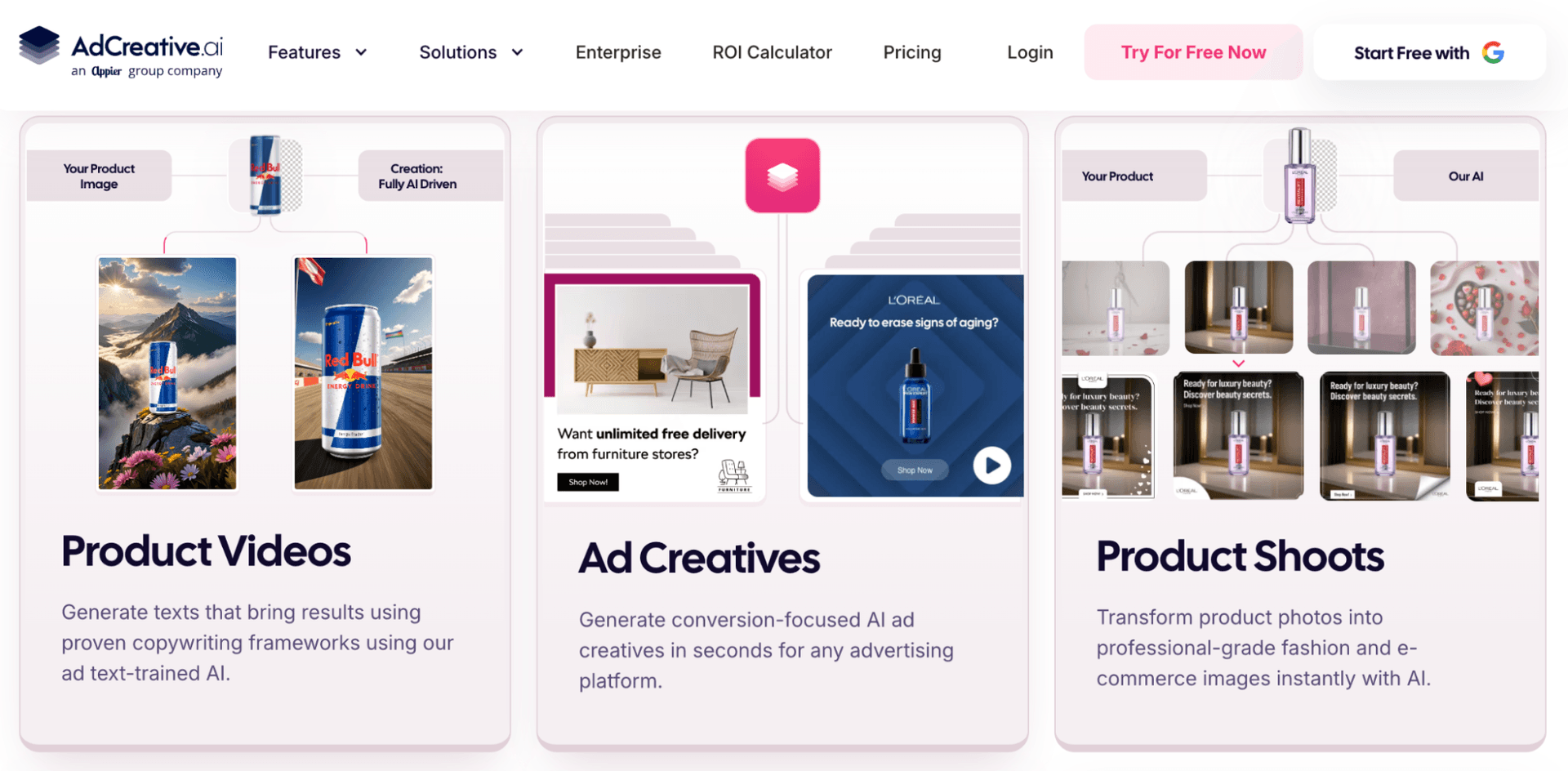
AdCreative.ai is primarily built to turn a product, URL or campaign idea into finished advertising assets. Its current toolkit includes static ad creatives, AI images, ad copy, product photoshoots, product videos, UGC-style video, fashion content, batch creatives, Creative Insights and Creative Scoring. Atria starts further upstream and downstream: it combines competitor research, connected ad performance, customer review mining, creative tagging, AI-generated concepts and continuous analysis through Raya and Radar.
If the bottleneck is producing enough advertising assets, AdCreative.ai has the stronger production stack. If the bottleneck is identifying what the team should test next and learning systematically from previous campaigns, Atria has the deeper creative-intelligence workflow.
That distinction is more useful than asking which platform has the longer feature list.
AdCreative.ai vs Atria at a Glance
AdCreative.ai vs Atria becomes clearer when the platforms are compared by the job each one performs best. AdCreative.ai compresses production work; Atria compresses research, analysis and creative decision-making.

The overlap is substantial, but the center of gravity is different. AdCreative.ai is a production platform that has added intelligence; Atria is an intelligence platform that has added production.
| **Feature** | **AdCreative.ai** | **Atria** |
|---|---|---|
| Primary focus | Creative production + optimization | Creative intelligence + performance-led production |
| Static ad generation | Yes | Yes |
| AI image generation | Yes | Yes |
| Product photoshoots | Yes | Not a core product area |
| Full AI video generation | Strong | More limited |
| UGC-style video | Yes | Not a primary feature |
| Ad copy / scripts | Yes | Yes |
| Competitor research | Yes | Major workflow |
| Creative scoring | Dedicated Creative Scoring AI | Radar / performance intelligence |
| Customer review mining | Limited | Yes |
| AI creative strategist | Insights + scoring tools | Raya |
| Ad library | Competitor Insights | 25M+ ads |
| Connected ad analytics | Yes | Yes |
| Meta workflow | Yes | Major focus |
| Google / LinkedIn workflow | Yes | Less central |
| TikTok intelligence | Less central | Strong |
| API / MCP | More enterprise-oriented | REST API + MCP |
| Entry price | Lower | Higher |
| Best fit | Production bottleneck | Research / testing bottleneck |
AdCreative.ai vs Atria Across the Ad Workflow
The biggest AdCreative.ai vs Atria difference appears when both tools are placed inside a normal advertising cycle rather than compared feature by feature. AdCreative.ai is strongest from the creative brief through finished asset production, while Atria is designed to connect research, existing campaign performance and the next creative test.
A mature advertising operation could use Atria to identify a promising hook from competitor activity, customer reviews and existing account performance, then use AdCreative.ai to turn that direction into multiple static, video and copy variations. A smaller company usually does not need both.
The real buying question is whether more time is being lost making ads or deciding what ads deserve to be made.
| **Workflow Stage** | **AdCreative.ai** | **Atria** |
|---|---|---|
| Competitor research | Competitor Insights | Deep research and brand monitoring |
| Audience / persona work | Buyer Personas | Personas + customer and performance signals |
| Review mining | Limited | Yes |
| Creative concepts | Yes | Strong strategic focus |
| Static production | Strong | Yes |
| Video production | Strong | More limited |
| Copy and scripts | Strong | Strong |
| Batch variations | Strong | Available |
| Pre-launch creative evaluation | Creative Scoring | Intelligence-led evaluation |
| Live campaign analysis | Creative Insights | Core analytics workflow |
| Fatigue detection | Yes | Yes |
| Decide next test | Insights and scoring | Raya + Radar |
AdCreative.ai for Creative Production vs Atria for Creative Intelligence
AdCreative.ai has the broader creation engine. Its current platform can produce static ad creatives, AI-generated images, product photoshoots, product videos, UGC-style videos, fashion visuals and advertising copy. It also supports batch creatives and custom templates on higher plans, which matters when one concept needs to become many sizes, formats or campaign variants.
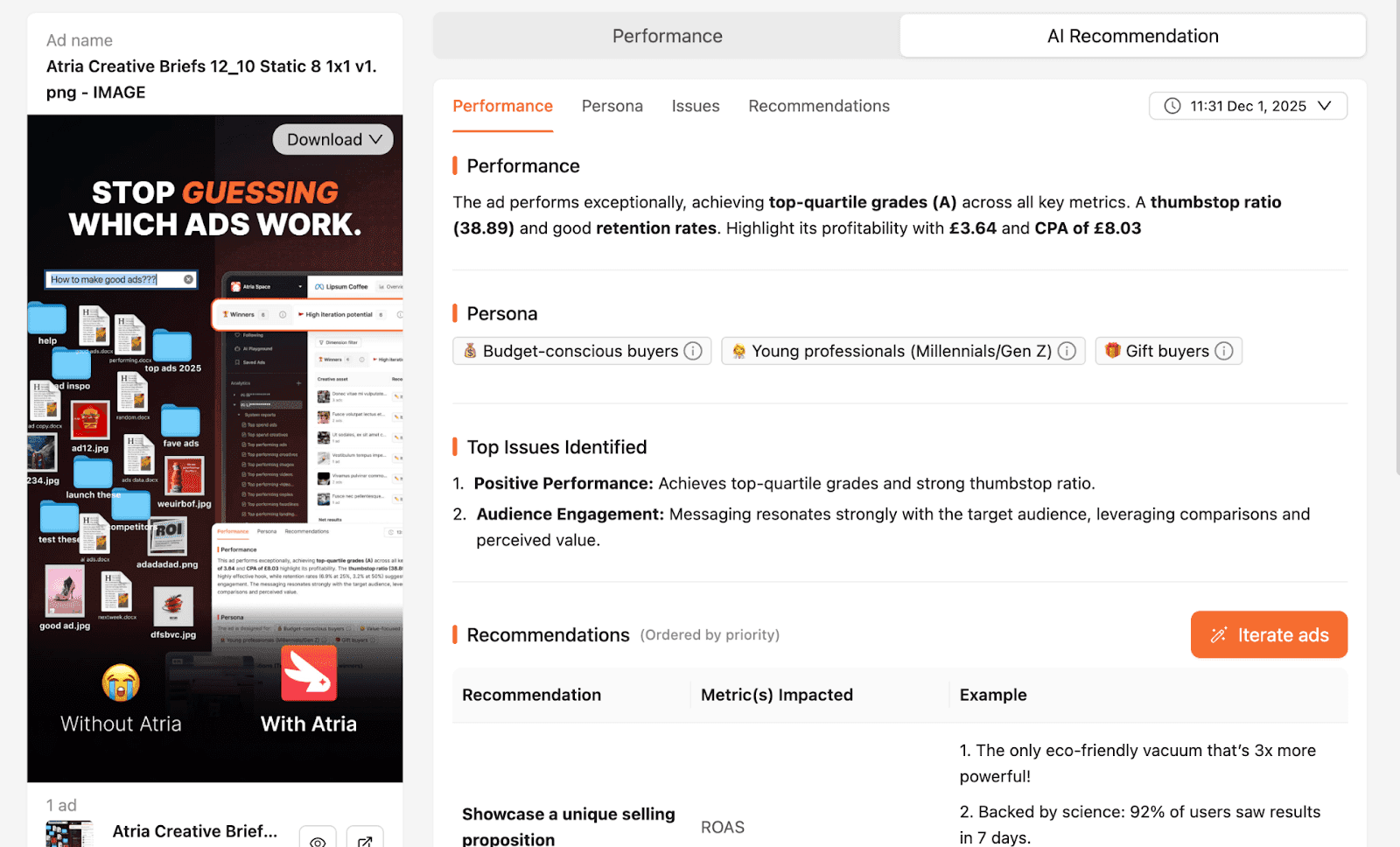
Atria can also generate images, ad concepts, hooks, scripts and copy, but creation is tied more closely to its intelligence layer. The platform can use connected campaign data, competitor creatives, brand information and customer reviews to shape the creative direction before output is produced.
This difference becomes practical in two common situations. A retailer with a product photo, offer and approved message may need 30 usable creatives before the next promotion – AdCreative.ai removes more steps. A performance team already producing dozens of ads every week may instead need to understand which personas are working, what competitors have changed and which creative iteration should come next – Atria addresses more of that work.
AdCreative.ai vs Atria Creative Intelligence
Both platforms analyze creative, but their approaches are different enough to affect the buying decision. AdCreative.ai provides Creative Insights, Competitor Insights and Creative Scoring, while Atria builds more of its product around persistent research and performance analysis.
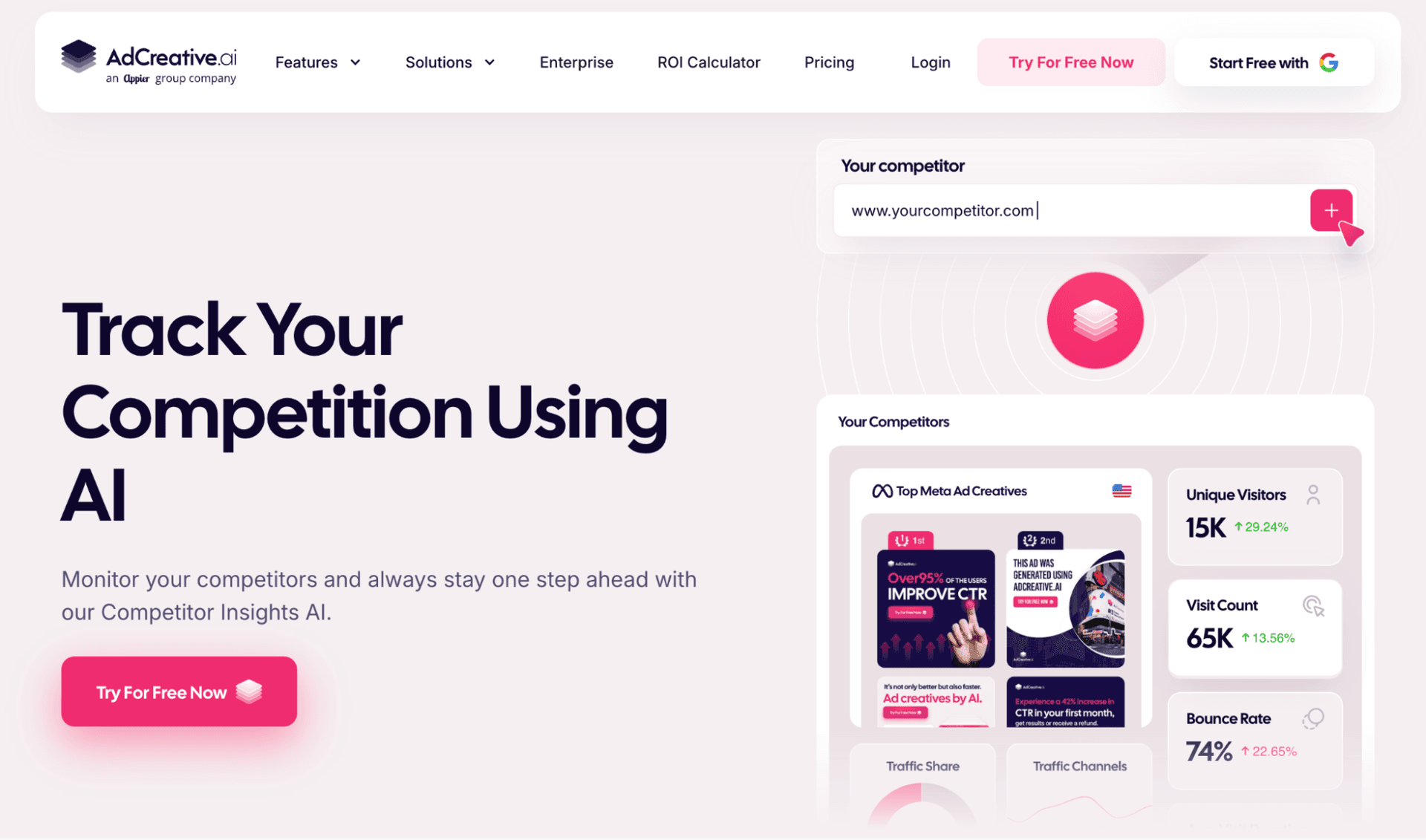
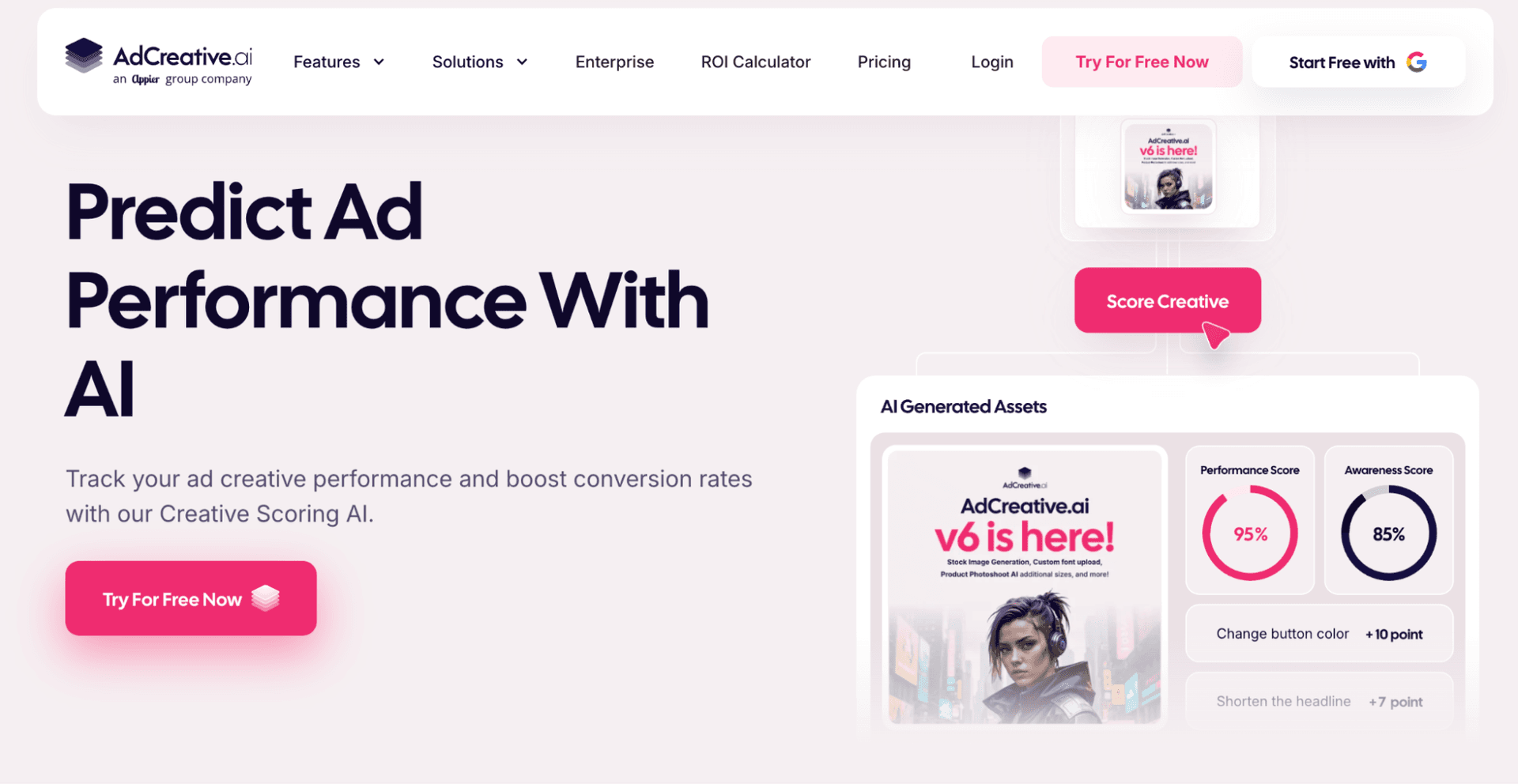
AdCreative.ai Creative Scoring evaluates an uploaded ad and produces Performance and Awareness scores, then highlights elements that may affect the result. Creative Insights can analyze connected advertising activity and surface top performers, fatigue and opportunities to refresh underperforming assets. These tools make AdCreative.ai more than a generator, because creative evaluation can happen before and after launch.
Atria makes this intelligence layer the center of the product. Raya is its AI creative strategist, trained on more than $9 billion in advertising-spend data, while Radar continuously analyzes advertising performance and can surface specific creative changes, fatigue signals and new testing directions. Raya can also analyze competitor creatives, customer reviews and existing account performance before generating concepts, scripts, copy or new creative.
Neither platform can predict a campaign result with certainty. Creative scores and AI recommendations should be used to prioritize testing, not treated as substitutes for real campaign performance.
AdCreative.ai vs Atria for Competitor Research
Atria has the stronger dedicated competitor-research environment, although AdCreative.ai includes enough competitive intelligence for teams that do not want a separate research-heavy workflow.
AdCreative.ai Competitor Insights is designed to expose competitor advertising and website patterns alongside the rest of the platform. Because this sits beside generation and scoring, a marketer can research a competitor and move directly into producing new assets without leaving the same environment.
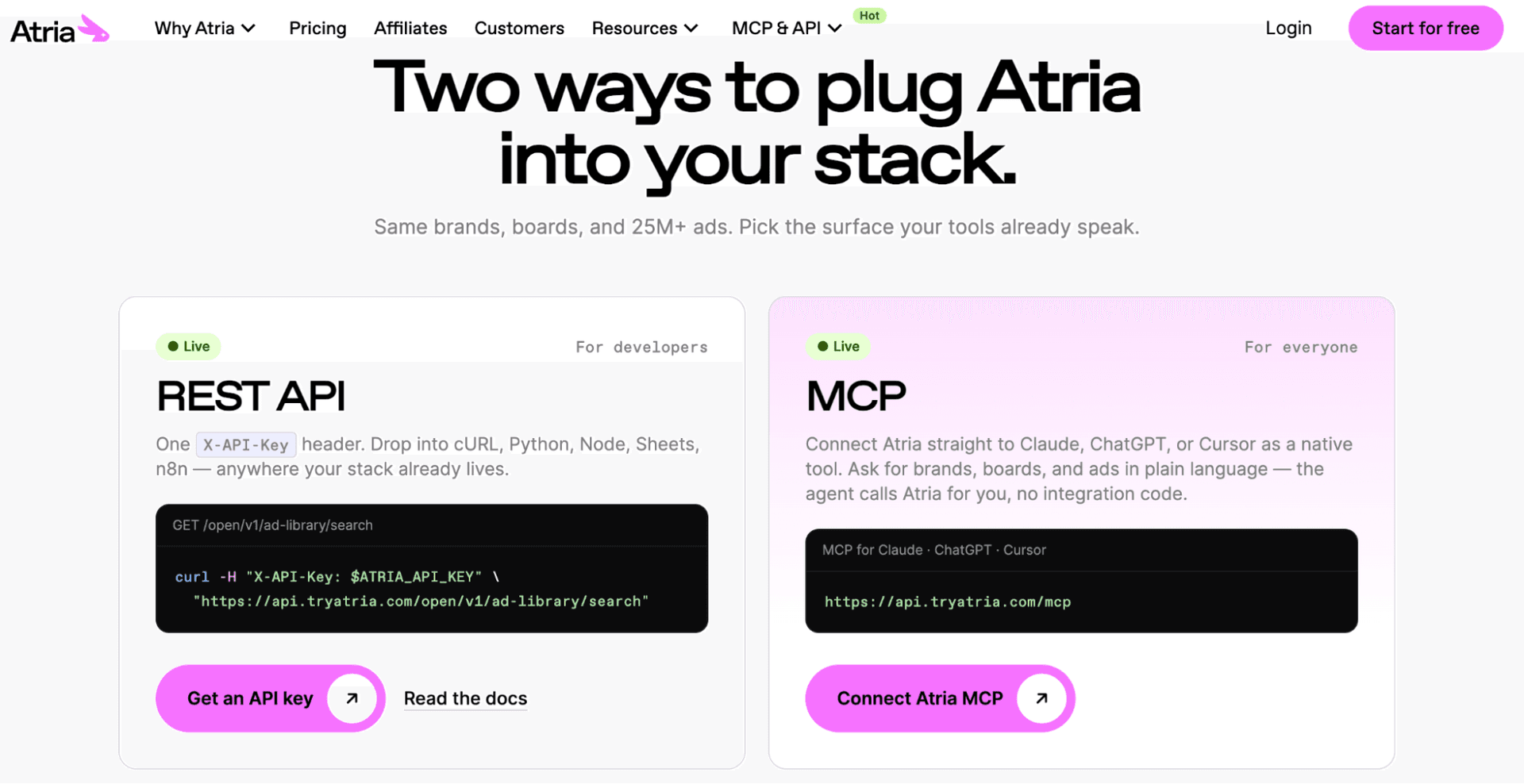
Atria goes deeper into ongoing monitoring. Its current API and MCP product references 25M+ ads, while the core platform allows teams to follow competing brands, search and filter advertising, inspect active and inactive campaigns, sort by longevity, save ads into boards and analyze elements such as hooks, personas, USPs, themes and landing pages.
For occasional competitive research, AdCreative.ai can provide enough context without adding another system. For a team where competitor analysis directly feeds every weekly testing cycle, Atria is the more structured option.
| **Research Task** | **AdCreative.ai** | **Atria** |
|---|---|---|
| Find competitor ads | Yes | Yes |
| Competitor monitoring | Yes | Stronger ongoing workflow |
| Searchable ad library | Yes | 25M+ ads |
| Analyze hooks / personas | Yes | Core AI workflow |
| Landing-page research | Yes | Yes |
| Save ads into research boards | Less central | Yes |
| Customer review mining | Limited | Yes |
| Weekly competitor monitoring | Not a core workflow | Yes |
| Use intelligence inside AI agents | Limited | MCP / API |
AdCreative.ai vs Atria for Static Ads, Video and Copy
AdCreative.ai has the stronger end-to-end production toolkit, particularly when a campaign needs several media formats. Static ad generation is only one part of the product: current tools also cover AI images, product photography, product videos, UGC-style content, fashion video, ad-copy generation and multi-format creative.

Atria's creation layer is more focused on turning intelligence into testable concepts. It can generate image creative, hooks, scripts, ad copy and variants based on performance data, competitor research and customer feedback, but full synthetic video production is not its main advantage.
The production advantage therefore goes to AdCreative.ai. Atria is more compelling when the team already has designers, creators or editors and wants AI to improve the quality of their briefs rather than replace more of the production process.
| **Output** | **AdCreative.ai** | **Atria** |
|---|---|---|
| Static ads | Strong | Yes |
| AI images | Yes | Yes |
| Product photography | Yes | Not a primary feature |
| Product video | Yes | More limited |
| UGC-style video | Yes | Not a primary feature |
| Fashion visual production | Yes | No comparable dedicated suite |
| Headlines / primary copy | Yes | Yes |
| Video scripts | Yes | Yes |
| Batch production | Strong | Available in workflow |
| Concepts informed by reviews | Limited | Strong |
| Concepts informed by account data | Yes | Strong |
AdCreative.ai vs Atria for Meta, TikTok, Google and LinkedIn
Channel mix can decide the AdCreative.ai vs Atria choice before pricing is even considered. AdCreative.ai has a broader cross-channel production position, while Atria is more heavily optimized around paid-social intelligence.
AdCreative.ai explicitly supports creative and copy workflows for platforms such as Meta, Google and LinkedIn, with platform integrations available inside its plans. Its value increases when the same marketing team regularly needs display-style creative, paid social, Google campaigns and LinkedIn assets.
Atria is particularly strong around Meta and TikTok creative analysis. Its connected account workflow, competitive intelligence, creative tagging and Radar/Raya system are designed around high-volume paid-social testing, and its API product exposes connected Meta and TikTok account data.
A multi-channel marketing team is more likely to use the breadth of AdCreative.ai. A performance team dominated by Meta and TikTok is more likely to use the depth of Atria.
AdCreative.ai vs Atria Pricing in 2026
AdCreative.ai has the substantially lower entry price. Atria starts higher because even its Core plan includes several users, ad-account connections, creative analytics, research capacity and thousands of AI credits.
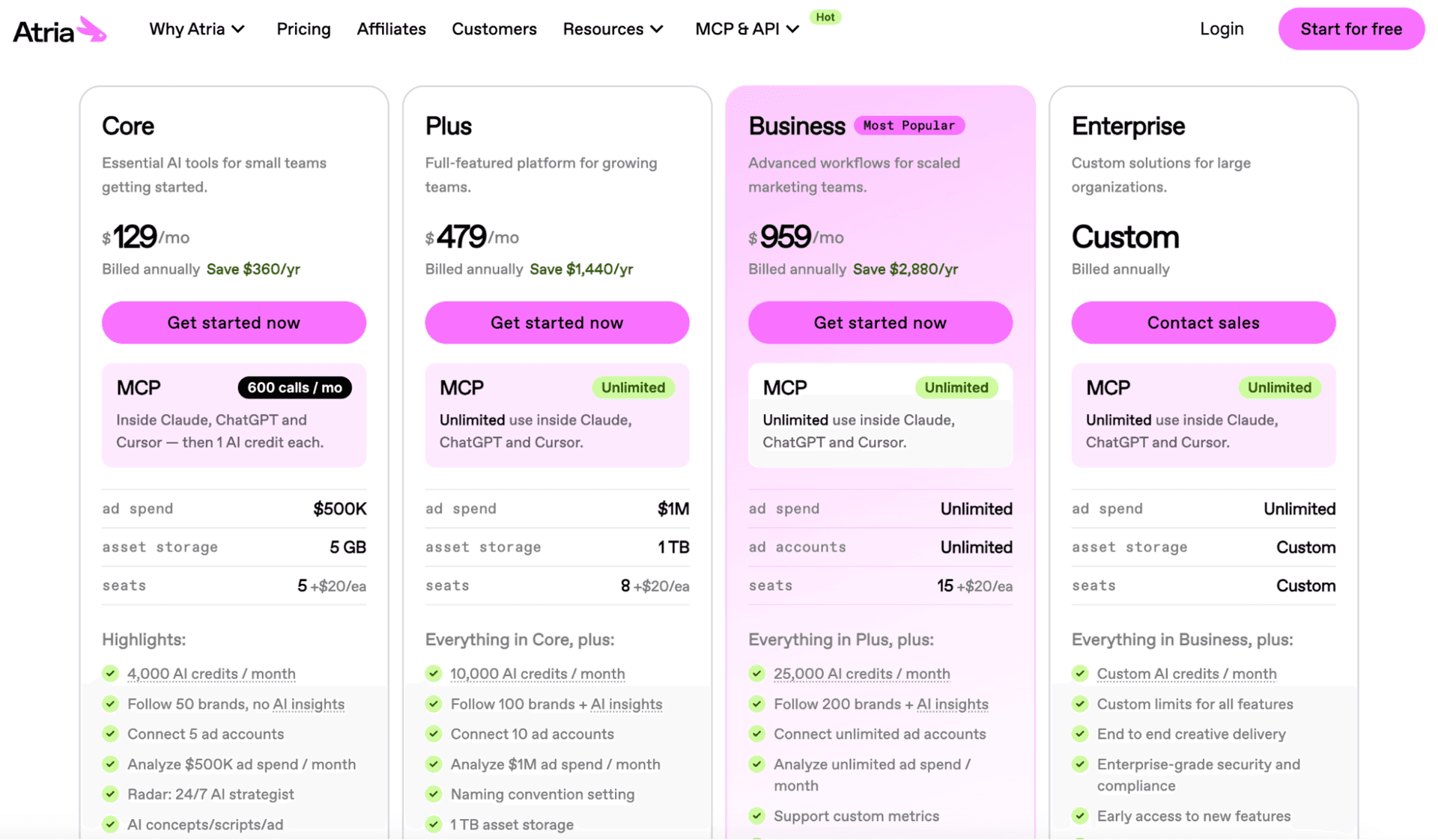
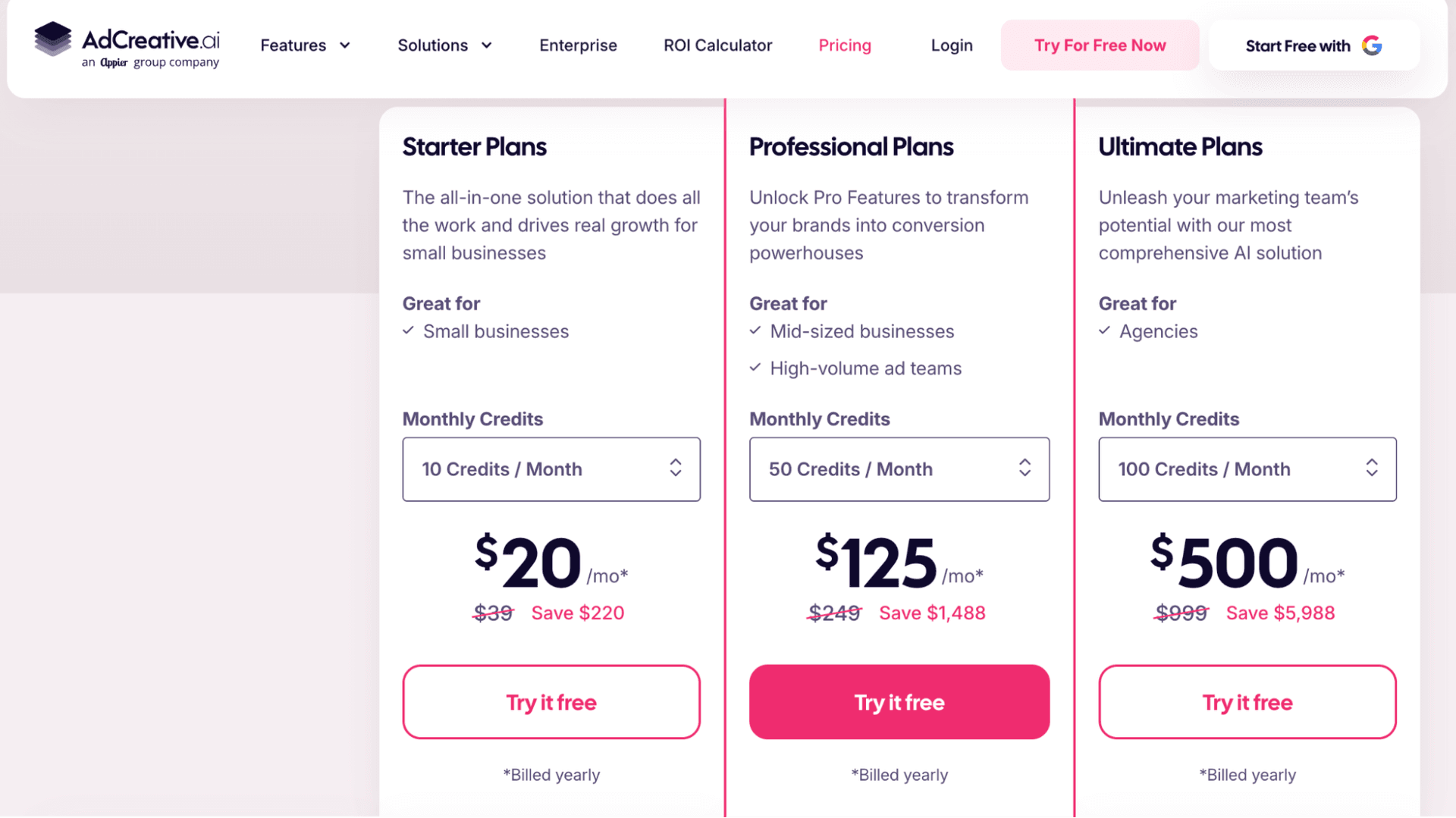
Current official pricing reviewed in September 2026 is shown below.
AdCreative.ai discounts longer billing cycles significantly: the current Starter equivalent falls to $20 per month when billed yearly, Professional starts at $125 per month on annual billing and Ultimate starts at $500 per month. Atria advertises a 20% annual discount, with Core, Plus and Business shown at $129, $479 and $959 per month when billed annually.
The credit numbers should not be compared directly. AdCreative.ai and Atria use credits for different types of operations, so “4,000 credits versus 10 credits” does not mean Atria provides 400 times more output.
AdCreative.ai is easier to justify when the buyer primarily needs creation. Atria's higher price only makes sense if its research, analytics and testing workflow replaces enough manual work.
| **Plan** | **Price** | **Main Included Capacity** |
|---|---|---|
| AdCreative.ai Starter | $39/month | 10 credits, 1 brand, 1 user |
| AdCreative.ai Professional | $249/month | 50-credit entry tier, team features |
| AdCreative.ai Ultimate | $999/month | 100-credit entry tier, agency-focused capacity |
| Atria Core | $129/month billed annually | 4,000 AI credits, 5 seats, 5 ad accounts, $500K analyzed monthly ad spend |
| Atria Plus | $479/month billed annually | 10,000 AI credits, 8 seats, 10 ad accounts, $1M analyzed monthly ad spend |
| Atria Business | $959/month billed annually | 25,000 AI credits, 15 seats, unlimited standard ad accounts and analyzed spend |
| Enterprise | Custom | Custom capacity and support |
AdCreative.ai vs Atria Team and Plan Limits
Pricing looks different again when the tools are evaluated for a team rather than a solo marketer. AdCreative.ai Starter is designed around one user, while Atria Core starts with five seats.
Atria Core also includes five connected ad accounts, up to $500,000 in analyzed monthly ad spend, three brand profiles and 5GB of asset storage. Plus raises those limits to eight seats, ten ad accounts, $1 million in monthly analyzed spend and 1TB of storage. Business includes 15 seats, unlimited standard ad accounts and analyzed spend, unlimited brand profiles and 5TB of storage.
This capacity makes Atria disproportionately expensive for a solo advertiser but more logical for an established performance team. AdCreative.ai has the opposite advantage at entry level: a small company can begin using the full creative-production concept without buying team capacity it does not need.
AdCreative.ai vs Atria for Ecommerce and Agencies
The ecommerce and agency comparisons do not need separate feature lists because both reduce to the same operational question: where are expensive staff hours being spent?
A smaller ecommerce company usually needs product visuals, promotional banners, social ads, short video and frequent variations. AdCreative.ai directly replaces more of that production work and starts at a much lower price. A mature DTC brand may already have designers and editors but still spend substantial time analyzing creative fatigue, competitors, customer objections and new angles, which is where Atria becomes more useful.
For agencies, the same distinction applies at a larger scale. AdCreative.ai can help reduce time spent creating variants, resizing assets, producing product imagery and generating copy across multiple client brands. Atria can reduce time spent browsing ad libraries, tagging creative, monitoring competitors, building reports and turning performance data into new briefs.
The better agency or ecommerce tool is the one that removes the more expensive bottleneck, not necessarily the one with more AI features.
| **Business Scenario** | **Better Fit** | **Main Reason** |
|---|---|---|
| Solo marketer | AdCreative.ai | Lower entry cost |
| Small ecommerce store | AdCreative.ai | More finished creative formats |
| Brand without an in-house designer | AdCreative.ai | Production automation |
| DTC brand with active Meta testing | Atria | Creative intelligence |
| Meta / TikTok performance team | Atria | Research-analysis-test loop |
| Multi-channel paid-media team | AdCreative.ai | Broader channel production |
| Creative strategist | Atria | Hooks, personas, reviews and analytics |
| High-volume creative agency | AdCreative.ai | Batch asset production |
| Performance agency | Atria | Research, reporting and iteration |
| Mature growth team | Both can fit | Intelligence + production |
AdCreative.ai vs Atria Ease of Use
AdCreative.ai has the shorter path to a finished asset. A user can select a brand or product, choose a creative type, generate alternatives, edit or score them and move the selected output into an advertising workflow.
Atria requires more context before its strongest features become useful. Connecting ad accounts, building a brand profile, following competitors and allowing Raya or Radar to analyze existing signals creates more setup, but that setup is precisely what allows the platform to produce deeper recommendations later.
AdCreative.ai is easier when the goal is “make an ad.” Atria becomes more useful when the goal is “understand what ad should be made next.”
| **Step** | **AdCreative.ai** | **Atria** |
|---|---|---|
| Add brand/product | Yes | Yes |
| Connect ad accounts | Optional but useful | Central to full value |
| Follow competitors | Available through insights | Core workflow |
| Add customer-review signals | Not central | Yes |
| Generate immediately | Yes | Yes |
| Value increases with historical campaign data | Yes | Strongly |
| Learning curve | Lower | Higher |
AdCreative.ai vs Atria in the Same Campaign
A practical example shows the difference better than another list of features. Consider a DTC skincare brand launching a $49 vitamin C serum with product photography, customer reviews and several months of Meta performance history.
AdCreative.ai can move from product information to finished campaign assets quickly. Atria spends more of the process determining which customer problem, persona or message deserves those production resources.
For the same campaign, AdCreative.ai reduces production workload. Atria reduces research and decision workload.
| **Campaign Task** | **AdCreative.ai** | **Atria** |
|---|---|---|
| Understand product | URL / brand input | URL analysis + brand profile |
| Build audience direction | Buyer Personas | Personas + campaign and review data |
| Research competitors | Competitor Insights | Brand monitoring + ad library |
| Find hooks | AI copy + insights | Reviews + competitor and account data |
| Generate concepts | Yes | Raya / Radar |
| Produce static ads | Strong | Yes |
| Produce full video | Strong | More limited |
| Generate many variants | Strong | Yes, but not main differentiator |
| Evaluate creative | Creative Scoring | Radar + campaign intelligence |
| Learn from live campaigns | Creative Insights | Core workflow |
| Define next test | Insights | Major strength |
AdCreative.ai vs Atria at Different Ad-Spend Levels
Ad spend is not a hard eligibility threshold, but scale changes which problem is likely to become expensive. At low spend, the company often needs inexpensive creative output; at higher spend, poor testing decisions and creative fatigue can cost more than the software.
A business spending around $5,000 per month may find a $39 AdCreative.ai Starter subscription easier to justify than a full creative-intelligence system. At $50,000 per month, campaign history and testing volume can make Atria's analysis more useful. At six-figure monthly paid-social spend, research, tagging, reporting, fatigue monitoring and deciding what to produce next can become significant operational tasks.
Atria's current plan limits reflect that positioning: Core supports analysis of up to $500,000 in monthly ad spend, Plus up to $1 million and Business removes the standard analyzed-spend limit.
These are not recommendations based purely on spend. A $100,000 advertiser with excellent internal analytics may need production more than intelligence, while a smaller performance team with poor creative processes may benefit from Atria earlier.
AdCreative.ai vs Atria for AI Agents and Automation
Atria has a clear additional advantage for companies building AI-agent workflows. Its REST API and MCP server can expose advertising intelligence directly to tools such as Claude, ChatGPT and Cursor.
The MCP layer can search Atria's ad and brand libraries, access boards and connected ad accounts, transcribe advertising video and work with image generation. Core currently includes 600 MCP calls and 1,200 REST API calls per month, while Plus and higher tiers include unlimited standard usage.
AdCreative.ai focuses automation much more heavily on generating, adapting, analyzing and exporting creative rather than exposing an ad-intelligence dataset to external AI agents.
For most small marketers, this distinction is irrelevant. For a company building custom marketing agents, internal dashboards or automated research workflows, Atria has the more developed integration layer.
Can AdCreative.ai Replace Atria?
AdCreative.ai can replace much of the Atria workflow when the business mainly needs finished creative plus occasional competitor and performance insights. Creative Insights, Competitor Insights, Buyer Personas and Creative Scoring already cover considerably more than basic design generation.
It is less likely to replace Atria when the team specifically depends on continuous competitor monitoring, review mining, AI creative tags, detailed performance reporting, Raya, Radar or an ad-intelligence database that feeds the next testing cycle.
For production-led teams, the overlap may be enough. For intelligence-led performance teams, it usually is not.
Can Atria Replace AdCreative.ai?
Atria can replace part of AdCreative.ai when an existing creative team already handles execution and mainly needs research-led concepts, static creative, scripts and advertising copy. It is less likely to replace AdCreative.ai when the business regularly needs product photography, UGC-style AI video, product videos, fashion content or large batches of multi-format campaign assets.
Atria can cover more of the thinking around the next iteration. AdCreative.ai covers more of the finished production required to execute it.
Should a Business Use AdCreative.ai and Atria Together?
Using both can make sense when a mature paid-media operation has both bottlenecks. Atria can monitor competitors and current campaign results, turn those signals into concepts and briefs, and AdCreative.ai can then produce larger batches of static, video and copy variations.
A combined workflow is straightforward:
• Atria analyzes competitors, customer language and campaign performance. • Raya and Radar identify new hooks, personas or concepts. • The team approves a creative direction. • AdCreative.ai produces multiple finished variations and formats. • Campaign results return to the next analysis cycle.
For a small advertiser producing a few ads per month, that setup is unnecessarily complex. Using both makes sense only when research and production are separately large enough to justify two specialized tools.
AdCreative.ai vs Atria – Which Makes More Sense in 2026?
AdCreative.ai makes more sense when the immediate requirement is finished creative output. It has a lower starting price, broader video and product-visual tools and stronger cross-channel production across Meta, Google, LinkedIn and other advertising formats.
Atria makes more sense when creative testing itself has become a structured operating process. Its strength is connecting competitor activity, customer reviews, connected ad performance, creative tags and AI analysis so the team can decide what to produce next rather than starting every brief from a blank page.
AdCreative.ai is primarily a creative-production engine that has added intelligence. Atria is primarily a creative-intelligence engine that has added production.
That remains the most useful distinction in the AdCreative.ai vs Atria comparison.
| **If Your Main Need Is...** | **Better Fit** |
|---|---|
| Produce more finished ads | AdCreative.ai |
| Product photography and video | AdCreative.ai |
| UGC-style AI video | AdCreative.ai |
| Google + LinkedIn + Meta creative | AdCreative.ai |
| Lower entry price | AdCreative.ai |
| Competitor monitoring | Atria |
| Review mining | Atria |
| Meta / TikTok creative intelligence | Atria |
| Connected performance-led briefs | Atria |
| AI strategist and continuous analysis | Atria |
| External AI agents via MCP | Atria |
| Research + high-volume production | Potentially both |
FAQ
AdCreative.ai focuses more heavily on producing finished advertising assets such as static creatives, images, product visuals, copy and video. Atria focuses more heavily on competitor research, campaign intelligence, customer insights and deciding which creative concepts should be tested next.
AdCreative.ai is the stronger fit when high-volume creative production is the priority. Atria is stronger when a business needs systematic research, performance analysis and creative-testing intelligence.
Atria can be the better option for Meta- and TikTok-heavy performance teams that already produce significant creative volume and need better competitor research, reporting and testing decisions.
AdCreative.ai has the lower entry price. Starter is currently $39 per month on monthly billing, while Atria Core is $129 per month when billed annually.
AdCreative.ai is stronger for producing large quantities of finished Meta creative. Atria is stronger for analyzing Meta performance, competitors, creative fatigue and deciding what should be tested next.
AdCreative.ai has the broader fit because Google and LinkedIn are part of its cross-channel creative and copy workflow. Atria is more heavily focused on paid-social intelligence.
Yes. Its current production suite includes ad videos, product videos, UGC-style content and other AI video formats.
Yes. Atria can generate image creative, concepts, hooks, scripts and ad copy, but its main differentiation is the research and performance intelligence behind those outputs.
Raya is Atria's AI creative strategist, trained on more than $9 billion in advertising-spend data. It uses performance, competitor and customer signals to help develop new creative directions.
Radar is Atria's continuous creative-performance analysis system. It can identify declining creative, surface insights and suggest specific changes or new testing directions.
Yes. Competitor Insights is part of the AdCreative.ai platform and adds competitive advertising and website intelligence to its creative-production workflow.
Yes. Competitor research is one of Atria's core strengths, with brand monitoring, searchable advertising intelligence, AI tagging, boards and analysis of hooks, personas, USPs and landing pages.
AdCreative.ai is easier to justify for smaller ecommerce businesses that need product visuals, video and frequent campaign assets. Atria becomes more relevant for established DTC teams running a structured paid-social testing program.
AdCreative.ai is stronger when agency hours are being consumed by asset production. Atria is stronger when the expensive work is competitor research, reporting, creative strategy and campaign analysis.
Partly. It can cover generation, competitor intelligence and creative analysis, but it does not replicate Atria's full research, review-mining and continuous creative-intelligence workflow.
Partly. Atria can handle concepts, images, copy and scripts, but AdCreative.ai has a broader finished-production suite, particularly for video, product visuals and high-volume creative.
Yes. Atria can identify what should be tested, while AdCreative.ai can produce larger quantities of finished creative from the selected direction.
AdCreative.ai has a shorter route from input to finished creative. Atria requires more setup because its value grows when advertising accounts, competitors, brand information and historical performance data are connected.
AdCreative.ai is usually easier to justify for a small business because of its lower entry price and broad production toolkit. Atria is more appropriate when the business already has enough campaign volume to benefit from deeper creative intelligence.
Choose AdCreative.ai when the bottleneck is making enough ads. Choose Atria when the bottleneck is understanding which ads, hooks and concepts should be created next.
10 AI Tools for Data Analysis
Frequently Asked Questions
- What is the difference between AdCreative.ai and Atria?
- AdCreative.ai focuses more heavily on producing finished advertising assets such as static creatives, images, product visuals, copy and video. Atria focuses more heavily on competitor research, campaign intelligence, customer insights and deciding which creative concepts should be tested next.
- Is AdCreative.ai better than Atria?
- AdCreative.ai is the stronger fit when high-volume creative production is the priority. Atria is stronger when a business needs systematic research, performance analysis and creative-testing intelligence.
- Is Atria better than AdCreative.ai?
- Atria can be the better option for Meta- and TikTok-heavy performance teams that already produce significant creative volume and need better competitor research, reporting and testing decisions.
- Which is cheaper, AdCreative.ai or Atria?
- AdCreative.ai has the lower entry price. Starter is currently $39 per month on monthly billing, while Atria Core is $129 per month when billed annually.
- Which is better for Meta ads, AdCreative.ai or Atria?
- AdCreative.ai is stronger for producing large quantities of finished Meta creative. Atria is stronger for analyzing Meta performance, competitors, creative fatigue and deciding what should be tested next.
- Which is better for Google Ads and LinkedIn Ads?
- AdCreative.ai has the broader fit because Google and LinkedIn are part of its cross-channel creative and copy workflow. Atria is more heavily focused on paid-social intelligence.
- Does AdCreative.ai generate video ads?
- Yes. Its current production suite includes ad videos, product videos, UGC-style content and other AI video formats.
- Does Atria generate ads?
- Yes. Atria can generate image creative, concepts, hooks, scripts and ad copy, but its main differentiation is the research and performance intelligence behind those outputs.
- What is Raya in Atria?
- Raya is Atria's AI creative strategist, trained on more than $9 billion in advertising-spend data. It uses performance, competitor and customer signals to help develop new creative directions.
- What is Radar in Atria?
- Radar is Atria's continuous creative-performance analysis system. It can identify declining creative, surface insights and suggest specific changes or new testing directions.
- Does AdCreative.ai analyze competitors?
- Yes. Competitor Insights is part of the AdCreative.ai platform and adds competitive advertising and website intelligence to its creative-production workflow.
- Does Atria analyze competitors?
- Yes. Competitor research is one of Atria's core strengths, with brand monitoring, searchable advertising intelligence, AI tagging, boards and analysis of hooks, personas, USPs and landing pages.
- Which is better for ecommerce?
- AdCreative.ai is easier to justify for smaller ecommerce businesses that need product visuals, video and frequent campaign assets. Atria becomes more relevant for established DTC teams running a structured paid-social testing program.
- Which is better for agencies?
- AdCreative.ai is stronger when agency hours are being consumed by asset production. Atria is stronger when the expensive work is competitor research, reporting, creative strategy and campaign analysis.
- Can AdCreative.ai replace Atria?
- Partly. It can cover generation, competitor intelligence and creative analysis, but it does not replicate Atria's full research, review-mining and continuous creative-intelligence workflow.
- Can Atria replace AdCreative.ai?
- Partly. Atria can handle concepts, images, copy and scripts, but AdCreative.ai has a broader finished-production suite, particularly for video, product visuals and high-volume creative.
- Can AdCreative.ai and Atria be used together?
- Yes. Atria can identify what should be tested, while AdCreative.ai can produce larger quantities of finished creative from the selected direction.
- Which is easier to use, AdCreative.ai or Atria?
- AdCreative.ai has a shorter route from input to finished creative. Atria requires more setup because its value grows when advertising accounts, competitors, brand information and historical performance data are connected.
- Which AI ad tool is better for a small business?
- AdCreative.ai is usually easier to justify for a small business because of its lower entry price and broad production toolkit. Atria is more appropriate when the business already has enough campaign volume to benefit from deeper creative intelligence.
- AdCreative.ai or Atria – which should a business choose in 2026?
- Choose AdCreative.ai when the bottleneck is making enough ads. Choose Atria when the bottleneck is understanding which ads, hooks and concepts should be created next. 10 AI Tools for Data Analysis

Written by
Olivia Grant
Olivia Grant runs content operations for B2B brands and evaluates AI writing and SEO platforms against brand-voice constraints.
Last reviewed September 22, 2026
More in this topic
- B2B Sales Strategies for Distributors
Build a repeatable B2B sales motion that helps distributors win high-value accounts and grow recurring wholesale revenue.
- How to Find Customers for a Distribution Business
Proven ways to find and win B2B customers for your distribution company using outbound, partnerships, and market positioning.
- Pricing and Profit Margins in Distribution
How distributors set pricing models, protect margins, and scale revenue without sacrificing profitability.