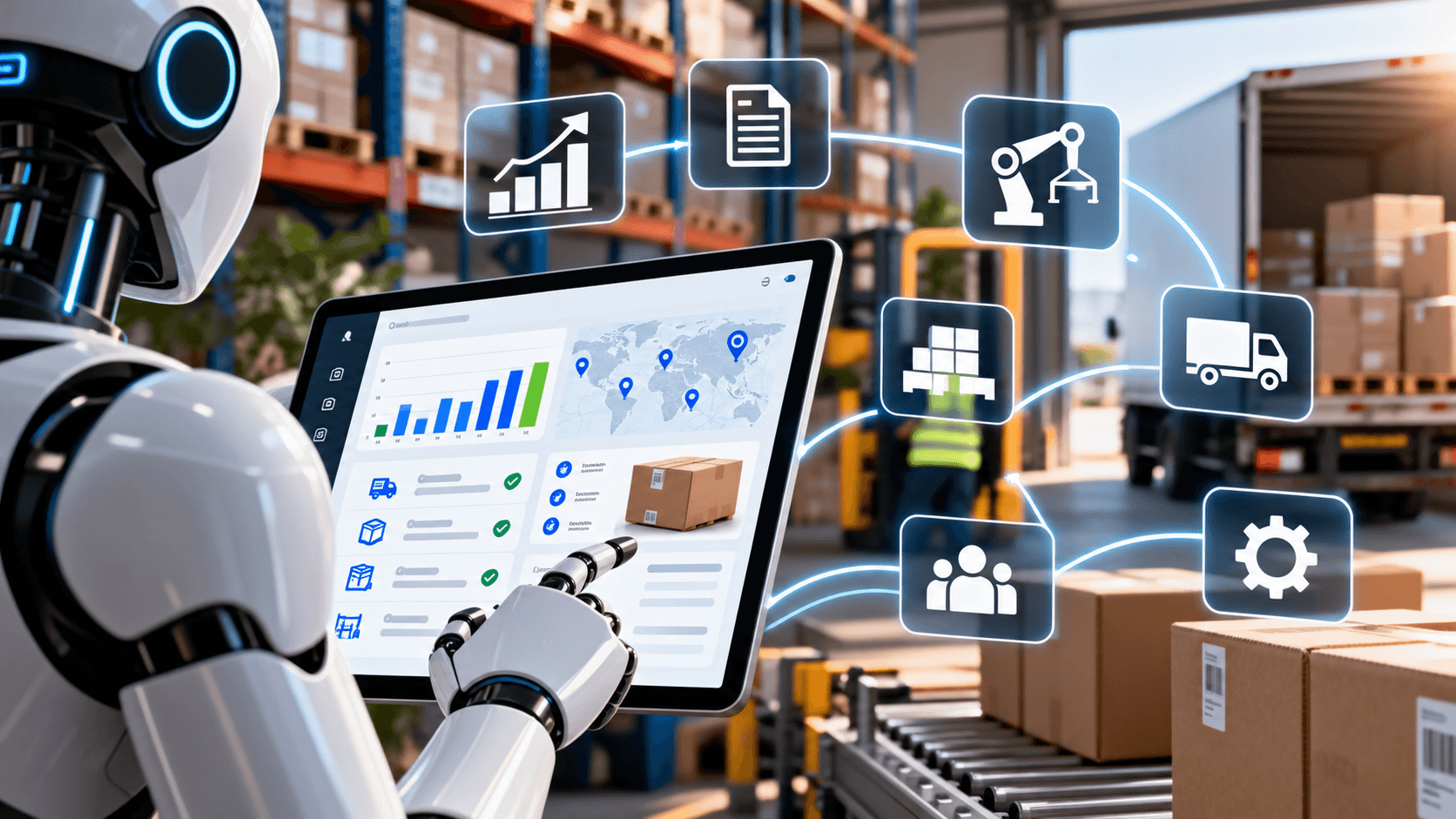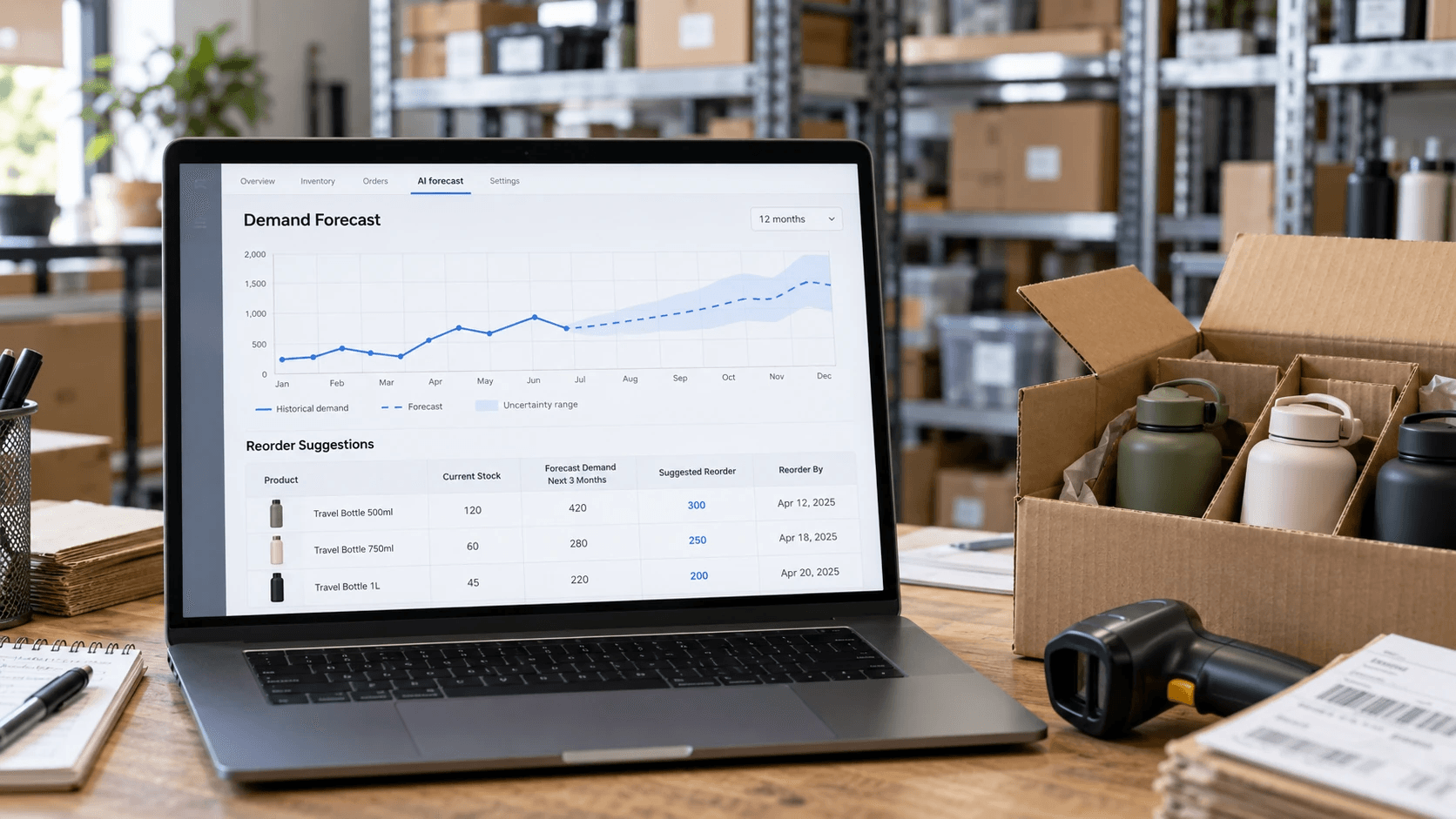
AI inventory forecasting uses artificial intelligence and statistical learning techniques to estimate future product demand and support purchasing, replenishment, and inventory allocation decisions. It can help businesses identify patterns across historical sales, seasonal fluctuations, promotional activity, and other relevant variables.
For small retailers, wholesalers, and distributors, inventory planning presents a persistent challenge. Purchasing too much stock ties up cash and warehouse space, while purchasing too little can create stockouts and lost sales. Traditional spreadsheets may work well for a limited product range, but forecasting becomes more complicated as the number of products, locations, and demand patterns increases.
AI-based forecasting tools aim to make this process more systematic. However, advanced technology does not guarantee accurate predictions. Data quality, model selection, operational constraints, and ongoing monitoring remain essential.
What Is AI Inventory Forecasting?
AI inventory forecasting is the application of machine learning or related analytical techniques to predict future inventory demand using historical and contextual business data. The forecast may estimate expected sales by product, store, warehouse, customer segment, or time period.
Traditional forecasting frequently uses historical averages, seasonal indexes, or established time-series models. AI-based systems may incorporate additional variables and identify nonlinear relationships that simpler methods do not capture easily.
For example, a distributor selling beverages might forecast demand using transaction history, holidays, local weather, promotions, and past supplier availability. A well-designed model could recognize that different products respond to these factors in different ways.
The output is usually a demand estimate or range of possible demand outcomes. Replenishment software may then translate those estimates into purchasing recommendations after considering supplier lead times, safety stock, inventory already on order, and minimum purchasing requirements.
How Does AI Inventory Forecasting Work?
AI inventory forecasting works by collecting relevant data, preparing it for analysis, training forecasting models, evaluating prediction errors, and using the results to inform inventory decisions. The process is iterative rather than a one-time software installation.
Step 1: Collect Historical Sales and Inventory Data
AI inventory forecasting begins with reliable transaction and product-level data. Typical inputs include daily or weekly sales, product identifiers, prices, inventory availability, returns, promotions, and supplier delivery records.
A business should distinguish observed sales from actual demand. If a product was unavailable for several days, recorded sales may understate customer interest because shoppers could not purchase the item.
Historical data should also identify product launches, discontinued SKUs, unusual bulk orders, and temporary operational disruptions where possible.
Step 2: Identify Demand Patterns and External Factors
AI models can analyze recurring patterns such as seasonality, trends, promotional effects, and relationships between products. Some systems incorporate external variables such as holidays, weather, economic indicators, or local events.
For example, an outdoor equipment retailer may experience seasonal demand for particular products, while a building materials distributor may see purchasing activity affected by project schedules and weather conditions.
Additional variables should be included only when they provide useful predictive information. Unreliable external data can increase model complexity without improving forecasting performance.
Step 3: Train and Test Forecasting Models
A forecasting model learns from historical observations and is tested against data that was not used for training. This helps evaluate whether the model can predict future demand rather than merely explain past patterns.
Businesses can compare machine learning methods with simpler benchmarks, including moving averages, seasonal naive forecasts, and established time-series models.
A more complex model is not automatically superior. When demand is stable and data is limited, a simple statistical forecast may perform just as well or better.
Step 4: Generate Product Demand Forecasts
The forecasting system produces estimates for a specified future period, such as the next week, month, or replenishment cycle. Results may include a single expected quantity, prediction intervals, or multiple demand scenarios.
Suppose a model estimates that a retailer will sell 480 units of a product next month. That forecast does not mean the retailer should immediately purchase 480 units.
The actual purchasing requirement depends on beginning inventory, outstanding orders, expected inventory receipts, customer commitments, replenishment policies, and desired service levels.
Step 5: Convert Forecasts Into Replenishment Decisions
Inventory replenishment decisions combine forecast demand with supply constraints and stock policies. Systems may recommend order quantities after considering safety stock, reorder points, lead times, packaging multiples, and supplier minimum order quantities.
Human review remains valuable for exceptional circumstances. A buyer may know about a supplier shutdown, major customer contract, or promotional campaign that is not yet reflected in historical data.
The strongest process connects automated forecasting with operational judgment and documented overrides.
AI Inventory Forecasting vs Traditional Forecasting
The main difference between AI inventory forecasting and traditional forecasting is the range of techniques and data relationships that can be modeled. Traditional methods are often easier to interpret and maintain, while machine learning can be useful for large, complex datasets.
Many modern forecasting platforms combine traditional statistics with machine learning. Businesses should therefore evaluate actual model performance rather than relying exclusively on an AI label.
| Feature | Traditional Forecasting | AI-Based Forecasting |
|---|---|---|
| Common methods | Moving averages, exponential smoothing, seasonal models | Machine learning, ensembles, neural networks |
| Data requirements | Can be relatively modest | Often benefits from larger, richer datasets |
| External variables | Possible, depending on method | Can incorporate complex relationships |
| Interpretability | Often comparatively straightforward | Varies by model |
| Maintenance | Regular assumption review | Monitoring, retraining and data management |
| Best fit | Stable or moderately complex demand | Complex patterns with sufficient reliable data |
AI Inventory Forecasting Example
An AI inventory forecasting example shows how predicted demand can support purchasing decisions when combined with inventory planning data. Consider a small electronics retailer preparing for a four-week sales period.
The retailer has the following information:
A simplified purchasing requirement is:
Required Purchase = Forecast Demand + Target Ending Inventory − Available Inventory − Incoming Inventory
Required Purchase = 600 + 100 − 180 − 120
Required Purchase = 400 units
The retailer would need an additional 400 units under these assumptions.
This example demonstrates the purchasing calculation rather than proving that an AI model will predict demand accurately. In practice, the forecast should also account for the timing of incoming deliveries and expected sales throughout the period.
| Variable | Quantity |
|---|---|
| Forecast demand for four weeks | 600 units |
| Current available inventory | 180 units |
| Incoming confirmed orders | 120 units |
| Target ending inventory buffer | 100 units |
What Data Is Needed for AI Inventory Forecasting?
The quality and relevance of input data are critical to AI inventory forecasting performance. A large amount of poorly maintained data can produce less useful predictions than a smaller, consistent dataset.
Product identifiers should remain consistent across sales, purchasing, and inventory systems. If the same SKU appears under multiple names or codes, forecasts may be fragmented or duplicated.
For small businesses, data cleanup is often a more valuable first investment than implementing a highly sophisticated model.
| Data Category | Examples | Planning Purpose |
|---|---|---|
| Sales history | Units sold by SKU and date | Identify demand patterns |
| Inventory records | On-hand inventory, stockouts | Distinguish sales from availability |
| Product data | Category, price, lifecycle | Group similar products |
| Promotions | Discounts, campaigns | Estimate promotional demand |
| Supplier information | Actual lead times, delays | Support replenishment |
| Calendar information | Holidays, seasonal periods | Identify recurring variation |
| External variables | Weather, relevant market conditions | Add contextual signals |
Benefits of AI Inventory Forecasting
AI inventory forecasting can improve inventory decisions when it produces more useful demand estimates than existing methods and those estimates are integrated into purchasing workflows. Benefits are not automatic and should be measured against a realistic baseline.
Reduce Overstocking
Better demand estimates can help buyers avoid ordering quantities that exceed likely sales. This may reduce warehouse occupancy, excess carrying costs, and the need for clearance discounts.
The benefit is especially relevant to businesses managing many product variants or rapidly changing assortments.
Reduce Stockouts
Forecasting can identify products likely to experience higher demand during upcoming periods. When combined with appropriate reorder points and supplier planning, this may improve product availability.
However, stockouts can also result from delivery problems, inventory inaccuracies, and unexpected operational disruptions. Forecasting is only one part of prevention.
Improve Cash Flow Planning
Inventory purchases consume working capital, sometimes long before customers generate corresponding cash receipts. More disciplined purchasing decisions can reduce unnecessary cash commitments.
Businesses can connect demand forecasts with expected payment schedules to evaluate future liquidity requirements.
Support Multi-Location Inventory Planning
Companies operating several stores or warehouses may need different forecasts for each location. Local demand patterns can vary even when products and prices are similar.
Forecasting systems can support stock allocation by identifying where inventory is likely to be needed, although transfer costs and operational constraints must also be considered.
AI Inventory Forecasting Accuracy: How to Measure Results
Forecast accuracy should be evaluated using out-of-sample predictions and clearly defined error metrics. Comparing a model only with the data on which it was trained can create an unrealistic impression of performance.
Mean Absolute Error (MAE)
MAE = Sum of Absolute Forecast Errors ÷ Number of Observations
Suppose actual weekly demand is 100, 120, 80, and 110 units, while the forecast is 105, 110, 90, and 115 units.
The absolute errors are 5, 10, 10, and 5 units.
MAE = (5 + 10 + 10 + 5) ÷ 4 = 7.5 units
MAE is easy to interpret because it uses the same unit of measurement as the forecasted product demand.
Weighted Absolute Percentage Error (WAPE)
WAPE = Sum of Absolute Forecast Errors ÷ Sum of Actual Demand × 100
Using the same example:
WAPE = 30 ÷ 410 × 100 = 7.32%
WAPE provides a useful aggregate error measure, although it can become unstable when actual demand is very low and may conceal poor performance on individual products.
Forecast Bias
Forecast bias indicates whether predictions systematically overestimate or underestimate demand. A business may have an acceptable average absolute error while consistently underforecasting its most important products.
One possible signed-error convention is:
Forecast Bias = Sum of (Forecast − Actual) ÷ Number of Observations
Under this convention, a positive value indicates overforecasting, while a negative value indicates underforecasting.
The selected convention should be documented because some software uses the opposite sign.
How Small Businesses Can Implement AI Inventory Forecasting
Small businesses should implement AI inventory forecasting gradually, beginning with a limited product group and measurable performance objectives. A large-scale deployment is rarely necessary for the first test.
Start With One Product Category
Choose a category with sufficient historical data and meaningful inventory costs. Avoid beginning with products that have only a few sales observations or unusually unpredictable one-time demand.
A limited pilot makes it easier to identify errors in product records and purchasing workflows.
Establish a Baseline Forecast
Use a simple forecasting method as a comparison. A seasonal naive forecast or moving average can provide a useful starting point.
The AI-based model should demonstrate operational value beyond its technical complexity.
Run a Historical Backtest
Use rolling historical periods to simulate how the forecasting method would have performed. Do not allow future sales information to enter the model during earlier forecast periods.
Evaluate accuracy across different demand conditions rather than focusing on one favorable month.
Test Purchasing Recommendations
Compare recommended order quantities with actual demand, lead times, and stock availability. Monitor whether improved forecast accuracy translates into fewer stockouts, lower excess inventory, or better working capital efficiency.
Forecasting improvements that do not change operational decisions may provide limited commercial value.
Expand Only After Demonstrating Benefits
Once the pilot produces dependable results, expand into additional product categories or locations. Document model assumptions, responsibility for overrides, and procedures for detecting deteriorating performance.
A scalable process requires both technology and consistent inventory management practices.
Challenges and Limitations of AI Inventory Forecasting
AI inventory forecasting has important limitations, including incomplete data, unpredictable market changes, implementation costs, and difficulties explaining model behavior. These factors can reduce the practical benefits of advanced systems.
Limited Historical Data
New products and low-volume SKUs often lack enough observations for reliable individual forecasts. Businesses may need category-level forecasts, comparable-product data, or judgment-based estimates.
Changing Customer Behavior
Sudden changes in consumer preferences, competitor activity, regulations, or economic conditions can make historical patterns less relevant.
Models must be monitored and updated when demand conditions change materially.
Stockout-Distorted Sales Records
A business cannot assume that zero sales means zero demand. If inventory was unavailable, customer demand may not have been fully observed.
Forecasting systems need appropriate stockout indicators or demand adjustments.
Integration and Maintenance Costs
Software subscriptions, data preparation, inventory system integrations, staff training, and ongoing model maintenance can increase total implementation cost.
Small businesses should compare these costs with measurable reductions in inventory-related losses.
AI Inventory Forecasting Software: What to Look For
AI inventory forecasting software should be evaluated by its forecasting performance, data integration, transparency, and ability to support real purchasing decisions. Marketing claims about automation or prediction accuracy are insufficient on their own.
Important features include:
- Integration with POS, ERP, or inventory management systems.
- SKU- and location-level forecasting.
- Support for promotions and seasonality.
- Forecast accuracy and bias reporting.
- Supplier lead-time and safety stock settings.
- Minimum order quantity and packaging constraints.
- Manual adjustments with an audit trail.
- Scenario planning and exception alerts.
- Clear pricing, security controls, and data export options.
Request a pilot using the company's own historical data whenever feasible. A vendor demonstration based on a carefully selected example may not represent actual performance.
Final Thoughts
AI inventory forecasting can become a valuable part of inventory planning when businesses combine reliable data, appropriate models, and disciplined purchasing processes. Its main purpose is not to replace operational judgment but to improve the information available for decisions.
Small businesses should begin with measurable objectives, test forecasts against historical outcomes, and expand only when results justify additional investment. Better forecasts can support lower inventory risk, stronger product availability, and improved cash flow, but the benefits depend on effective implementation.
A practical forecasting system is one that consistently improves business decisions—not simply one that uses artificial intelligence.
Frequently Asked Questions
- What is AI inventory forecasting?
- AI inventory forecasting uses machine learning or related analytical methods to estimate future demand and support inventory planning. It analyzes historical business information and potentially external factors to identify patterns. Its predictions can inform purchasing and replenishment decisions.
- Is AI inventory forecasting better than Excel?
- AI inventory forecasting can be useful when products, locations, and demand drivers are too complex for basic spreadsheet models. However, Excel can remain effective for businesses with simple, stable demand. The better approach is the one that produces reliable decisions at an acceptable cost.
- How accurate is AI demand forecasting?
- Accuracy varies by product, data quality, model design, and market conditions. No universal accuracy percentage applies to all businesses. Forecasts should be evaluated against historical out-of-sample observations and compared with simpler methods.
- Can small businesses use AI for inventory management?
- Yes. Small businesses can use forecasting tools that integrate with their existing sales and inventory systems. A limited pilot is usually a practical starting point. Reliable data and clear purchasing procedures are more important than implementing the most complex model available.
- What is the difference between AI forecasting and inventory optimization?
- AI forecasting estimates future demand, while inventory optimization determines stocking and purchasing decisions under business constraints. Optimization may consider forecast uncertainty, lead times, service levels, carrying costs, and order quantities. The two processes work together but solve different problems.