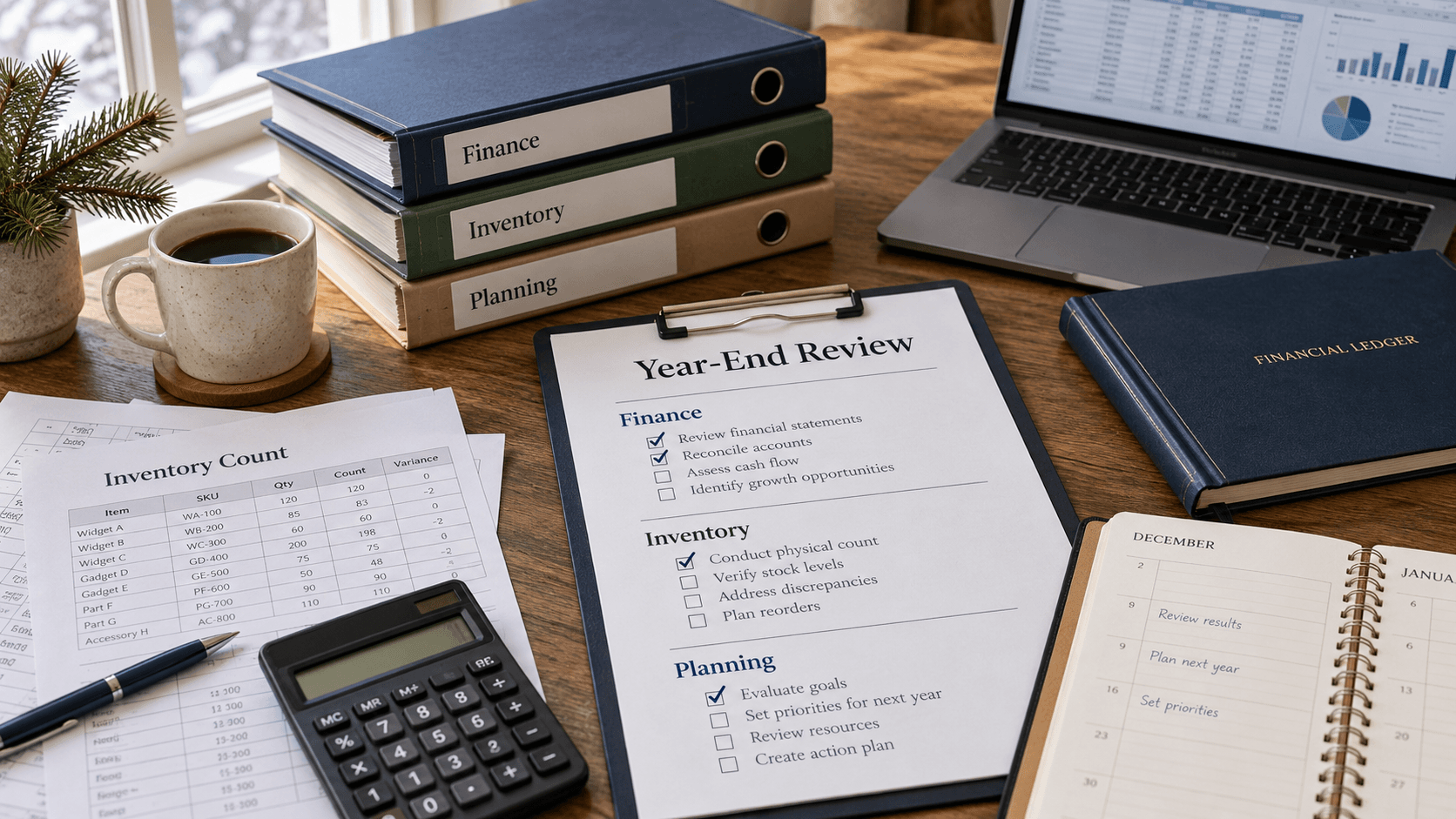
A year-end business checklist helps companies organize the financial, accounting, inventory, and operational tasks required to close one business year and prepare for the next. It provides a structured approach to reviewing performance, resolving outstanding issues, and setting realistic financial and commercial priorities.
For small business owners, wholesalers, retailers, and distributors, year-end preparation can be particularly demanding. Inventory may require reconciliation, customers may have outstanding invoices, supplier commitments may extend into the following year, and financial records must be prepared for reporting and tax obligations.
A well-organized checklist reduces the risk of overlooking important tasks. It also creates an opportunity to evaluate whether the business is becoming more profitable, financially stable, and operationally efficient.
What Is a Year-End Business Checklist?
A year-end business checklist is an organized set of tasks used to review and close a company's financial and operational activities for a reporting year. It commonly covers bookkeeping, financial statements, receivables, payables, inventory, payroll, tax preparation, contracts, budgets, and strategic planning.
The specific requirements depend on the company's legal structure, accounting framework, jurisdiction, and fiscal year.
Not every business uses December 31 as its financial year-end. Companies operating on a different fiscal calendar should apply the checklist to their own reporting dates.
Why Year-End Business Planning Matters
Year-end business planning helps owners understand financial performance and identify risks before entering another operating period. It is not simply an administrative exercise.
A company may report higher sales while experiencing declining margins, increasing inventory, or slower customer payments. Reviewing these changes can reveal whether growth is generating sustainable economic value.
The process also helps management establish priorities for purchasing, pricing, investment, staffing, and cash flow.
Year-End Business Checklist: Quick Overview
A comprehensive year-end business checklist should cover financial accuracy, working capital, compliance, and future planning. The following table provides a starting framework.
The checklist should be assigned to responsible employees or service providers, with clear internal deadlines and supporting documentation.
| Business Area | Year-End Task | Expected Outcome |
|---|---|---|
| Bookkeeping | Reconcile accounts and transactions | Reliable accounting records |
| Financial statements | Review profit, assets and cash flow | Clear performance assessment |
| Accounts receivable | Identify overdue customer balances | Better collection planning |
| Accounts payable | Verify unpaid supplier obligations | Accurate liabilities |
| Inventory | Reconcile physical and recorded stock | Reliable inventory valuation |
| Taxes | Review filing and payment obligations | Improved compliance readiness |
| Payroll | Reconcile compensation records | Accurate employee reporting |
| Cash flow | Prepare forward-looking forecasts | Better liquidity visibility |
| Contracts | Review commercial commitments | Reduced operational risk |
| Budgeting | Build next-year financial projections | Measurable business targets |
| Sales | Evaluate customers and sales channels | Better revenue planning |
| Operations | Review suppliers and processes | Improved efficiency |
1. Reconcile Business Bank Accounts and Financial Records
The first year-end business checklist task is to reconcile bank accounts, cash balances, and accounting records. Accurate financial statements depend on reliable underlying transactions.
Compare accounting balances with bank statements and investigate unexplained differences. Review unrecorded fees, outstanding checks, transfers, interest, duplicate entries, and transactions assigned to incorrect accounts.
Businesses should also reconcile credit card accounts, payment processors, loan balances, and other material financial accounts.
Review Outstanding Transactions
Transactions initiated near year-end may not settle immediately. The appropriate accounting treatment depends on transaction details and the reporting framework.
Review outstanding payments and receipts carefully to avoid reporting the same transaction twice or assigning it to the wrong accounting period.
Verify Revenue and Expense Classification
Check that revenue, cost of goods sold, operating expenses, financing transactions, and capital expenditures are classified appropriately.
Incorrect classification can distort profitability, cash flow, and management reporting. Material or unusual transactions should be reviewed with the company's accountant.
2. Review the Profit and Loss Statement
A year-end profit and loss review shows whether the business generated sustainable earnings and which costs affected performance. The statement should be compared with previous periods, budgets, and relevant operating activity.
Key figures include revenue, cost of goods sold, gross profit, operating expenses, and net income.
The formulas are:
Gross Profit Margin = Gross Profit ÷ Revenue × 100
Net Profit Margin = Net Profit ÷ Revenue × 100
In the example, gross profit margin is 35% and net profit margin is 10%.
These results should be interpreted alongside sales mix, pricing changes, staffing costs, and other business conditions. A higher revenue figure does not automatically indicate improved profitability.
Compare Actual Results With the Budget
Budget variance analysis identifies where actual business performance differed from financial expectations. It helps management distinguish predictable cost changes from unexpected operational problems.
For each significant revenue or expense category, calculate:
Budget Variance = Actual Amount − Budgeted Amount
The meaning of a positive or negative variance depends on the category. Higher revenue may be favorable, while higher expenses may be unfavorable.
Investigate material differences and document the reasons. This improves the assumptions used in next year's budget.
| Financial Metric | Example Annual Value |
|---|---|
| Revenue | $800,000 |
| Cost of goods sold | $520,000 |
| Gross profit | $280,000 |
| Operating expenses | $200,000 |
| Net profit | $80,000 |
| Gross profit margin | 35% |
| Net profit margin | 10% |
3. Review Cash Flow and Working Capital
A year-end cash flow review evaluates whether the business has sufficient liquidity to support upcoming commitments. Accounting profit alone does not establish whether supplier payments, payroll, or debt obligations can be covered.
Examine historical cash inflows and outflows, seasonal changes, planned purchases, and customer collection patterns.
A rolling 13-week cash flow forecast can help identify short-term financing requirements.
Calculate Working Capital
A basic working capital formula is:
Working Capital = Current Assets − Current Liabilities
Suppose a company has current assets of $250,000 and current liabilities of $175,000.
Working Capital = $250,000 − $175,000
Working Capital = $75,000
Positive working capital may indicate short-term financial flexibility, but its composition matters. A large inventory balance or overdue customer receivables may not convert into cash quickly.
Review the Cash Conversion Cycle
The cash conversion cycle helps evaluate how long money remains committed to operating activities.
Cash Conversion Cycle = Days Inventory Outstanding + Days Sales Outstanding − Days Payable Outstanding
A longer cycle may increase financing requirements, particularly for distributors purchasing inventory before collecting customer payments.
4. Review Accounts Receivable and Customer Payments
The year-end accounts receivable review identifies unpaid invoices, delayed collections, disputed balances, and potential credit losses. Businesses should reconcile customer accounts and confirm that payments have been allocated correctly.
Prepare an accounts receivable aging report showing current and overdue balances. Group invoices according to a documented aging convention.
Common past-due categories include 1–30, 31–60, 61–90, and more than 90 days.
Prioritize Overdue Customer Accounts
Review the largest overdue balances first, while also considering customer payment history and the reasons for delays.
Some unpaid invoices may result from administrative errors or pricing disputes rather than financial distress. Resolving these issues can improve collection performance.
Evaluate Doubtful Accounts
Businesses should assess whether receivables remain recoverable and whether credit loss allowances or write-offs are required under their accounting framework.
An invoice becoming overdue does not automatically make it uncollectible. Appropriate estimates should reflect relevant evidence and applicable reporting standards.
5. Review Accounts Payable and Supplier Obligations
The year-end accounts payable review ensures that supplier invoices, accrued expenses, and outstanding payment obligations are correctly recorded. Missing liabilities can make a company's financial position appear stronger than it actually is.
Compare supplier statements with the accounting ledger and purchasing records.
Verify received goods not yet invoiced, outstanding purchase commitments, disputed supplier charges, and payments scheduled shortly after year-end.
Review Supplier Payment Terms
Evaluate whether current payment terms support the company's cash conversion cycle.
Extended terms may improve short-term cash availability, but late payments can damage supplier relationships or cause supply interruptions.
Negotiations should balance financial flexibility with reliable access to products and services.
6. Perform a Year-End Inventory Review
A year-end inventory review confirms whether physical merchandise matches recorded quantities and whether inventory values remain appropriate. This task is particularly important for wholesalers, distributors, manufacturers, and retailers.
Businesses may perform a full physical inventory count or use an appropriate cycle-counting process supported by reliable controls.
Investigate differences between physical stock and inventory system balances.
Identify Slow-Moving and Dead Stock
Review the age of inventory, last sale dates, product turnover, and expected future demand.
Products that are damaged, obsolete, or unlikely to sell at their recorded value may require additional accounting assessment.
Check Inventory Valuation
Confirm that inventory is valued using the company's applicable accounting policies and reporting standards.
Under relevant accounting frameworks, inventory may require write-downs when recoverable value falls below its recorded cost. Specific rules depend on whether the business reports under US GAAP, IFRS, or another framework.
Review Inventory Turnover
Inventory Turnover Ratio = Cost of Goods Sold ÷ Average Inventory
Compare turnover with previous periods and evaluate significant differences by product category.
Slow-moving inventory may increase warehousing expenses and restrict working capital. Very high turnover may indicate insufficient stock if customer service levels have deteriorated.
7. Prepare Business Tax Records
Year-end business tax preparation involves organizing financial records and identifying filing, payment, and reporting obligations. Requirements vary by jurisdiction, business structure, accounting method, and applicable tax rules.
Businesses should review revenue records, deductible expenses, payroll information, asset purchases, financing costs, and relevant documentation.
Tax preparation should not rely on generic assumptions about deductions or reporting dates.
Organize Supporting Documents
Maintain invoices, receipts, bank statements, payroll records, and other records required for accounting and tax purposes.
Digital records should be accessible, appropriately protected, and retained according to applicable legal requirements.
Review Estimated Tax Payments and Liabilities
Where applicable, compare estimated tax payments with expected obligations.
Tax deadlines and payment rules differ by business type and jurisdiction. A qualified tax adviser can help assess unusual transactions or complex year-end decisions.
Evaluate Business Asset Purchases
Review equipment acquisitions, software investments, vehicles, and other capital purchases.
Financial statement depreciation and tax deductions may follow different rules. Businesses should not assume that every year-end purchase qualifies for an immediate full deduction.
8. Review Payroll and Employee Records
A year-end payroll review ensures that employee compensation, deductions, employer obligations, and reporting records are accurate. Errors can create financial and compliance problems that extend into the following year.
Reconcile payroll records with accounting entries and actual payments.
Review compensation changes, bonuses, employee benefits, leave balances, and any applicable employer contributions.
Where required, prepare employee tax statements and other payroll reports using the appropriate reporting rules.
Evaluate Workforce Planning
Year-end is also an opportunity to compare staffing capacity with expected business demand.
A company may need additional warehouse employees during seasonal peaks or different expertise when expanding into new product categories.
Staffing decisions should reflect sustainable demand rather than temporary sales increases alone.
9. Review Business Contracts and Supplier Relationships
A year-end contract review helps identify renewals, price changes, commercial obligations, and operational risks that may affect the next reporting period. Businesses should examine important agreements before automatic renewals or notice deadlines occur.
Relevant contracts may include:
- Supplier and distribution agreements.
- Warehouse and property leases.
- Software subscriptions.
- Transportation and logistics services.
- Insurance policies.
- Financing arrangements.
- Customer service agreements.
- Outsourcing and professional services contracts.
Review pricing terms, performance requirements, termination provisions, and contractual deadlines.
Evaluate Supplier Performance
Assess suppliers using measurable indicators such as on-time delivery, order accuracy, quality problems, pricing stability, and responsiveness.
A lower purchase price may not represent the best commercial value when delays or defects create additional costs.
10. Evaluate Sales, Customers and Marketing Performance
A year-end sales review identifies which customers, products, and acquisition channels generated sustainable business value. Revenue totals alone may conceal differences in profitability and operating requirements.
Analyze sales by customer segment, product category, region, and channel.
Identify the Most Profitable Customers
Customer profitability can differ substantially because of discounts, shipping requirements, returns, payment terms, and service costs.
A customer generating high sales volume may contribute less profit than a smaller account with consistent orders and lower fulfillment expenses.
Review Customer Retention
Compare new customer acquisition with repeat purchasing and lost accounts.
For distributors and B2B suppliers, recurring purchasing relationships can provide more predictable revenue than one-time transactions.
Evaluate Marketing Returns
Review marketing expenditure alongside qualified leads, converted customers, acquisition costs, and contribution from resulting sales.
Avoid evaluating marketing success exclusively by impressions, clicks, or website visits.
11. Prepare the Next Year's Business Budget
A year-end business budget converts historical financial results and future assumptions into a structured operating plan. It should estimate revenue, expenses, cash requirements, investments, and major risks.
Start with actual performance and document expected changes in prices, demand, payroll, supplier costs, and operating capacity.
Build a Revenue Forecast
Separate established customer revenue from uncertain new business opportunities.
For example, recurring sales may be forecast using historical purchasing patterns, while new customer revenue should reflect realistic conversion assumptions.
Estimate Operating Costs
Account for fixed expenses and costs that change with sales volume.
Include planned salary adjustments, rent increases, software subscriptions, transportation costs, and other known commitments.
Plan Capital Expenditures
Identify major planned investments in equipment, technology, facilities, and other assets.
Evaluate their expected benefits, financing requirements, implementation schedules, and cash flow implications.
Prepare Financial Scenarios
Scenario budgeting helps businesses understand how different outcomes may affect profitability and cash flow.
These hypothetical figures illustrate the planning approach. Actual expense behavior may be more complex, especially when sales growth requires additional working capital or fixed-capacity investment.
| Scenario | Revenue | Estimated Expenses | Estimated Operating Result |
|---|---|---|---|
| Downside | $700,000 | $680,000 | $20,000 |
| Base case | $850,000 | $760,000 | $90,000 |
| Upside | $1,000,000 | $870,000 | $130,000 |
12. Set Business Goals and KPIs
Year-end business planning should conclude with measurable priorities that connect financial performance to operational improvements. Goals such as increasing sales or improving efficiency are difficult to manage without specific definitions and review dates.
Businesses may establish targets for gross profit margin, customer retention, inventory turnover, overdue receivables, delivery reliability, or operating cash flow.
Example Business KPI Dashboard
The targets are illustrative, not universal industry benchmarks.
Every KPI should have an accountable owner and a documented calculation method. Review progress regularly so that corrective action is possible before another year ends.
| KPI | Current Result | Illustrative Next-Year Target |
|---|---|---|
| Gross profit margin | 28% | 31% |
| Inventory turnover | 4.5 | 5.5 |
| Days sales outstanding | 52 days | 45 days |
| On-time delivery | 92% | 96% |
| Customer retention | 80% | 85% |
Year-End Business Checklist by Department
A department-based year-end business checklist helps distribute responsibility and prevent essential tasks from being overlooked. Even small companies can use this approach when one person manages several functions.
Each task should have a responsible person, expected completion date, and evidence of completion.
| Department | Priority Tasks |
|---|---|
| Finance | Reconciliation, statements, cash forecast |
| Accounting | Accruals, adjustments, documentation |
| Sales | Customer review, pipeline, revenue forecast |
| Purchasing | Supplier terms, commitments, purchasing plans |
| Warehouse | Inventory counts, obsolete stock, stock accuracy |
| Operations | Performance, staffing, process improvement |
| Management | Budget approval, risks, strategic priorities |
When Should Businesses Start Year-End Preparation?
Businesses should begin year-end preparation before their reporting period closes rather than postponing every task until the final month. Early preparation provides more time to resolve accounting discrepancies and operational problems.
For companies using a December 31 financial year-end, a practical schedule is:
This timeline is illustrative. Statutory filing deadlines, accounting procedures, and fiscal year dates vary.
| Period | Recommended Focus |
|---|---|
| October | Initial financial review and issue identification |
| November | Receivables, inventory and contract review |
| Early December | Reconciliations and document collection |
| Late December | Inventory procedures and closing controls |
| January | Final adjustments and reporting preparation |
| Following months | Applicable filings, audits and strategic reviews |
Common Year-End Business Mistakes
Year-end business mistakes often result from incomplete financial records, delayed reconciliation, unrealistic budgets, and insufficient coordination between departments. Many issues can be prevented through regular monthly controls.
Common problems include:
- Waiting until the final week to review bookkeeping.
- Ignoring overdue customer balances.
- Failing to reconcile physical and recorded inventory.
- Overlooking outstanding supplier invoices.
- Treating reported profit as available cash.
- Assuming all tax rules apply equally to every business.
- Using optimistic revenue forecasts without supporting evidence.
- Neglecting contract renewal deadlines.
- Failing to document management assumptions.
- Establishing annual goals without responsible owners.
A checklist is most effective when it creates clear action, not simply a record of tasks completed.
Final Thoughts
A year-end business checklist provides a practical framework for closing financial records accurately while preparing the company for stronger performance in the following year. It brings together accounting, cash flow, inventory, sales, supplier management, and strategic planning into one coordinated process.
Businesses should begin early, use consistent financial information, and assign clear responsibility for important tasks. Identifying overdue receivables, excess stock, operational weaknesses, and unrealistic budgets before the next year begins can improve both financial stability and decision-making.
The strongest year-end process does more than confirm what happened during the previous twelve months. It uses those findings to build a more efficient, resilient, and financially sustainable business.
Frequently Asked Questions
- What should be on a year-end business checklist?
- A year-end business checklist should include financial reconciliation, profit and loss review, cash flow analysis, accounts receivable, accounts payable, inventory, tax preparation, payroll, contracts, and next-year planning. Additional tasks depend on the company's legal structure and operating activities.
- When should a small business start year-end planning?
- Small businesses should begin reviewing financial and operational issues several weeks or months before their fiscal year ends. Companies with extensive inventory, complex accounting, or external reporting requirements may need more preparation. Regular monthly reviews can reduce the year-end workload.
- What financial reports should businesses review at year-end?
- Important reports include the income statement, balance sheet, cash flow statement, accounts receivable aging report, accounts payable aging report, and inventory valuation reports. Budget variance and customer profitability reports may also provide useful management information.
- How do you prepare inventory for year-end?
- Reconcile inventory records, verify physical quantities, investigate discrepancies, and review damaged or obsolete stock. Evaluate inventory valuation under the applicable accounting framework and document necessary adjustments. Review turnover and purchasing policies to improve future inventory management.
- Is the business year-end always December 31?
- No. Some businesses use a calendar year ending December 31, while others operate on a different fiscal year. The appropriate reporting period depends on legal, tax, and accounting circumstances. Businesses should follow their applicable financial reporting requirements.