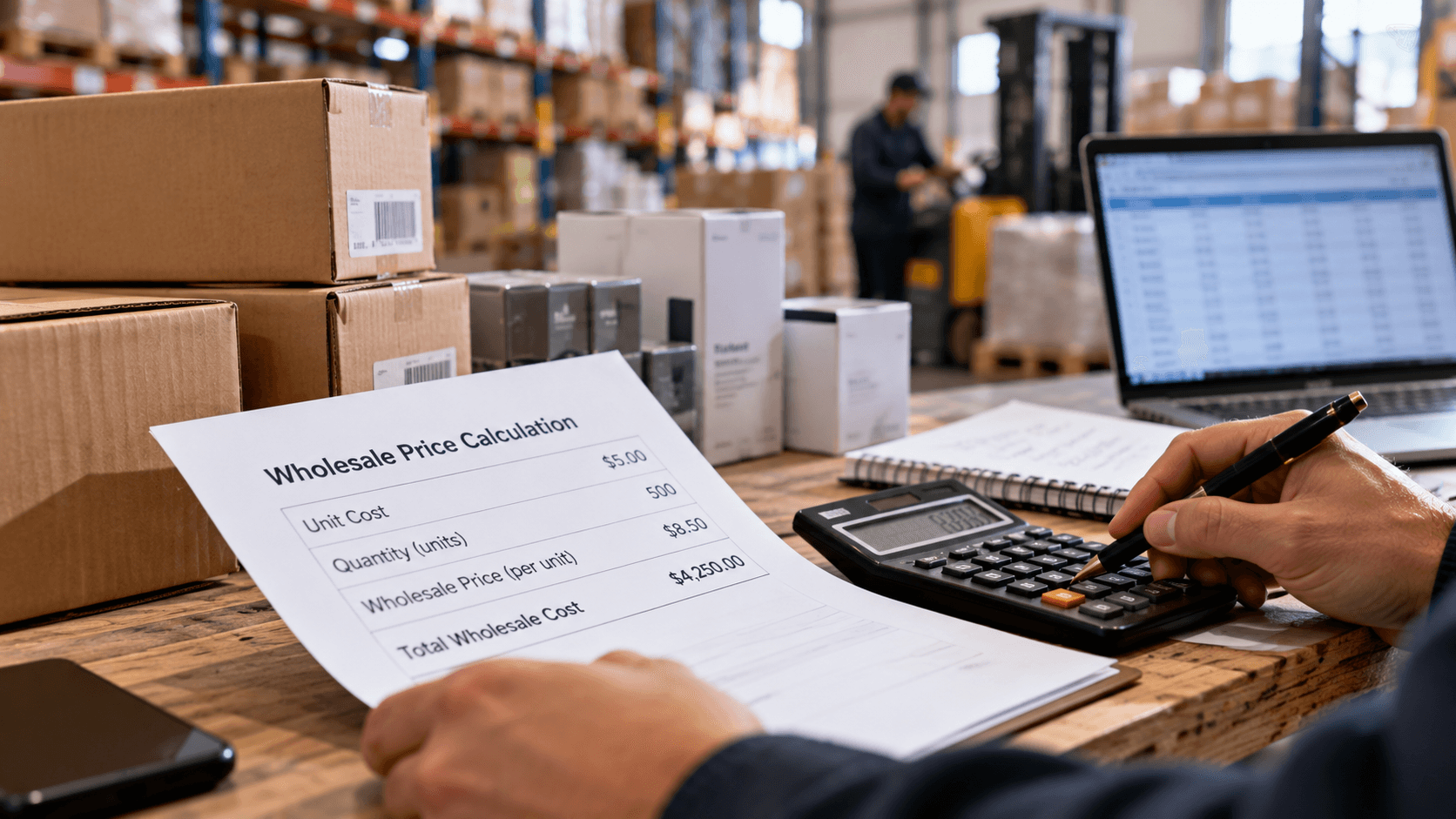
What is wholesale price? A wholesale price is the amount a business charges another business for merchandise, typically for resale, commercial use, or distribution. Wholesale prices are often lower per unit than consumer retail prices because buyers purchase under commercial terms and may order multiple units, cases, or pallets.
Understanding wholesale price is essential for manufacturers, distributors, retailers, and entrepreneurs entering B2B commerce. The price printed on a supplier's catalog is only one part of the purchasing decision. Order quantities, freight charges, payment terms, product quality, returns, and inventory financing can all affect the actual cost of doing business.
Wholesale pricing also determines whether a distributor can operate profitably. A price that appears attractive may produce an inadequate margin once acquisition costs, customer discounts, and fulfillment expenses are considered. This guide explains how wholesale prices work, how to calculate them, and how businesses use pricing formulas without confusing markup with profit margin.
What Is Wholesale Price? Definition and Meaning
Wholesale price is the selling price offered to a commercial buyer for goods supplied through a business-to-business transaction. A wholesaler may purchase products from a manufacturer and then establish prices for retailers, contractors, restaurants, or other distributors. Manufacturers can also sell directly at wholesale prices when serving commercial customers.
Wholesale prices are not determined exclusively by quantity. A supplier may establish different price lists for authorized distributors, regional dealers, major accounts, and other commercial buyers. The final price often reflects purchase commitments, negotiated terms, customer relationships, and the services included in the sale.
For example, a manufacturer might sell an item to a distributor for $8, the distributor may sell it to a retailer for $12, and the retailer may offer it to consumers for $20. These figures represent separate commercial transactions rather than a universal pricing formula. Each seller must recover its own costs while competing in its market.
For a broader explanation of these transactions, see What Is Wholesale?, which introduces the wholesale business model and its supply-chain roles.
How Does Wholesale Pricing Work?
Wholesale pricing works by combining product acquisition costs, commercial expenses, the required profit margin, and market conditions to establish a selling price. Businesses must determine what it costs to make a product available for sale and how much customers are willing to pay. Some suppliers also offer quantity discounts or different price levels for different types of accounts.
A manufacturer typically starts with production costs, including materials, direct labor, and applicable manufacturing overhead. A merchant wholesaler generally begins with the cost of purchasing inventory and bringing it to the appropriate location. Both must understand which costs are included in cost of goods sold and which appear as operating expenses.
Wholesale prices may be listed in a catalog or negotiated individually. A supplier serving hundreds of small retailers might use published volume tiers, while a manufacturer dealing with one large distributor may negotiate annual pricing. In either case, the wholesale price should be evaluated alongside payment deadlines, delivery responsibilities, minimum order quantities, and product return conditions.
Wholesale Pricing Example: Manufacturer to Consumer
A hypothetical product can demonstrate how wholesale pricing creates different revenue and cost structures throughout the supply chain.
The distributor's $4 difference between its buying and selling prices is not automatically net profit. Freight, warehousing, inventory shrinkage, employee compensation, software, and financing may consume part of that amount. The retailer's $8 difference also excludes selling expenses and other costs.
The important lesson is that every participant performs different functions. A manufacturer produces goods, a distributor makes inventory available to commercial buyers, and a retailer provides the final consumer sales experience. The price at each stage must reflect the responsibilities and costs of that stage.
| Transaction | Unit selling price | Relevant business |
|---|---|---|
| Manufacturer sells to distributor | $8 | Manufacturer |
| Distributor sells to retailer | $12 | Distributor |
| Retailer sells to consumer | $20 | Retailer |
Wholesale Price vs. Retail Price: What Is the Difference?
The main difference between wholesale price and retail price is the type of transaction and buyer. Wholesale prices are generally charged to businesses purchasing merchandise for resale or commercial use, while retail prices are charged to final consumers. Retail prices often incorporate additional expenses associated with consumer selling and service.
Wholesale purchases may require larger quantities, formal business accounts, or agreed purchasing schedules. Retail transactions usually permit customers to buy individual products without negotiating a commercial supply agreement. However, the distinction is not simply that one price is lower: a company may sell the same product through both channels under different terms.
Retail prices are not always fixed, and wholesale prices are not always individually negotiated. Large retailers may negotiate sophisticated purchasing arrangements, while smaller wholesalers may use standardized online price lists. Understanding the complete transaction matters more than assuming one pricing method always applies.
| Feature | Wholesale price | Retail price |
|---|---|---|
| Typical buyer | Business customer | Final consumer |
| Common order size | Cases, cartons, pallets, or negotiated quantities | Individual items or small orders |
| Price calculation | Commercial margin, volume, contract terms | Consumer demand, competition, retail costs |
| Payment | Immediate or agreed business credit terms | Usually paid at purchase |
| Shipping | Often quoted separately or negotiated | May be included or separately charged |
| Discounts | Volume, contract, account-based | Promotions, coupons, loyalty offers |
| Return conditions | Commercial agreement | Applicable consumer policy and law |
How to Calculate Wholesale Price Using Gross Margin
A wholesale price can be calculated by dividing unit cost by one minus the desired gross margin expressed as a decimal. This approach helps sellers understand the revenue required to retain a particular percentage of gross profit. It is especially useful when businesses manage many products with different acquisition costs.
Wholesale price = Unit cost ÷ (1 − Target gross margin)
Suppose a distributor's inventory cost is $20 per unit and the business wants a 30% gross margin.
Wholesale price = $20 ÷ (1 − 0.30)
Wholesale price = $20 ÷ 0.70 = $28.57
At this price, the distributor earns approximately $8.57 of gross profit per unit. Dividing $8.57 by the $28.57 selling price gives approximately 30%. The calculation does not mean the business has a 30% net profit margin, because administrative and other operating expenses still need to be paid.
Wholesale Price Formula Table
These calculations assume the $10 unit cost has been correctly determined and that there are no additional deductions from the selling price. Actual contract discounts, allowances, rebates, and returns can reduce realized revenue. Businesses should calculate margins using the amounts ultimately recognized in their financial records.
Why a Target Gross Margin Is Not a Guaranteed Margin
A target gross margin is a planning assumption, not an assurance of profitability. If customers negotiate discounts or product costs increase after the price is published, the realized margin can be lower than expected. Credits for damaged products, special freight arrangements, and rebates can also affect the outcome.
For example, a distributor selling a $20-cost item for $28.57 targets a 30% gross margin. If the realized selling price falls to $26 after a discount, gross profit becomes $6 and the gross margin falls to approximately 23.1%. The business should therefore monitor actual invoice-level margins rather than relying exclusively on its original price list.
A more detailed approach to controlling margins is covered in Pricing and Profit Margins in Distribution.
| Unit cost | Target gross margin | Calculated wholesale price | Approximate gross profit |
|---|---|---|---|
| $10 | 15% | $11.76 | $1.76 |
| $10 | 20% | $12.50 | $2.50 |
| $10 | 25% | $13.33 | $3.33 |
| $10 | 30% | $14.29 | $4.29 |
| $10 | 40% | $16.67 | $6.67 |
| $10 | 50% | $20.00 | $10.00 |
Wholesale Markup vs. Gross Margin
Markup is calculated relative to cost, while gross margin is calculated relative to selling revenue. Both are useful for wholesale pricing, but they measure different relationships. Confusing markup with gross margin can lead to lower-than-expected gross profit.
The markup formula is:
Markup % = (Selling price − Cost) ÷ Cost × 100
The gross margin formula is:
Gross margin % = (Selling price − Cost) ÷ Selling price × 100
Consider a product with a cost of $40 and a selling price of $60. The gross profit is $20. Markup equals 50%, because $20 is half the $40 cost, while gross margin is approximately 33.3%, because $20 is one-third of the $60 selling price.
For planning, a business should establish whether its target is expressed as markup, gross margin, contribution margin, or another metric. These measures cannot be used interchangeably. Wholesale distribution systems should maintain consistent definitions across sales quotes, price lists, and management reports.
| Unit cost | Selling price | Markup | Gross margin |
|---|---|---|---|
| $40 | $50 | 25% | 20% |
| $40 | $60 | 50% | 33.3% |
| $40 | $70 | 75% | 42.9% |
| $40 | $80 | 100% | 50% |
How to Calculate Wholesale Price Using Markup
Wholesale price can also be calculated by multiplying cost by one plus the desired markup percentage. This method is straightforward for businesses that base prices on a percentage increase over acquisition costs. It should not be confused with the gross-margin formula.
Wholesale price = Unit cost × (1 + Markup rate)
If unit cost is $25 and the target markup is 40%, the calculation is $25 × 1.40, producing a selling price of $35. The gross profit is $10, and the corresponding gross margin is approximately 28.6%. That difference is important when evaluating whether the price covers operating expenses.
Markup-based pricing is simple to administer, but a single markup percentage may not suit every product. Competitive products, high-return categories, slow-moving inventory, and complex fulfillment requirements can need different pricing policies. A distributor should test the result against actual demand and expected cost-to-serve.
What Costs Should Be Included in Wholesale Pricing?
Wholesale pricing should account for product acquisition costs and the other costs required to serve commercial customers profitably. However, not every business expense belongs in the accounting cost of inventory. Proper cost classification matters because it affects gross margin, financial reporting, and management decisions.
Product-related costs can include supplier prices, inbound transportation, certain handling expenses, and import duties when applicable. Other expenses, such as outbound delivery, sales commissions, office operations, and customer acquisition, may be treated separately depending on the applicable accounting framework. These costs still matter when setting a commercially sustainable price.
Example of Wholesale Landed Cost
Assume a distributor purchases 1,000 units with the following expenses:
If the distributor targets a 25% gross margin using this illustrative landed cost, the price becomes $12 ÷ 0.75 = $16 per unit. That produces a $4 gross profit per unit before operating expenses and assuming no other cost adjustments. A company that prices using the $10 supplier invoice alone would overstate its expected margin.
In international trade, actual landed cost depends on product classification, transportation, customs responsibilities, and agreed delivery terms. Importers should verify current applicable requirements rather than assuming an advertised factory price represents the cost of inventory delivered to their facility. See International Shipping for Distributors for additional context.
| Cost item | Total |
|---|---|
| Supplier invoice | $10,000 |
| Inbound freight | $1,200 |
| Import duties | $600 |
| Directly attributable inbound handling | $200 |
| Total illustrative landed cost | $12,000 |
| Landed cost per unit | $12 |
How Do Wholesale Volume Discounts Work?
Wholesale volume discounts reduce the unit price when buyers meet specified quantity or spending thresholds. Suppliers offer these arrangements to encourage larger orders, reduce transaction costs, utilize production capacity, or strengthen long-term customer relationships. Discounts can be calculated by order size, cumulative purchases, or negotiated contractual commitments.
A common arrangement uses price breaks at defined quantity levels. For example, the supplier may charge $14 per unit for smaller orders and $12 per unit once the buyer reaches a certain threshold. The lower price can improve the buyer's gross margin, but only if the additional inventory can be sold efficiently.
Example of Quantity-Based Wholesale Pricing
Illustrative all-units quantity tiers. Actual supplier schedules may use incremental tiers or different conditions.
Buying 500 units at $12 each is cheaper per unit than buying 100 at $13.25. Nevertheless, the larger purchase requires $6,000 rather than $1,325. A buyer expecting limited short-term sales must consider whether the $1.25 per-unit discount justifies the additional cash tied up in inventory.
Quantity discounts should therefore be evaluated with inventory turnover, demand forecasts, available storage, and the supplier's minimum order requirements. The analysis becomes particularly important when products are seasonal, have expiration dates, or face rapid technological obsolescence. See Minimum Order Quantity for Distributors for the related purchasing considerations.
| Order quantity | Price per unit | Total for a qualifying order |
|---|---|---|
| 50 units | $14.00 | $700 |
| 100 units | $13.25 | $1,325 |
| 250 units | $12.50 | $3,125 |
| 500 units | $12.00 | $6,000 |
What Factors Affect Wholesale Prices?
Wholesale prices depend on product costs, supply and demand, order quantity, competition, purchasing terms, and distribution services. A supplier rarely determines its entire price list using one formula. Different products and customers can create different levels of risk and expense.
The most important pricing variables include:
- Supplier and production costs. Changes in materials, labor, supplier rates, or manufacturing conditions affect the economic foundation of the selling price.
- Purchase volumes. Larger and predictable commitments can support different price terms, although discounts are not guaranteed.
- Freight and logistics. Heavy, fragile, hazardous, or temperature-controlled products may create additional handling expenses.
- Customer credit terms. Extended payment periods can increase financing needs and exposure to nonpayment.
- Market competition. Buyers may have multiple suppliers offering similar products, which limits achievable prices.
- Availability and lead times. Reliable inventory and faster deliveries may justify a different service offering.
- Returns and warranty obligations. Products with frequent claims or complex support needs introduce additional costs.
- Currency and import exposure. International purchasing may create exchange-rate and customs-related risks.
A practical wholesale pricing policy considers these factors alongside demand forecasts and customer profitability. Different accounts can produce different levels of gross profit even when purchasing the same product at similar prices. Standardizing cost calculations while allowing justified commercial adjustments improves decision-making.
How to Set Wholesale Prices for a New Business
A new wholesale business should set prices by calculating real unit costs, testing market demand, and verifying that the expected margin can cover operating expenses. Starting from a competitor's price without understanding costs is risky because businesses may have different freight contracts, purchasing volumes, and service obligations. A disciplined pricing process helps prevent unprofitable sales growth.
Step 1: Calculate the Actual Product Cost
The first step is to determine the cost of acquiring products in a saleable condition. Include relevant inbound freight, applicable duties, and directly attributable acquisition expenses. Keep accounting inventory costs separate from operating expenses, while considering both for pricing decisions.
Step 2: Establish a Target Gross Margin
Set a margin that reflects the product category, market conditions, and expected operating cost structure. A target may vary between fast-moving commodity items and specialized products requiring technical service. The correct percentage is not universal and should be supported by financial projections.
Step 3: Check Competitor and Customer Prices
Compare equivalent products under equivalent conditions rather than looking only at advertised unit prices. Differences in packaging, delivery, warranties, credit, and minimum quantities can make apparently similar offers difficult to compare. Interviewing potential B2B customers can help establish which factors they value most.
Step 4: Test Different Order Sizes
Model how the selling price changes when a customer orders 25, 100, or 500 units. Calculate the gross margin and total contribution at each level, including any additional cost-to-serve. Large orders can reduce certain per-unit expenses but may also create operational or credit risks.
Step 5: Monitor Realized Margins
After sales begin, compare expected margins with actual invoices and the related costs. Track discounts, returns, supplier increases, customer-specific freight, and slow-moving stock. Use those results to update price lists and contract terms before small losses accumulate across many transactions.
Supplier relationships influence every stage of this process. The guide to Negotiating With Suppliers explains commercial terms that can improve purchasing economics without focusing exclusively on price reductions.
Wholesale Pricing Mistakes to Avoid
The most damaging wholesale pricing mistakes involve confusing markup with margin, ignoring costs, and offering discounts without measuring the result. These errors can remain hidden when management concentrates on revenue instead of unit economics. Accurate pricing requires consistent calculations and realistic operating assumptions.
Common mistakes include treating a manufacturer's quoted price as fully landed cost, granting quantity discounts without evaluating working capital, and failing to review individual customer profitability. Businesses may also keep outdated price lists after supplier costs rise or allow sales representatives to offer discounts without clear authority. Each problem can weaken margins even when order volume is growing.
A practical safeguard is to establish a minimum acceptable contribution for each product or order type. Exceptions should require an explicit commercial reason, such as acquiring a strategic account or moving inventory that would otherwise become obsolete. These decisions still need measured limits and management review.
Final Takeaway
What is wholesale price? It is the commercial selling price used in transactions between suppliers and business customers, shaped by product costs, purchasing terms, market conditions, and the seller's required margin. It should not be viewed simply as a fixed discount from retail pricing. Every transaction has its own costs and responsibilities, which determine whether the selling price is sustainable.
Businesses that consistently calculate landed costs, distinguish markup from gross margin, and measure customer-level profitability can make better pricing decisions. The strongest wholesale pricing systems balance competitive offers with sufficient financial returns. For new distributors, mastering these calculations is an essential step toward building a business that can grow without sacrificing profitability.
Frequently Asked Questions
- What is wholesale price in simple terms?
- Wholesale price is the amount a supplier charges a business buyer for merchandise, often intended for resale or commercial use. It is commonly lower than the final retail price per unit, although the complete purchase terms affect the real cost. Wholesale pricing may include negotiated account conditions and volume-based discounts.
- How do you calculate wholesale price?
- Wholesale price can be calculated by dividing unit cost by one minus the desired gross margin. For example, a $30 unit cost with a 25% target gross margin produces a $40 selling price. Businesses should verify that the underlying costs and target margin are commercially realistic.
- Is wholesale price always 50% of retail price?
- No. There is no universal requirement that wholesale price equal 50% of retail price. The relationship depends on industry, product costs, distribution channels, demand, competition, and the services performed by each seller.
- Is wholesale price the same as cost price?
- Not necessarily. A wholesaler's cost price is what it pays or incurs to acquire inventory, while its wholesale selling price is the amount charged to business customers. The difference contributes to gross profit, subject to correct cost accounting and revenue adjustments.
- Can a small business get wholesale prices?
- Yes, many suppliers offer commercial pricing to qualifying small businesses. Requirements vary by supplier and may include business information, minimum orders, credit approval, or resale documentation. Smaller accounts may face different discounts or purchasing terms than large customers.
- What is the difference between markup and wholesale margin?
- Markup measures gross profit relative to cost, while gross margin measures gross profit relative to sales revenue. A product bought for $50 and sold for $75 has a 50% markup but a 33.3% gross margin. Businesses should identify which metric they are using before setting prices.