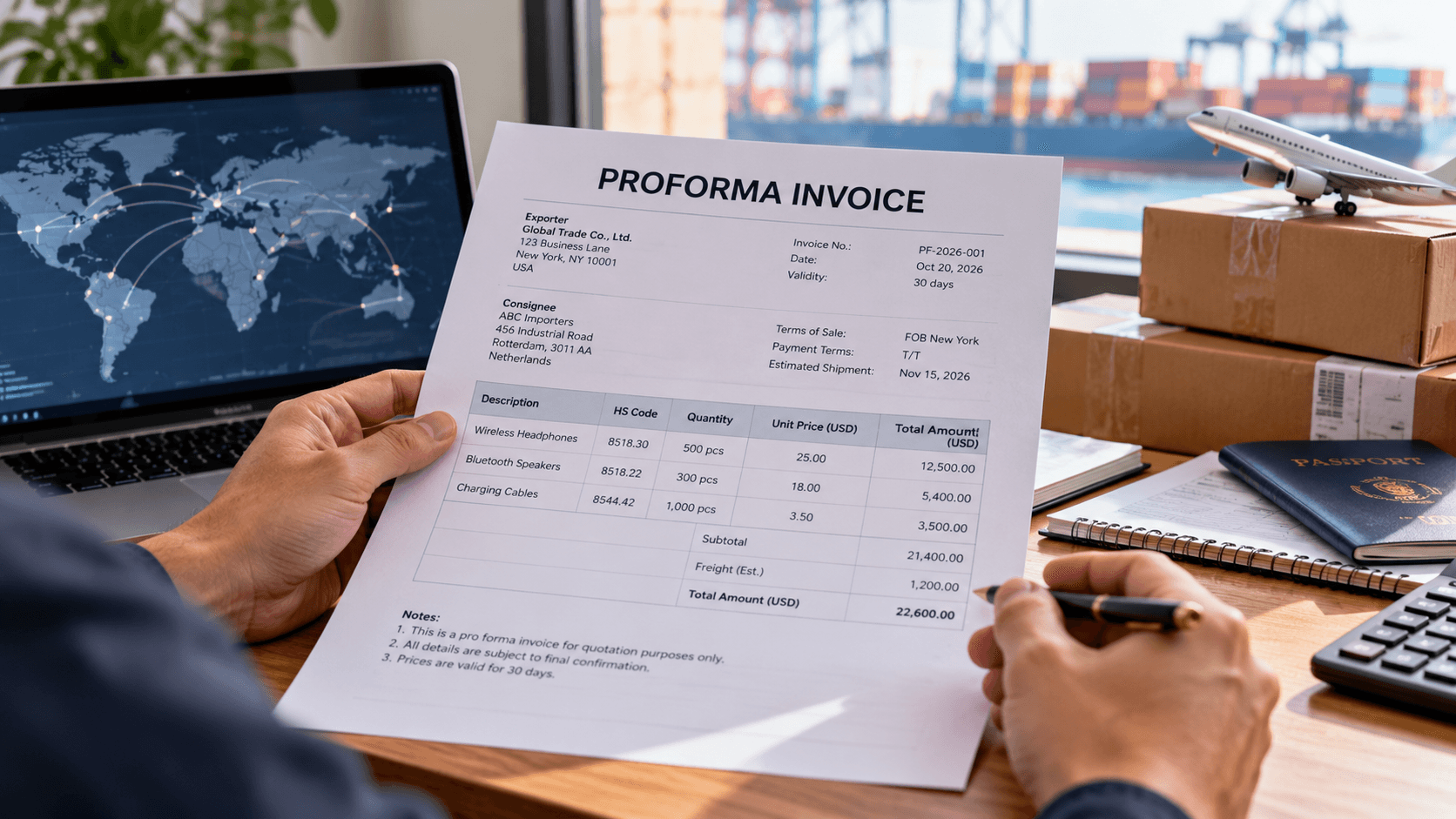
A proforma invoice is a preliminary document issued by a seller to describe a proposed sale before the transaction is finalized or goods are shipped. It resembles a regular invoice but generally functions as a detailed quotation rather than a final demand for payment. A proforma invoice typically includes product descriptions, quantities, prices, delivery conditions, payment terms, and other information the buyer needs to evaluate the proposed transaction.
Proforma invoices are widely used in international trade, wholesale purchasing, manufacturing, and business-to-business transactions. They allow buyers to review the expected cost and commercial conditions before committing to an order. In cross-border transactions, they may also support import-license applications, financing arrangements, or other pre-shipment procedures.
Understanding what a proforma invoice means is particularly important when dealing with overseas suppliers. A buyer may receive several documents during one transaction, including a quotation, purchase order, proforma invoice, packing list, and commercial invoice. Each serves a different purpose, and confusing them can lead to payment errors, shipping delays, or customs problems.
What Is a Proforma Invoice?
A proforma invoice is a quotation presented in invoice format that outlines the details of a proposed commercial transaction. It provides buyers with a structured summary of the goods or services being offered, estimated charges, and the conditions under which the seller intends to supply them. It is normally issued before the final commercial invoice.
According to the U.S. International Trade Administration, a pro forma invoice can support negotiations and provide details needed for certain import and financing procedures. Although it may resemble the final invoice, its primary function is to communicate the proposed transaction before shipment. Its legal and contractual effect depends on the terms, acceptance, and applicable law.
For example, a U.S. distributor purchasing packaging materials from an overseas manufacturer may request a proforma invoice before placing a final order. The document can specify the products, order quantities, currency, agreed Incoterm, expected shipping date, and payment requirements. The buyer can then verify the information against its purchasing budget and import arrangements.
What Is the Purpose of a Proforma Invoice?
The purpose of a proforma invoice is to give the buyer clear commercial information before the transaction proceeds. It helps both parties confirm what is being purchased, how much it is expected to cost, and what conditions apply. This reduces the risk of misunderstandings between initial negotiations and final shipment.
A proforma invoice can serve several business functions. Buyers may use it to obtain internal purchasing approval, arrange financing, compare supplier quotations, or confirm the details of an international transaction. Sellers may use it to document the proposed terms and demonstrate that they are prepared to supply the specified products.
In international trade, the document can also provide information needed when arranging a letter of credit, applying for an import license, or preparing for other pre-shipment requirements. Whether it is accepted for a particular purpose depends on the bank, customs authority, transaction, and importing country's rules. It is not automatically a substitute for the final commercial invoice required for customs clearance.
When Is a Proforma Invoice Used?
A proforma invoice is usually used before shipment, especially when the buyer needs a formal estimate of the proposed transaction. The timing is important because the final quantity, price, shipping arrangement, or other details may still need confirmation. Businesses should clearly distinguish estimated terms from final contractual obligations.
International Wholesale Purchasing
International wholesale purchasing often involves longer lead times, multiple service providers, and different responsibilities for transport and customs. A proforma invoice brings important commercial details into one document so the buyer can review them before authorizing the purchase. It may also provide a reference for a freight forwarder or financing provider.
An importer should check that the proforma invoice identifies the correct parties, merchandise, currency, delivery point, and terms of sale. Product descriptions must be sufficiently precise for the transaction and any related administrative processes. General descriptions such as "goods" or "assorted products" may be inadequate for actual trade requirements.
Manufacturing and Custom Orders
Manufacturers may use proforma invoices to document custom specifications before production begins. This is especially useful when products have unique packaging, materials, sizes, branding, or minimum order quantities. Both parties can confirm the scope and expected charges before substantial production costs are incurred.
A custom packaging order, for example, might specify carton dimensions, printing requirements, quantity, unit price, setup fees, and estimated production time. The proforma invoice can help the customer obtain approval and arrange payment. The final manufacturing agreement may still require separate contracts, drawings, or quality specifications.
Advance Payment and Financing Arrangements
A proforma invoice can provide information for a buyer arranging an advance payment, bank transfer, or other financing process. The document helps establish what the proposed payment relates to and which products are expected to be supplied. Certain banking or trade-finance procedures may require additional documents.
However, a proforma invoice by itself is not generally the same as a final payment invoice or proof that goods have been delivered. If a deposit is required, the buyer should verify the supplier, account information, contractual obligations, and payment instructions. Commercial safeguards are particularly important when dealing with a supplier for the first time.
What Information Should a Proforma Invoice Include?
A proforma invoice should include enough information for the buyer to evaluate the proposed goods, prices, shipping terms, and payment conditions. International transactions may require additional details depending on the products and destination country. The exact format is not universal, but incomplete documents can create avoidable uncertainty.
For international shipments, the document may also include package dimensions, weights, country of origin, and other trade-related information when relevant. The U.S. International Trade Administration recommends comprehensive descriptions and clear commercial terms in export quotations and proforma invoices. Requirements may vary with the transaction.
Why the Currency and Delivery Terms Matter
Currency determines how the buyer understands the quoted price and can affect exchange-rate exposure. A supplier quoting $15,000 in U.S. dollars creates a different financial commitment from a quotation in another currency. Buyers should confirm the currency rather than assuming it from a symbol or previous transactions.
Delivery terms are equally important. An Incoterm such as FCA or DAP describes defined transportation obligations, costs, and risk allocation when used correctly under the applicable rules. The proforma invoice should name the delivery point and identify the agreed version where an Incoterm is used.
| Field | Purpose |
|---|---|
| Document title | Identifies the document as a proforma invoice |
| Proforma invoice number | Provides an internal reference |
| Issue date | Shows when the quotation was prepared |
| Seller information | Identifies the supplier and contact details |
| Buyer information | Identifies the intended purchaser |
| Product description | Specifies the goods being offered |
| Quantity and unit | Defines the proposed order size |
| Unit price | Shows the quoted price per unit |
| Extended line total | Quantity multiplied by unit price |
| Currency | Identifies the pricing currency |
| Discounts | Documents agreed price reductions |
| Freight and other charges | Identifies included or additional estimated costs |
| Terms of sale | Clarifies delivery and transport responsibilities |
| Payment terms | Explains proposed payment arrangements |
| Shipping date | States the expected shipment timing |
| Validity date | Shows when the quotation expires |
Proforma Invoice Example
A proforma invoice example shows how a supplier can present the expected terms of a wholesale order before issuing final transaction documents. The following simplified example illustrates a U.S. distributor purchasing commercial packaging products. All company names and figures are hypothetical.
Sample Proforma Invoice
Illustrative document only. Freight beyond the named FCA delivery point, import charges, and other buyer-side costs are not included in the example. The seller and buyer would need complete identifying details and any additional information required for the actual transaction.
The proposed deposit is 30% of $3,300, or $990, with a remaining balance of $2,310. These payment figures should match the supplier's formal agreement and approved payment instructions. The buyer should also verify the products, specifications, lead time, and responsibility for transportation before accepting the transaction.
This example demonstrates how a proforma invoice brings together quantity, pricing, and commercial terms. It is not intended to replace a purchase contract, shipping documentation, or customs commercial invoice. Actual documents must reflect the requirements of the parties and relevant authorities.
| Product | Quantity | Unit price | Total |
|---|---|---|---|
| Corrugated shipping cartons | 2,000 | $1.20 | $2,400 |
| Protective packaging inserts | 2,000 | $0.35 | $700 |
| Printed product labels | 2,000 | $0.10 | $200 |
| Total quoted goods value | $3,300 |
How to Create a Proforma Invoice Step by Step
Creating a proforma invoice involves identifying the parties, describing the proposed sale, calculating expected charges, and specifying commercial terms. The document should be clear enough that the buyer can understand the proposed transaction without making assumptions. Accuracy is particularly important for international orders.
Step 1: Identify the Seller and Buyer
Start with the correct legal or commercial names and relevant contact details of both parties. Where required, include addresses, tax or registration identifiers, and buyer reference numbers. These details should match the information used in supplier onboarding and purchasing documentation.
Inaccurate company names can create problems when buyers submit documents to banks or import authorities. The seller should confirm that the proposed buyer and delivery destination are correct. Buyers should independently verify changes to payment or beneficiary information.
Step 2: Describe Every Product Clearly
List each product with a sufficiently precise description, quantity, and unit of measure. Product codes, material specifications, packaging formats, or technical details may be appropriate depending on the merchandise. A precise description helps prevent disputes over what the supplier has agreed to provide.
For imported goods, a generic product description may be insufficient for customs-related procedures. Depending on the transaction, additional details such as country of origin and product classification may be needed. Those requirements should be checked with the appropriate trade professional.
Step 3: Calculate Unit Prices and Order Totals
Enter the quoted unit price and multiply it by the relevant quantity. Apply any agreed discounts, and clearly distinguish merchandise totals from freight, insurance, setup fees, or other charges. Indicate which charges are estimates and which are fixed under the proposed terms.
A buyer should compare the proposed amounts with its expected purchasing budget and landed-cost assumptions. A low product price may not represent the complete cost of bringing inventory into the warehouse. See Importing Products for Distribution for broader import-cost planning.
Step 4: State Payment and Delivery Conditions
Include the intended payment structure, currency, shipment timing, and terms of sale. If the parties agree to use an Incoterm, specify the named place and applicable version. Ambiguous statements such as "shipping included" may not explain the actual division of responsibility.
Payment terms should state whether a deposit is required and when any remaining balance becomes payable. Credit terms, if available, should be clearly defined. The proforma invoice should align with any related supply agreement or purchase order.
Step 5: Add a Validity Date
A validity date tells the buyer how long the proposed quotation remains available under its stated conditions. This is useful when product costs, freight rates, exchange rates, or supplier capacity may change. An expired quotation should not automatically be treated as a binding current offer.
If the buyer requests changes after the validity period, the seller may need to issue a revised proforma invoice. Updated versions should use clear reference information so the parties know which terms are current. Version control prevents purchasing teams from relying on outdated prices.
Step 6: Review and Send the Document
Before sending the document, confirm arithmetic, product descriptions, quantities, currency, and commercial terms. Review any special conditions that have been negotiated separately. The final document should identify itself clearly as a proforma invoice.
Businesses may create these documents using spreadsheets, accounting systems, ERP platforms, or dedicated invoicing software. The tool matters less than the accuracy and consistency of the information. For growing distributors, standardized templates reduce manual errors and improve purchasing traceability.
Proforma Invoice vs. Commercial Invoice
The main difference between a proforma invoice and a commercial invoice is that a proforma invoice describes a proposed transaction, while a commercial invoice documents the actual sale and amount payable. In international trade, the commercial invoice is an important document for customs valuation and clearance. The proforma invoice is generally used earlier in the transaction.
A commercial invoice must accurately reflect the transaction rather than merely repeat an earlier estimate. If quantities, product descriptions, prices, or commercial terms change before shipment, the final document should show the actual agreed sale. Customs requirements vary by jurisdiction and product.
According to the U.S. International Trade Administration, the commercial invoice is one of the principal documents used by customs authorities in determining duties. A proforma invoice, by contrast, helps establish the proposed terms before the shipment. See the International Trade Administration's export document guidance.
| Feature | Proforma invoice | Commercial invoice |
|---|---|---|
| Main purpose | Preliminary quotation | Document actual commercial sale |
| Typical timing | Before shipment or finalization | In connection with finalized sale and shipment |
| Prices | Proposed or quoted | Actual invoiced amounts |
| Payment demand | Generally not final billing | Usually requests or records payment due |
| Customs role | May support preliminary procedures | Common document for customs clearance |
| Changes | May be revised during negotiation | Must accurately reflect the actual sale |
| Accounting treatment | Generally not recognized as final sales invoice | Used in sales and accounting records as applicable |
Proforma Invoice vs. Purchase Order
A proforma invoice is usually issued by the seller, while a purchase order is typically issued by the buyer to request or authorize a purchase. Both describe products, quantities, prices, and commercial conditions, but they perform different functions in the purchasing process. A purchase order can create contractual obligations when accepted under applicable terms.
A buyer may first request a quotation or proforma invoice to establish proposed terms. After reviewing and approving the offer, the buyer may issue a purchase order referencing those terms. The supplier then processes the order according to the agreement.
The distinction is operationally important because a proforma invoice should not automatically be treated as proof that the buyer has placed an approved purchase order. Businesses should establish a consistent purchasing authorization process. This can include approval limits, documented supplier terms, and matching order information to later invoices.
| Feature | Proforma invoice | Purchase order |
|---|---|---|
| Issued by | Seller | Buyer |
| Main function | Presents proposed selling terms | Requests or authorizes purchase |
| Typical use | Quotation and pre-shipment planning | Procurement control |
| Product details | Proposed goods and pricing | Ordered goods and agreed requirements |
| Timing | Usually before final order processing | When buyer places or authorizes order |
| Contractual effect | Depends on acceptance and terms | May become binding under applicable conditions |
Proforma Invoice vs. Quotation
A proforma invoice and a quotation can serve similar preliminary selling functions, but a proforma invoice typically uses a more formal invoice-style structure. Both communicate proposed prices and conditions before the sale is finalized. The practical difference depends on the transaction and the information requested by the buyer.
A basic quotation may list products and selling prices without extensive shipment information. A proforma invoice often includes more detailed buyer identification, shipping conditions, payment arrangements, and other transaction data. International buyers may specifically request proforma invoices for financing or administrative purposes.
Neither document should automatically be assumed to transfer ownership of goods or establish final customs values. Those consequences depend on the actual agreement, applicable law, and the completed transaction. Sellers should use clear document labels and avoid mixing provisional and finalized terms.
Is a Proforma Invoice Legally Binding?
A proforma invoice is not automatically a legally binding contract merely because it has been issued, but its contractual significance depends on the parties' conduct, wording, and applicable law. A document described as preliminary can still form part of a binding agreement if the relevant legal requirements are satisfied. Businesses should not rely solely on the title of the document to determine their obligations.
For example, a supplier may send a proforma invoice and a buyer may accept its stated terms through an agreed ordering process. Whether that acceptance creates enforceable obligations depends on the transaction and governing law. In complex transactions, a separate written contract can make responsibilities clearer.
Companies should carefully distinguish quotations from order confirmations, deposit requirements, and final invoices. When significant amounts or international legal considerations are involved, qualified legal advice may be appropriate. Clear commercial documentation is generally less costly than resolving a later dispute.
Is a Proforma Invoice Used for Payment?
A proforma invoice may provide details used to arrange a deposit or advance payment, but it is not generally a final commercial invoice requesting settlement for completed delivery. Some sellers require deposits before manufacturing or shipment, particularly for custom or internationally sourced goods. Buyers should distinguish the agreed payment obligation from the preliminary document used to describe it.
The presence of banking details on a proforma invoice does not by itself verify that the recipient is legitimate. Businesses should confirm beneficiary information through trusted channels, especially if payment instructions change unexpectedly. International transfers may be difficult to reverse after processing.
A good payment control process compares the proforma invoice with the approved purchase order, supplier agreement, and verified bank details. Finance teams should also confirm that deposits are correctly recorded and reconciled against the final transaction. These steps support both fraud prevention and accurate accounting.
Can a Proforma Invoice Be Used for Customs?
A proforma invoice can be used in certain preliminary customs, licensing, or import procedures, but it is not universally accepted as a substitute for the final commercial invoice. Requirements depend on the importing country, shipment type, product, customs procedure, and supporting documents. A transaction involving an actual sale generally requires documentation reflecting the real commercial value and other applicable details.
The U.S. International Trade Administration describes proforma invoices as useful for advance arrangements such as import licensing or letters of credit. Its guidance also identifies the commercial invoice as a key customs document. Businesses should confirm the requirements for their particular shipment before relying on a preliminary invoice.
Customs professionals and freight forwarders can help determine which documents are necessary. Inaccurate or incomplete paperwork can delay clearance or create additional costs. The International Shipping Guide for Distributors explains related responsibilities in cross-border distribution.
Common Proforma Invoice Mistakes
The most common proforma invoice mistakes involve missing commercial terms, incorrect totals, ambiguous product descriptions, and confusion with final invoices. These errors can delay purchasing approvals or cause different teams to work from inconsistent assumptions. A standardized review process helps prevent them.
A frequent problem is quoting a product price without specifying which party pays freight and import charges. Another is omitting the quotation validity date, leaving buyers uncertain about whether prices remain available. Incorrect currencies or banking details create additional financial risks.
Businesses should also ensure that the proforma invoice, purchase order, and final commercial invoice can be reconciled. Differences may be legitimate, but they should be explained and approved. The purpose of the documentation is to create a traceable transaction rather than generate paperwork for its own sake.
How Proforma Invoices Help Wholesale Distributors
Proforma invoices help wholesale distributors evaluate supplier offers before committing working capital to inventory. A clear document allows purchasing teams to compare quantities, quoted costs, production timelines, and delivery responsibilities. This is particularly valuable when several suppliers offer similar goods under different commercial terms.
For example, one supplier may quote a lower unit price but require a larger minimum order and a significant advance deposit. Another may offer a higher price with a smaller opening order and shorter delivery lead time. The proforma invoice gives the buyer a structured starting point for comparing those terms.
Distributors should still evaluate total landed cost, demand forecasts, supplier reliability, and inventory exposure. The preliminary quotation is an input into purchasing decisions, not a substitute for financial analysis. The guides on Negotiating With Suppliers and Minimum Order Quantity explain related purchasing controls.
Final Takeaway
A proforma invoice is a preliminary commercial document that helps buyers and sellers confirm proposed transaction details before shipment or final billing. It commonly includes product descriptions, quantities, prices, payment terms, delivery conditions, and expected shipment information. Its value lies in making the proposed sale clear enough for purchasing, financing, and operational planning.
For wholesale distributors, a carefully prepared proforma invoice can reduce uncertainty when comparing suppliers and arranging international purchases. However, it should not be confused with an approved purchase order, a final commercial invoice, or proof that goods have been delivered. Clear documentation, verified suppliers, and consistent purchasing controls are essential to completing the transaction successfully.
Frequently Asked Questions
- What is a proforma invoice in simple terms?
- A proforma invoice is a preliminary invoice-style quotation showing the proposed products, quantities, prices, and commercial conditions of a transaction. It is generally issued before the final sale or shipment. Buyers use it to review costs and arrange the next purchasing steps.
- What is the difference between proforma and commercial invoice?
- A proforma invoice describes a proposed sale, while a commercial invoice records the actual commercial transaction. Commercial invoices are commonly used for final billing and customs purposes. The two documents may contain similar information but serve different stages of the transaction.
- Can a proforma invoice be changed?
- Yes, a proforma invoice can generally be revised during negotiations, subject to the parties' obligations and any accepted agreement. Changes may include quantities, product specifications, prices, delivery terms, or expected shipment dates. Revised documents should be clearly identified.
- Does a proforma invoice require payment?
- A proforma invoice does not automatically create a final payment obligation simply because it is issued. However, an agreed transaction may require an advance deposit or another payment based on the accepted terms. Buyers should confirm the underlying agreement before transferring funds.
- Who prepares a proforma invoice?
- The seller or supplier normally prepares the proforma invoice. It communicates the proposed sale to the buyer and may include the information needed for internal approval, financing, or trade arrangements. The buyer should review the document before proceeding.
- Is a proforma invoice the same as a purchase order?
- No. The seller typically issues the proforma invoice to present proposed terms, while the buyer typically issues a purchase order to request or authorize goods. The documents can refer to the same transaction but have different business functions.
- Is a proforma invoice required for every international shipment?
- No universal rule requires a proforma invoice for every international shipment. Its necessity depends on the parties, financing arrangements, importing country, and relevant procedures. A final commercial invoice and other export or import documents may still be required.