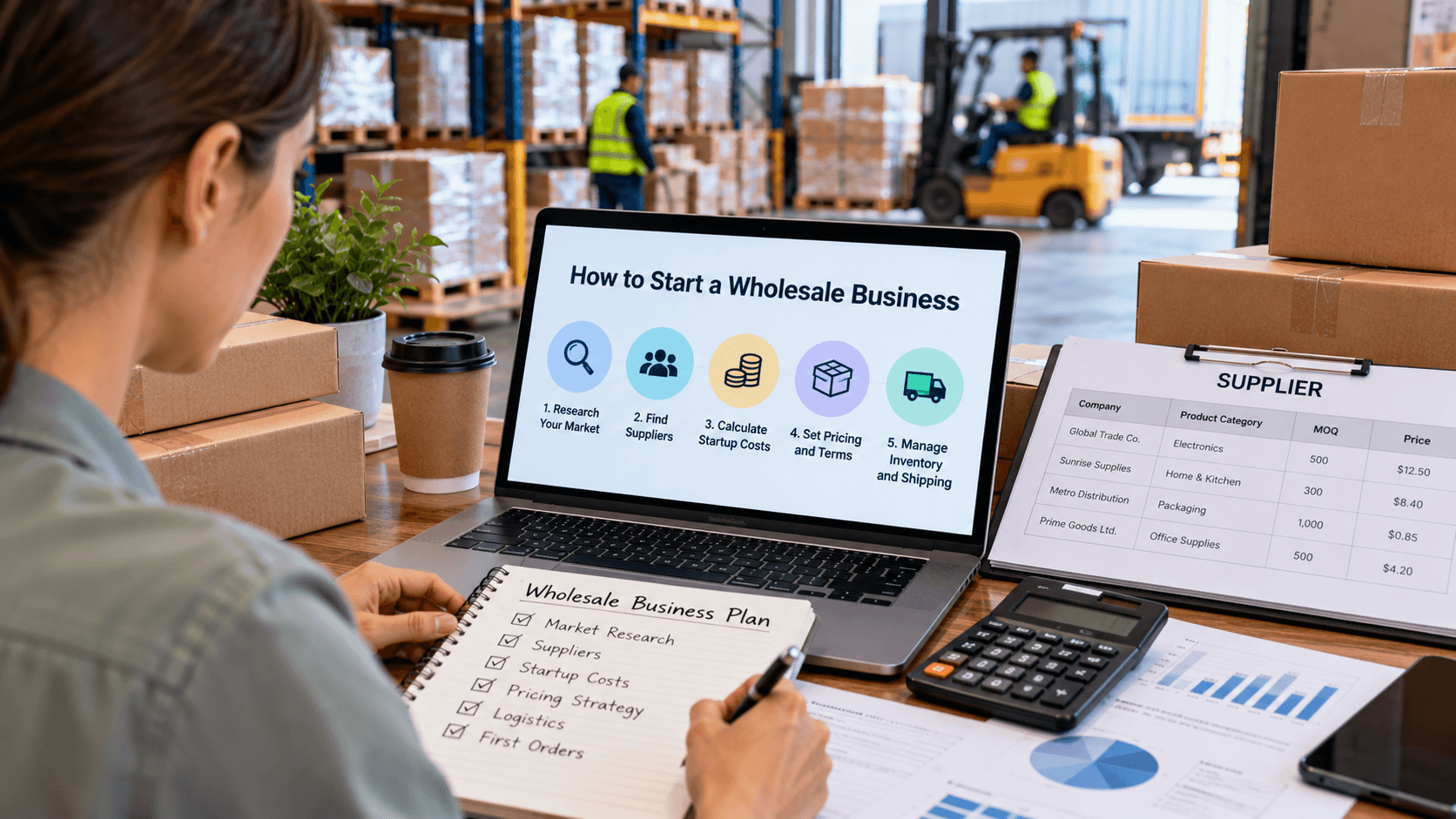
Learning how to start a wholesale business begins with choosing products that business customers repeatedly need, finding reliable suppliers, and establishing a profitable purchasing and resale model. A wholesale business typically sells merchandise to retailers, contractors, restaurants, institutions, or other businesses rather than primarily to individual consumers. Successful operations combine competitive sourcing with dependable inventory availability, realistic pricing, and repeat customer relationships.
Starting a wholesale business does not necessarily require a large warehouse or a national supplier network. Some entrepreneurs begin with a narrow product category, a few commercial customers, and outsourced fulfillment. Others establish regional stock-and-deliver operations with warehouses, delivery vehicles, and extensive product catalogs.
The financial requirements differ considerably between these approaches. A company purchasing and storing inventory must finance merchandise before it sells, while a commission-based wholesale agent may avoid owning stock. Understanding these differences before signing supplier agreements helps founders reduce costly mistakes.
How to Start a Wholesale Business: 10 Essential Steps
Starting a wholesale business requires a structured process covering market research, suppliers, registration, pricing, inventory, and customer acquisition. The order matters because entrepreneurs can commit substantial money to inventory before confirming that enough businesses will buy it. Demand validation should come before major purchasing commitments.
The main steps are:
- Choose a wholesale business model.
- Select a profitable product niche.
- Research potential wholesale customers.
- Create a business plan and cash-flow forecast.
- Register the business and verify legal requirements.
- Find and evaluate wholesale suppliers.
- Calculate startup costs and obtain financing.
- Set wholesale prices and purchasing terms.
- Establish inventory and order fulfillment.
- Acquire customers and build repeat B2B sales.
Each step should produce a concrete business decision. For example, supplier research should result in verified quotations and purchasing requirements, while customer research should identify actual businesses and their expected order volumes.
Step 1: Choose Your Wholesale Business Model
The first step in starting a wholesale business is choosing whether to own inventory, arrange transactions, or use another commercially viable supply model. This decision affects startup capital, operating responsibilities, supplier contracts, and the type of customers the company can serve.
Merchant Wholesale
A merchant wholesaler purchases goods and resells them to other businesses. It normally takes ownership of inventory and earns revenue through a spread between purchasing and selling prices. This model provides control over stock availability and fulfillment but creates inventory and working capital exposure.
Wholesale Distribution
A wholesale distributor may build ongoing relationships with manufacturers, represent product lines, and serve a defined market or customer network. Some distributors provide product support, credit terms, local warehousing, and delivery services. The distinction between wholesalers and distributors is not absolute, and many businesses operate as both.
The guide to Wholesaler vs. Distributor vs. Retailer explains the overlapping roles.
Wholesale Agent or Broker
A wholesale agent connects buyers with sellers and earns fees or commissions under agreed terms. The agent generally does not need to own the merchandise being sold. This can reduce inventory investment but makes revenue dependent on successful commercial transactions and reliable supplier relationships.
Supplier-Direct Fulfillment
A wholesale business can sometimes arrange for suppliers or third-party providers to ship products directly to customers. This reduces the need for an owned warehouse but can limit control over delivery performance and inventory accuracy. Contracts should clearly allocate responsibility for shipping errors, returns, customer service, and damaged products.
Step 2: Choose a Wholesale Product Niche
A wholesale business should begin with a product category that has identifiable business customers, repeat demand, and workable supplier economics. Popular products are not automatically profitable wholesale opportunities. An entrepreneur needs an advantage in sourcing, product availability, service quality, or market access.
Potential categories include restaurant packaging, janitorial supplies, automotive components, industrial consumables, office supplies, building materials, and specialty retail merchandise. Some categories have additional licensing, product safety, storage, or import requirements. These obligations must be investigated before buying inventory.
A specialized niche can be easier to manage because the company learns the purchasing patterns of a defined customer group. It also allows the founder to identify fewer, more relevant suppliers instead of building an unfocused catalog.
| Product category | Potential customers | Important consideration |
|---|---|---|
| Restaurant supplies | Restaurants, caterers | Repeat demand and delivery frequency |
| Janitorial products | Cleaning companies, facilities | Product specifications and route density |
| Automotive parts | Repair shops | SKU breadth and fitment accuracy |
| Industrial supplies | Manufacturers, contractors | Technical requirements and availability |
| Retail accessories | Independent stores | Fashion risk and seasonality |
| Food products | Restaurants, retailers | Shelf life and food safety |
| Packaging materials | Ecommerce businesses | Freight volume and storage space |
Step 3: Validate Customer Demand Before Buying Inventory
Validating wholesale demand means confirming that identifiable businesses are willing to purchase the proposed products at workable prices and volumes. General market popularity is insufficient evidence. A product may sell well to consumers while offering little room for a new wholesale intermediary.
Start by identifying potential customers within a realistic service area or sales channel. Determine which products they purchase, how often they reorder, what minimum quantities they accept, and which service problems existing suppliers fail to solve. Conversations with purchasing managers can reveal opportunities that broad online research misses.
A practical validation exercise might involve contacting 25–50 relevant businesses, gathering purchasing information, and seeking trial-order commitments where possible. The number is a planning suggestion, not a guarantee of market viability. Actual willingness to place orders matters more than favorable informal feedback.
Step 4: Write a Wholesale Business Plan
A wholesale business plan should connect expected customer demand with purchasing costs, supplier terms, inventory investment, and cash-flow requirements. It should explain how the company will generate revenue, fulfill orders, and remain financially stable while growing. A plan based entirely on hoped-for sales is not sufficient.
The business plan should cover the target industry, customer segments, competitor analysis, supplier arrangements, product economics, marketing approach, fulfillment model, staffing, and financial projections. A 12-month operating budget can help establish expected costs and revenue targets. Founders should also test downside scenarios.
For example, evaluate what happens if monthly sales reach only 60% of the forecast, suppliers require advance payment, or customers pay two weeks later than expected. These scenarios reveal whether startup financing is adequate. The complete Distribution Business Startup Guide provides a broader framework for operational planning.
Step 5: Register Your Wholesale Business in the USA
Starting a wholesale business in the United States requires selecting an appropriate legal structure, completing applicable registration, and checking relevant tax and industry requirements. The exact obligations vary by state, product category, location, and business activities. No single wholesale license applies universally to every U.S. wholesaler.
Businesses commonly consider LLCs and corporations, but sole proprietorships and partnerships may also be possible depending on the situation. After establishing the appropriate legal structure, an owner may need an Employer Identification Number from the IRS, state tax registration, local business permits, and other category-specific authorizations.
Do You Need a Resale Certificate?
A resale certificate is commonly used to document qualifying purchases of merchandise intended for resale under applicable state sales-tax rules. It is not necessarily the same as a business license or seller's permit. Requirements and acceptance procedures vary between states.
Entrepreneurs should verify whether their products require additional permissions. Food, pharmaceuticals, medical devices, alcohol, and hazardous materials can involve specialized obligations. Qualified legal or tax assistance may be useful for regulated categories or multi-state operations.
Step 6: Find Reliable Wholesale Suppliers
Finding suppliers for a new wholesale business requires identifying legitimate manufacturers, authorized distributors, importers, or commercial supply companies with suitable products and purchasing conditions. The cheapest quote is not necessarily the best option. Product quality, reliability, minimum orders, and the supplier's willingness to support a new account all matter.
Supplier discovery can involve industry associations, manufacturer websites, trade shows, B2B marketplaces, referrals, and professional sourcing directories. A useful shortlist should contain suppliers capable of serving the intended market rather than an indiscriminate collection of contacts.
Before placing an order, confirm the supplier's business identity, product authorization where relevant, quality requirements, lead times, payment conditions, and return policy. Obtain samples or conduct a controlled trial when the product and transaction justify it.
What to Ask a Wholesale Supplier
Negotiation should address the entire commercial arrangement rather than just purchase price. Our Negotiating With Suppliers guide explains the importance of minimum quantities, freight, payment terms, and supplier performance.
| Question | Why it matters |
|---|---|
| What is the minimum order quantity? | Determines initial stock commitment |
| What are your price breaks? | Supports volume and margin analysis |
| What are the payment terms? | Affects working capital |
| How long is replenishment? | Influences inventory requirements |
| What happens with defects? | Clarifies claims and replacement costs |
| Is brand authorization required? | Reduces channel and sourcing risks |
| Who pays freight? | Determines delivered cost |
| Are products returnable? | Limits exposure to slow-moving stock |
Step 7: Calculate Wholesale Business Startup Costs
Wholesale business startup costs depend on inventory commitments, warehouse arrangements, delivery requirements, software, insurance, and the cash needed to finance operations. A small commission-based brokerage can require considerably less merchandise financing than an inventory-owning wholesaler. A warehouse-based distributor may need substantial capital before its first customer pays.
The following budget is a hypothetical lean inventory-owning wholesale startup, not a verified industry average.
Actual expenses can be substantially lower or higher. Some businesses require their own facilities, vehicles, specialized storage, or larger purchasing commitments. Others can begin by arranging transactions without owning inventory.
Working Capital Matters More Than the First Inventory Order
A wholesale business can report profitable sales but struggle because customer invoices are collected after supplier bills become due. Suppose the company holds inventory for 45 days, collects receivables after 35 days, and pays suppliers after 20 days. Its simplified cash conversion cycle is 45 + 35 − 20 = 60 days.
That cycle represents an ongoing financing requirement, not simply a one-time opening purchase. Growing sales can increase inventory and receivables faster than cash becomes available. The Distribution Business Startup Cost Guide explores budget planning in greater detail.
| Startup expense | Illustrative budget |
|---|---|
| Initial merchandise inventory | $25,000 |
| Registration, professional fees, initial compliance | $2,000 |
| Insurance and deposits | $3,500 |
| Outsourced warehouse setup | $4,500 |
| Software and equipment | $2,500 |
| Product samples and customer acquisition | $3,000 |
| Initial freight and receiving | $4,000 |
| Operating cash reserve | $15,000 |
| Total illustrative startup requirement | $59,500 |
Step 8: Set Wholesale Prices That Protect Profit
Wholesale pricing must cover appropriate product costs and support the expenses of acquiring, storing, selling, and delivering merchandise. A competitive supplier quote is useful only when the final customer price can produce a sustainable financial contribution. Pricing decisions should reflect both market conditions and actual operating costs.
A common gross-margin pricing formula is:
Selling price = Unit cost ÷ (1 − Target gross margin)
If a product costs $18 per unit and management targets a 25% gross margin, the selling price is $18 ÷ 0.75 = $24.
The resulting $6 gross profit must contribute toward expenses not included in COGS. Customer-specific freight, sales commissions, credit terms, and returns can reduce overall profitability. Entrepreneurs should monitor realized margins instead of assuming every invoice produces the planned result.
Step 9: Establish Inventory and Fulfillment Operations
A wholesale business needs a reliable way to receive, track, store, and deliver products even if it does not operate its own warehouse. Customers expect accurate quantities and predictable delivery. An appealing price rarely compensates for repeated shortages or damaged shipments.
A lean business can outsource storage and fulfillment to a third-party logistics provider. This reduces some fixed facility commitments but adds service fees and dependence on an external operator. The economics should be compared with expected order size, SKU count, storage requirements, and shipment frequency.
At a minimum, the company should track stock by SKU, available quantity, committed orders, supplier lead time, and replenishment requirements. Periodic physical verification is necessary even when inventory software is used. Accurate records support purchasing and prevent promising products that cannot be delivered.
Step 10: Find Your First Wholesale Customers
Finding wholesale customers requires identifying businesses with a recurring purchasing need and presenting a commercially credible offer. Most new wholesalers cannot rely on website traffic alone. Direct outreach, referrals, trade associations, local business networks, and targeted B2B marketing can help establish initial accounts.
A strong first offer should explain product availability, price structure, minimum order, delivery expectations, and how the supplier solves an existing problem. Buyers may request samples, company documentation, credit applications, or a limited initial order. The objective is to make the first transaction low-risk for both parties.
The business should focus on securing repeat customers rather than accumulating leads that never purchase. Measure trial-order conversion, reorder frequency, average order value, gross contribution, and payment performance. These indicators provide better evidence of traction than the number of contacts collected.
Wholesale Business Profit Example
Wholesale profitability depends on the relationship between sales, cost of goods sold, operating expenses, and working capital. Large invoice totals do not automatically translate into large earnings. A financial forecast should show the complete operating picture.
This business generates a 25% gross margin and a 5% operating margin in the simplified model. Interest and applicable taxes would affect net profit. Cash receipts may also differ from reported revenue because of customer credit terms.
| Monthly financial item | Hypothetical amount |
|---|---|
| Revenue | $80,000 |
| COGS | $60,000 |
| Gross profit | $20,000 |
| Warehouse and fulfillment | $5,000 |
| Sales and marketing | $3,000 |
| Administration, insurance, software | $5,000 |
| Other operating expenses | $3,000 |
| Operating profit | $4,000 |
Common Mistakes When Starting a Wholesale Business
The most expensive wholesale startup mistakes often involve buying inventory before proving demand, accepting unsuitable supplier terms, and underestimating cash needs. Entrepreneurs may focus heavily on discounts while overlooking shipping, storage, returns, and the sales cycle. A large opening order can quickly create a liquidity problem.
Other common mistakes include serving too many product categories, extending customer credit without controls, using inconsistent inventory records, and assuming suppliers will always deliver on time. A new company should keep its initial operation manageable and expand only as purchasing data and customer demand become more reliable.
The first milestone should be a repeatable profitable order, not the largest possible warehouse or catalog. Validated demand, predictable fulfillment, and disciplined finances form a stronger foundation than rapid expansion funded by speculative stock purchases.
A Practical 90-Day Wholesale Startup Plan
A 90-day wholesale startup plan should focus on validating customers, completing legal and supplier setup, and proving the first operating cycle. The sequence below is an illustrative framework rather than a promise that every business can launch in three months.
The plan should be adjusted for product licensing, imports, long manufacturing lead times, and financing approvals. No inventory should be purchased merely to satisfy the calendar. Financially supported orders and reliable suppliers matter more than arbitrary launch speed.
| Period | Main objective | Deliverable |
|---|---|---|
| Days 1–15 | Select category and target customers | Product shortlist and buyer research |
| Days 16–30 | Verify suppliers and purchasing requirements | Quotations and supplier comparison |
| Days 31–45 | Complete business setup and financial model | Budget, registrations, pricing |
| Days 46–60 | Establish fulfillment and order processes | Tested purchasing-to-delivery workflow |
| Days 61–75 | Conduct outreach and secure trial orders | First qualified purchase commitments |
| Days 76–90 | Fulfill orders, collect feedback, optimize | Performance and cash-flow review |
Final Takeaway
How to start a wholesale business successfully comes down to validating commercial demand, securing reliable suppliers, and protecting cash throughout the purchasing and resale cycle. A profitable wholesale operation needs more than access to discounted merchandise. It requires sound pricing, customer relationships, inventory discipline, and dependable fulfillment.
Founders should begin with a narrow market, test real purchasing demand, and commit capital gradually where practical. Supplier terms and customer payment timing deserve as much attention as selling prices. Building a repeatable operating system creates a stronger foundation for long-term wholesale growth.
Frequently Asked Questions
- How do I start a wholesale business with no experience?
- Begin by researching a specific product category and speaking with prospective commercial buyers. Learn supplier purchasing terms, product costs, and inventory economics before making major commitments. A small trial operation can help develop practical experience.
- How much money do you need to start a wholesale business?
- The amount depends on the business model, product category, inventory requirements, and operating structure. An inventory-owning wholesaler may need significant capital for merchandise and working capital, while an agent model may require less. A cash-flow forecast is more useful than a universal startup estimate.
- Do I need a warehouse to start a wholesale business?
- Not necessarily. Some businesses use third-party logistics providers, supplier-direct delivery, or commission-based arrangements. The chosen model must still provide reliable order fulfillment and appropriate inventory control.
- Can you start a wholesale business from home?
- Some wholesale businesses can manage administration and sales from a home office, subject to local requirements and the products involved. Physical storage, shipping, zoning, and product regulations may limit what can be operated at a residential address.
- How do wholesale businesses make money?
- Merchant wholesalers generally earn revenue by purchasing merchandise and reselling it at a higher price. Agents or brokers may earn fees or commissions. Profitability depends on purchasing costs, selling prices, operating expenses, and order volume.
- How do I find wholesale buyers?
- Identify businesses that purchase the product category and contact decision-makers through appropriate B2B channels. Demonstrate pricing, service reliability, product suitability, and fulfillment capabilities. Customer retention and repeat orders are important measures of success.