Logistics
Wholesaler vs Distributor vs Retailer: How Products, Prices, and Profits Move Through the Supply Chain
Distributor, wholesaler, and retailer are often shown as three fixed steps between the manufacturer and consumer. Real supply chains are more flexible. This guide explains who buys from whom, who owns inventory, how each business makes money, and where the roles overlap.
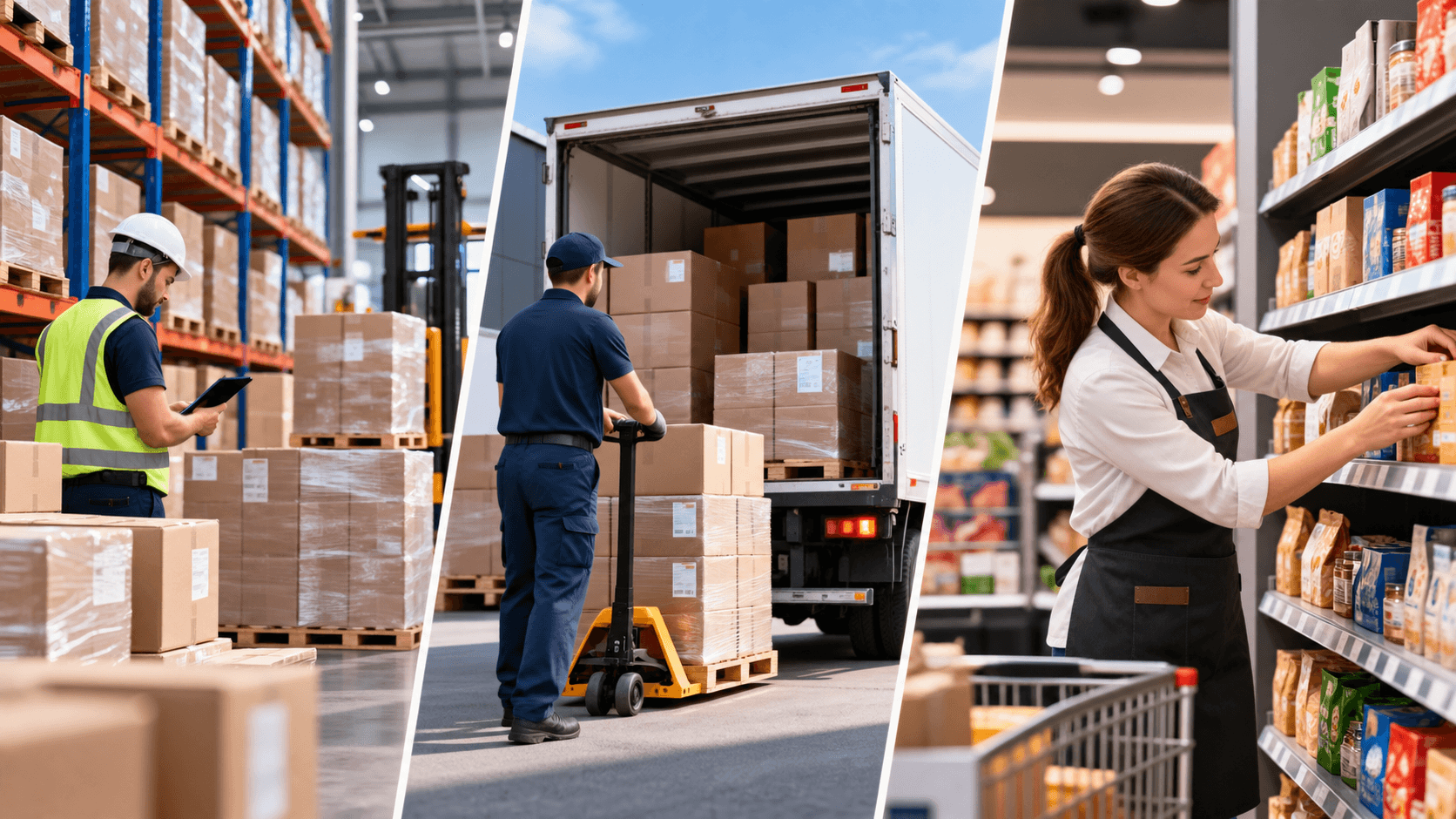
The wholesaler vs distributor vs retailer difference starts with where each business creates value. A distributor commonly builds market coverage around manufacturers and product lines, a wholesaler focuses on sourcing and reselling goods efficiently to other businesses, and a retailer sells primarily to the final consumer.
That description is useful, but it is not a rigid rule. A manufacturer can sell directly to a retailer, a distributor can sell directly to business end users, a wholesaler can buy straight from the manufacturer, and one company can perform more than one role at the same time.
There is another important distinction that many wholesaler vs distributor vs retailer comparisons miss. Under U.S. Census Bureau definitions, distributors that buy and take title to merchandise are a type of merchant wholesaler. In other words, “distributor” and “wholesaler” can describe meaningfully different commercial models while still overlapping in official U.S. industry classification.
Understanding that overlap matters because the real business question is not simply what each company calls itself. The important differences are who it buys from, who it sells to, whether it owns inventory, how it earns its margin, what services it performs, and which risks it accepts.
Wholesaler vs Distributor vs Retailer: The 30-Second Answer
A distributor usually buys products and develops sales across a market, territory, dealer network, or customer group. The relationship with the manufacturer is often more structured, although exclusivity and territory rights should never be assumed without an actual agreement.
A wholesaler primarily buys or arranges the sale of products for other businesses. Merchant wholesalers commonly make money by purchasing goods, holding or sourcing inventory, and reselling them to retailers, contractors, institutions, farms, resellers, or other commercial customers.
A retailer operates closest to the final consumer. Retailers sell products for personal or household use through stores, ecommerce sites, marketplaces, vending, direct delivery, and other consumer-facing channels.
The wholesaler vs distributor vs retailer table shows why “who has the highest markup?” is not enough to choose between these models. Each business performs different work before it earns that markup.
| Comparison | Distributor | Wholesaler | Retailer |
| Primary role | Develops and supplies a market/channel | Sources and resells goods to businesses | Sells to final consumers |
| Typical supplier | Manufacturer or brand | Manufacturer, distributor, importer, other wholesaler | Wholesaler, distributor, manufacturer |
| Typical customer | Dealers, retailers, wholesalers, businesses | Retailers and other businesses | Consumers |
| B2B or B2C | Mainly B2B | Mainly B2B | Mainly B2C |
| Inventory ownership | Common | Common for merchant wholesalers | Common |
| Typical order size | Large | Medium to large | Small |
| Unit selling price | Generally lower downstream | Generally higher than upstream distributor level | Generally highest |
| Manufacturer relationship | Can be close/formal | Often more transactional | Varies |
| Territory | May be defined | Usually less central | Local, regional, national, or online |
| Assortment | May focus on fewer brands | Often broader | Curated for final customer |
| Marketing focus | Market/channel development | Account acquisition and product availability | Consumer demand |
| Sales cycle | B2B, sometimes complex | B2B | Usually shorter |
| Payment terms | Often commercial terms | Often commercial terms | Usually immediate |
| Main asset | Supplier rights + market coverage | Procurement + inventory + customer base | Consumer access + brand/store traffic |
| Main risk | Supplier dependence and inventory | Inventory and working capital | Consumer demand and acquisition cost |
The Typical Supply Chain – and Why It Is Not a Rule
The textbook version of the supply chain often looks like this:
Manufacturer → Distributor → Wholesaler → Retailer → Consumer
This model does exist. A manufacturer can appoint a distributor to develop a region, the distributor can supply wholesalers, wholesalers can serve independent retailers, and retailers can sell individual units to shoppers.
But treating this as the required wholesaler vs distributor vs retailer structure creates problems. Modern channels frequently remove one or more stages.
A product may instead move through any of these paths:
- Manufacturer → Distributor → Retailer → Consumer
- Manufacturer → Wholesaler → Retailer → Consumer
- Manufacturer → Distributor → Business end user
- Manufacturer → Retailer → Consumer
- Manufacturer → Consumer
- Manufacturer → Distributor → Dealer → Customer
- Manufacturer → Company-owned distribution center → Retail store → Consumer
Even academic supply-chain materials distinguish between wholesaler channels, direct-to-retailer channels, and direct-to-consumer channels rather than treating every intermediary as mandatory.
The practical lesson is simple: supply-chain roles should be identified by what the company actually does, not by forcing every business into one diagram.
What Is a Distributor?
A distributor is generally a business that purchases products for resale and makes them available across a market, territory, customer network, or industry. In many sectors, distributors build closer manufacturer relationships than general wholesalers and may take responsibility for sales development, dealer recruitment, forecasting, technical support, marketing, training, warranty coordination, or regional inventory.
The official U.S. definition is particularly useful. The Census Bureau defines a wholesale distributor as a wholesaler that buys and owns, or takes title to, products before reselling them to customers.
That means a distributor is not simply a salesperson or broker. In the merchant-distribution model, the distributor puts its own capital into inventory and accepts the risk that the products may take longer than expected to sell.
Within the wholesaler vs distributor vs retailer comparison, the distributor is therefore usually best understood as a market-access business. Its value can come from making the manufacturer’s products available to many downstream buyers more efficiently than the manufacturer could serve those accounts itself.
What Is a Wholesaler?
A wholesaler sells merchandise primarily to other businesses rather than to the general public. Those customers can include retailers, contractors, farms, institutions, government buyers, manufacturers, restaurants, service companies, or other wholesalers.
The Census Bureau describes wholesale trade as an intermediate stage in merchandise distribution and notes that wholesalers sell goods for resale, capital or durable nonconsumer goods, and raw or intermediate materials used in production. Wholesale establishments generally operate through warehouses or offices rather than locations designed primarily to attract consumer walk-in traffic.
This definition also reveals why the wholesaler vs distributor vs retailer comparison is more nuanced than everyday terminology suggests. Census includes wholesale merchants, distributors, jobbers, drop shippers, import/export merchants, sales branches, agents, brokers, and manufacturers’ representatives within the broader wholesale sector, although their ownership and operating models differ.
A merchant wholesaler typically earns money from the spread between acquisition cost and resale revenue. The company creates additional value through assortment, purchasing volume, local inventory, credit, delivery, consolidated ordering, and making procurement easier for business customers.
What Is a Retailer?
A retailer primarily sells goods to consumers. The Census Bureau’s Monthly Retail Trade definitions describe retailers as businesses selling goods in small quantities directly to consumers.
Retail should not be confused with physical stores. Ecommerce businesses, direct sellers, vending operations, and other non-store formats can all perform the retail function when they are organized around final consumer sales.
Retailers sit closest to the customer in the conventional wholesaler vs distributor vs retailer chain. This gives them direct access to consumer behavior and often greater control over merchandising, promotions, customer experience, and the final selling price.
It also makes retailers responsible for generating consumer demand. A wholesaler may maintain 500 business accounts, while a retailer might need tens of thousands of individual transactions to produce a comparable level of revenue.
Distributor and Wholesaler Are Not Exact Opposites
This is one of the most important points in the entire wholesaler vs distributor vs retailer discussion. In everyday business language, distributors and wholesalers can be distinguished by their manufacturer relationships, territory, product focus, market-development responsibilities, and assortment.
Official U.S. classification is broader. Merchant distributors are classified within wholesale trade because they purchase and own products for resale.
A practical distinction is therefore:
Distributor: often builds around the manufacturer or brand relationship.
Wholesaler: often builds around the customer assortment and purchasing relationship.
Consider an electrical-products market. A regional distributor may represent several manufacturers, stock their products, train contractors, support specifications, and develop demand in a territory. A broad-line wholesaler may carry products from dozens or hundreds of brands so contractors can consolidate purchasing through one supplier.
Both companies can technically be wholesalers. Their business strategies are still different.
Wholesaler vs Distributor vs Retailer: Who Buys From Whom?
There is no single answer that applies to every industry. The most common relationships look like this:
This flexibility is crucial. A large retailer may have enough purchasing power to buy directly from manufacturers, removing both distributor and wholesaler layers for some products.
A small independent retailer may benefit from buying from a wholesaler because the wholesaler allows it to combine products from many manufacturers in one order. A specialized manufacturer may rely on distributors because its customer base is too fragmented to serve economically through a factory sales team.
The strongest supply chain minimizes unnecessary cost without eliminating services that someone still needs to perform.
| Business | May buy from | May sell to |
| Distributor | Manufacturer, brand owner, master distributor | Wholesaler, retailer, dealer, contractor, institution, business end user |
| Wholesaler | Manufacturer, distributor, importer, other wholesaler | Retailer, contractor, business, institution, reseller |
| Retailer | Manufacturer, distributor, wholesaler, importer | Final consumer |
Who Owns the Inventory?
A merchant distributor normally owns the inventory it buys. Merchant wholesalers also generally purchase merchandise on their own account, while wholesale agents and brokers can arrange transactions without taking ownership.
Retailers usually own consumer-ready inventory until it is sold, although consignment, marketplace, dropshipping, and other arrangements can change ownership timing.
This makes inventory one of the defining economics in wholesaler vs distributor vs retailer models.
The distributor may carry deep regional stock to support many downstream accounts. The wholesaler may carry a broad assortment to let customers consolidate purchasing. The retailer carries inventory designed around expected final consumer demand.
All three can lose money when inventory stops moving.
Inventory Risk Is Different at Every Stage
Consider a consumer electronics accessory. A distributor might commit to 50,000 units to obtain sufficient supplier economics and cover its market. A wholesaler might purchase 5,000 units for independent retail customers, while an individual retailer might stock only 50 units.
The distributor has the largest single upstream commitment but also potentially supplies hundreds of accounts. The retailer holds fewer units but faces immediate consumer-fashion risk if demand moves to a competing design.
U.S. wholesale inventory demonstrates how central stock is to the sector. Merchant wholesalers covered by the Monthly Wholesale Trade report held $958.9 billion of inventory at the end of July 2026, while July sales were $801.3 billion. The inventories-to-sales ratio stood at 1.20.
Those figures are national economic indicators, not recommended inventory levels for an individual business. They nevertheless show why inventory management is not a secondary issue in wholesale and distribution.
How Pricing Changes Through the Supply Chain
Every intermediary must create enough economic value to justify its place in the channel. When a product moves through several independently owned businesses, each business normally needs enough gross profit to pay for the work it performs.
The distributor may pay for product acquisition, freight, warehousing, regional sales, dealer development, customer credit, technical support, and inventory financing. The wholesaler may carry thousands of SKUs, manage business accounts, offer purchasing convenience, extend payment terms, and operate delivery routes.
The retailer faces a different cost structure. Retail gross profit may need to cover consumer marketing, store rent, ecommerce acquisition, payment processing, individual-order fulfillment, customer support, shrink, returns, merchandising, and promotions.
That is why wholesaler vs distributor vs retailer margins cannot be compared responsibly through a generic percentage table. A business with a 35% gross margin can be less profitable than one with a 15% gross margin if its operating costs and inventory economics are significantly worse.
One Product Moving Through Distributor, Wholesaler, and Retailer
A simplified example makes the economics easier to see. Assume a manufacturer sells a product into a multi-stage channel.
The numbers below are illustrative only. They are not presented as U.S. industry averages.
At first glance, the retailer appears to have the most attractive economics because it earns $35 of gross profit per item. That conclusion would be premature.
Suppose the distributor moves 5,000 units in one series of B2B transactions, the wholesaler sells 500 units per account, and the retailer sells products one at a time while paying for traffic, fulfillment, returns, and customer service. The operational cost required to generate each dollar of gross profit is very different.
The wholesaler vs distributor vs retailer decision is therefore fundamentally a volume-versus-margin-versus-service calculation.
| Stage | Purchase price | Selling price | Gross profit per unit | Gross margin |
| Distributor | $40 | $52 | $12 | 23.1% |
| Wholesaler | $52 | $65 | $13 | 20.0% |
| Retailer | $65 | $100 | $35 | 35.0% |
Who Usually Has the Lowest Unit Price?
The upstream business usually sells at a lower unit price because downstream companies need enough room to cover their own costs and earn a return. This is why a distributor selling cases or pallets typically charges less per unit than a retailer selling individual products.
Order quantity is only one explanation. Payment terms, delivery frequency, freight, product support, returns, territorial commitments, customer volume, supplier rebates, and service requirements can all affect the price.
A retailer can occasionally sell a product below a wholesaler’s normal unit price during promotions, clearance, loss-leader campaigns, or inventory liquidation. That does not change the structural difference between retail and wholesale economics.
Order Size Changes the Operating Model
Distributors and wholesalers generally process fewer but larger transactions than retailers. Large orders create efficiency because warehousing, sales, invoicing, picking, and freight costs can be spread across more units.
Retailers perform the opposite function. They make products accessible in quantities convenient for the final consumer, even when the consumer needs only one unit.
This is why “breaking bulk” remains a useful way to understand wholesale distribution. A manufacturer can produce truckload quantities, an intermediary can divide those quantities across business accounts, and retailers can make individual products available to shoppers.
The wholesaler vs distributor vs retailer chain therefore converts production-scale quantities into consumption-scale quantities.
Customers Matter More Than Quantity Alone
It is tempting to define wholesale as “selling bulk” and retail as “selling one at a time,” but official classification is more sophisticated than that. The Census Bureau notes that capital and durable nonconsumer goods such as farm machinery, heavy-duty trucks, and industrial machinery remain within wholesale trade even when sold as single units.
A company can sell one $300,000 industrial machine to a factory and still perform a wholesale function. A retailer can sell 24 bottles of water to a household and remain a retailer.
The underlying wholesaler vs distributor vs retailer distinction is therefore based more on the economic purpose of the transaction and the buyer than on a specific number of units.
How Distributor Relationships With Manufacturers Differ
Distributors often have a closer upstream relationship than general wholesalers. A manufacturer may appoint a distributor to cover a territory, maintain inventory, recruit dealers, achieve sales targets, provide technical support, run promotions, report forecasts, or support warranty processes.
However, none of those characteristics should be assumed merely because the company uses “distributor” in its name. Agreements can be exclusive or nonexclusive and can apply to particular products, customers, territories, or channels.
A wholesaler may have strong supplier relationships too, especially when purchase volumes are large. The strategic difference is that a wholesaler can more often build its value proposition around a broad assortment, while a distributor may build greater value around particular supplier lines.
How Retailers Create Value
Retailers solve the final-access problem. They turn product availability into a buying experience suitable for consumers.
That can involve physical location, ecommerce navigation, merchandising, product information, reviews, personal assistance, delivery, returns, financing, loyalty programs, promotions, and convenient payment methods. A retailer can also build a brand experience around products manufactured and distributed by other companies.
Consumer access has enormous economic value. U.S. retail and food services sales were estimated at $773.9 billion in August 2026, up 6.0% from August 2025. This statistic covers retail and food services and should not be compared directly with the Census wholesale sales figure as though the two surveys measured identical universes.
Ecommerce Does Not Eliminate These Roles
Ecommerce changes how orders are placed, but it does not eliminate the economic functions behind the wholesaler vs distributor vs retailer structure. A B2B wholesale portal can operate entirely online while still selling to businesses, maintaining contract pricing, offering credit terms, and fulfilling pallet quantities.
A retailer can also operate completely online. The consumer sees a storefront, places an individual order, pays electronically, and receives parcel delivery.
U.S. retail ecommerce sales reached $340.2 billion in Q2 2026, up 12.2% from Q2 2025 and representing 17.1% of total retail sales for the quarter on a seasonally adjusted basis.
Digital commerce therefore changes the interface, not necessarily the supply-chain role.
B2B Ecommerce Looks Different From Retail Ecommerce
Wholesale and distribution systems often need functionality that ordinary consumer stores do not. Buyers may require account-specific catalogs, negotiated pricing, purchase orders, tax documentation, credit limits, net payment terms, bulk uploads, minimum order quantities, approval workflows, freight quotes, multiple ship-to addresses, and fast reordering.
Retail ecommerce is optimized around product discovery, conversion, payment, parcel fulfillment, promotions, reviews, returns, and individual customer accounts.
A website can therefore look like a retailer from the outside while operating an entirely different commercial process behind the login screen.
Payment Terms Change Cash Flow
Retailers usually receive payment at or close to the time of purchase. Card processing creates a short settlement delay, but the customer generally does not receive a 30- or 60-day trade account for normal consumer purchases.
Wholesalers and distributors commonly operate differently. Valuable business customers may receive commercial payment terms, meaning the intermediary delivers inventory before collecting cash.
This can make growth surprisingly expensive. A distributor may pay suppliers, replenish sold inventory, fund warehouse payroll, and ship additional orders while still waiting to collect invoices from earlier customers.
In the wholesaler vs distributor vs retailer comparison, working capital can therefore matter as much as gross margin.
Who Carries the Most Risk?
There is no universal winner because the risk changes by stage.
Distributor risks commonly include supplier concentration, territory changes, excess inventory, losing an important product line, accounts-receivable exposure, warehouse costs, and channel conflict if the manufacturer starts selling directly.
Wholesaler risks include poor inventory turns, intense price competition, broad SKU complexity, customer concentration, freight expenses, credit losses, and suppliers bypassing the wholesale layer.
Retailer risks include weak consumer demand, customer-acquisition costs, returns, shrink, store expenses, promotional pressure, changing trends, marketplace dependence, and unsold seasonal inventory.
The strongest wholesaler vs distributor vs retailer business is therefore not necessarily the one closest to the manufacturer or consumer. It is the one that controls its particular risks better than competitors.
What Happens When an Intermediary Is Removed?
Removing one level can reduce the number of markups in the channel, but it does not automatically remove the work that level performed.
Suppose a manufacturer stops using a distributor and begins selling directly to 2,000 independent retailers. The manufacturer may now need its own regional sales staff, account onboarding, credit department, warehouses, inventory planning, small-order fulfillment, customer support, and collections operation.
The gross margin retained by bypassing the distributor must pay for those functions.
The same principle applies when a retailer buys directly from manufacturers. Better purchase pricing can be attractive, but minimum order quantities, import logistics, inventory exposure, quality control, and longer lead times may also move onto the retailer.
Disintermediation saves money only when the remaining businesses can perform the eliminated function more efficiently.
Can One Company Be Distributor, Wholesaler, and Retailer?
Yes. Modern businesses frequently combine channel roles.
A brand could distribute its products to independent stores, wholesale complementary products to business customers, and sell directly to consumers through its own ecommerce site. A large retailer could operate internal distribution centers that perform functions traditionally handled by independent distributors or wholesalers.
Official classifications generally focus on the primary economic activity of an establishment, while the commercial reality of a multi-channel company can be more complex.
This is another reason wholesaler vs distributor vs retailer terminology should not be treated as three boxes that can never overlap.
What Is the Difference Between a Distributor and an Agent?
Ownership is the critical distinction. A merchant distributor purchases and takes title to merchandise before reselling it.
Wholesale agents and brokers facilitate transactions for others and typically earn a commission or fee without owning the merchandise. The Census Bureau expressly distinguishes wholesale agents and brokers from merchant wholesalers on that basis.
That difference substantially changes capital requirements and risk. A distributor can lose money because inventory becomes obsolete; an agent generally does not have the same inventory exposure but also does not capture the same resale spread.
Which Model Requires the Most Capital?
Any of the three can become capital intensive, but the capital goes to different places.
Distributors can require substantial inventory, warehouses, vehicles, sales teams, credit capacity, and supplier purchase commitments. Wholesalers may carry broad assortments and significant accounts receivable while investing heavily in warehouse throughput.
Retailers may need stores, fixtures, consumer-ready inventory, ecommerce technology, advertising, fulfillment infrastructure, and customer service. A national retail chain can obviously require far more capital than a small regional wholesaler.
The better question in a wholesaler vs distributor vs retailer analysis is therefore: where does capital become tied up, and how quickly does it return as cash?
How Each Model Scales
A distributor can scale by adding territories, product lines, suppliers, dealer networks, warehouses, or business accounts. Purchasing leverage and route density can improve as volume increases.
A wholesaler can scale through assortment, accounts, purchasing volume, fulfillment capacity, and geographic expansion. The business becomes especially powerful when customers rely on it as a consolidated source for many recurring purchases.
A retailer scales through stores, ecommerce traffic, marketplaces, new locations, customer acquisition, repeat purchases, category expansion, and higher average order values.
Each wholesaler vs distributor vs retailer model can become very large. The constraint is different: distributors and wholesalers often run into working-capital and inventory limits, while retailers frequently encounter customer-acquisition, store economics, or consumer-demand constraints.
Which Model Has the Closest Customer Relationship?
Retailers normally have the most direct relationship with the final consumer. That provides valuable first-party information about what shoppers buy, why they return products, which promotions work, and how demand changes.
Wholesalers know their business customers rather than the consumer behind each transaction. Their insight centers on account purchasing behavior, product velocity, price sensitivity, replenishment, and procurement needs.
Distributors can sit farther upstream but may have broad visibility into how different territories, dealers, retailers, or commercial sectors perform.
That difference affects strategic power. The retailer often owns consumer access, the wholesaler often owns procurement convenience, and the distributor often owns market coverage.
When a Distributor Model Makes Sense
Distribution is attractive when manufacturers need someone to build coverage they cannot efficiently create themselves. This is especially relevant when customers are fragmented across many locations or when products require local inventory, technical knowledge, dealer support, or regional logistics.
A distributor can also create defensibility through supplier relationships. Attractive product lines, defined territories, technical expertise, and a dense network of customers are difficult for a new competitor to reproduce quickly.
The downside is dependence. If one manufacturer represents a large share of revenue, losing that relationship can materially change the business.
When a Wholesale Model Makes Sense
Wholesaling works well when customers value purchasing efficiency. A retailer or contractor may prefer to buy 100 different products through one account rather than establish relationships with 30 manufacturers.
The wholesaler creates value through assortment, availability, price, credit, logistics, and ordering convenience. A strong business customer base can become more durable than dependence on any one product line.
Wholesale is particularly attractive for products with recurring commercial demand. Packaging, janitorial supplies, foodservice products, replacement components, beauty supplies, industrial consumables, office supplies, and similar categories can generate regular reordering.
When a Retail Model Makes Sense
Retail becomes more attractive when the business has a meaningful advantage in reaching and converting consumers. That advantage could come from location, ecommerce acquisition, branding, community, selection, expertise, convenience, price, experience, or exclusive products.
Retail also provides the most direct control over how a product is presented to the final buyer. The business can control merchandising, promotions, product descriptions, bundles, loyalty programs, and customer communication.
The trade-off is that consumer demand must continually be generated. A retailer cannot rely solely on having inventory available; customers need a reason to choose that retailer rather than dozens of alternatives.
Choosing Between Wholesaler vs Distributor vs Retailer
An entrepreneur should not choose a model based on which stage appears to have the highest selling price. The stronger approach is to identify where the founder or company has a real advantage.
Ask these questions:
- Who can the business reach most effectively? Manufacturers, commercial buyers, independent retailers, dealers, or consumers?
- What problem can it solve better than existing competitors? Availability, assortment, sales coverage, purchasing convenience, service, or consumer experience?
- How much inventory is required? Include lead times and supplier minimums, not just initial purchasing cost.
- Who finances the transaction? Model supplier terms, inventory days, customer credit, and payment timing.
- How concentrated is the business? Dependence on one supplier or customer can outweigh an attractive margin.
- What services must be provided? Sales, warehousing, technical support, delivery, marketing, returns, warranty, and customer service all cost money.
- What happens when the business scales? Determine whether growth mainly requires more inventory, people, locations, advertising, or facilities.
- Who owns the customer relationship? This affects future pricing power, data, cross-selling, and retention.
- Can the intermediary be bypassed? If so, identify what makes the business valuable enough to remain in the channel.
- Can the model be tested before major capital is committed? A limited territory, narrow assortment, pilot account group, or small retail launch can expose weak assumptions early.
The best answer to wholesaler vs distributor vs retailer depends on where the business can create value that customers or suppliers will continue paying for.
The Strongest Supply Chain Is Not Necessarily the Shortest
It is easy to assume that every intermediary makes a product unnecessarily expensive. Sometimes that is true, particularly when a layer contributes little beyond passing the product to the next buyer.
But efficient intermediaries exist because they solve real economic problems. A distributor can give a manufacturer access to fragmented markets. A wholesaler can allow hundreds of small businesses to consolidate purchasing. A retailer can make products accessible, understandable, and convenient for millions of consumers.
The important question is not how many businesses stand between factory and consumer. It is whether each stage performs a function more efficiently than the companies around it could perform themselves.
That is the central lesson of the wholesaler vs distributor vs retailer comparison. Distributor, wholesaler, and retailer are not simply three labels attached to different markups. They are different ways of creating value through market access, procurement, inventory, logistics, sales, and customer relationships.
FAQ
The main wholesaler vs distributor vs retailer difference is the role each business plays in getting products to the customer. Distributors commonly develop manufacturer products across a market or channel, wholesalers mainly supply other businesses, and retailers sell primarily to final consumers.
The boundaries are not absolute. U.S. Census definitions actually include merchant distributors within wholesale trade, which means distributor and wholesaler roles can overlap.
A distributor can be a wholesaler in official classification, but the terms often signal different commercial strategies. Distributors commonly have closer manufacturer relationships, while general wholesalers may focus more heavily on broad assortment, procurement efficiency, and supplying business customers.
The exact difference varies by industry and contract. A company’s supplier relationship, inventory ownership, territory, services, and customer structure provide more useful information than its name alone.
A wholesaler can buy from a distributor, but it can also buy directly from manufacturers, importers, or other wholesalers. There is no mandatory supply-chain rule requiring every product to move through a distributor first.
The sourcing route usually depends on manufacturer policy, purchasing volume, geography, product complexity, order minimums, and commercial terms.
No. Retailers can source from wholesalers, distributors, manufacturers, importers, or other approved suppliers.
Large retailers frequently have enough volume to establish direct manufacturer relationships. Smaller retailers may prefer wholesalers because they can purchase a mixed assortment without meeting the much larger minimum order quantities required by individual manufacturers.
There is no universal answer. Retailers can earn more gross profit per unit, while distributors and wholesalers may process much larger orders with lower selling costs per unit.
Net profitability depends on purchasing cost, inventory turnover, labor, facilities, freight, advertising, credit losses, customer acquisition, returns, financing, and many other variables. Generic “average margin” tables should therefore be treated cautiously unless they are tied to a specific industry and reliable dataset.
Upstream distributors and wholesalers generally sell at lower unit prices than retailers because they sell to business buyers and often process larger orders. Retailers normally charge a higher per-unit price because they perform the final consumer-facing sale.
However, promotions, clearance sales, supplier rebates, order size, freight, payment terms, and individual contracts can create exceptions.
Yes. One company can perform several channel functions through different operations or customer groups.
For example, a company could distribute a manufacturer’s products to independent stores, wholesale additional product lines to commercial accounts, and operate its own ecommerce site for consumers. The economics of each channel should still be measured separately.
Often, but not always. Many distributors have formal or direct manufacturer relationships and may receive specific responsibilities for a market or territory.
A wholesaler can also purchase directly from a manufacturer, particularly when order volume is large enough. The actual supplier agreement matters more than a generalized supply-chain diagram.
It can be either. Ecommerce describes how an order is placed, not whether the underlying business is wholesale or retail.
A consumer buying one item from an online store is generally participating in retail. A business ordering cases through an online B2B portal with commercial pricing and payment terms can be participating in wholesale trade.
Think about where each business creates its main value. The distributor builds market coverage, the wholesaler makes business purchasing efficient, and the retailer provides access to the final consumer.
Those functions can overlap, and not every product uses all three stages. That is why the actual flow of ownership, inventory, customers, and services is more important than the company title.
Frequently Asked Questions
- What is the main difference between a wholesaler, distributor, and retailer?
- The main wholesaler vs distributor vs retailer difference is the role each business plays in getting products to the customer. Distributors commonly develop manufacturer products across a market or channel, wholesalers mainly supply other businesses, and retailers sell primarily to final consumers. The boundaries are not absolute. U.S. Census definitions actually include merchant distributors within wholesale trade, which means distributor and wholesaler roles can overlap.
- Is a distributor the same as a wholesaler?
- A distributor can be a wholesaler in official classification, but the terms often signal different commercial strategies. Distributors commonly have closer manufacturer relationships, while general wholesalers may focus more heavily on broad assortment, procurement efficiency, and supplying business customers. The exact difference varies by industry and contract. A company’s supplier relationship, inventory ownership, territory, services, and customer structure provide more useful information than its name alone.
- Does a wholesaler buy from a distributor?
- A wholesaler can buy from a distributor, but it can also buy directly from manufacturers, importers, or other wholesalers. There is no mandatory supply-chain rule requiring every product to move through a distributor first. The sourcing route usually depends on manufacturer policy, purchasing volume, geography, product complexity, order minimums, and commercial terms.
- Does a retailer have to buy from a wholesaler?
- No. Retailers can source from wholesalers, distributors, manufacturers, importers, or other approved suppliers. Large retailers frequently have enough volume to establish direct manufacturer relationships. Smaller retailers may prefer wholesalers because they can purchase a mixed assortment without meeting the much larger minimum order quantities required by individual manufacturers.
- Who makes the most money: distributor, wholesaler, or retailer?
- There is no universal answer. Retailers can earn more gross profit per unit, while distributors and wholesalers may process much larger orders with lower selling costs per unit. Net profitability depends on purchasing cost, inventory turnover, labor, facilities, freight, advertising, credit losses, customer acquisition, returns, financing, and many other variables. Generic “average margin” tables should therefore be treated cautiously unless they are tied to a specific industry and reliable dataset.
- Who usually has the lowest price?
- Upstream distributors and wholesalers generally sell at lower unit prices than retailers because they sell to business buyers and often process larger orders. Retailers normally charge a higher per-unit price because they perform the final consumer-facing sale. However, promotions, clearance sales, supplier rebates, order size, freight, payment terms, and individual contracts can create exceptions.
- Can a company be a distributor, wholesaler, and retailer at the same time?
- Yes. One company can perform several channel functions through different operations or customer groups. For example, a company could distribute a manufacturer’s products to independent stores, wholesale additional product lines to commercial accounts, and operate its own ecommerce site for consumers. The economics of each channel should still be measured separately.
- Is a distributor closer to the manufacturer than a wholesaler?
- Often, but not always. Many distributors have formal or direct manufacturer relationships and may receive specific responsibilities for a market or territory. A wholesaler can also purchase directly from a manufacturer, particularly when order volume is large enough. The actual supplier agreement matters more than a generalized supply-chain diagram.
- Is ecommerce wholesale or retail?
- It can be either. Ecommerce describes how an order is placed, not whether the underlying business is wholesale or retail. A consumer buying one item from an online store is generally participating in retail. A business ordering cases through an online B2B portal with commercial pricing and payment terms can be participating in wholesale trade.
- What is the simplest way to remember wholesaler vs distributor vs retailer?
- Think about where each business creates its main value. The distributor builds market coverage, the wholesaler makes business purchasing efficient, and the retailer provides access to the final consumer. Those functions can overlap, and not every product uses all three stages. That is why the actual flow of ownership, inventory, customers, and services is more important than the company title.
Written by

James ColeWholesale distribution operator
James Cole is a wholesale operator who has run distribution P&Ls through first-warehouse launch, inventory turns, trade credit, and EDI-backed accounts.
Published October 14, 2026 · Last reviewed October 5, 2026
