Growth
How to Respond to Angry Customers Online Without Making Things Worse
One angry review can become a much bigger reputation problem if the response sounds defensive, generic, or dismissive. The right approach is simple: acknowledge what happened, explain the next step, move sensitive details out of public view, fix the issue, and track why it happened.
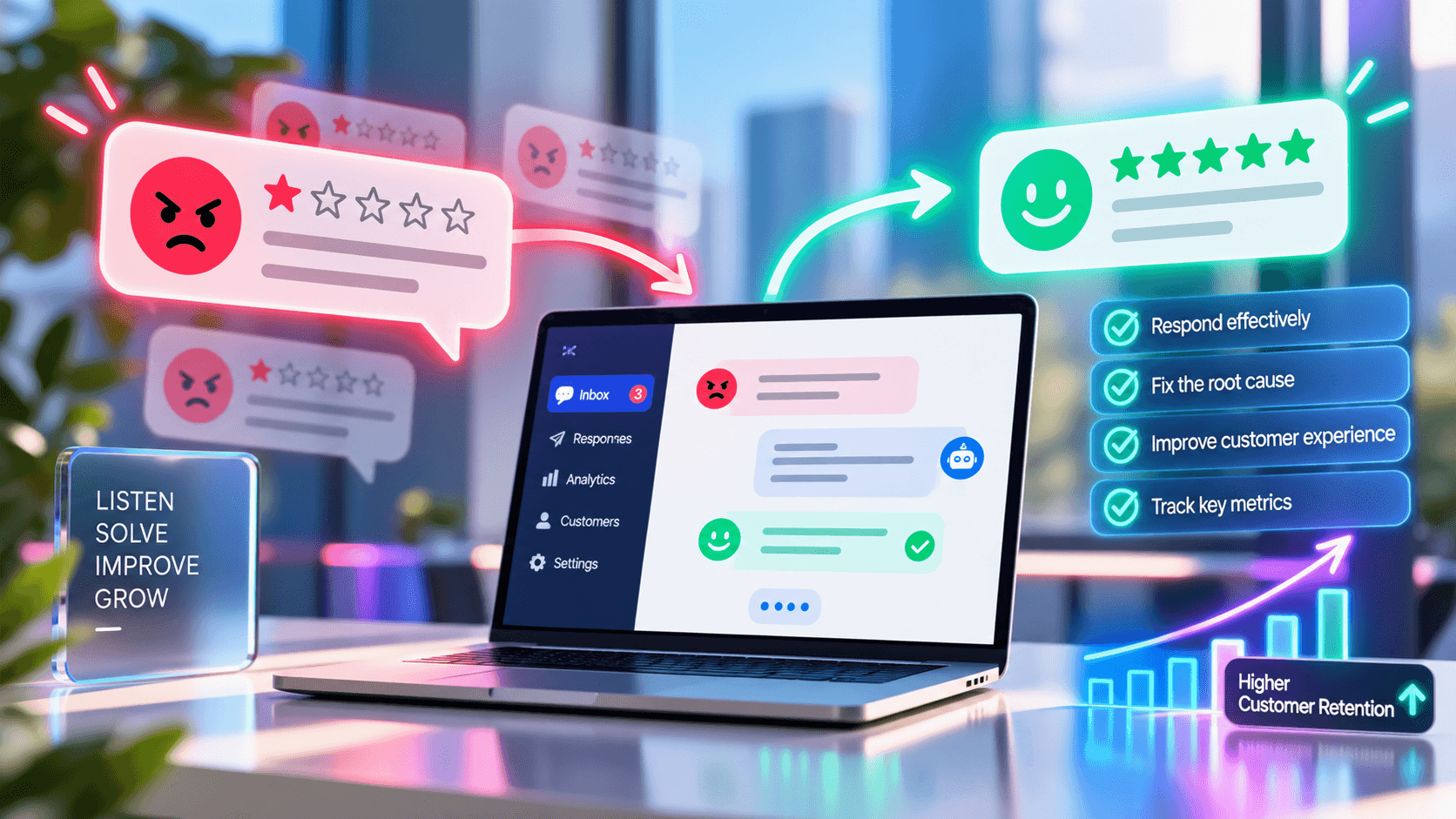
Knowing how to respond to angry customers online matters because the reply is often seen by far more people than the original complaint. On Google reviews, social media, marketplaces, and public forums, future customers are judging not only what went wrong but how the business behaves when something does go wrong.
The best response is usually calm, specific, and practical. Acknowledge the problem, avoid arguing, explain what happens next, move private details to an appropriate channel, resolve the underlying issue, and follow up. A polished apology without a real fix is reputation management, not customer service.
The 7-Step Process for Responding to Angry Customers Online
The goal is not to prove that the business is right. The goal is to reduce tension, solve the problem, and prevent one complaint from turning into a larger public conflict.
- **Read the full complaint before replying.** Check what happened, whether the customer already contacted support, and whether someone is already handling the case.
- Acknowledge the specific problem. Refer to the actual issue instead of sending a generic apology that could apply to anyone.
- Apologize when the experience fell below expectations. An apology does not always mean accepting every claim as fact; it can acknowledge the poor experience.
- **Explain the next step.** Tell the customer what will happen, who will handle it, and what information is needed.
- **Move sensitive details to a private channel.** Account numbers, addresses, payment information, and case-specific data should not be discussed publicly.
- Fix the underlying problem. Do not focus only on the comment if the real issue is late delivery, billing, a failed refund, or poor support.
- Follow up after resolution. Confirm that the refund arrived, replacement was delivered, or technical issue was actually resolved.
The public reply is only the visible part of the process. What matters most is whether the customer leaves with the problem solved and less effort than before.
Respond Quickly, but Do Not Respond Emotionally
An angry customer should not be ignored, especially when the complaint is public, but an immediate defensive reply can make the situation worse. Before responding, verify the relevant facts and determine what the business can realistically do.
For reviews and social media, a same-day acknowledgement is often a sensible operating target when staffing allows it. If the issue requires investigation, the company can still respond quickly without pretending the answer is already known.
A useful reply might say:
"We're sorry your order arrived damaged and that you had to contact support twice. Please send the order number by private message so the team can review the case and confirm the available replacement options."
This works because it identifies the problem and gives the customer a next step. Specific acknowledgement is more credible than a long generic apology.
Do Not Argue in Public – Even When the Customer Is Wrong
A customer can be mistaken, exaggerate what happened, or omit important context. That does not mean the business should turn a review thread into a public argument.
The better approach is to separate the customer's experience from the factual point that needs correcting. For example:
"We're sorry the delivery experience was frustrating. Our records show the order left the warehouse on Tuesday, but we'd like to review what happened after dispatch."
This is very different from replying, "You're wrong, we shipped it on time." The first corrects the record while still moving toward resolution.
Being factually correct does not require being confrontational. If detailed evidence, account history, or personal information is involved, keep the public correction brief and continue the discussion privately.
Every Reply Needs a Clear Next Step
One of the most frustrating customer-service responses is an apology followed by no action. "Please contact customer service" also creates unnecessary work when the customer is already speaking to the company.
A strong reply explains what happens next. It should tell the customer where to send information, what the team will review, and what type of resolution may be available without promising an outcome that has not yet been verified.
For example:
"Please send the booking number through our private support channel. The team will check the payment and cancellation history and confirm the available options."
That response is more useful because it reduces uncertainty. Every complaint response should answer one practical question: what happens now?
Move Private Details Off the Public Thread
Public channels are useful for acknowledging a complaint but are often the wrong place to complete the investigation. Customers should not be asked to post passwords, payment details, identification documents, full addresses, or other sensitive information in a review or comment thread.
The move to private support should also preserve context. A customer who already explained the problem should not have to repeat the entire story to a second employee.
Moving the conversation private should protect the customer, not hide the complaint. The public acknowledgement should remain clear enough for other readers to see that the business responded and offered a path to resolution.
What to Say – and What to Avoid
The wording matters most when the customer is already frustrated. Short, specific language usually works better than corporate scripts or defensive explanations.
The principle is simple: do not add poor communication as a second problem on top of the original one.
| Avoid | Better Approach |
|---|---|
| "You are wrong." | Correct the relevant fact calmly |
| "That's our policy." | Explain the policy and available options |
| "Calm down." | Acknowledge the specific frustration |
| "There's nothing we can do." | Explain what can still be done |
| "Contact support." | Give a specific channel and next step |
| Copy-pasted apology | Refer to the actual complaint |
| Public discussion of account details | Move sensitive information private |
| Promise of an instant fix | Give a realistic action and timeframe |
| Blaming an employee or vendor | Take ownership of the customer-facing process |
How to Respond to Negative Reviews
Negative reviews need extra care because the response becomes part of the company's public reputation. A good reply should acknowledge the concern, avoid exposing private information, correct major factual errors only when necessary, and provide a clear route to resolution.
Businesses should also avoid trying to manufacture a better review history. In the United States, FTC rules prohibit several deceptive review practices, including fake reviews, certain incentives conditioned on positive or negative sentiment, and the use of unfounded legal threats to suppress negative reviews.
A resolved complaint does not automatically justify pressuring a customer to remove a truthful review. Fix the experience first. Do not try to erase the evidence that a problem occurred.
What If the Customer Becomes Abusive?
Businesses should de-escalate legitimate complaints, but employees do not have to tolerate harassment, threats, hate speech, or repeated personal abuse. A professional boundary can be set without abandoning the underlying customer issue.
For example:
"The team is available to help resolve the order issue, but abusive language toward staff cannot continue. If you'd like assistance, the case can still be reviewed through support."
Serious threats, suspected fraud, legal escalation, or safety concerns should move out of the normal support workflow and into the appropriate internal process.
De-escalation means reducing conflict, not accepting abuse.
Should Negative Comments Be Deleted?
Ordinary criticism should generally remain visible even when it is uncomfortable. Deleting a legitimate complaint can make the customer more frustrated and may create a second reputation problem if they repost it elsewhere.
Moderation or reporting may be appropriate when content includes spam, threats, impersonation, hate speech, exposed personal information, or material that clearly violates the platform's rules. The distinction is important: negative is not the same as abusive or prohibited.
Angry Customers Often Reveal Operational Problems
A single complaint may be an isolated event. Repeated complaints about the same issue usually indicate a process failure rather than a customer-service wording problem.
Patterns worth investigating include repeated complaints about late deliveries, confusing pricing, failed cancellations, unexpected charges, slow refunds, product defects, or unanswered messages. If the same complaint appears repeatedly, the business should stop optimizing the apology and fix the workflow.
The strongest response to recurring anger is prevention.
What to Measure After Customer Complaints
Response quality should be measured by whether problems are actually resolved, not simply how quickly agents send a first message.
Speed should always be read together with quality. A fast reply that creates another contact, reopens the case, or sends the customer to the wrong team is not an operational improvement.
| Metric | What It Shows |
|---|---|
| First response time | How quickly the complaint is acknowledged |
| Resolution time | How long it takes to actually solve the problem |
| First contact resolution | Whether the issue is solved without repeat contacts |
| Reopen rate | How often "resolved" problems return |
| Escalation rate | How many cases require higher-level support |
| CSAT | How customers rate the support interaction |
| Complaint category | Which operational failures repeat most often |
The Rule to Remember
The best way to respond to angry customers online is not to produce the perfect apology. It is to acknowledge the specific problem, reduce customer effort, give a clear next step, resolve the issue, and learn from the reason it happened.
A strong public reply protects reputation. A strong resolution protects the customer relationship. Businesses that consistently do both are less dependent on damage control because they gradually remove the problems that create angry customers in the first place.
Frequently Asked Questions
- How should you respond to an angry customer online?
- Acknowledge the specific issue, remain calm, explain what happens next, move sensitive details to a private channel when needed, resolve the problem, and follow up.
- How quickly should a business respond to an angry customer?
- Respond as quickly as the team can provide a meaningful acknowledgement. Public complaints should not sit unanswered unnecessarily, but a useful response is more important than an instant generic one.
- Should you apologize if the customer is wrong?
- You can acknowledge the customer's frustration without agreeing with an incorrect factual claim. Correct the relevant information calmly and focus on the available solution.
- Should businesses reply to negative reviews?
- Yes. A professional response can help resolve the issue and also shows future customers how the business handles problems.
- Should an angry customer be moved to private messages?
- Yes, when the case involves personal data, payment details, account information, orders, refunds, or a detailed investigation. The public complaint can still receive a brief acknowledgement first.
- Can a business delete negative comments?
- Negative comments should not be removed simply because they criticize the business. Spam, threats, impersonation, personal information, or content violating platform rules may be moderated or reported.
- What should a business do if a customer becomes abusive?
- Set a clear professional boundary, continue offering help for the legitimate issue where appropriate, document serious behavior, and escalate threats or safety concerns.
- Can a business ask a customer to change a negative review?
- A business may resolve the issue and invite a customer to update their experience voluntarily, but should not use pressure, fake reviews, groundless legal threats, or incentives conditioned on positive sentiment.
- What metrics should be tracked after customer complaints?
- Track first response time, resolution time, first contact resolution, reopen rate, escalation rate, customer satisfaction, and recurring complaint categories.
Written by

Marcus HaleB2B sales and growth
Marcus Hale coaches B2B sellers on conversation intelligence, pipeline hygiene, and the sales tools that change what happens after the call.
Published September 29, 2026