1 Cover ALT: Accountant reviewing a business income statement showing revenue, cost of goods sold, operating expenses, and net income
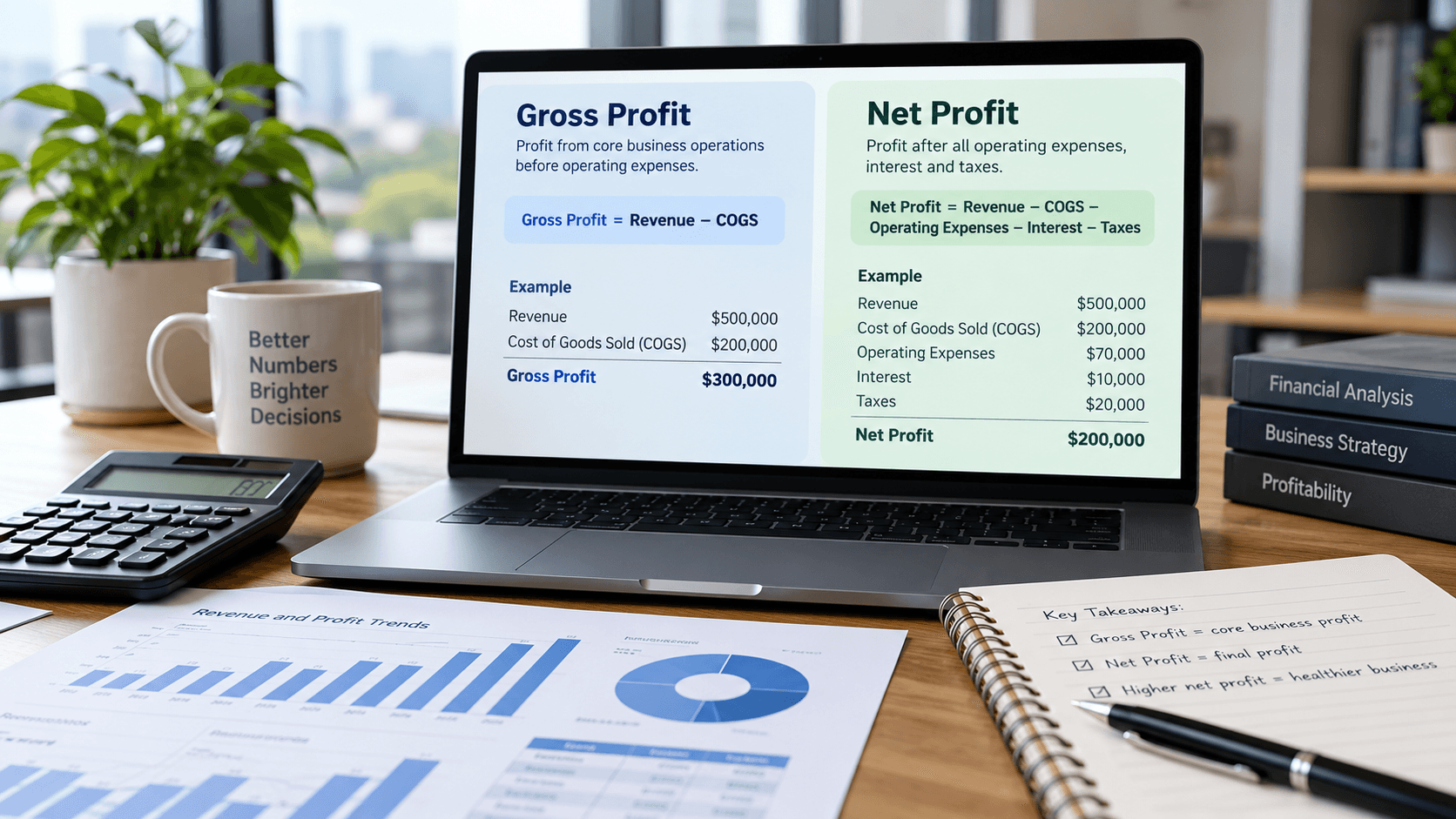
Gross profit vs net profit describes two different measures of business profitability: gross profit is revenue remaining after cost of goods sold, while net profit is what remains after all expenses and applicable taxes are accounted for. Gross profit focuses on the economics of providing products or services. Net profit shows the company's overall earnings after the full set of expenses.
Understanding gross profit vs net profit helps business owners determine whether their company is profitable at the product level and across the entire organization. A distributor may generate millions of dollars in revenue while spending most of its gross profit on warehousing, delivery, payroll, financing, and administration. Looking only at sales or gross margin can therefore create an overly optimistic view of performance.
Both financial measures are important, but they answer different questions. Gross profit helps evaluate pricing, purchasing, and product costs, while net profit measures the final financial outcome for the reporting period. Neither figure alone provides a complete picture of cash flow.
What Is the Difference Between Gross Profit and Net Profit?
The main gross profit vs net profit difference is which expenses are deducted from revenue. Gross profit deducts cost of goods sold, whereas net profit reflects cost of goods sold plus other expenses and income items affecting the company's final result. A standard income statement shows these figures at different stages.
The difference is important because a company can report positive gross profit and negative net profit. This occurs when gross profit is insufficient to cover remaining expenses. Conversely, unusual nonoperating income may cause net profit to look stronger than normal operations would suggest.
| Feature | Gross profit | Net profit |
|---|---|---|
| Calculation | Net revenue − COGS | Total recognized income − all relevant expenses |
| Main focus | Direct economics of goods or services | Overall company profitability |
| Includes COGS? | Yes | Yes |
| Includes operating expenses? | Not generally | Yes |
| Includes interest and tax? | No | Yes, when applicable |
| Main metric | Gross margin | Net profit margin |
| Common use | Product pricing, purchasing, cost analysis | Overall performance and financial planning |
What Is Gross Profit?
Gross profit is the difference between net sales revenue and the cost of goods sold. For a wholesale distributor, COGS generally includes the recognized inventory costs of merchandise sold during the period. Gross profit measures the revenue left after those product-related costs.
Gross profit = Net revenue − Cost of goods sold
Suppose a distributor generates $250,000 in net revenue and recognizes $185,000 in COGS.
Gross profit = $250,000 − $185,000 = $65,000.
This $65,000 must cover expenses not included in COGS, such as applicable outbound distribution costs, sales salaries, office overhead, and financing expenses. It is not the amount the business owner can withdraw without consequences.
What Is Included in Cost of Goods Sold?
Cost of goods sold depends on the business type and relevant accounting policies. For a merchandise wholesaler, it generally reflects the cost of inventory sold, including properly attributable acquisition expenses. Purchase prices, certain inbound freight, and applicable costs of bringing inventory to its present condition and location may form part of inventory cost.
For a manufacturer, COGS also reflects appropriate production costs. For service businesses, direct service delivery costs may be classified differently according to financial reporting practices. Comparisons should use consistent accounting definitions.
A frequent mistake is omitting inbound freight or inventory adjustments from merchandise costs when they should be included. This can overstate gross profit and produce misleading pricing decisions. Distributors need a reliable landed-cost process and proper inventory reconciliation.
What Is Net Profit?
Net profit, also called net income, is the earnings remaining after all recognized expenses, income adjustments, financing costs, and applicable income taxes have been included. It represents the bottom-line result of a reporting period. Unlike gross profit, it captures the financial impact of running the entire company.
Net profit can be expressed in a simplified form as:
Net profit = Total revenue + Other income − All expenses − Applicable taxes
The exact presentation depends on the company's income statement and accounting framework. Other gains, losses, discontinued activities, or exceptional items may affect the reported amount. Net profit should therefore be read in the context of the full financial statements.
Net Profit Example
Assume a distributor records $500,000 in net revenue and $350,000 in COGS. Gross profit equals $150,000. After operating expenses, interest, and income taxes, net profit is $25,000.
Hypothetical simplified income statement, assuming no other income or expenses.
The business earns a 30% gross margin but only a 5% net profit margin. This does not necessarily indicate poor management; different industries have different operating structures. It does, however, demonstrate that substantial gross profit can be consumed by the cost of operating the business.
| Income statement item | Amount |
|---|---|
| Net revenue | $500,000 |
| Cost of goods sold | −$350,000 |
| Gross profit | $150,000 |
| Payroll and operating expenses | −$95,000 |
| Depreciation | −$15,000 |
| Operating profit | $40,000 |
| Interest expense | −$8,000 |
| Income taxes | −$7,000 |
| Net profit | $25,000 |
Gross Profit vs Net Profit Formula
The gross profit vs net profit formulas separate merchandise economics from total business profitability. The gross-profit calculation requires revenue and COGS, while the net-profit calculation requires the complete set of recognized income and expenses.
For a simple business with no additional income items:
Gross profit = Revenue − COGS
Net profit = Gross profit − Operating expenses − Interest − Taxes
In a full financial statement, other income, gains, and losses must also be included where relevant. These simplified formulas are useful for understanding the concepts, but financial reporting should follow the applicable accounting framework.
Both measures should be calculated over the same reporting period. Comparing quarterly gross profit with annual net income would produce a misleading result. Consistent time periods also make trend analysis more useful.
Gross Profit Margin vs Net Profit Margin
Gross profit margin measures gross profit as a percentage of revenue, while net profit margin measures final net earnings as a percentage of revenue. Both ratios help compare performance across periods or companies of different sizes. They should not be confused with markup, which uses product cost as its denominator.
Gross profit margin = Gross profit ÷ Net revenue × 100
Net profit margin = Net profit ÷ Net revenue × 100
Using the previous distributor example:
Gross profit margin = $150,000 ÷ $500,000 × 100 = 30%.
Net profit margin = $25,000 ÷ $500,000 × 100 = 5%.
For every $100 of net revenue, the company retains $30 after COGS and ultimately reports $5 in net income. The remaining $25 difference reflects the other net expenses in this simplified example.
Why Gross Profit Matters for Wholesale Distributors
Gross profit matters to wholesale distributors because it reveals the spread between sales revenue and the recognized cost of merchandise sold. This information helps evaluate supplier prices, product mix, purchase discounts, and selling-price policies. It is especially important where high order volumes amplify small per-unit differences.
Suppose a wholesaler reduces product acquisition cost by $0.40 per unit across 100,000 units sold annually. Assuming the savings flow fully through COGS and selling prices remain unchanged, gross profit increases by $40,000. That improvement can meaningfully affect overall results.
However, higher gross profit is not necessarily better if earning it requires expensive fulfillment or additional credit exposure. A large account may generate substantial gross profit but require repeated emergency deliveries and extended payment terms. The company should measure customer contribution after relevant cost-to-serve as well.
Our Pricing and Profit Margins in Distribution guide explores these operational effects.
Why Net Profit Matters for Business Owners
Net profit matters because it shows whether the company generates earnings after accounting for the financial cost of running the business. It is an important measure for owners, lenders, investors, and management. Positive revenue growth does not guarantee increasing net profit.
A distributor might open an additional warehouse and experience increased sales, but the new facility may require extra rent, equipment, labor, insurance, and transportation expenses. Net profit helps reveal whether the expansion contributes to company-wide earnings. Comparing operating profit and net profit can also clarify the impact of financing and taxes.
Nevertheless, net income should not be confused with cash available in a bank account. A profitable company can have substantial unpaid customer invoices, inventory investments, or debt principal repayments. Cash-flow analysis is necessary alongside profitability reporting.
Gross Profit vs Operating Profit vs Net Profit
Gross profit, operating profit, and net profit represent three stages of an income statement. Gross profit deducts COGS, operating profit further reflects operating expenses, and net profit includes applicable nonoperating items and taxes. Comparing all three helps identify where earnings are generated or consumed.
For example, a wholesale operation may have a strong gross margin but weak operating profit due to delivery inefficiency. Another company may have healthy operating profit but lower net profit because of interest expense. These require different management responses.
The correct improvement strategy depends on where profitability deteriorates. Supplier renegotiation may help gross margin, while route optimization may improve operating profit. Refinancing debt may affect interest expense and net profit without changing gross profit.
| Profit metric | Main purpose |
|---|---|
| Gross profit | Evaluate merchandise or service economics |
| Operating profit | Evaluate earnings from business operations |
| Net profit | Measure the bottom-line result |
Can Gross Profit Be Positive When Net Profit Is Negative?
Gross profit can be positive while net profit is negative when other expenses exceed gross profit. This is a common situation for young businesses investing in staff, systems, and customer acquisition. It can also affect mature companies when overhead grows faster than sales.
Consider a business with $300,000 in revenue and $210,000 in COGS. Gross profit is $90,000. If operating and other expenses total $105,000 after applicable adjustments, the business reports a $15,000 net loss.
The appropriate response is not always to increase prices immediately. Management should examine the sales mix, capacity utilization, fixed costs, customer profitability, and the likelihood of future demand. A cost reduction that damages service quality can create new problems.
How to Improve Gross Profit and Net Profit
Improving gross and net profit requires identifying whether the main problem lies in product economics, operating costs, or both. Different interventions affect different parts of the income statement. A business should avoid treating every profit problem as a pricing problem.
Ways to improve gross profit include negotiating better supplier terms, reducing purchase-cost errors, managing discounts, and improving product mix. Changes in inbound freight efficiency and inventory shrinkage can also affect COGS where properly accounted for. These improvements should be measured rather than assumed.
Ways to improve net profit include controlling fixed expenses, improving route density, reducing unnecessary administrative work, managing interest expense, and eliminating persistently unprofitable activities. A disciplined business reviews both the gross-profit contribution and the complete cost of serving customers.
Common Gross Profit vs Net Profit Mistakes
The most common gross profit vs net profit mistakes involve treating revenue as profit, confusing gross margin with net margin, and excluding costs from the wrong accounting category. Businesses may also assume that a profitable sale automatically improves cash flow. These misunderstandings can lead to poor pricing and investment decisions.
Another mistake is comparing profit figures from companies using different accounting classifications. One distributor may include certain warehouse costs in COGS, while another presents them in operating expenses. Gross margins may therefore differ even when the underlying economics are similar.
Financial comparisons should use consistent definitions and consider the complete income statement. Business owners should review both dollar profit and percentage margins. A higher margin on lower revenue does not necessarily mean higher total earnings.
Final Takeaway
Gross profit vs net profit is the difference between the earnings generated after product costs and the earnings remaining after the business's complete expenses. Gross profit helps owners understand purchasing and pricing performance. Net profit shows the overall financial result.
A company needs reliable cost accounting and consistent reporting to evaluate both measures accurately. Wholesale businesses should pay particular attention to inventory valuation, freight, warehousing, financing, and customer-specific operating expenses. Sustainable profitability depends on protecting gross profit while controlling the cost of running the organization.
Frequently Asked Questions
- What is the main difference between gross profit and net profit?
- Gross profit is revenue minus cost of goods sold. Net profit is the remaining income after the full set of relevant expenses, income adjustments, and taxes.
- Is gross profit always higher than net profit?
- Gross profit is generally higher in ordinary operations with positive operating and other expenses. However, unusual gains or other income can sometimes cause net profit to exceed gross profit.
- What is the gross profit formula?
- Gross profit equals net revenue minus cost of goods sold. It measures profitability before other operating and nonoperating expenses.
- How do you calculate net profit?
- Determine total recognized income and subtract all applicable expenses, including COGS, operating costs, financing expenses, and taxes. The result is net income or net loss.
- Is net profit the same as cash flow?
- No. Net profit follows accounting recognition rules, while cash flow records cash movement. Inventory purchases, receivables, payables, and financing can create substantial differences.
- Which is more important: gross profit or net profit?
- Both are essential. Gross profit evaluates product economics, while net profit measures overall financial outcomes. Business decisions generally require understanding both.