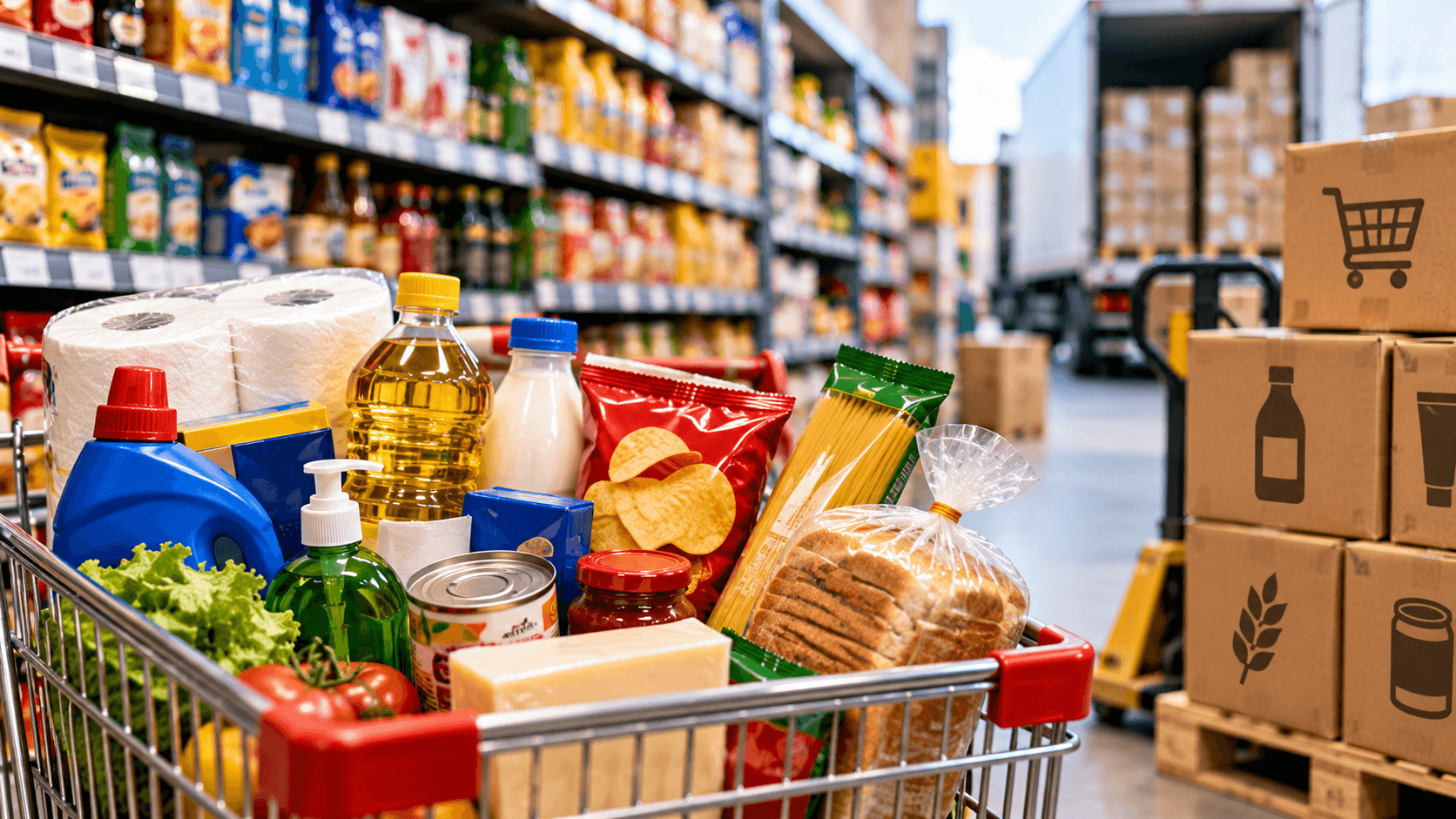
FMCG full form is Fast-Moving Consumer Goods, a category of everyday products that sell quickly, are purchased frequently, and generally have relatively low prices per item. FMCG products include packaged foods, beverages, toiletries, cleaning supplies, personal care items and certain over-the-counter healthcare products. These goods move rapidly through stores and distribution networks because consumers regularly purchase, consume and replace them.
Understanding FMCG meaning is important for anyone studying retail, wholesale distribution, supply chains, marketing or consumer products. Unlike expensive durable goods that customers purchase occasionally, fast-moving consumer goods depend heavily on repeat demand, product availability and efficient replenishment. A supermarket may sell hundreds of units of a popular beverage while a comparable shelf space allocation for a slow-moving item generates far fewer transactions.
The FMCG business model connects manufacturers, distributors, wholesalers, retailers and consumers through a high-volume supply chain. Successful companies must manage product pricing, market coverage, inventory turnover, transportation, retailer relationships and customer demand. Although many FMCG products have relatively modest margins per unit, high sales volumes and operational efficiency can make them commercially attractive.
What Is the FMCG Full Form?
The FMCG full form is Fast-Moving Consumer Goods. The abbreviation describes consumer products that sell rapidly because they are used frequently, need regular replacement or have limited shelf lives. The term is common in retail, marketing, business education, supply chain management and wholesale distribution.
Each part of the FMCG full form explains the category:
- Fast-Moving: Products are sold and replenished relatively frequently.
- Consumer: The final users are consumers purchasing goods for personal or household use.
- Goods: The category consists of physical merchandise rather than services.
For example, toothpaste is considered an FMCG product because consumers use it regularly and replace it when the package is empty. Bottled water, packaged snacks, soap and laundry detergent are other familiar examples. They may be sold through supermarkets, convenience stores, pharmacies, wholesalers or ecommerce channels.
An important distinction is that fast-moving describes sales velocity, not necessarily the product's physical expiration date. A packaged product with a long shelf life can still be an FMCG item if it sells rapidly. Conversely, a perishable product that sells slowly can create significant inventory problems.
FMCG Meaning in Business
FMCG meaning in business refers to the commercial activities involved in producing, distributing, marketing and selling frequently purchased consumer products. The industry depends on delivering the right products to the right retail outlets at the right time. Because many goods are relatively inexpensive, manufacturers and distributors often depend on repeat purchases and high volumes.
Consider a manufacturer producing packaged snacks. The company must purchase ingredients, manufacture and package products, establish sales channels, supply retailers and respond to consumer demand. Distributors and wholesalers may help reach thousands of retail locations that would be difficult for the manufacturer to serve individually.
Retail availability is particularly important in FMCG markets. If a customer cannot find a preferred everyday product, they may choose a competing brand rather than postpone the purchase. Manufacturers and distributors therefore monitor stock availability, sales velocity and replenishment performance closely.
What Does FMCG Mean in Retail?
FMCG in retail describes frequently purchased products that generate regular sales and require repeated shelf replenishment. Supermarkets, convenience stores, pharmacies and mass-market retailers sell numerous FMCG categories. These businesses must balance product availability, shelf capacity, promotional activity and inventory turnover.
For example, a supermarket may receive regular deliveries of milk, bread, beverages and toiletries because customers purchase them continuously. Stockouts can immediately affect sales, while excessive orders increase storage costs and waste. Retailers therefore rely on demand forecasts and supplier performance to maintain suitable inventory.
What Does FMCG Mean in Distribution?
FMCG in distribution describes the movement of fast-selling consumer products from manufacturers and suppliers to commercial customers such as retailers and hospitality businesses. Distributors may purchase inventory, operate regional warehouses, deliver to stores and manage retailer accounts. Their value comes from product availability, service coverage and efficient order fulfillment.
A distributor serving 200 convenience stores may consolidate products from several manufacturers into scheduled deliveries. This reduces the need for individual stores to negotiate and receive shipments from numerous factories. However, the distributor must control transportation expenses, credit exposure, damaged products and stock rotation to remain profitable.
What Are FMCG Products?
FMCG products are consumer goods characterized by frequent purchasing, relatively rapid sales and generally affordable unit prices. Their common feature is high turnover relative to many other product categories, not an identical shelf life or manufacturing method. The industry covers food, beverages, household cleaning products, personal care and several other consumable categories.
Not every product in these categories sells equally quickly. Premium variants, seasonal merchandise, new products and specialized items may have lower velocity than established mass-market products. FMCG classification helps describe the overall category, but individual SKU performance still determines purchasing and distribution decisions.
| FMCG category | Common product examples | Typical buying behavior |
|---|---|---|
| Packaged food | Pasta, cereals, biscuits, snacks | Regular household replenishment |
| Beverages | Water, juice, soft drinks, coffee | Frequent repeat purchases |
| Personal care | Shampoo, soap, toothpaste, deodorant | Recurring consumption |
| Household cleaning | Detergents, surface cleaners, dishwashing liquids | Replenishment after use |
| Paper products | Toilet paper, tissues, paper towels | Routine household purchases |
| Healthcare essentials | Selected OTC medicines and everyday healthcare supplies | Need-based repeat purchasing |
| Baby care | Diapers, wipes, basic care products | Regular purchases within relevant households |
| Pet care | Pet food, litter and hygiene products | Recurring consumption |
Main Characteristics of Fast-Moving Consumer Goods
Fast-moving consumer goods typically combine repeat consumer demand, relatively low unit prices, frequent inventory replenishment and extensive retail distribution. Many also face strong competition, promotional pressure and limited shelf space. These characteristics shape how manufacturers and distributors operate.
1. High Sales Volume
FMCG businesses often depend on selling substantial quantities rather than earning a large amount on every individual unit. A packaged-food producer may generate many transactions across thousands of retail locations. High volume creates opportunities for scale but also increases manufacturing, logistics and inventory requirements.
Sales volume should be evaluated alongside contribution margin. A product that sells rapidly may still be unprofitable if transportation, retailer allowances or manufacturing expenses are excessive. Businesses need both demand and sustainable economics.
2. Frequent Consumer Purchases
Consumers regularly replenish many FMCG products because they are consumed or used up. Toothpaste, cleaning products, beverages and packaged groceries are examples of recurring purchases. Purchasing frequency helps businesses plan replenishment and customer retention strategies.
However, purchasing frequency varies by category and household. A family may purchase milk several times per week but replace detergent less frequently. Demand models should therefore reflect actual consumption patterns rather than applying one universal reorder cycle.
3. Relatively Low Prices per Item
Many FMCG products are affordable compared with durable goods such as refrigerators or furniture. Consumers may make purchasing decisions quickly, especially for familiar household brands. Pricing remains competitive because retailers frequently offer several alternatives within the same category.
Low unit prices also mean that logistics and handling costs can represent a meaningful share of revenue. Shipping a small quantity of inexpensive goods over a long distance may be economically unattractive. Efficient order consolidation and route planning become important.
4. High Inventory Turnover
High inventory turnover is a common characteristic of successful FMCG products. Inventory turnover measures the relationship between cost of goods sold and average inventory value over a reporting period. Faster turnover can reduce the amount of capital committed to stock when other conditions are comparable.
Nevertheless, high turnover must be balanced against product availability. A distributor that reduces stock too aggressively may experience frequent shortages. Appropriate reorder points, supplier lead-time monitoring and inventory accuracy help maintain this balance.
5. Intensive Competition
FMCG companies compete through price, product quality, branding, promotion, availability and convenience. Popular categories may contain international manufacturers, private-label products and smaller specialized brands. Retailers compare suppliers based on commercial terms and product performance.
Brand recognition may help attract customers, but retail execution is essential. A recognizable product cannot generate a store sale when it is unavailable. Distribution coverage and shelf replenishment directly influence the consumer purchasing experience.
FMCG Product Examples in Everyday Life
FMCG examples include the products consumers repeatedly buy during ordinary shopping trips. A typical household may purchase numerous fast-moving goods each week without thinking of them as a distinct industry category. These purchases support manufacturers, distributors, wholesalers and retailers.
Consider a customer visiting a supermarket and purchasing bottled water, cereal, bread, shampoo, laundry detergent and paper towels. These items come from several FMCG categories and may have been supplied by different manufacturers or distributors. Their demand patterns also vary because food consumption, household usage and promotional pricing affect purchases differently.
A practical distinction is between product category and individual sales velocity. A specific shampoo variant may sell slowly even though shampoo is generally considered an FMCG category. Inventory managers should therefore measure actual sales by SKU rather than assuming every item qualifies as fast-moving.
Types of FMCG Products by Shelf Life
FMCG products can be grouped into perishable, shelf-stable and non-food consumable categories according to their storage and replenishment requirements. These differences affect warehousing, packaging, transportation and inventory planning. A distributor handling dairy products faces different operational requirements from one supplying paper towels.
Perishable FMCG Products
Perishable FMCG products have limited usable or saleable life and may require temperature-controlled storage. Examples include fresh dairy products, certain prepared foods and chilled beverages. These categories demand close attention to expiration dates and delivery schedules.
Businesses often use first-expired, first-out (FEFO) stock rotation to reduce waste. Temperature monitoring and traceability can also be necessary depending on the product. Poor stock management can create spoilage and financial losses even when customer demand is strong.
Shelf-Stable FMCG Products
Shelf-stable FMCG products can often remain saleable for longer periods under appropriate storage conditions. Examples include many packaged snacks, dry pasta, canned products and certain beverages. They usually provide greater inventory flexibility than highly perishable products.
However, shelf-stable does not mean indefinite. Products can still have best-before dates, packaging limitations and quality requirements. Warehouses should track inventory age and follow suitable rotation procedures.
Non-Food FMCG Products
Non-food FMCG products include toiletries, cleaning supplies, paper products and certain personal care items. They may have longer storage periods than fresh food but can still face damage, leakage, formulation changes or product obsolescence. Handling requirements differ significantly between categories.
For example, a distributor transporting household cleaning products may need to consider chemical classification, packaging integrity and spill procedures. Paper products occupy substantial space relative to their unit value. These differences affect freight economics and warehouse planning.
FMCG vs. CPG: What Is the Difference?
FMCG stands for Fast-Moving Consumer Goods, while CPG stands for Consumer Packaged Goods. The terms overlap considerably and are often used interchangeably in retail and consumer-products industries. In a narrower interpretation, FMCG refers to the faster-selling subset of the broader CPG category.
There is also a regional difference in terminology. CPG is especially common in North American industry discussions, while FMCG appears frequently in international business contexts. Neither abbreviation automatically defines an entirely separate supply chain.
For example, bottled water clearly fits both FMCG and CPG descriptions. A cosmetic item purchased less frequently may be classified as CPG without being among the fastest-moving products in its category. Actual industry usage is flexible, so businesses should clarify definitions when interpreting market research.
For U.S.-focused entrepreneurs, researching both FMCG and CPG can provide a more complete view of suppliers, retail channels and industry terminology. The key operational measures remain sales velocity, margins, distribution coverage and product availability.
| Feature | FMCG | CPG |
|---|---|---|
| Full form | Fast-Moving Consumer Goods | Consumer Packaged Goods |
| Main emphasis | Rapid sales and replenishment | Packaged consumer products |
| Typical products | Food, beverages, toiletries | Food, household goods, beauty and other packaged products |
| Sales frequency | Generally high | Varies across the category |
| Geographic usage | Widely used internationally | Particularly common in North America |
| Business overlap | Substantial | Substantial |
FMCG vs. Durable Goods
FMCG products are purchased and consumed relatively frequently, while durable goods are designed to provide utility over a longer period. Consumers repeatedly buy groceries and toiletries but may purchase appliances or furniture only occasionally. These demand differences create distinct business models.
Durable goods may require installation, technical support, warranty service or specialized transportation. FMCG distribution places more emphasis on recurring orders, retailer coverage and efficient replenishment. Some businesses carry both categories but manage them using different inventory policies.
| Characteristic | FMCG | Durable goods |
|---|---|---|
| Purchase frequency | Generally frequent | Generally less frequent |
| Consumer usage | Consumed or used up | Used repeatedly over longer periods |
| Common price level | Relatively low per item | Often higher |
| Inventory turnover | Frequently high | Often lower |
| Examples | Snacks, detergent, toothpaste | Refrigerators, furniture, washing machines |
| Distribution focus | Replenishment and availability | Product value, service and delivery |
How Does the FMCG Business Work?
The FMCG business works through a network that manufactures consumer products, moves them through distribution channels and makes them available to final buyers. Depending on the company, products may pass through regional distributors and wholesalers or travel directly from manufacturers to large retailers. Ecommerce and direct-to-consumer channels can also be part of the distribution model.
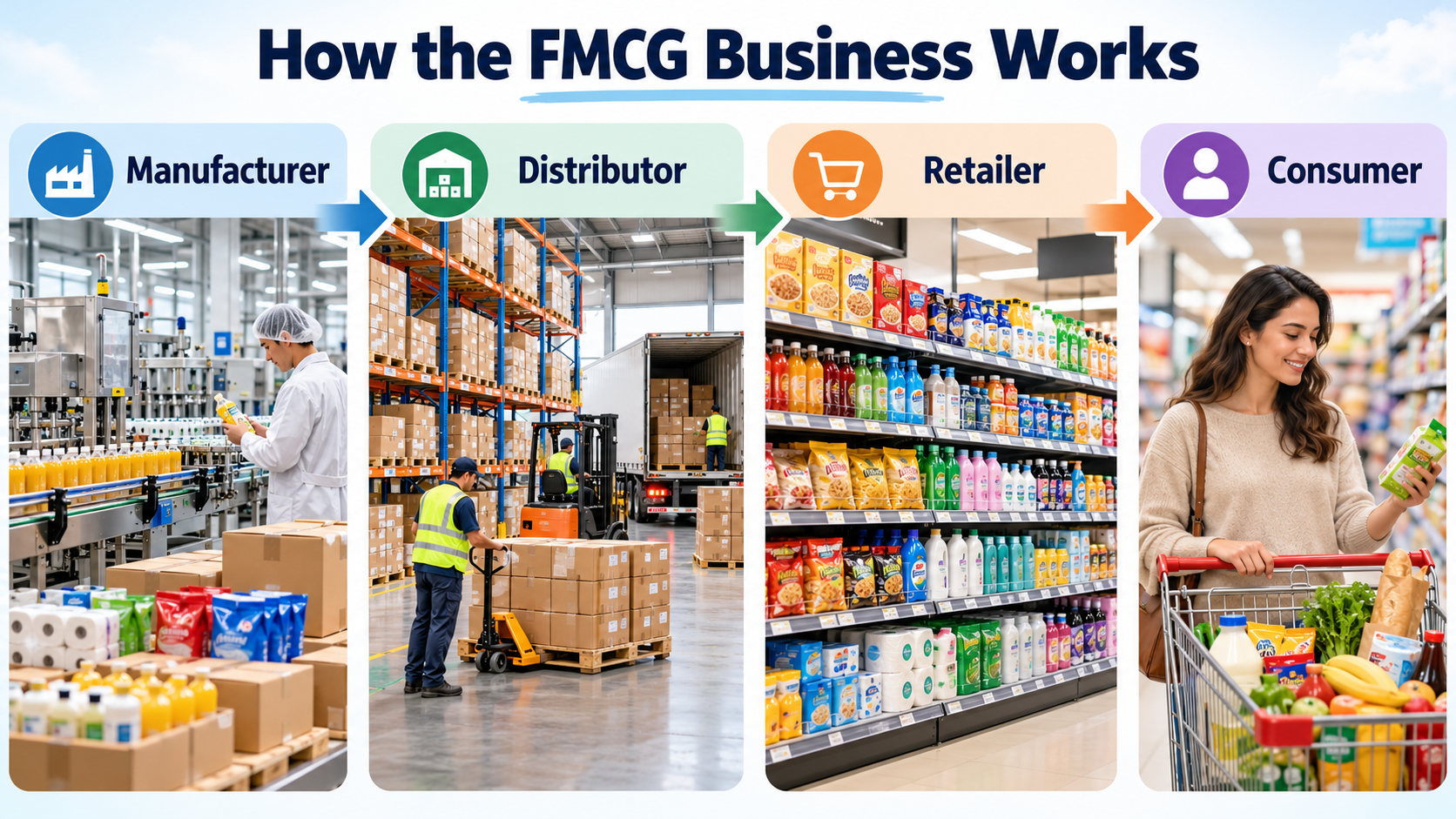
A conventional FMCG supply chain includes raw-material suppliers, manufacturers, distributors, retailers and consumers. Each stage contributes a specific activity, such as production, inventory consolidation, transportation, retail merchandising or final sales. Not every FMCG product passes through every intermediary.
FMCG Supply Chain Example
Imagine a company manufacturing bottled beverages. It produces finished goods and transfers them to a distribution warehouse. Regional distributors or direct retail supply arrangements then make those products available across supermarkets and other outlets.
Consumer purchases eventually reduce store inventory and create new replenishment requirements. Retailers place additional orders, distributors replenish their warehouses and manufacturers adjust production plans. The cycle continues as long as there is demand.
Direct vs. Indirect FMCG Distribution
Direct distribution occurs when a manufacturer supplies retailers or consumers without an independent wholesale intermediary in that part of the channel. Indirect distribution involves one or more distributors, wholesalers or other intermediaries. Both approaches are common, and manufacturers may combine them.
Large retailers may receive direct shipments because their purchasing volumes justify dedicated arrangements. Small independent stores may be easier to serve through distributors that consolidate orders and operate local delivery routes. The appropriate model depends on market coverage, purchasing volume, transportation costs and service requirements.
For more detailed operational guidance, see Distribution Logistics: Complete Guide for B2B Distributors.
| Stage | Main responsibility | Example |
|---|---|---|
| Raw-material supplier | Provides ingredients or materials | Packaging and food ingredients |
| Manufacturer | Produces and packages products | Beverage bottling company |
| Distributor | Stocks and delivers products to business customers | Regional beverage distributor |
| Retailer | Offers products to consumers | Supermarket or convenience store |
| Consumer | Purchases and uses the product | Household shopper |
What Is FMCG Distribution?
FMCG distribution is the process of supplying fast-moving consumer products to retailers and other commercial outlets through a planned sales and logistics network. Distributors may buy products from manufacturers, maintain inventory, collect retailer orders and arrange deliveries. They can also provide merchandising support, credit arrangements or local market coverage.
A small retailer may not need an entire truckload of products from one manufacturer. Instead, a distributor can consolidate goods from several suppliers into one delivery. This creates convenience for the retailer but also adds inventory, picking and transport responsibilities for the distributor.
Successful FMCG distribution depends on three interconnected factors: sufficient product availability, efficient order fulfillment and financially sustainable selling terms. High-volume product categories can create substantial operating costs if order quantities are too small or delivery routes are inefficient.
Intensive Distribution in FMCG
Intensive distribution is a strategy that aims to make a product available through as many suitable retail outlets as commercially practical. It is common for widely consumed goods where convenience and immediate availability influence customer choice. Bottled drinks, snacks and everyday toiletries are typical categories where broad coverage may be valuable.
Brands pursuing intensive distribution work to increase their presence across supermarkets, convenience stores and other relevant channels. However, broad coverage can be expensive because each additional outlet may require deliveries, account management and merchandising resources. Distribution reach must therefore be evaluated against actual product sales.
Our published guide to Exclusive vs. Intensive Distribution explains how manufacturers and distributors choose between intensive, selective and exclusive channel strategies.
Examples of Major FMCG Companies
Major FMCG companies manufacture or market widely purchased food, beverage, household and personal care brands. Many operate internationally and distribute products through multiple retail channels. Their product portfolios illustrate the breadth of the fast-moving consumer goods industry.
Examples describe widely recognized brand portfolios; brand ownership, licensing and product availability can differ by market.
These businesses demonstrate several FMCG growth strategies, including product innovation, brand marketing, distribution expansion and retail partnerships. Their scale also shows why competition for shelf space can be significant. Small FMCG manufacturers typically need a more focused product and market strategy rather than attempting to match the reach of global companies immediately.
| Company | Well-known product categories | Brand examples |
|---|---|---|
| Procter & Gamble | Laundry, grooming, personal care | Tide, Pampers, Gillette |
| Unilever | Personal care, home care, food | Dove, Hellmann's, Vaseline |
| Nestlé | Coffee, packaged food, confectionery | Nescafé, KitKat, Maggi |
| PepsiCo | Beverages and convenient foods | Pepsi, Lay's, Gatorade |
| The Coca-Cola Company | Beverages | Coca-Cola, Sprite, Fanta |
| Colgate-Palmolive | Oral care, personal care, home care | Colgate, Palmolive, Softsoap |
| Kimberly-Clark | Personal care and tissue products | Huggies, Kleenex, Scott |
How Do FMCG Companies Make Money?
FMCG companies make money by selling consumer products at prices that exceed their relevant production, purchasing and operating costs. Manufacturers earn revenue from products supplied to commercial partners or consumers, while wholesalers and retailers earn revenue through their own transactions. Profitability depends on the full cost structure, not simply the difference between two listed prices.
Many FMCG categories feature intense price competition. This can make cost control, production efficiency, distribution density and inventory management essential to financial performance. Strong brands may have additional pricing power, but no single margin applies across the industry.
FMCG Distributor Profit Example
Suppose a regional distributor purchases packaged consumer goods at a fully recognized inventory cost of $8 per case and sells them to retail customers for $10 per case.
The distributor's $50,000 gross profit must still support expenses not included in COGS. These may include outbound delivery, sales activity, warehouse overhead, administration, financing and other costs. Therefore, a 20% gross margin is not equivalent to a 20% net profit margin.
If the company's operating expenses total $42,000 for the month, simplified operating profit becomes $8,000. That represents a 3.2% operating margin on revenue. The example illustrates how a relatively modest contribution per case can produce substantial sales while leaving limited room for operational inefficiency.
| Metric | Hypothetical result |
|---|---|
| Cases sold monthly | 25,000 |
| Selling price per case | $10 |
| Cost per case | $8 |
| Monthly revenue | $250,000 |
| Cost of goods sold | $200,000 |
| Gross profit | $50,000 |
| Gross margin | 20% |
Why Inventory Turnover Matters in FMCG
Inventory turnover matters in FMCG because products are expected to sell and be replenished frequently, while excessive stock can tie up cash or become unsaleable. Distributors need enough inventory to support retailer demand but not so much that they accumulate obsolete or expired merchandise. Forecasting and stock rotation are central to this balance.
The standard inventory turnover formula is:
Inventory turnover = Cost of goods sold ÷ Average inventory value
Assume an FMCG distributor reports annual COGS of $2.4 million and average inventory of $300,000.
Inventory turnover = $2,400,000 ÷ $300,000 = 8 times annually.
The corresponding approximate days inventory outstanding is 365 ÷ 8, or 45.6 days. These figures are illustrative rather than industry benchmarks. Appropriate turnover depends on product shelf life, replenishment lead times, sales patterns and service requirements.
An FMCG business should also monitor inventory by individual product and category. A strong company-wide turnover ratio can conceal slow-moving merchandise or shortages of high-demand products. Our Inventory Management for Distribution guide explains reorder planning, working capital and inventory policies.
How to Start an FMCG Distribution Business
Starting an FMCG distribution business requires choosing a product category, validating retailer demand, finding legitimate suppliers and establishing reliable inventory and delivery operations. The central challenge is not simply purchasing popular products at wholesale prices. The business must demonstrate that customers will repeatedly order enough merchandise to cover purchasing, fulfillment and operating costs.
Step 1: Select an FMCG Category
Begin with products that have identifiable repeat demand among the retailers or business customers you intend to serve. Packaged snacks, household supplies, beverages and personal care products have different storage, logistics and regulatory requirements. Select a category that matches available capital and operating capabilities.
A narrow product assortment can be easier to launch than an unfocused catalog containing hundreds of SKUs. It simplifies supplier selection and helps the company learn customer ordering patterns. Expansion should follow actual demand rather than speculation.
Step 2: Research Retail Demand
Contact prospective retail customers and determine which products they purchase, how frequently they reorder and what problems they experience with current suppliers. Evaluate order values, delivery requirements, payment terms and geographical concentration. This information supports a realistic sales forecast.
A distributor serving stores located close together may achieve more efficient delivery routes than one serving widely scattered accounts. Customer density can therefore be as important as headline sales volume. Retailer interest should be converted into realistic trial-order opportunities before large inventory commitments are made.
Step 3: Find Manufacturers and Wholesale Suppliers
Look for suppliers capable of providing authentic products, predictable replenishment and clear commercial terms. Request product catalogs, price lists, minimum quantities, delivery schedules and applicable brand authorization. Verify the supplier's business identity and product requirements before transferring funds.
The existing guide on How to Find Wholesale Suppliers explains supplier verification, sourcing channels and practical warning signs.
Step 4: Negotiate Purchasing Terms
FMCG purchasing economics depend on more than unit prices. Discounts, case quantities, payment deadlines, freight responsibility, promotional allowances and return conditions can materially change profitability. Perishable products also require clarity about remaining shelf life at delivery.
A lower unit price may not justify accepting a minimum order equivalent to six months of projected sales. Businesses should evaluate total acquisition cost and realistic inventory coverage. The published guide to Negotiating With Suppliers covers these trade-offs.
Step 5: Build Fulfillment and Delivery Operations
FMCG distribution requires accurate receiving, picking, packing, transport and proof-of-delivery procedures. Warehouse systems should track product quantities, locations, lot information where necessary and stock availability. Retail customers also need predictable delivery schedules.
A distributor can operate its own warehouse or use an external logistics provider, depending on scale and economics. The selected arrangement must support product handling, customer service and required compliance. Our Order Fulfillment Process for Distributors explains the operational steps from order receipt to confirmed delivery.
Step 6: Monitor Profitability and Repeat Purchases
Early FMCG distribution performance should be measured through customer retention, case sales, product margins, delivery cost and inventory turnover. High sales without adequate gross contribution can create a financially weak business. Payment collection must also be monitored because commercial customers may purchase on credit terms.
A practical monthly review should identify the most profitable SKUs, slow-moving stock, recurring delivery errors and accounts requiring disproportionate service costs. These findings guide purchasing and pricing changes. Sustainable FMCG growth depends on reliable repeat orders and disciplined operating economics.
FMCG Marketing Strategies
FMCG marketing strategies focus on encouraging product trial, repeat purchases, brand recognition and retail availability. Because consumers often make quick purchasing decisions, visibility and convenience can influence sales alongside product quality and pricing. Manufacturers and distributors may support marketing activities through different arrangements.
Brand owners may invest in advertising, packaging, promotions and consumer research. Retailers control important aspects of shelf placement, store promotions and customer experience. Distributors may support product launches, retail execution or trade promotions depending on their contracts.
Trade Promotions
Trade promotions are commercial arrangements intended to support product sales through retailers or distributors. They may include temporary price reductions, display support, promotional allowances or specific volume incentives. The financial value should be measured against incremental sales and associated costs.
A discount that increases sales volume but reduces total contribution is not automatically successful. Businesses should compare results with a realistic baseline. Promotional inventory should also be planned carefully to avoid shortages or excess stock after the campaign ends.
Product Availability and Shelf Presence
Product availability is a basic requirement for FMCG marketing success. A successful advertising campaign can create demand that retailers cannot fulfill if distribution and replenishment are inadequate. Manufacturers should coordinate marketing activity with inventory planning and sales teams.
Retail shelf space is also limited. Brands compete for placement based on customer demand, sales performance, retailer economics and promotional support. Reliable supply can strengthen a brand's attractiveness to commercial partners.
Digital and Ecommerce Channels
Ecommerce allows FMCG brands and retailers to reach consumers beyond traditional physical stores. Subscription programs may suit products that customers purchase repeatedly. Online channels also provide data about product preferences and purchasing behavior.
However, individual-order delivery can be expensive for low-priced goods. Businesses should evaluate packaging, fulfillment fees, shipping expenses and returns before launching direct-to-consumer programs. Bundled products and suitable order minimums may improve economics where consumer demand supports them.
Challenges Facing FMCG Businesses
FMCG businesses face challenges involving price competition, retail availability, demand forecasting, inventory costs, product quality and supply-chain performance. The combination of high sales volumes and relatively low unit prices makes small operational inefficiencies important. Growth must therefore be supported by reliable data and disciplined execution.
Price and Margin Pressure
Retailers and consumers often compare similar FMCG products closely. Promotions and competing brands can limit price increases, even when manufacturing or transportation costs rise. Businesses must understand their contribution per product and account.
A low-margin product can still be attractive when it sells quickly and uses warehouse capacity efficiently. Conversely, a high-margin product may disappoint if it requires frequent markdowns or expensive delivery. Profitability should be evaluated at multiple levels.
Shortages and Forecasting Errors
FMCG demand changes with weather, promotions, seasonality and consumer preferences. Unexpected sales spikes can exhaust popular products, while overly optimistic forecasts create excess inventory. Suppliers may also experience manufacturing and transportation disruptions.
Distributors should review forecast accuracy and supplier lead-time performance. Appropriate inventory buffers can protect service levels, but no amount of additional stock eliminates every supply risk. Maintaining reliable replenishment processes is essential.
Expiration Dates and Product Waste
Certain FMCG products have limited shelf lives and require strict handling procedures. Expired or damaged products may need to be removed from sale. These losses directly affect inventory profitability.
Warehouses should use suitable stock rotation, quality inspection and traceability controls. Where applicable, FEFO helps prioritize products with earlier expiration dates. Regulatory requirements depend on the product category and market.
Logistics and Last-Mile Delivery Costs
Frequent deliveries to numerous small retailers can be costly. A distributor may need to visit several stores to deliver orders that generate relatively modest gross profit. Fuel, labor, loading time and failed deliveries can reduce account profitability.
Route planning, minimum order values and consolidated delivery schedules can improve service economics. Customers may value frequent deliveries, but the provider must understand the financial cost of that convenience. Operational decisions should be supported by actual route and account data.
Important FMCG Business KPIs
FMCG KPIs measure product sales, inventory efficiency, retail availability, commercial profitability and distribution execution. Businesses should choose indicators that reflect their position in the supply chain. Manufacturers, wholesalers and retailers may prioritize different measures even when handling the same goods.
A useful FMCG dashboard should separate product performance from customer and distribution performance. High sales velocity does not prove that a product is profitable, while strong gross margin does not guarantee consistent retailer availability. Management should review the relationships between metrics rather than optimizing one number in isolation.
| KPI | What it measures | Why it matters |
|---|---|---|
| Sales velocity | Units sold over a defined period or distribution base | Indicates product movement |
| Inventory turnover | COGS relative to average inventory | Measures stock efficiency |
| Gross margin | Gross profit as a share of revenue | Evaluates product economics |
| Fill rate | Share of ordered demand supplied | Indicates availability |
| On-time delivery | Deliveries meeting agreed timing | Measures service reliability |
| Product waste or shrinkage | Inventory lost, damaged or unsaleable | Identifies operating losses |
| Distribution coverage | Relevant outlets carrying the product | Measures market reach |
| Average order value | Revenue per customer order | Supports service-cost analysis |
| Repeat purchase rate | Customers purchasing again | Indicates retention |
| Days sales outstanding | Collection time for receivables | Measures credit exposure |
FMCG Industry Careers and Job Roles
The FMCG industry includes roles in production, purchasing, marketing, sales, finance, warehousing and supply chain management. Large companies may operate specialized departments, while smaller businesses combine several responsibilities within the same team. The work often requires coordination across manufacturers, distributors and retailers.
Common roles include FMCG sales representative, key account manager, category manager, demand planner, procurement specialist, warehouse supervisor, logistics coordinator and brand manager. Their responsibilities differ, but many depend on understanding product availability and commercial performance.
A demand planner estimates future requirements, while a procurement specialist arranges supply. A key account manager works with major business customers, and a warehouse manager ensures orders are processed accurately. Understanding the FMCG business model provides context for how these roles contribute to the same product flow.
Final Takeaway: FMCG Full Form and Business Meaning
FMCG full form is Fast-Moving Consumer Goods, the everyday products that consumers purchase frequently and that move rapidly through retail and distribution networks. Food, beverages, toiletries, cleaning products and other consumables are among the most familiar examples. The category is defined by purchasing and sales patterns rather than by one specific manufacturing process.
The FMCG industry connects manufacturers, wholesalers, distributors and retailers through ongoing replenishment. Businesses in this sector must balance product availability, competitive pricing, inventory turnover, operational expenses and customer demand. Large sales volumes create opportunities, but sustainable performance requires protecting margins and controlling costs throughout the supply chain.
For entrepreneurs and distributors, understanding FMCG meaning is only the starting point. The commercial opportunity lies in selecting suitable products, building dependable supplier relationships, securing repeat customers and operating a reliable distribution system. Those fundamentals determine whether fast-moving goods translate into a financially successful business.
Frequently Asked Questions
- What is the full form of FMCG?
- FMCG stands for Fast-Moving Consumer Goods. These are everyday products that sell relatively quickly and are purchased frequently, such as packaged food, beverages, toiletries and cleaning supplies. The abbreviation is widely used in business, marketing and retail.
- What is FMCG meaning in simple words?
- FMCG means products that consumers buy, use and replace regularly. They often have relatively low unit prices and high sales turnover. Examples include toothpaste, milk, snacks and laundry detergent.
- What are 10 examples of FMCG products?
- Ten common FMCG examples are bottled water, bread, milk, toothpaste, shampoo, soap, laundry detergent, packaged biscuits, toilet paper and soft drinks. Individual products vary in shelf life and sales velocity. Not every item within a category sells at the same rate.
- What is the difference between FMCG and CPG?
- FMCG means Fast-Moving Consumer Goods, while CPG means Consumer Packaged Goods. The terms overlap and are often interchangeable, although FMCG can be treated as the faster-turnover portion of CPG. CPG is especially common in North American business terminology.
- Is Coca-Cola an FMCG company?
- The Coca-Cola Company is a major beverage business operating in a category strongly associated with FMCG. Products such as Coca-Cola and Sprite are widely sold consumer beverages. Actual manufacturing, bottling and distribution arrangements vary by market.
- Is FMCG a profitable business?
- FMCG businesses can be profitable when product demand, gross margins, inventory management and operating costs are managed effectively. However, high sales volume does not guarantee high net profit. Transportation, promotion, waste and customer credit can materially affect earnings.
- What is FMCG distribution?
- FMCG distribution is the process of supplying frequently purchased consumer products to retail outlets and other commercial customers. It can involve warehousing, sales, transportation, order fulfillment and inventory replenishment. Manufacturers may use distributors or supply large retailers directly.
- What are the main types of FMCG?
- The main FMCG categories include packaged foods, beverages, personal care products, household cleaning supplies, paper goods and selected everyday healthcare products. Businesses may also group them according to shelf life or storage requirements.
- What is the difference between FMCG and retail?
- FMCG describes a category of consumer products, while retail describes the activity of selling goods to final consumers. A retailer may sell FMCG products alongside clothing, electronics and durable goods. FMCG manufacturers and distributors can operate at earlier stages of the supply chain.
- Why are FMCG products called fast-moving?
- They are called fast-moving because consumers purchase and replace them frequently, leading to relatively rapid sales and replenishment. High demand and repeat consumption are important characteristics. The description does not necessarily mean every product has a short expiration date.