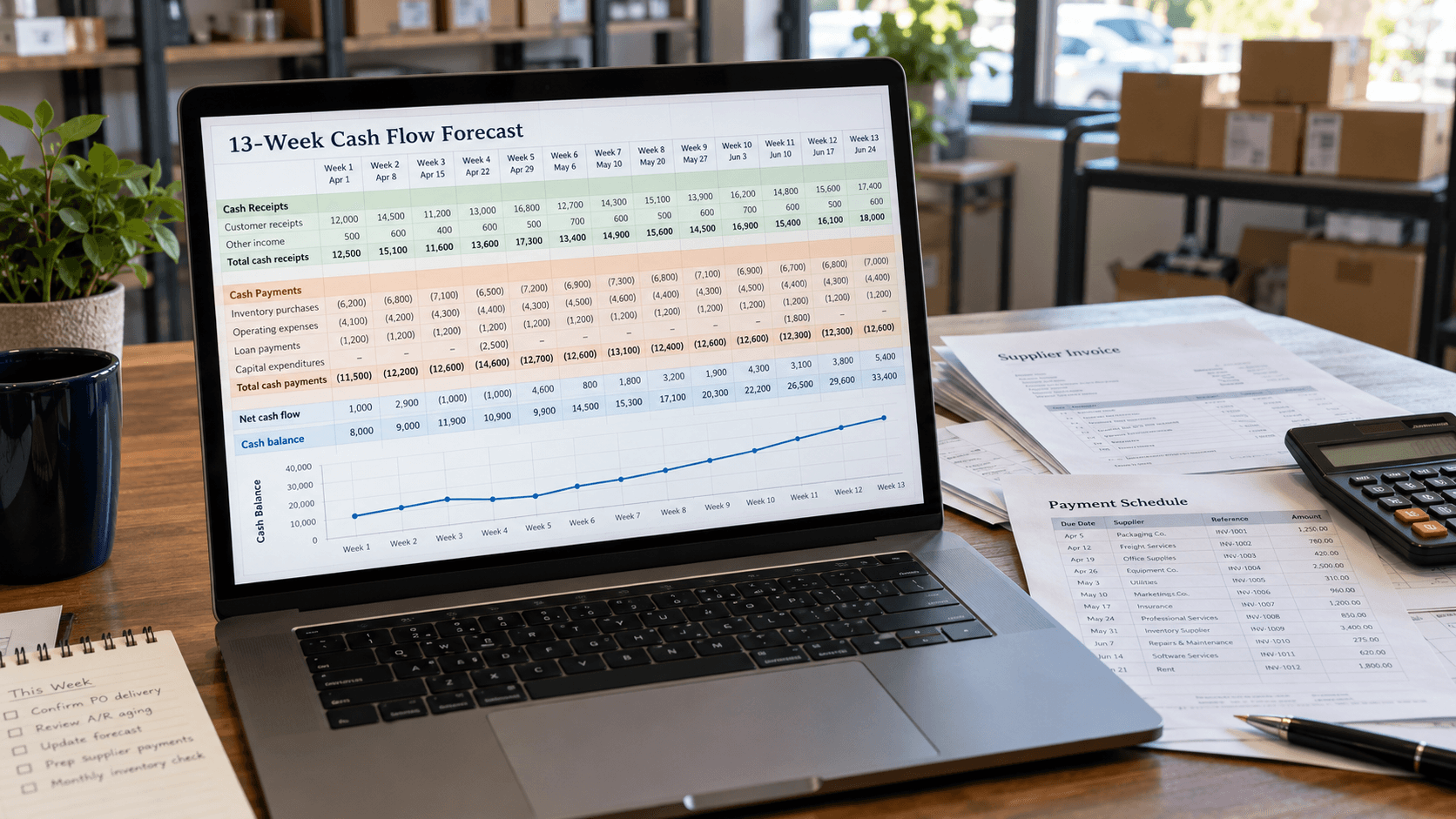
A cash flow forecast estimates how much money a business expects to receive and spend over a future period. It helps owners understand whether they will have enough available cash to pay suppliers, employees, lenders, and other obligations when payments become due.
A company can generate strong sales and report an accounting profit while experiencing a serious cash shortage. Customers may take 30, 60, or 90 days to settle invoices, while payroll, rent, and inventory purchases require immediate payment. Without a reliable forecast, these timing differences can create unexpected financial pressure.
Cash flow forecasting is particularly valuable for wholesalers, distributors, retailers, manufacturers, and growing small businesses. These companies often commit substantial working capital to inventory before collecting revenue from customers.
What Is a Cash Flow Forecast?
A cash flow forecast is a financial projection showing expected cash inflows, cash outflows, and the resulting cash balance over a specified period. It focuses on when money actually moves rather than when revenue or expenses are recorded for accounting purposes.
A forecast typically begins with the company's available cash balance. Expected customer payments, financing proceeds, and other receipts increase that balance, while supplier payments, wages, taxes, and loan repayments reduce it.
The resulting figure shows how much cash the business expects to have at the end of each forecasting period.
Cash Flow Forecast vs Cash Flow Statement
A cash flow forecast and a cash flow statement serve different purposes, although both examine movements of cash.
A forecast should be updated as new information becomes available. Unlike a historical statement, its accuracy depends on assumptions about future customer behavior, spending, and operating conditions.
| Feature | Cash Flow Forecast | Cash Flow Statement |
|---|---|---|
| Time orientation | Future | Historical |
| Primary purpose | Financial planning | Financial reporting |
| Data | Estimates and expected transactions | Recorded cash transactions |
| Typical periods | Daily, weekly, monthly | Monthly, quarterly, annually |
| Main question | Will enough cash be available? | Where did cash come from and go? |
| Main users | Owners, managers, finance teams | Owners, managers, investors, lenders |
Cash Flow Forecast Formula
The basic cash flow forecast formula is:
Closing Cash Balance = Opening Cash Balance + Forecast Cash Inflows − Forecast Cash Outflows
The closing balance for one period becomes the opening balance for the next. This creates a continuous projection of the company's future liquidity.
Consider a small distribution business with the following expected cash movements:
Total cash inflows are $45,000, while total cash outflows are $46,000.
Closing Cash Balance = $25,000 + $45,000 − $46,000 = $24,000
The company expects to finish the period with $24,000 in cash. Although the net cash movement is negative $1,000, the business still has a positive closing balance.
This distinction is important because negative net cash flow does not automatically mean a business is insolvent. The real question is whether available liquidity can cover upcoming obligations.
| Item | Amount |
|---|---|
| Opening cash balance | $25,000 |
| Customer payments received | $42,000 |
| Other cash receipts | $3,000 |
| Supplier payments | $28,000 |
| Payroll | $12,000 |
| Rent and utilities | $4,000 |
| Loan payments | $2,000 |
How to Build a Cash Flow Forecast Step by Step
A reliable cash flow forecast starts with verified financial information and realistic payment assumptions. Businesses should begin with a simple structure and introduce more detailed forecasting only when the additional complexity improves decision-making.
Step 1: Determine Your Opening Cash Balance
The opening balance should represent cash that is genuinely available at the beginning of the forecasting period. Start with reconciled bank and cash balances, excluding restricted funds and accounting balances that do not represent usable cash.
If a business has $18,000 in its operating account and $7,000 in another unrestricted account, its opening available cash may be $25,000. However, outstanding checks, pending transfers, and other transactions must be considered to avoid overstating available funds.
Step 2: Estimate Incoming Customer Payments
Cash inflows should be forecast according to expected collection dates, not simply according to sales dates. A business making $100,000 in sales this month may collect only a portion of that amount immediately.
For example, suppose a wholesaler expects $80,000 in sales, with 25% collected immediately and 75% on 30-day credit terms. The forecast should initially allocate $20,000 to immediate receipts and $60,000 to later periods, adjusted for realistic payment delays and customer collection patterns.
Other inflows may include customer deposits, refunds, asset sales, loan proceeds, and owner contributions. Financing receipts should remain separately identifiable because borrowed cash is not operating revenue.
Step 3: Forecast Operating Cash Outflows
Operating cash outflows include the payments necessary to keep the business functioning. These commonly include inventory purchases, payroll, transportation, warehousing, utilities, insurance, software, advertising, and professional services.
Record each payment when it is expected to leave the bank account. A supplier invoice received in October but payable in November belongs in the November cash forecast, assuming the business expects to pay it then.
Separate fixed expenses from variable costs to make future adjustments easier. Rent may remain relatively stable, while freight charges, packaging expenses, and payment processing fees may rise with sales volume.
Step 4: Include Taxes, Debt and Capital Expenditures
A cash flow forecast must include major non-operating payments that can materially reduce available funds. Examples include tax installments, loan principal repayments, equipment purchases, dividend distributions, and owner withdrawals.
A common forecasting mistake is to include interest expense but overlook the principal portion of a loan payment. Both components generally represent cash outflows, even though only interest is typically treated as an expense in the income statement.
Tax payments should be forecast using the company's actual obligations and applicable payment dates. These amounts vary according to jurisdiction, legal structure, and tax circumstances.
Step 5: Calculate the Closing Balance and Update the Forecast
For each period, add expected receipts to opening cash and subtract expected payments. The resulting closing balance becomes the starting point for the following period.
Update the forecast when actual cash transactions become known. Comparing expected and actual movements reveals whether the assumptions underlying the model remain reliable.
13-Week Cash Flow Forecast Template
A 13-week cash flow forecast provides a rolling view of approximately one quarter of business cash movements. Weekly forecasting is especially helpful when cash reserves are limited, customer collections fluctuate, or large supplier payments occur irregularly.
The following example shows the structure using the first four weeks of a 13-week model.
Extend the same structure through Week 13 and use formulas to link each week's opening balance to the previous week's closing balance.
The example shows positive cash throughout the four weeks, but the balance declines to $15,000 in Week 3. If the company requires a minimum operating buffer of $18,000, the forecast reveals a potential liquidity shortfall despite the positive bank balance.
How to Build the Template in Excel
An Excel cash flow forecast can be built with one column per week and separate rows for each inflow and outflow category. The spreadsheet should calculate total inflows, total outflows, net cash movement, and closing balances automatically.
A simple arrangement uses:
- Row 2: Opening cash balance
- Rows 3–7: Individual cash inflows
- Row 8: Total cash inflows
- Rows 9–15: Individual cash outflows
- Row 16: Total cash outflows
- Row 17: Net cash flow
- Row 18: Closing cash balance
If the first forecast period is in column B, the following formulas can be used:
B8: =SUM(B3:B7)
B16: =SUM(B9:B15)
B17: =B8-B16
B18: =B2+B17
C2: =B18
Copy the formulas across subsequent columns. Adjust the row ranges to match the actual spreadsheet layout and add a separate assumptions worksheet for customer payment timing, supplier terms, and planned expenditures.
| Cash Flow Item | Week 1 | Week 2 | Week 3 | Week 4 |
|---|---|---|---|---|
| Opening cash | $20,000 | $17,000 | $21,000 | $15,000 |
| Customer receipts | $12,000 | $18,000 | $10,000 | $20,000 |
| Supplier payments | $9,000 | $8,000 | $11,000 | $10,000 |
| Payroll | $4,000 | $4,000 | $4,000 | $4,000 |
| Other payments | $2,000 | $2,000 | $1,000 | $3,000 |
| Net cash flow | -$3,000 | $4,000 | -$6,000 | $3,000 |
| Closing cash | $17,000 | $21,000 | $15,000 | $18,000 |
Direct vs Indirect Cash Flow Forecasting
The direct method forecasts individual cash receipts and payments, while the indirect method begins with projected accounting profit and adjusts it for non-cash items and working-capital movements. Both approaches can support financial planning, but they answer different operational needs.
A 13-week operational forecast usually benefits from the direct method because it identifies specific payment periods. A business preparing annual financial projections may combine an indirect cash flow model with its projected income statement and balance sheet.
| Method | Direct Forecast | Indirect Forecast |
|---|---|---|
| Starting point | Expected cash transactions | Forecast profit |
| Main inputs | Receipts and payment schedules | Income statement and balance sheet projections |
| Best suited to | Short-term liquidity | Longer-term financial planning |
| Typical period | Daily or weekly | Monthly, quarterly, annually |
| Main advantage | Detailed cash timing | Financial statement integration |
How to Forecast Cash Flow for a Wholesale Business
Wholesale cash flow forecasting must account for the delay between purchasing inventory and collecting payment from customers. This delay can be substantial when suppliers require early payment but retailers receive extended credit terms.
Consider a distributor that purchases $50,000 in inventory on 15-day supplier terms and sells the products to customers on 45-day payment terms. Even if the distributor earns a healthy gross margin, it may have to finance inventory for several weeks before collecting sales proceeds.
The forecast should connect purchase orders, expected delivery dates, customer invoicing, payment terms, and anticipated collections. Businesses with seasonal products should also forecast higher inventory commitments ahead of peak selling periods.
Cash Conversion Cycle
The cash conversion cycle measures the approximate time between paying for inventory and collecting cash from customers. It provides useful context for understanding why a profitable business may need additional working capital.
The formula is:
Cash Conversion Cycle = Days Inventory Outstanding + Days Sales Outstanding − Days Payable Outstanding
Suppose a distributor has:
The distributor has an estimated 50-day cash conversion cycle. This does not mean every transaction follows the same schedule, but it indicates that cash may remain tied up in operations for a considerable period.
| Component | Days |
|---|---|
| Days inventory outstanding | 40 |
| Days sales outstanding | 35 |
| Days payable outstanding | 25 |
| Cash conversion cycle | 50 |
Cash Flow Forecast Scenarios
Scenario forecasting shows how cash balances may change if actual business conditions differ from expectations. Instead of relying on one optimistic projection, businesses can prepare base-case, downside, and upside scenarios.
In the downside scenario, a 30% reduction in receipts causes the closing balance to fall to $7,000. Management can use this result to assess whether spending reductions, earlier collections, or financing arrangements may be necessary.
Scenario assumptions should be explicitly documented. Changing several variables without recording the reasons can make the forecast difficult to interpret.
| Scenario | Customer receipts | Cash outflows | Opening cash | Closing cash |
|---|---|---|---|---|
| Base case | $60,000 | $55,000 | $20,000 | $25,000 |
| Downside | $42,000 | $55,000 | $20,000 | $7,000 |
| Upside | $72,000 | $58,000 | $20,000 | $34,000 |
Common Cash Flow Forecasting Mistakes
The most damaging cash flow forecasting errors involve unrealistic collection assumptions, missing payments, and outdated financial information. Even a correctly designed spreadsheet produces misleading results when its inputs are unreliable.
Common errors include:
- Treating all issued invoices as immediate cash receipts.
- Assuming customers always pay on their contractual due dates.
- Omitting inventory purchases and supplier deposits.
- Forgetting loan principal repayments or tax obligations.
- Double-counting transfers between company bank accounts.
- Treating approved but undrawn credit facilities as available cash.
- Failing to update the forecast after actual payments occur.
Another important mistake is confusing forecasted profit with cash availability. Depreciation, receivables, payables, and inventory transactions affect accounting results and cash balances differently.
How to Improve Cash Flow Forecast Accuracy
Cash flow forecast accuracy improves when businesses compare their projections with actual results and revise assumptions systematically. Historical customer payment behavior, current receivables, approved purchase orders, and scheduled supplier payments should form the starting point.
Review the forecast at least weekly when using a 13-week model, with more frequent checks during liquidity pressure. Monitor differences between expected and actual customer collections, supplier disbursements, payroll costs, and unexpected expenditures.
A useful measure is cash flow variance:
Cash Flow Variance = Actual Net Cash Flow − Forecast Net Cash Flow
If actual net cash flow is $8,000 and forecast net cash flow was $12,000, the variance is -$4,000. Management should identify which receipts or payments caused the difference rather than simply replacing the original assumptions.
Final Thoughts
A cash flow forecast transforms financial planning from a retrospective exercise into a practical decision-making process. By estimating when money will enter and leave the business, managers can anticipate liquidity gaps, adjust purchasing decisions, negotiate payment terms, and preserve operating flexibility.
For most small businesses, a well-maintained weekly forecast is more useful than an elaborate model that is rarely updated. Begin with accurate opening balances and realistic transaction schedules, then improve the forecast through regular comparisons with actual cash movements.
The most effective cash flow forecasting system is one that helps the business make better decisions before a shortage occurs.
Frequently Asked Questions
- What is a cash flow forecast in simple terms?
- A cash flow forecast is an estimate of the money a business expects to receive and pay during a future period. It shows whether enough cash is likely to be available to cover upcoming bills. The forecast is especially useful when customer payments arrive later than business expenses.
- How do you calculate forecast cash flow?
- Calculate forecast net cash flow by subtracting expected cash outflows from expected inflows. Then add that result to the opening cash balance to determine the projected closing balance. Repeat the calculation for each forecasting period.
- What is a 13-week cash flow forecast?
- A 13-week cash flow forecast is a rolling weekly projection covering approximately three months. It includes starting cash, anticipated receipts, planned payments, and ending cash for each week. Businesses use it to identify short-term liquidity risks and payment timing problems.
- How often should a business update its cash flow forecast?
- Businesses commonly update short-term forecasts weekly, although companies experiencing financial pressure may need daily monitoring. Monthly forecasts can be appropriate for longer planning horizons. The review frequency should reflect transaction volume, financial risk, and the reliability of the underlying information.
- Can a profitable business have negative cash flow?
- Yes. A profitable business may experience negative cash flow when customers pay late, inventory purchases increase, or debt payments exceed current cash receipts. Accounting profit and available cash measure different financial outcomes. A cash flow forecast helps identify these timing differences before they become critical.