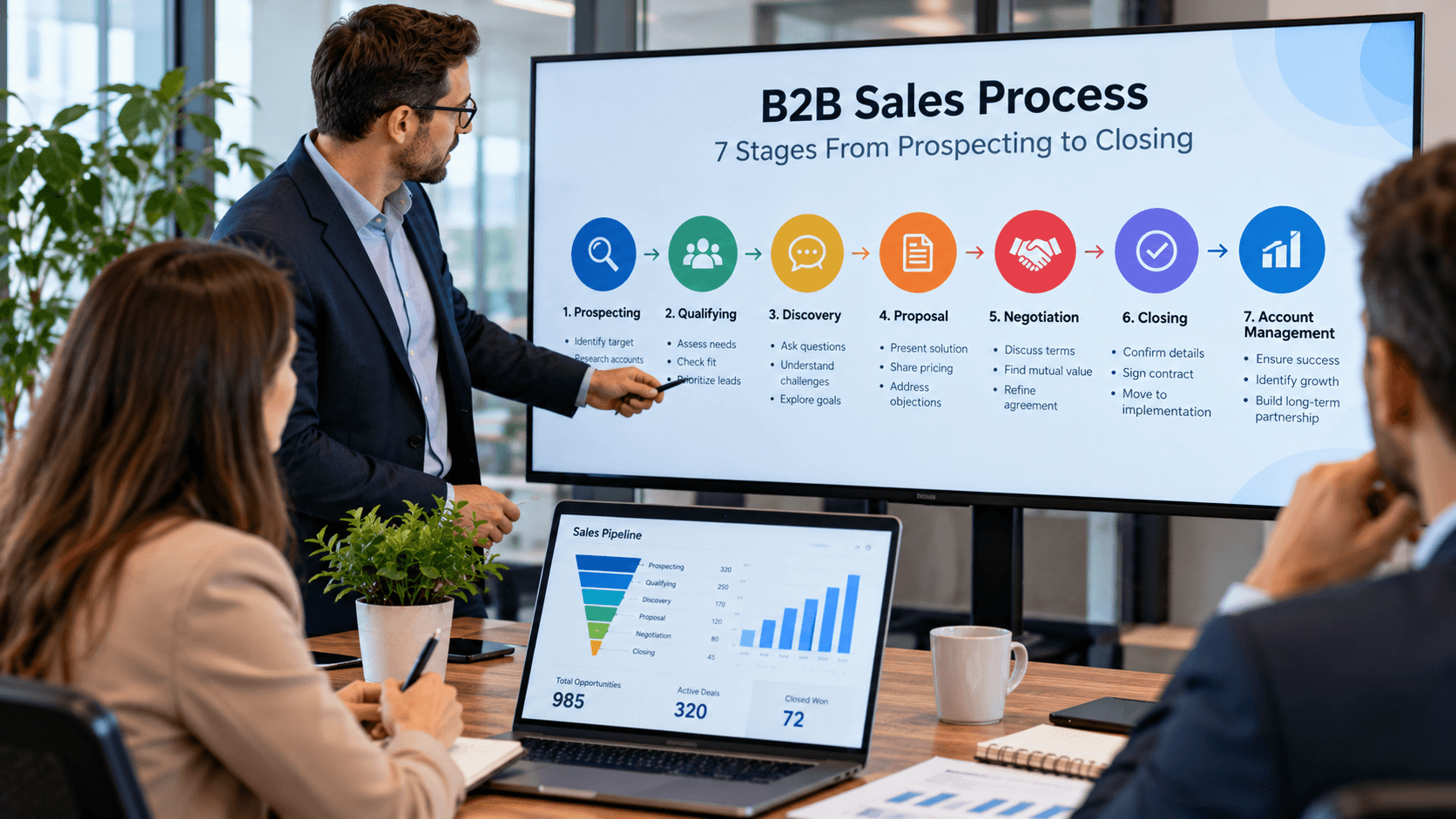
ʼCover ALT: Business sales manager discussing commercial proposals and purchasing terms with a B2B client in a modern office
The B2B sales process is a structured sequence businesses use to identify potential commercial customers, understand their requirements, present solutions, negotiate terms, and secure purchases. A typical B2B sales process includes prospecting, qualification, discovery, solution development, proposal, negotiation, and closing. After the initial sale, account management and retention become essential to generating repeat business.
Understanding the B2B sales process is particularly important for wholesalers, distributors, manufacturers, and service companies. Business customers often evaluate suppliers through formal purchasing requirements, internal approvals, financial reviews, and operational testing. Winning a commercial account can therefore involve multiple conversations and decision-makers rather than a single purchase decision.
An effective sales process makes these interactions more predictable. It establishes what information the sales team should collect at each stage and which conditions must be satisfied before moving forward. The goal is not to make every buyer follow an identical script but to ensure important commercial questions are addressed before a deal closes.
What Is the B2B Sales Process?
The B2B sales process is the set of activities a company follows to turn a potential business customer into a purchasing account. It covers everything from identifying suitable organizations to obtaining a purchase order or another form of commercial commitment. The process also supports communication between sales, finance, operations, and customer service.
B2B sales differ from many consumer transactions because buying decisions can involve purchasing managers, department heads, finance teams, executives, and technical specialists. Each stakeholder may evaluate different aspects of the supplier. One decision-maker focuses on price, while another prioritizes delivery reliability, product compatibility, or contractual risk.
The sales process must account for these competing requirements. A proposal that satisfies one employee may still fail when procurement evaluates payment terms or operations questions fulfillment capacity. Successful B2B selling requires understanding both the customer organization and the commercial transaction.
What Are the 7 Stages of the B2B Sales Process?
The seven B2B sales process stages are prospecting, lead qualification, discovery, solution presentation, proposal, negotiation, and closing. These stages provide a practical framework, although some businesses combine activities or add formal technical evaluation and procurement approval. Complex deals may move backward when new stakeholders or requirements appear.
A CRM system can help track these stages, but software should not replace thoughtful selling. Each stage should have an observable exit criterion rather than relying on a salesperson's optimism. For example, a prospect should not be treated as ready to close merely because they requested a catalog.
| Stage | Main objective | Typical outcome |
|---|---|---|
| 1. Prospecting | Identify potential business customers | Target account list |
| 2. Qualification | Evaluate fit and purchasing potential | Qualified opportunity |
| 3. Discovery | Understand customer needs and constraints | Documented requirements |
| 4. Solution development | Match products or services to needs | Suitable commercial solution |
| 5. Proposal | Present pricing and terms | Formal quotation |
| 6. Negotiation | Resolve commercial and operational conditions | Agreed terms |
| 7. Closing | Obtain purchasing commitment | Signed agreement or accepted order |
Stage 1: Prospecting and Lead Generation
B2B prospecting identifies organizations that may need the products or services a company offers. It is the foundation of the sales process because an unsuitable target account is unlikely to become profitable regardless of the quality of the pitch. Effective prospecting focuses on commercial fit rather than generating the largest possible contact list.
For wholesale distributors, relevant prospects may include retailers, restaurants, contractors, manufacturers, institutional purchasers, or regional service companies. A prospect list should reflect products sold, purchasing frequency, geography, operating size, and expected order requirements. The business should prioritize accounts that can realistically use its fulfillment capabilities.
Common B2B prospecting channels include industry directories, trade shows, professional referrals, targeted search marketing, LinkedIn, direct outreach, and manufacturer introductions. Each channel has different costs and levels of buyer intent. Sales teams should measure which sources generate qualified accounts rather than simply recording contact counts.
Example of B2B Prospecting
Suppose a packaging wholesaler wants to supply independent ecommerce brands in one metropolitan area. It identifies businesses with regular parcel shipments and researches their likely packaging requirements. The sales team prioritizes companies large enough to place repeat orders but small enough to value a responsive regional supplier.
The company may contact operations or purchasing managers with a focused offer. Instead of sending a generic catalog, it can explain how consolidated purchasing, faster local delivery, or appropriate packaging materials may solve known operating problems. The objective of initial outreach is to start a relevant conversation, not to force an immediate sale.
Stage 2: B2B Lead Qualification
B2B lead qualification determines whether a prospect has a genuine need, an appropriate commercial fit, and a realistic path to purchasing. Qualification prevents sales teams from spending excessive time on opportunities that cannot close or would not be profitable. It should happen early and be updated as new information becomes available.
Important factors include demand, buying authority, purchasing timing, existing suppliers, required pricing, service expectations, and payment requirements. A company may also consider geography, product compatibility, regulatory restrictions, and the economics of serving the customer.
B2B Qualification Questions
A qualified prospect is not necessarily ready to buy immediately. Some organizations have annual procurement reviews or long vendor-approval processes. Sales teams should record these conditions so they can follow up at appropriate times without repeatedly asking the same questions.
| Question | What it reveals |
|---|---|
| What products do you purchase regularly? | Actual demand |
| How frequently do you reorder? | Repeat sales potential |
| What is your normal order size? | Revenue and fulfillment fit |
| Who approves new suppliers? | Decision-making process |
| When will you next review suppliers? | Purchasing timeline |
| What delivery requirements apply? | Operational feasibility |
| Do you require trade credit? | Financial exposure |
| What problems exist with current suppliers? | Potential differentiation |
Stage 3: Discovery and Needs Assessment
The B2B discovery stage identifies the buyer's operational problems, purchasing priorities, and criteria for selecting a supplier. It moves the conversation beyond general product interest toward a clear business requirement. Discovery is especially important when multiple products or service arrangements could satisfy the customer.
For example, a retailer complaining about high supply costs may actually face frequent emergency freight caused by unreliable deliveries. Offering a lower unit price alone would not solve the underlying problem. A distributor that understands replenishment schedules and delivery expectations may present a more valuable solution.
Discovery should clarify product specifications, order quantities, seasonal patterns, service requirements, payment processes, and the consequences of supply failures. Salespeople should verify which stakeholder owns each requirement. Accurate notes reduce the risk of proposing something the customer cannot approve.
Discovery Questions for Wholesale Sales
A wholesale representative might ask how many locations the customer serves, whether orders are centralized, what happens during stockouts, and how delivery performance is measured. Questions about current supplier performance should be respectful and specific. The aim is to understand the operational gap, not assume every existing supplier is inadequate.
For technical products, discovery may also require engineering approval or product testing. Purchasing requirements can include certifications, insurance, electronic data interchange, barcode standards, and documented return processes. These factors should be identified before pricing negotiations advance.
Stage 4: Presenting the Solution
The solution stage matches the supplier's products, services, and fulfillment capabilities to the needs established during discovery. A good presentation explains measurable benefits and relevant trade-offs rather than listing every feature in the catalog. The proposed solution should address the buyer's actual purchasing conditions.
A distributor might demonstrate how it can consolidate several product categories into one scheduled delivery. Another may offer a dependable inventory program for replacement components that routinely cause production delays. The sales argument should be supported by operational capability, not promises the business cannot consistently meet.
A useful presentation can include suitable products, technical documentation, delivery schedules, expected order quantities, implementation requirements, and estimated financial effects. Any savings estimate should explain its assumptions. Overstating cost reductions or delivery performance can undermine trust during the first order.
Stage 5: Creating the B2B Sales Proposal
A B2B sales proposal documents the products or services offered, pricing, purchasing conditions, and operational commitments. It translates discovery into a commercial offer the customer can evaluate and approve. Depending on the industry, it may take the form of a quotation, account agreement, product schedule, or formal response to a request for proposal.
A complete wholesale proposal should specify product descriptions, quantities, prices, discounts, minimum orders, freight arrangements, expected lead times, payment terms, quotation validity, and applicable return conditions. It should also identify special onboarding or integration requirements. Unclear proposals can cause delays or disagreements after the sale.
B2B Proposal Example
These details are hypothetical, but they demonstrate the importance of a proposal beyond unit prices. A buyer needs to understand whether the supplier can meet operational requirements and how the arrangement will work once orders begin.
The company should also verify that the proposal protects its own contribution. See Pricing and Profit Margins in Distribution for guidance on landed cost, delivery economics, customer terms, and pricing exceptions.
| Proposal field | Illustrative terms |
|---|---|
| Customer | Regional Facilities Company |
| Products | Janitorial and maintenance supplies |
| Estimated monthly order | $12,000 |
| Delivery | Weekly scheduled deliveries |
| Order minimum | $500 |
| Payment terms | Net 30, subject to credit approval |
| Pricing | Contract price list |
| Initial trial | 30-day pilot |
| Review | Service and purchasing review after pilot |
Stage 6: B2B Sales Negotiation
B2B sales negotiation resolves differences between the buyer's requirements and the supplier's proposed commercial terms. Discussions may involve price, volume commitments, payment terms, delivery frequency, product substitutions, service levels, and contractual responsibilities. Successful negotiation creates a workable agreement for both businesses.
Price is often the most visible topic, but it is not the only variable. A distributor may offer a better price when the customer purchases full cases, accepts scheduled delivery, commits to minimum volume, or pays sooner. Those conditions can reduce the supplier's operational costs or financial risk.
Example of Negotiating Without Destroying Margin
Suppose a supplier quotes $40 per case with a $28 variable cost. The customer requests a 10% discount, reducing the selling price to $36.
Before discount, unit contribution is $12. After discount, it is $8, assuming variable costs remain unchanged. The requested discount therefore reduces unit contribution by approximately 33.3%.
The supplier could explore alternatives such as a quarterly volume commitment, reduced delivery frequency, or prepaid orders. These arrangements may offset some of the economics of the requested discount. Every concession should be linked to an understood commercial benefit.
For supplier-side commercial negotiations, see Negotiating With Suppliers, where payment terms and purchasing requirements are examined from the distributor's perspective.
Stage 7: Closing the B2B Sale
Closing a B2B sale means obtaining a valid commercial commitment and confirming the requirements needed to begin fulfillment. Depending on the business, this may involve a signed agreement, approved purchase order, accepted quotation, or another documented authorization. A verbal expression of interest is not automatically a completed sale.
Before closing, the sales team should confirm products, prices, delivery details, payment conditions, account setup, and responsible contacts. Finance may need to approve trade credit, while operations verifies product availability and the customer's receiving requirements. Coordinating these steps prevents the first order from becoming a service failure.
Closing should also establish the immediate next actions. Both parties should know when the order will be processed, what documentation is required, who will communicate shipment updates, and how exceptions will be handled. A smooth first transaction can create the foundation for recurring business.
What Happens After the B2B Sale?
After closing, the B2B sales process continues through onboarding, fulfillment, account management, and customer retention. For many distributors, the economic value of a customer comes from repeat purchases rather than the first order. The post-sale experience therefore deserves explicit responsibility.
A successful onboarding process may include customer account validation, product data exchange, credit approval, ordering instructions, delivery setup, and contact information. Larger buyers may require EDI transactions or approved-vendor documentation. Small accounts may need only a straightforward order and billing process.
After delivery, the sales representative should verify whether the promised products and service were received. Problems should be resolved before they become recurring complaints. Periodic account reviews can identify additional needs, upcoming demand, and opportunities to improve fulfillment.
How Long Is the B2B Sales Cycle?
The B2B sales cycle is the time between an identified sales opportunity and a completed commercial purchase. Its duration varies widely with purchase value, product complexity, approval requirements, and the number of stakeholders involved. There is no single sales-cycle length that applies to every B2B business.
A small retail account purchasing standard goods may be able to open quickly if credit, products, and delivery requirements are straightforward. An industrial manufacturer evaluating a critical component may require samples, technical testing, audits, contracts, and formal approval. The latter opportunity may involve substantially more work before the first order.
Businesses should measure sales-cycle duration by customer segment and deal type. Combining simple replenishment accounts with complex enterprise contracts can make averages misleading. Tracking the time spent in each stage helps identify specific process delays.
B2B Sales Process vs. Sales Funnel
The B2B sales process describes activities performed to advance an opportunity, while the sales funnel describes how the number of potential deals changes as prospects move toward purchase. They are closely related but serve different management purposes. A sales process defines work, while a funnel helps analyze conversion.
For example, a company might begin with 200 targeted prospects, generate 50 qualified conversations, submit 20 proposals, and win eight customers. These are illustrative figures, not industry benchmarks. The funnel identifies where prospects exit and where improvements might produce more results.
A CRM system can display both the sales process and conversion performance. Managers should examine whether deals advance because required buyer actions occurred rather than because a salesperson changed a status manually. Accurate opportunity records are essential for meaningful forecasting.
B2B Sales Process KPIs
B2B sales process KPIs measure prospect quality, conversion, deal value, sales efficiency, and customer retention. The appropriate metrics depend on whether the business is acquiring new customers, expanding existing accounts, or managing both. A distributor should also evaluate profitability and payment performance.
Metrics should be calculated consistently and interpreted together. A high win rate may reflect excellent qualification or overly aggressive discounting. A large contract can appear successful while creating poor margins or slow customer payments.
| KPI | What it measures |
|---|---|
| Qualified lead rate | Share of leads meeting defined criteria |
| Meeting-to-opportunity conversion | Effectiveness of early qualification |
| Proposal win rate | Share of proposals converted into won deals |
| Average sales cycle | Time required to close opportunities |
| Average deal value | Value of completed commercial agreements |
| Customer acquisition cost | Spending required to acquire a customer |
| Repeat purchase rate | Share of customers purchasing again |
| Gross profit per account | Product-level financial contribution |
| Customer retention | Ability to maintain commercial relationships |
| Days sales outstanding | Collection timing and credit exposure |
How to Improve a B2B Sales Process
Improving the B2B sales process starts with understanding where qualified deals stall and why customers choose not to purchase. The solution may involve better prospect targeting, stronger discovery, faster proposals, clearer pricing, or improved coordination with operations. Adding more outreach is not always the most effective response.
Sales managers should review both successful and unsuccessful deals. Common causes of failure include insufficient purchasing authority, unsuitable price expectations, long approval processes, product mismatch, and unreliable fulfillment commitments. Categorizing these reasons can reveal systematic weaknesses.
Standardized CRM stages, proposal templates, follow-up responsibilities, and approval rules can improve consistency. Automation may help with reminders and routine information, but critical commercial conversations still require judgment. Technology should support the process rather than determine it.
B2B Sales Process Example for a Wholesale Distributor
A wholesale distributor's sales process can be illustrated through a regional foodservice supplier approaching a group of independent restaurants. The supplier identifies restaurants with recurring demand for packaging and cleaning materials. Its sales team contacts purchasing managers and determines which businesses have suitable order volumes.
Qualified prospects enter discovery conversations about delivery frequency, current purchasing costs, product specifications, and supplier reliability. The distributor then prepares a proposal with relevant products, case quantities, prices, and scheduled deliveries. Negotiation covers the minimum order value and payment terms.
After the customer approves the arrangement, the distributor processes the first order and reviews delivery performance. The account manager monitors reorder frequency and resolves shortages quickly. Over time, successful service may lead the customer to purchase additional product categories.
The full process connects commercial sales with inventory and fulfillment. A business that wins customers faster than it can serve them may damage its reputation. The Order Fulfillment Process explains the operational side of delivering on sales commitments.
Common B2B Sales Mistakes
Common B2B sales mistakes include pursuing unqualified prospects, skipping discovery, quoting too early, and negotiating discounts without evaluating profitability. These mistakes waste selling time and can create unprofitable customer relationships. The process should prevent them through clear qualification and commercial review.
Another frequent problem is focusing exclusively on the initial deal while neglecting account onboarding. A customer who experiences incorrect invoices or delayed shipments may never place a second order. Sales and operations should share responsibility for the quality of the customer experience.
Businesses should also avoid measuring success only through signed contracts or booked revenue. Gross profit, fulfillment performance, repeat orders, and payment collection determine whether the relationship produces sustainable financial value. A larger pipeline is useful only if the resulting business can be served profitably.
Final Takeaway
The B2B sales process provides a repeatable framework for moving from prospecting to a completed commercial transaction. Its seven stages help teams identify suitable customers, uncover purchasing needs, prepare credible offers, and reach workable agreements. Strong execution also requires coordination between sales, purchasing, finance, and operations.
For wholesale distributors, closing the initial sale is only the beginning. Long-term profitability depends on reliable deliveries, accurate pricing, repeat orders, and customer relationships that create value for both parties. A consistent sales process helps businesses grow without losing control of service quality or financial performance.
Frequently Asked Questions
- What is the B2B sales process?
- The B2B sales process is the structured sequence a business uses to find commercial customers, understand their needs, present solutions, negotiate terms, and secure purchases. The process can also include onboarding and ongoing account management.
- What are the 7 stages of B2B sales?
- A practical seven-stage model includes prospecting, qualification, discovery, solution development, proposal, negotiation, and closing. Some companies organize these activities differently depending on the industry and purchase complexity.
- What is the difference between B2B and B2C sales?
- B2B sales involve business customers, often with multiple stakeholders and formal purchasing procedures. B2C sales primarily serve individual consumers and may involve simpler purchasing decisions. Both can use digital and relationship-based sales methods.
- How do you qualify a B2B lead?
- Determine whether the prospect has a relevant need, appropriate purchasing potential, an identifiable decision process, and commercially workable requirements. Qualification should also consider the supplier's ability to deliver profitably.
- What makes B2B sales difficult?
- B2B sales can involve multiple decision-makers, lengthy approval processes, technical evaluation, credit requirements, and negotiation. The supplier must address both the buyer's needs and the requirements of the wider organization.
- How can a business shorten its B2B sales cycle?
- Clear qualification, accurate proposals, early identification of decision-makers, and prompt resolution of purchasing requirements can reduce avoidable delays. However, some technical and procurement processes cannot be responsibly bypassed.
- What is the most important B2B sales KPI?
- No single KPI captures the complete process. Win rate, sales-cycle duration, gross profit, retention, and customer acquisition cost provide complementary information. Distributors should also monitor order fulfillment and collection performance.