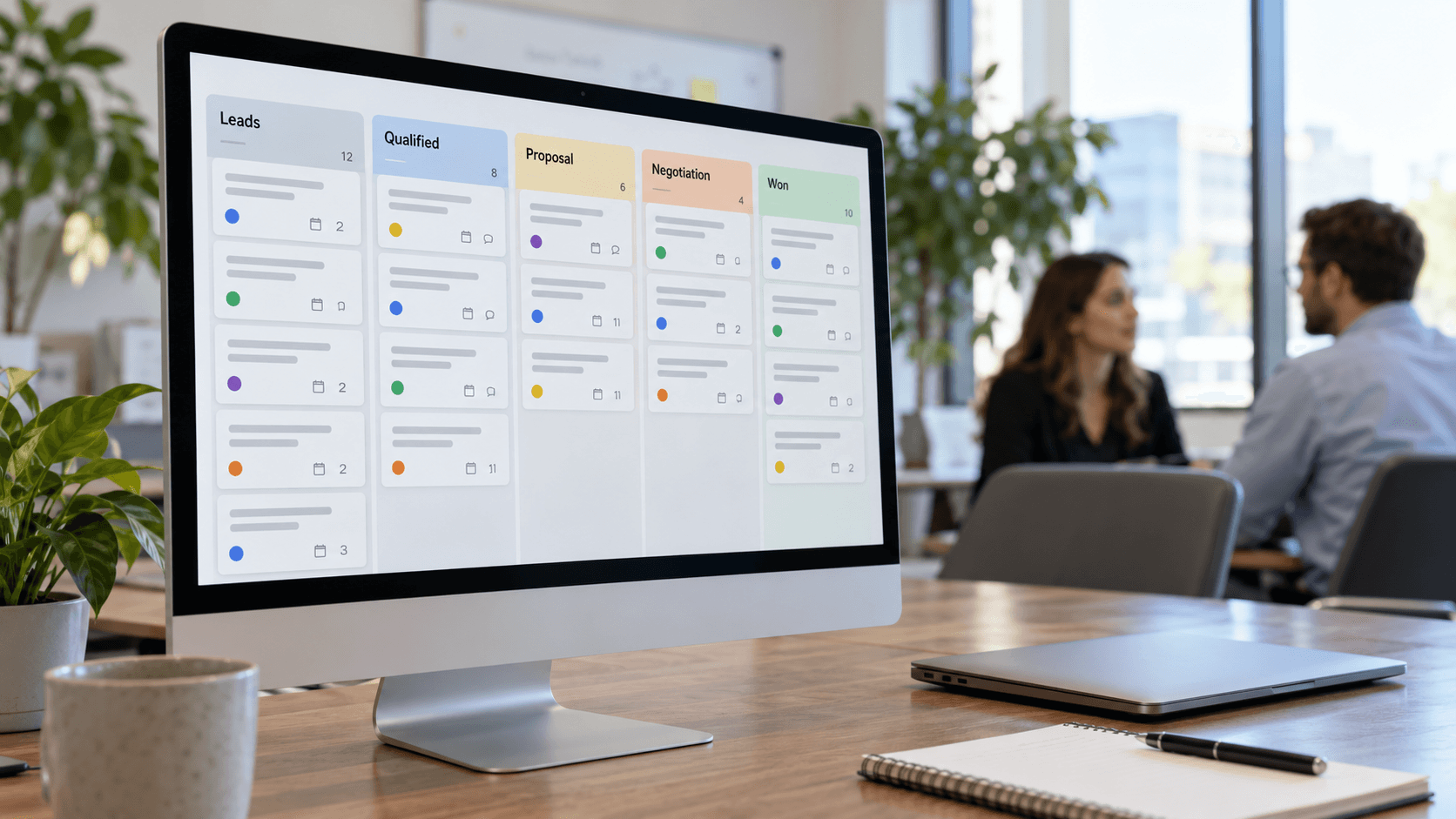
A B2B sales funnel describes how potential business customers move from discovering a company to evaluating its products, making purchasing decisions, and becoming paying clients. It helps sales and marketing teams understand where opportunities originate, how prospects progress, and why some potential deals never convert.
Business-to-business sales are often more complex than consumer transactions. A company purchasing wholesale inventory, enterprise software, manufacturing equipment, or professional services may involve several decision-makers, formal procurement procedures, budget approvals, and extended negotiations.
An effective B2B sales funnel creates structure around this process. Instead of treating every lead as equally valuable, businesses can evaluate buyer readiness, identify conversion problems, allocate sales resources, and improve revenue forecasting.
What Is a B2B Sales Funnel?
A B2B sales funnel is a framework that organizes potential business customers into stages according to their awareness, interest, evaluation, and purchasing readiness. It helps companies understand how many prospects enter the buying process and what percentage eventually become customers.
The funnel is typically wider at the beginning because many businesses may discover a supplier without intending to purchase immediately. As prospects move through qualification, product evaluation, commercial proposals, and negotiations, the number of active opportunities usually becomes smaller.
For a wholesale distributor, the funnel might begin with a retailer discovering its product catalog. The prospect requests pricing, receives a trade account assessment, compares competing suppliers, and eventually places an initial purchase order.
B2B Sales Funnel vs Sales Pipeline
A B2B sales funnel focuses on conversion across the buyer journey, while a sales pipeline tracks individual commercial opportunities and their progress toward closing. These concepts overlap, but they are not identical.
A company may use the same CRM data to evaluate both. However, an effective reporting system should preserve the distinction between generating qualified demand and closing specific opportunities.
| Feature | B2B Sales Funnel | B2B Sales Pipeline |
|---|---|---|
| Main perspective | Buyer journey and conversion | Seller activities and deal progress |
| Primary focus | Movement and drop-off between stages | Managing active opportunities |
| Typical metrics | Conversion rate, lead quality | Deal value, stage age, expected close |
| Main users | Marketing, sales, revenue operations | Sales representatives and managers |
| Main objective | Improve customer acquisition | Advance and close opportunities |
The 6 Main B2B Sales Funnel Stages
The six practical B2B sales funnel stages are awareness, interest, qualification, evaluation, negotiation, and purchase. Some organizations combine stages or introduce additional milestones based on their products, sales cycle, and customer requirements.
Stage 1: Awareness — Attract Potential Business Buyers
The awareness stage introduces a business to potential customers who may benefit from its products or services. Prospects may discover the company through search engines, business directories, professional networks, referrals, industry events, or paid advertising.
For example, a retailer searching for a wholesale packaging supplier might discover an educational article explaining packaging costs and minimum order quantities. That visitor may not be ready to buy immediately, but the interaction can become the beginning of a commercial relationship.
Useful awareness-stage content includes educational guides, industry research, product comparisons, webinars, and practical business tools.
Stage 2: Interest — Generate Leads
The interest stage begins when a potential buyer takes an identifiable action that demonstrates curiosity about the company or its offering. This might include downloading a catalog, requesting product information, subscribing to a business newsletter, or submitting a contact form.
A prospect expressing interest is not necessarily a qualified sales opportunity. Someone downloading a catalog may be researching suppliers without having purchasing authority or an approved budget.
Businesses should collect enough information to understand the prospect's company, product requirements, location, and likely purchasing needs without introducing unnecessary barriers.
Stage 3: Qualification — Identify Sales-Ready Prospects
The qualification stage determines whether a lead has a realistic need, commercial fit, purchasing capacity, and potential buying timeline. This prevents sales teams from spending excessive time on contacts who cannot or are unlikely to purchase.
One common approach is BANT:
BANT is one framework rather than a universal rule. Complex B2B sales may require deeper evaluation of procurement procedures, stakeholder priorities, technical compatibility, and organizational risk.
For a wholesale business, qualification may also include expected order volume, geographic delivery coverage, payment terms, and minimum order requirements.
Stage 4: Evaluation — Present the Solution
The evaluation stage allows qualified buyers to compare the supplier's offering with their commercial and operational requirements. Activities may include product demonstrations, sample orders, detailed quotations, technical documentation, and supplier assessments.
B2B customers often evaluate more than price. Delivery reliability, product availability, warranty provisions, implementation requirements, payment terms, and supplier responsiveness may influence the decision.
A useful sales process helps the buyer quantify potential value. For example, a distributor offering reliable next-day replenishment might demonstrate how reduced stockouts and inventory carrying costs could offset a higher unit purchase price.
Stage 5: Negotiation — Resolve Commercial Requirements
The negotiation stage focuses on reaching agreement about pricing, contract terms, service levels, delivery conditions, and purchasing commitments. Several stakeholders may participate, including procurement managers, finance teams, legal representatives, and operational decision-makers.
Sales representatives should understand which terms can be adjusted without undermining profitability. Offering a price reduction may be reasonable when a customer commits to higher order volumes, but repeated concessions without corresponding value can damage margins.
Proposals should clearly explain product specifications, payment schedules, minimum quantities, responsibilities, and conditions for future orders.
Stage 6: Purchase — Convert the Opportunity Into a Customer
The purchase stage occurs when the buyer makes a confirmed commercial commitment, such as signing a contract or placing an accepted order. The precise closing event should be defined consistently in the company's CRM.
For wholesale businesses, receiving the first purchase order is an important milestone, but customer acquisition does not end there. Order fulfillment, invoicing, delivery performance, and account support influence whether the new customer purchases again.
A strong sales funnel therefore connects with customer onboarding and retention processes rather than treating the first transaction as the end of the relationship.
| Qualification Factor | Key Question |
|---|---|
| Budget | Can the business afford the solution? |
| Authority | Who approves the purchase? |
| Need | What problem must be solved? |
| Timeline | When is the buying decision expected? |
B2B Sales Funnel Example
A B2B sales funnel example illustrates how lead volume decreases as prospects advance toward purchase. Consider a distributor attracting 2,000 business visitors during a reporting period.
The visitor-to-customer conversion rate is:
12 ÷ 2,000 × 100 = 0.6%
The lead-to-customer conversion rate is:
12 ÷ 200 × 100 = 6%
These results are hypothetical and should not be interpreted as industry benchmarks. Actual conversion rates depend on channel quality, product category, purchasing requirements, and the definition of each funnel stage.
The funnel also reveals where prospects leave the process. In this example, only 40% of identified leads become qualified, suggesting that lead targeting or qualification criteria deserve closer examination.
| Funnel Stage | Number of Prospects | Conversion From Previous Stage |
|---|---|---|
| Website visitors | 2,000 | — |
| Identified leads | 200 | 10% |
| Qualified leads | 80 | 40% |
| Sales opportunities | 40 | 50% |
| Proposals | 24 | 60% |
| New customers | 12 | 50% |
B2B Sales Funnel Metrics and Formulas
B2B sales funnel metrics measure how efficiently a company converts prospects into customers and how much revenue the process generates. Businesses should focus on a manageable set of indicators that reflect commercial outcomes.
Lead Conversion Rate
Lead Conversion Rate = Converted Leads ÷ Total Leads × 100
If 45 of 300 identified leads become qualified opportunities, the conversion rate is 15%.
The calculation must use a consistent definition of conversion. A lead becoming sales-qualified is different from an opportunity becoming a paying customer.
Opportunity Win Rate
Opportunity Win Rate = Won Opportunities ÷ Closed Opportunities × 100
Suppose a sales team closes 50 opportunities during a quarter, winning 20 and losing 30.
Win Rate = 20 ÷ 50 × 100 = 40%
This metric excludes opportunities that remain open when using the closed-opportunity method.
Average Deal Size
Average Deal Size = Total Value of Won Deals ÷ Number of Won Deals
A company winning 15 contracts worth a combined $300,000 has an average deal size of $20,000.
Businesses should define whether deal value represents initial orders, annual contract value, or total contract value. Mixing these measures can distort comparisons.
Sales Cycle Length
Average Sales Cycle Length = Total Days to Close Won Deals ÷ Number of Won Deals
If ten completed deals required a combined 600 days from the defined starting point to closure, the average sales cycle is 60 days.
Sales cycle calculations should use the same beginning and ending milestones for every opportunity.
Sales Velocity
A common sales velocity formula is:
Sales Velocity = Number of Opportunities × Average Deal Value × Win Rate ÷ Sales Cycle Length
Consider 40 qualified opportunities, an average deal value of $15,000, a 25% win rate, and an average sales cycle of 50 days.
Sales Velocity = 40 × $15,000 × 0.25 ÷ 50
Sales Velocity = $3,000 per day
This is a planning indicator based on modeled sales performance, not a guarantee of daily revenue.
How to Build a B2B Sales Funnel Step by Step
Building a B2B sales funnel requires clear buyer definitions, meaningful conversion milestones, and a reliable system for tracking prospect activity. Start with the customer's purchasing process rather than copying a generic funnel template.
Step 1: Define Your Ideal Customer Profile
An ideal customer profile describes the businesses most likely to benefit from the offering and generate sustainable revenue. Criteria may include industry, location, company size, purchasing volume, distribution requirements, and operational needs.
For a wholesale supplier, a small independent retailer and a national retail chain may require entirely different sales approaches. Separating these segments improves lead qualification and commercial messaging.
Step 2: Map the Customer Buying Journey
Identify the actions buyers take before purchasing. These may include researching products, comparing suppliers, requesting quotations, conducting compliance checks, and obtaining internal approval.
Map each buying milestone to an observable funnel stage. Avoid stages based exclusively on subjective salesperson opinions, such as labeling a prospect interested without a documented interaction.
Step 3: Create Relevant Content for Every Stage
Different stages require different information. Educational articles can attract early-stage prospects, while comparison sheets, product specifications, and pricing proposals support later decisions.
Content should help the buyer make a purchasing decision rather than merely increase website traffic.
Step 4: Establish CRM Stages and Responsibilities
A customer relationship management system should identify the account owner, stage, expected deal value, next action, and relevant contact details.
Define conditions for moving an opportunity between stages. For example, a proposal stage may require an actual quotation sent to a qualified customer, not simply an intention to prepare one.
Step 5: Set Conversion and Revenue Targets
Use historical performance to establish realistic expectations for lead volume, qualification rates, win rates, and customer acquisition cost. New businesses may begin with provisional assumptions and revise them as data accumulates.
Separate targets by customer segment and acquisition channel when possible. Inbound inquiries from existing product searches may behave differently from cold outreach campaigns.
Step 6: Monitor and Improve the Funnel
Review conversion rates, stalled opportunities, stage duration, and lost-deal reasons. A high number of prospects entering the funnel is not valuable if few match the company's ideal customer profile.
Focus improvements on the actual bottleneck. Low qualification rates may indicate weak targeting, while frequent losses after proposals may suggest pricing, positioning, or solution-fit problems.
| Funnel Stage | Useful Content |
|---|---|
| Awareness | Guides, industry articles, research |
| Interest | Catalogs, webinars, newsletters |
| Qualification | Discovery forms, needs assessments |
| Evaluation | Case studies, samples, demonstrations |
| Negotiation | Proposals, pricing comparisons, contracts |
| Purchase | Order instructions, onboarding materials |
B2B Sales Funnel for Wholesale and Distribution Businesses
A wholesale B2B sales funnel must account for recurring orders, trade credit, minimum order quantities, and long-term commercial relationships. The initial transaction often represents only a small portion of a customer's potential lifetime value.
For example, a packaging distributor may acquire a retail customer through a sample order worth $800. That customer could subsequently place monthly orders of $4,000, making retention and service quality more important than the initial transaction value suggests.
Wholesale funnel reporting should therefore track both new account acquisition and ongoing account development.
Useful additional metrics include repeat purchase rate, average order value, gross margin per customer, order frequency, and customer retention.
Common B2B Sales Funnel Mistakes
The most common B2B sales funnel mistakes involve poorly defined stages, inflated lead counts, weak qualification, and inconsistent follow-up. These problems make conversion reports unreliable and create misleading revenue forecasts.
Businesses should avoid:
- Treating every website visitor as a sales lead.
- Moving opportunities forward without qualifying evidence.
- Mixing different customer segments in one performance benchmark.
- Focusing on deal count while ignoring profitability.
- Failing to record why opportunities were lost.
- Allowing inactive leads to remain indefinitely in the pipeline.
- Overlooking procurement stakeholders and decision-makers.
- Ignoring customer onboarding and repeat purchase potential.
A smaller funnel containing high-quality opportunities can generate better commercial results than a larger funnel filled with poorly matched prospects.
Final Thoughts
A B2B sales funnel provides a structured way to connect lead generation with measurable commercial results. It helps businesses identify the prospects worth pursuing, understand where deals are lost, and improve the efficiency of sales activities.
For wholesalers and distributors, the funnel should extend beyond the first purchase to reflect account development, recurring orders, and customer profitability. Strong sales performance comes from attracting suitable buyers, supporting their purchasing decisions, and maintaining productive relationships after the initial transaction.
The most effective funnel is not necessarily the most complicated. It is one whose stages, metrics, and responsibilities accurately reflect how customers actually buy.
Frequently Asked Questions
- What is a B2B sales funnel?
- A B2B sales funnel represents the stages potential business customers move through before making a purchase. It helps companies evaluate lead quality, conversion performance, and the effectiveness of sales and marketing activities. The stages typically extend from initial awareness through qualification, evaluation, negotiation, and purchase.
- What are the main stages of a B2B sales funnel?
- Common stages include awareness, interest, qualification, evaluation, negotiation, and purchase. Some businesses add stages for demonstrations, formal proposals, onboarding, and customer retention. The structure should reflect the actual buying process rather than an arbitrary number of steps.
- What is a good B2B sales funnel conversion rate?
- There is no universal conversion rate suitable for every B2B business. Results depend on lead sources, customer segments, deal size, purchasing complexity, and the definition of conversion. Businesses should compare consistent internal metrics over time and use relevant external benchmarks cautiously.
- How do you calculate B2B sales funnel conversion?
- Divide the number of prospects completing a defined stage by the number entering the relevant earlier stage, then multiply by 100. For example, 20 new customers from 200 qualified leads represent a 10% qualified-lead-to-customer conversion rate. Clearly define the measured stages and reporting period.
- What tools help manage a B2B sales funnel?
- CRM systems, marketing automation platforms, analytics dashboards, and reporting spreadsheets can help manage B2B sales funnels. Useful features include lead tracking, qualification fields, opportunity management, conversion reporting, and automated reminders. The best tool depends on company size, sales complexity, and integration requirements.