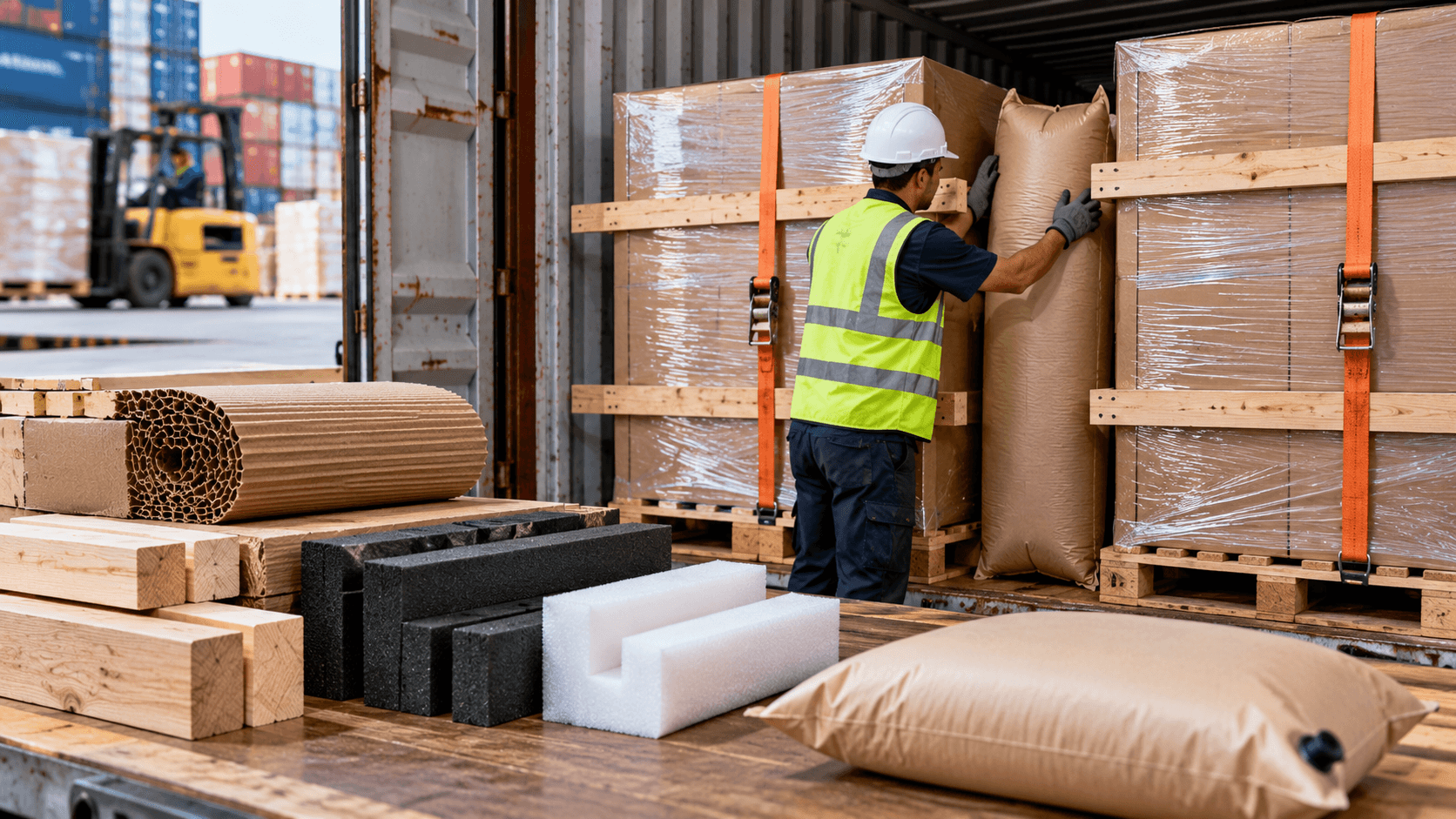
Dunnage is material used to support, cushion, separate, or protect cargo during storage and transportation. It helps prevent products from shifting, colliding, rubbing against surfaces, or experiencing certain types of damage while a truck, railcar, container, or vessel is moving. Common dunnage materials include wood, inflatable bags, foam, corrugated fiberboard, plastic, and specialized protective components.
Understanding what dunnage is matters for wholesalers and distributors because shipping damage can quickly erase the profit from an otherwise successful order. A pallet of products may leave a warehouse in excellent condition but experience vibration, sudden braking, handling impacts, and movement during transit. Without appropriate packaging and cargo protection, even short shipments can result in broken merchandise and costly claims.
Dunnage is not simply empty space filled with packing material. Different forms of dunnage serve different purposes, and the correct material depends on product weight, fragility, transport mode, load configuration, and environmental conditions. In regulated commercial transportation, dunnage may form part of a cargo securement system, but it must be suitable for the job and used in compliance with applicable requirements.
What Is Dunnage in Shipping?
Dunnage in shipping refers to loose or specialized materials used to protect, support, or stabilize goods while they are being transported. The U.S. Federal Motor Carrier Safety Administration describes dunnage as loose materials used to support and protect cargo. Dunnage bags are identified separately as inflatable bags intended to fill spaces between cargo units or between cargo and vehicle walls.
Dunnage can be placed beneath machinery, between pallets, around fragile items, or in the empty spaces inside a container. Its purpose is to limit undesirable cargo movement, distribute contact loads, and prevent damage caused by the surrounding environment or neighboring products. The same shipment may use more than one type of protective material.
For example, a distributor shipping metal components might place timber supports beneath the load and protective separators between products. A container filled with palletized cartons might require appropriately selected inflatable void-fill bags. Fragile electronic products may need engineered foam supports within their packaging.
Dunnage Meaning in Simple Terms
Dunnage means protective material placed around or between goods to help them travel safely. It can cushion fragile merchandise, support heavy equipment, or fill spaces that would otherwise allow cargo to move. The correct selection helps keep products in saleable condition until they reach the customer.
Consider a truck transporting 16 pallets of boxed merchandise. Even if the pallets are wrapped, empty spaces may allow loads to shift during transportation. Suitable dunnage, combined with an appropriate cargo securement arrangement, can help reduce movement and protect the shipment.
Why Is Dunnage Used in Transportation?
Dunnage is used to protect freight from movement, impact, friction, pressure, and certain handling-related hazards. Shipping vehicles experience changing forces during acceleration, braking, cornering, loading, and unloading. A protective system must account for these conditions rather than assuming freight will remain motionless throughout the journey.
A shipment may also encounter rough handling at terminals, multiple carrier transfers, and significant temperature or humidity changes. Some products need protection from direct contact with floors or walls, while others require cushioning between stacked units. Choosing the right dunnage reduces exposure to these risks.
For distributors, the business value extends beyond the physical shipment. Lower damage rates can reduce customer credits, product replacement costs, emergency freight, claims administration, and account dissatisfaction. A well-designed packaging process therefore supports both service quality and gross margin.
Types of Dunnage Used in Shipping
The main types of dunnage include inflatable air bags, wood, foam, corrugated fiberboard, plastic, and engineered protective supports. Each type offers different load-bearing capacity, cushioning characteristics, cost, reusability, and compatibility with products. Material selection should be based on a documented load-protection requirement.
No single material is appropriate for every load. A lightweight paper separator cannot be expected to restrain heavy machinery, while oversized timber supports may be unnecessary for small consumer products. The choice should reflect the mechanical forces the packaging must withstand.
Inflatable Dunnage Bags
Inflatable dunnage bags are protective bags placed in appropriately sized voids and inflated to help stabilize adjacent cargo. They are commonly used in containers, trailers, and rail transportation where suitable. The bags apply pressure against neighboring freight surfaces, helping limit movement under specified conditions.
Bags differ in dimensions, material construction, working pressure, and intended loading applications. The correct bag must be chosen according to the shipment configuration and the manufacturer's instructions. Underinflated, overinflated, punctured, or poorly positioned bags may fail to provide adequate protection.
Air bags should not be treated as a universal replacement for blocking, bracing, or tiedowns. The entire load must remain secured under the applicable rules and actual transport conditions. Operators should verify that adjacent freight and surrounding vehicle structures can safely accept the forces applied.
Wood Dunnage
Wood dunnage supports, separates, or protects cargo using timber blocks, boards, cradles, or other wooden components. It is commonly associated with machinery, construction materials, industrial freight, and heavy loads requiring stable support. Its usefulness depends on wood quality, dimensions, loading direction, and the forces involved.
Timber can distribute pressure beneath heavy products or provide a base for suitable blocking and bracing systems. Poorly chosen or damaged wood can split, compress, or move during transportation. A securement plan should therefore specify appropriate materials and installation methods.
International shipments using solid wood packaging material may also be subject to phytosanitary requirements, including applicable ISPM 15 rules. Businesses should verify whether the selected wooden components are covered and whether required treatment and markings apply. Not every wood-derived material is treated identically under these rules.
Foam Dunnage
Foam dunnage is used to cushion fragile or sensitive products against impacts and vibration. It can be cut or molded to match the shape of merchandise and provide separation between components. Foam is especially useful for electronics, precision equipment, glass products, and manufactured components.
Cushioning performance depends on density, thickness, geometry, product weight, and expected impacts. A material that feels soft is not automatically suitable for shipping a valuable item. Compression and repeated impacts can affect performance.
Businesses should validate protective designs through appropriate packaging tests or shipment experience. Foam systems may offer strong product protection, but they can also increase packaging volume and material costs. The correct design balances performance, sustainability, warehouse efficiency, and transportation economics.
Corrugated Dunnage
Corrugated dunnage uses layered paper-based structures to separate, cushion, or stabilize packaged goods. Common forms include pads, partitions, folded inserts, and engineered honeycomb supports. Corrugated materials are often attractive when low weight, low cost, and recyclability are important.
Their performance depends on construction and loading conditions. Excessive compression or moisture can reduce strength, particularly when a shipment experiences repeated handling. Lightweight inserts should not be relied on for load restraint beyond their tested capabilities.
Corrugated dunnage can be effective for packed consumer products and smaller merchandise. Distributors should choose designs based on product protection rather than simply adding more paper to every carton. Consistent specifications can reduce packaging waste and shipping costs.
Plastic and Reusable Dunnage
Reusable plastic dunnage is designed to protect or position products across repeated movements within a supply chain. Examples include molded trays, separators, corner protectors, and industrial transport fixtures. These systems are frequently used where suppliers and customers operate recurring returnable-container programs.
Reusable dunnage can reduce repetitive packaging consumption, but it requires reverse logistics and asset tracking. Trays and fixtures must be collected, cleaned if necessary, inspected, and returned for reuse. Losses and return transportation can make a reusable system more expensive than expected.
A distributor should evaluate the number of usable cycles rather than comparing only the initial cost. Reusable dunnage performs best when shipping routes, product dimensions, and return arrangements are predictable.
| Dunnage type | Typical use | Main consideration |
|---|---|---|
| Inflatable dunnage bags | Filling voids between cargo units | Correct pressure and load rating |
| Wood dunnage | Supporting heavy equipment and freight | Strength, condition, and treatment requirements |
| Corrugated fiberboard | Separating or cushioning cartons | Compression and moisture exposure |
| Foam dunnage | Protecting fragile and high-value goods | Cushioning performance |
| Molded plastic | Reusable industrial supports | Product compatibility |
| Rubber or friction materials | Improving contact or protection | Suitability for required restraint |
| Engineered blocking | Restricting defined load movements | Structural strength and securement design |
Dunnage vs. Void Fill: What Is the Difference?
Dunnage is a broad cargo-protection term, while void fill usually refers to material used specifically to occupy empty spaces in packaging or a shipment. The concepts overlap because filling a void can help protect freight. However, dunnage may also support heavy cargo, separate products, or distribute loads.
For example, an air bag placed between two pallet rows is a form of void-filling dunnage. A wooden block supporting an industrial machine is dunnage even though it may not be filling a large empty space. Foam placed around a fragile component can provide cushioning and separation simultaneously.
The difference matters when writing packaging specifications. A purchasing instruction such as "add void fill" may not establish the load-bearing or cushioning performance required. Specific product-protection requirements are more useful than a general instruction to add extra material.
Dunnage vs. Blocking and Bracing
Dunnage provides support and protection, while blocking and bracing describe methods of restricting cargo movement using suitable structures or devices. Dunnage can be part of a blocking or bracing system, but the terms are not always synonymous. Cargo may require additional restraints even when protective materials are present.
For example, timber blocking might be used to prevent machinery from moving horizontally. Bracing can help prevent a load from tipping. Foam separators, by contrast, may protect surfaces without providing meaningful restraint against the forces of a truck accident or sudden braking.
FMCSA cargo securement guidance requires freight to be appropriately immobilized or secured using adequate structures, dunnage, dunnage bags, shoring bars, tiedowns, or combinations as applicable. Commodity-specific rules may impose additional obligations. The selected system must meet the relevant performance requirements rather than simply appear tightly packed.
How to Choose the Right Dunnage
Choosing dunnage requires evaluating the product, cargo weight, movement risk, transport environment, and required protection level. Material prices alone do not indicate suitability. A cheap protective component can become expensive if it causes rejected deliveries or freight damage.
A practical selection process should answer the following questions:
- What product is being shipped? Determine its weight, dimensions, fragility, and sensitivity to pressure.
- What type of movement is expected? Consider vibration, impacts, lateral movement, compression, and handling.
- Which transport modes are involved? Truck, rail, sea, and intermodal shipping may expose freight to different conditions.
- How is the cargo positioned? Examine pallet patterns, stacking arrangements, voids, and contact surfaces.
- What protection is required? Distinguish cushioning, support, separation, and cargo restraint.
- What rules apply? Verify applicable cargo securement and international packaging requirements.
- Can the packaging be reused? Consider return logistics, storage, inspection, and replacement.
These decisions should be documented as part of the packaging specification. Warehouse employees need practical instructions showing where protective materials belong and how to determine whether installation is correct. Standardization reduces variation between shifts and facilities.
How Much Dunnage Does a Shipment Need?
The amount of dunnage needed depends on the load geometry, the gaps between cargo units, the forces the shipment may experience, and the performance of the selected material. There is no universal quantity per pallet or container. A shipment of lightweight packaged goods requires a different protection system from heavy industrial equipment.
Consider a hypothetical trailer carrying 20 pallets with two significant voids between the pallet rows. The operator must evaluate the size and position of those voids, pallet strength, cargo weight, and available restraint structures. Choosing two appropriately rated bags may be part of a solution, but the number of bags alone does not establish compliance.
The full load plan should identify where support, cushioning, blocking, and tiedowns are required. Protective materials must not create unstable pressure against fragile packages. Loaders should follow tested procedures and manufacturer instructions.
Dunnage Cost vs. Shipping Damage
Dunnage cost should be evaluated against the expected cost of freight damage, customer returns, replacement goods, and service failures. Adding protection can be economically worthwhile when it substantially reduces claims or rejected shipments. However, excessive packaging adds material, labor, storage, and disposal costs.
Consider a distributor shipping 1,000 orders per month. Assume the company experiences damage claims on 3% of shipments, with an average direct cost of $180 per claim. Expected monthly direct damage cost is 30 × $180, or $5,400.
After introducing a properly tested packaging improvement costing $1.50 per shipment, the damage rate falls to 1% in this hypothetical scenario. Expected claims cost becomes $1,800, while additional packaging costs total $1,500. The resulting illustrative net reduction in monthly direct costs is $2,100.
These figures are hypothetical and assume the observed improvement is attributable to the packaging change. In practice, businesses should evaluate a representative sample and account for shipment mix, seasonality, carrier changes, and other factors. The goal is to establish whether packaging performance improves total cost, not simply to buy more dunnage.
| Cost measure | Before improvement | After improvement |
|---|---|---|
| Monthly shipments | 1,000 | 1,000 |
| Illustrative damage rate | 3% | 1% |
| Expected damage claims | 30 | 10 |
| Direct cost per claim | $180 | $180 |
| Expected damage cost | $5,400 | $1,800 |
| Additional dunnage cost | $0 | $1,500 |
| Combined modeled cost | $5,400 | $3,300 |
Dunnage in Different Industries
Dunnage requirements vary significantly between consumer products, industrial equipment, automotive components, electronics, and food distribution. The products, packaging formats, regulatory obligations, and expected transport conditions differ. A material suitable for one industry may be inappropriate for another.
Industrial distributors may need rigid supports and engineered restraint for machinery or metal products. Electronics distributors often prioritize cushioning, vibration protection, and product-specific packaging. Food distributors may need materials suitable for their handling environment, while temperature-controlled shipments require careful consideration of airflow and hygiene.
Automotive supply chains frequently use reusable trays or returnable containers because the same components move repeatedly between established business locations. Consumer-goods wholesalers may prefer economical corrugated inserts and pallet stabilization. Product requirements should determine the protective design.
Dunnage and Warehouse Operations
Dunnage should be integrated into warehouse packing, loading, and quality-control procedures rather than treated as an occasional last-minute addition. If employees select materials without standards, packaging performance can vary between orders and shifts. This creates inconsistent freight protection and unpredictable material consumption.
An effective warehouse process establishes approved materials for each relevant product or load type. Packing instructions identify the required placement, quantity where appropriate, and inspection steps. Supervisors can then monitor exceptions and investigate damage trends.
Dunnage specifications can also be linked to order profiles and transportation modes. A product shipped by parcel carrier may need a different packaging arrangement from the same product transported on a pallet. The Order Fulfillment Process for Distributors explains how packaging and shipping activities fit within a broader fulfillment operation.
Common Dunnage Mistakes
Common dunnage mistakes include using undersized materials, ignoring load forces, applying excessive pressure, and assuming that void fill alone makes cargo secure. These practices can lead to damaged freight or unsafe transportation conditions. A suitable packaging plan must address both product protection and any applicable cargo-restraint obligations.
Another mistake is selecting materials based only on initial price. Low-cost materials may collapse or shift during transit, while expensive reusable fixtures may be uneconomical without a return system. Businesses should compare total performance and lifecycle cost.
Packaging should also be reassessed when the company changes carriers, routes, products, pallet configurations, or shipment quantities. A method that worked for a full trailer may not perform identically in a partially loaded vehicle. Documented testing and damage analysis can identify when specifications need adjustment.
Final Takeaway
Dunnage is a practical cargo-protection tool that supports, separates, cushions, and sometimes helps stabilize freight during transportation. Appropriate material selection can reduce damage, claims, rejected deliveries, and unnecessary replacement shipments. Its value depends on proper design, loading, and use rather than simply filling empty spaces.
Wholesale distributors should evaluate dunnage as part of their complete transportation and warehouse process. The right protective system must match product characteristics, shipping conditions, and applicable cargo securement requirements. Investing in reliable packaging and measuring the results can improve customer service while reducing avoidable logistics costs.
Frequently Asked Questions
- What is dunnage in simple terms?
- Dunnage is material used to support, separate, cushion, or protect cargo during shipping. Common examples include wood supports, air bags, foam inserts, and corrugated separators. It helps reduce damage and unwanted movement.
- What is an example of dunnage?
- An inflatable bag placed between two pallet rows inside a freight container is an example of dunnage. The bag is selected and inflated to help stabilize the load. Other examples include wooden supports beneath machinery and foam cushioning around fragile goods.
- Is dunnage the same as packaging?
- Not exactly. Packaging is a broad term covering containers, wrapping, cartons, labels, and protective materials. Dunnage specifically refers to material used to support or protect cargo, often within a larger packaging or transportation system.
- What are dunnage bags used for?
- Dunnage bags fill suitable empty spaces between cargo units to help reduce movement during transportation. They are commonly used in railcars, trailers, and containers. Their pressure ratings, placement, and compatibility with the load must be verified.
- Is dunnage required for every shipment?
- Not necessarily. The appropriate protection and securement system depends on the cargo, vehicle, and applicable regulations. Some shipments require dunnage, while others rely on different packaging or securement methods.
- Can dunnage replace tiedowns?
- Not automatically. Dunnage can be part of a compliant cargo securement system, but the complete arrangement must meet applicable requirements. Heavy or specialized cargo may need blocking, bracing, tiedowns, or other engineered controls.
- What is the cheapest type of dunnage?
- The least expensive material depends on the application, order volume, protection requirements, and reuse possibilities. Corrugated materials may be economical for lighter products, while timber or specialized systems can be appropriate for heavy freight. Total damage cost matters more than unit material price alone.