Logistics
FOB Meaning in Shipping: FOB Origin vs. Destination Explained
FOB terms determine important shipping responsibilities, but their meaning depends on the legal framework being used. Learn the difference between FOB shipping point, FOB destination, and international FOB Incoterms through clear examples and cost calculations.
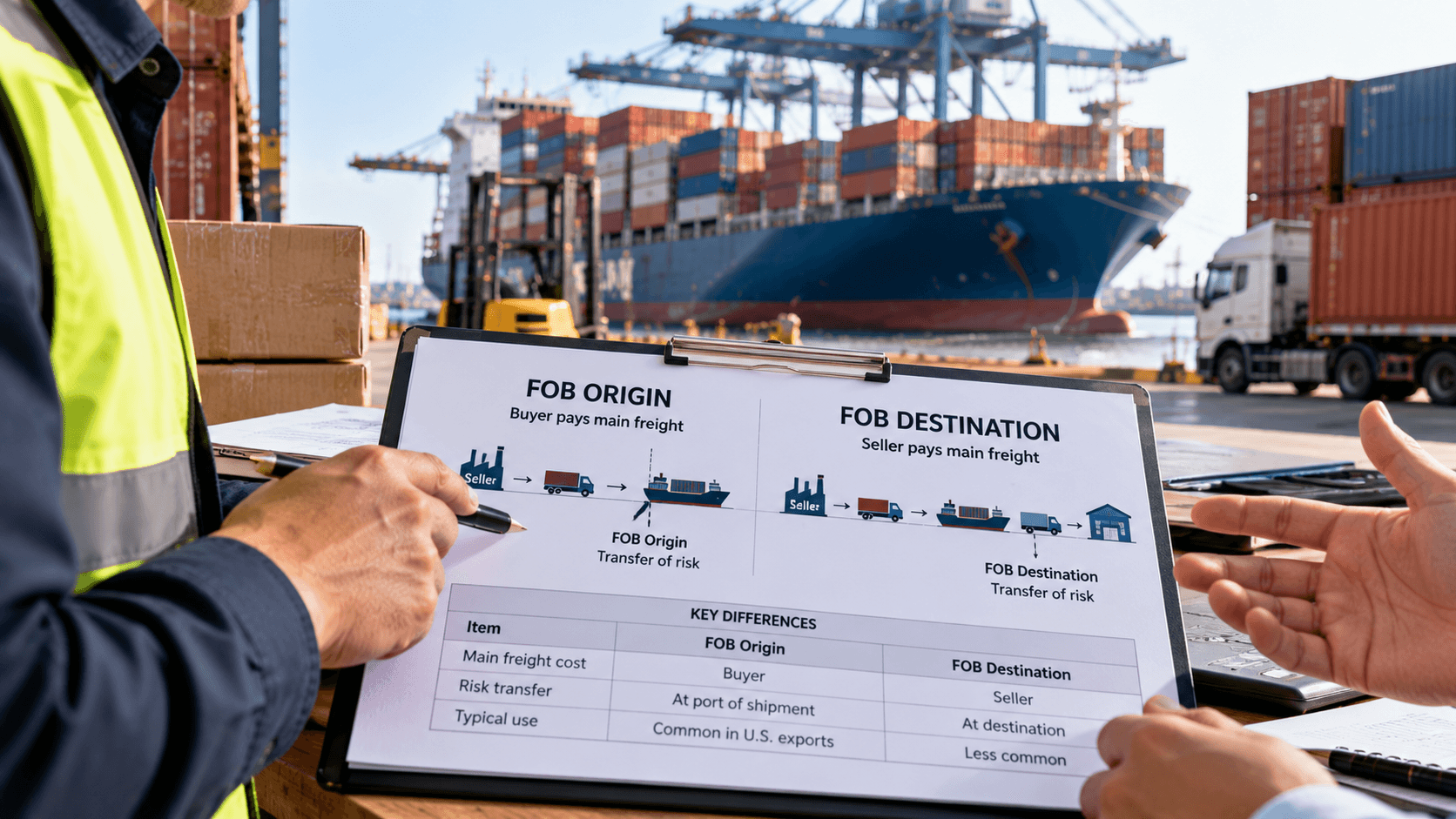
FOB meaning in shipping is Free on Board, a delivery term that helps determine where a seller fulfills its delivery obligation and how transportation risk is allocated. In U.S. commercial transactions under the Uniform Commercial Code, FOB can refer to a named shipping point or destination. In international trade under Incoterms 2020, FOB specifically concerns delivery of goods on board a vessel at a named port of shipment.
Understanding FOB meaning is important because the same abbreviation appears in different commercial systems. A U.S. supplier may quote "FOB Chicago" for goods shipped by truck, while an international manufacturer may quote "FOB Shanghai, Incoterms 2020" for an ocean shipment. These terms are not interchangeable, and interpreting them incorrectly can create disputes about freight charges and shipment losses.
FOB also does not answer every question about a transaction. Payment deadlines, insurance requirements, transfer of ownership, customs obligations, and product acceptance may depend on separate contractual provisions. A buyer should always read the full commercial agreement rather than treating three letters as a complete shipping contract.
What Does FOB Mean in Shipping?
FOB stands for Free on Board and identifies a delivery arrangement tied to a specified location and applicable commercial rules. In domestic U.S. trade, the location can be the point of shipment or the destination under UCC § 2-319. Under ICC Incoterms 2020, FOB identifies a specific sea or inland-waterway delivery arrangement at the port of shipment.
This distinction affects when the seller completes its delivery obligation and which party bears the risk of loss or damage during transportation. Under U.S. FOB shipping-point terms, risk generally transfers when the seller properly places the goods with the carrier, subject to the contract and applicable law. Under FOB destination terms, the seller generally bears transportation risk until the goods are properly tendered at the specified destination.
For an international FOB Incoterms 2020 transaction, the key event is delivery of the cargo on board the buyer-nominated vessel at the named port. The buyer then bears the transportation risk from that point. This is a different framework from the broad domestic shorthand of FOB origin and FOB destination.
FOB Origin vs. FOB Destination
The main difference between FOB origin and FOB destination is where the seller's delivery responsibility ends and the transportation risk normally shifts. FOB origin, also called FOB shipping point, is associated with delivery at the point of shipment. FOB destination is associated with delivery at the named destination.
These comparisons reflect the UCC framework rather than the Incoterms 2020 FOB ocean-shipping rule. The exact contract can modify obligations, and the FOB designation alone does not automatically determine who directly receives the carrier's invoice. Separately agreed freight-prepaid or freight-collect provisions may affect billing.
FOB Shipping Point Meaning
FOB shipping point means the seller's delivery obligation is generally completed when goods are properly placed with the carrier at the agreed place of shipment. Under UCC § 2-319, the seller must ship the goods appropriately and bear the relevant expense and risk of putting them into the carrier's possession. From that delivery point, transportation risk generally belongs to the buyer, subject to other applicable provisions.
For example, a distributor purchases 100 cartons from a manufacturer under FOB shipping point terms. Once the manufacturer properly tenders the cartons to the carrier at the agreed origin, the buyer generally assumes the risk of loss during transit. If the shipment is damaged, the commercial and carrier contracts determine the available remedies and claims procedures.
The buyer should therefore understand the carrier arrangement and consider whether appropriate cargo insurance is in place. FOB shipping point can create an earlier transfer of risk than a destination-delivery arrangement. However, it does not excuse a seller from delivering nonconforming goods or failing to perform other contractual obligations.
FOB Destination Meaning
FOB destination means the seller generally remains responsible for transporting the goods at its expense and risk to the named destination and properly tendering delivery there. This allocation follows the UCC's destination-term structure unless the parties agree otherwise. The buyer does not ordinarily bear the main transportation risk before the seller completes the required destination delivery.
For example, a wholesaler ships products to a retailer under FOB destination terms. The wholesaler arranges the transportation required by the agreement and bears the associated transit risk until proper tender at the destination. If freight is lost before arrival, the seller generally remains responsible under the stated delivery arrangement, subject to the full contract.
The retailer should still inspect the delivery and document any shortages or damage. Destination terms do not remove the need for accurate receiving procedures. They establish an important part of the risk allocation, not a complete product-acceptance system.
| Feature | FOB Origin / Shipping Point | FOB Destination |
| Delivery point | Named place of shipment | Named destination |
| Seller's basic duty | Properly deliver goods to carrier | Transport and tender goods at destination |
| Risk during main transport | Generally buyer after proper carrier handoff | Generally seller until proper destination tender |
| Seller's transport responsibility | Up to the named shipping point | To the named destination |
| Typical use | Domestic shipment-point arrangements | Domestic destination arrangements |
| Freight billing | Depends on contract | Depends on contract |
FOB Shipping Point vs. FOB Destination Example
A FOB shipping point versus FOB destination example shows how the same commercial shipment can create different risk responsibilities depending on the agreed delivery term. Consider a manufacturer in Ohio selling $25,000 of merchandise to a distributor in Texas. The goods are transported by truck, and the contract specifies the applicable UCC-based term.
Illustrative comparison assuming conforming goods, proper performance, and no overriding contractual provisions.
If the truck experiences a covered accident, the consequences depend on the agreed FOB term, relevant insurance, carrier liability, and applicable law. Allocation of risk does not necessarily mean a party will permanently absorb every dollar of damage. Insurance recovery and legal claims can affect the ultimate outcome.
This example highlights why logistics teams should review delivery terms before selecting insurance and transportation procedures. The price on the supplier invoice may look identical under both terms, but risk allocation and related commercial expenses can differ materially.
| Event | FOB Shipping Point | FOB Destination |
| Goods prepared at Ohio warehouse | Seller responsible before proper handoff | Seller responsible |
| Goods properly handed to carrier | Delivery obligation generally completed | Seller still has destination delivery obligation |
| Truck travels to Texas | Buyer generally bears transit risk | Seller generally bears transit risk |
| Truck suffers accidental cargo loss | Generally buyer's transit risk | Generally seller's transit risk |
| Goods properly tendered in Texas | Delivery already occurred earlier | Seller completes destination delivery |
FOB Meaning Under Incoterms 2020
Under Incoterms 2020, FOB means Free on Board and applies to goods delivered on board a vessel at a named port of shipment. The seller completes delivery when the goods are on board the vessel nominated by the buyer, or procures goods already so delivered in the circumstances covered by the rule. Risk then transfers to the buyer under that rule.
The International Chamber of Commerce lists FOB among the rules intended only for sea and inland waterway transport. Unlike a U.S. domestic FOB destination term, Incoterms FOB does not describe the seller delivering goods to the final overseas destination. Its risk-transfer point is the vessel at the port of shipment.
Seller Responsibilities Under FOB Incoterms 2020
The seller must meet the agreed delivery obligation at the named shipment port, including placing the goods on board the nominated vessel as required by the rule. Under the rule's allocation, the seller normally handles export clearance where applicable and bears relevant costs and risks up to delivery. The seller must provide required evidence of delivery and perform other specified obligations.
The seller should coordinate with the buyer about vessel information, loading arrangements, and applicable shipment instructions. The exact obligations are contained in the full ICC rule and the parties' commercial agreement. Exporters should avoid substituting informal trade shorthand for a properly defined Incoterm.
Buyer Responsibilities Under FOB Incoterms 2020
The buyer normally contracts or arranges the main carriage from the shipment port and bears risk after the goods are delivered on board. The buyer also takes responsibility for the relevant subsequent transport, import arrangements, and costs allocated to it under the rule. Additional insurance may be commercially advisable depending on the transaction.
FOB does not itself require either party to procure cargo insurance for the other's benefit. The buyer should therefore assess the exposure after the risk-transfer point. Payment conditions and transfer of title must be dealt with separately in the sale agreement.
Why FOB May Be Unsuitable for Containerized Cargo
FOB is often unsuitable for containerized shipments when the seller delivers goods to a container terminal before the cargo is loaded on board the vessel. ICC guidance explains that FOB is designed for delivery on board a vessel. When the seller hands the goods over to a carrier earlier, FCA may better reflect the actual delivery arrangement.
In a typical container shipment, a manufacturer transports a sealed container to a terminal, where it can remain before being loaded onto the vessel. The seller may no longer control the container during that interval. Using FOB can leave a mismatch between physical control and the contractual delivery point.
FCA, or Free Carrier, can provide a clearer handoff when the agreed delivery occurs at a carrier or terminal location rather than on board a ship. The chosen Incoterm should match the commercial process and be identified with the correct named place. The International Shipping Guide for Distributors provides additional context for import planning.
FOB vs. CIF: What Is the Difference?
FOB and CIF are both sea and inland-waterway Incoterms rules, but CIF places additional obligations on the seller to arrange and pay for carriage and specified insurance to the named destination port. Under FOB, the buyer normally arranges the main carriage. Under CIF, the seller arranges the required carriage and insurance, although risk transfers at the shipment port under the Incoterms framework.
A common misunderstanding is that CIF risk transfers at the destination port because the seller pays for carriage there. Under Incoterms 2020, the distinction between who pays transport and when risk transfers is fundamental. Buying cargo under CIF does not mean the seller necessarily bears transit risk all the way to the destination.
| Feature | FOB Incoterms 2020 | CIF Incoterms 2020 |
| Full name | Free on Board | Cost, Insurance and Freight |
| Permitted transport | Sea and inland waterway | Sea and inland waterway |
| Delivery / risk-transfer point | On board vessel at shipment port | On board vessel at shipment port |
| Main carriage arranged by | Normally buyer | Seller |
| Required seller-arranged cargo insurance | No general FOB requirement | Yes, prescribed minimum cover |
| Named location | Port of shipment | Port of destination for cost allocation |
FOB vs. EXW and FCA
FOB differs from EXW and FCA because the Incoterms rules define different seller delivery obligations and are suitable for different transport arrangements. EXW generally places relatively limited delivery obligations on the seller, while FCA provides for delivery to a carrier or other named party at an agreed location. FOB specifically requires the maritime on-board delivery event.
The best rule depends on who can control transportation, export formalities, terminal handling, and shipment documentation. Distributors importing containerized products should review FCA rather than assuming FOB is always the default. Properly matching trade terms to the shipment improves cost planning and reduces ambiguity.
| Rule | Suitable transport | Main delivery concept |
| EXW | Any mode | Goods placed at buyer's disposal at named place |
| FCA | Any mode | Goods delivered to carrier or nominated party at named place |
| FOB | Sea or inland waterway | Goods placed on board vessel at shipment port |
| CIF | Sea or inland waterway | On-board delivery, with seller-paid carriage and insurance to named port |
Who Pays Freight Under FOB?
Who pays freight under FOB depends on whether the transaction uses domestic U.S. FOB terms, Incoterms FOB, and any separately agreed freight-billing provisions. FOB should not be reduced to a universal statement that one party always pays every transport charge. Commercial contracts may allocate charges more specifically.
Under international FOB Incoterms 2020, the buyer normally arranges and pays the main carriage from the shipment port. Under U.S. FOB shipping-point terms, the seller's default responsibility concerns proper delivery to the carrier at origin, while subsequent arrangements depend on the contract. Under U.S. FOB destination terms, the seller is responsible for the expense and risk of transportation to the destination under the UCC framework unless otherwise agreed.
Freight prepaid and freight collect are billing instructions that should be interpreted alongside the delivery term. A seller may initially pay a carrier and recover the charge through the commercial invoice under an agreed arrangement. The distributor should verify actual economic responsibility instead of relying only on the party that receives the carrier invoice.
Does FOB Determine When Ownership Transfers?
FOB primarily addresses delivery and transportation risk, and should not be assumed to establish ownership transfer in every transaction. Under U.S. law, title questions involve the agreement and applicable UCC provisions, including rules beyond the FOB definition. Under Incoterms, transfer of ownership is outside the rules' primary scope.
A contract might allocate risk at shipment while using separate provisions for title, payment security, and acceptance. For example, parties may negotiate retention-of-title language, subject to the relevant legal framework. None of these issues should be determined exclusively by the abbreviation FOB.
Accounting teams must also avoid treating a shipping term as the only basis for revenue or inventory recognition. Actual recognition depends on relevant accounting standards and contract conditions. Businesses should coordinate procurement, logistics, and finance so that the terminology is used consistently.
How FOB Affects Landed Cost
FOB affects landed cost because it determines which transportation and handling responsibilities are assigned to the buyer and seller under the applicable arrangement. A quoted factory or FOB shipment-port price is not necessarily the cost of getting inventory into a U.S. distributor's warehouse. Buyers must calculate additional expenses according to their actual responsibilities.
Consider a hypothetical overseas purchase:
The figures are hypothetical and exclude other charges that may apply. Accounting inventory cost and cash outlay may differ depending on the nature of the expense.
A distributor comparing suppliers should model all relevant transportation and import expenses rather than only the quoted FOB price. The cheapest supplier at the shipping port may not produce the lowest delivered cost. Product classification, import requirements, shipment timing, and carrier rates can change the outcome.
A reliable distribution logistics process connects these expenses with purchasing, inventory, and customer pricing decisions.
| Cost component | Amount |
| FOB goods price at named shipment port | $20,000 |
| Ocean freight | $2,200 |
| Cargo insurance purchased by buyer | $150 |
| Destination terminal charges | $450 |
| Customs duties | $1,400 |
| Customs broker | $200 |
| Inland transportation | $900 |
| Total illustrative acquisition and logistics outlay | $25,300 |
How to Write FOB Terms Correctly
FOB terms should identify the delivery location and the governing framework clearly enough that both parties understand their responsibilities. Generic wording such as "FOB warehouse" can create uncertainty if the parties have not established whether they mean a domestic UCC arrangement or international Incoterms rules. Better documentation names the location and applicable version.
Examples include:
- Domestic U.S. transaction: FOB Shipping Point — Seller's Warehouse, Columbus, Ohio, subject to the agreed U.S. commercial terms.
- Domestic U.S. transaction: FOB Destination — Buyer's Distribution Center, Dallas, Texas, under the applicable contract.
- International maritime transaction: FOB Port of Houston, USA — Incoterms 2020.
These examples are templates for clear drafting, not substitutes for a complete agreement. A commercial contract should address freight billing, insurance, payment, inspection, claims, and any negotiated deviations. Parties should use terms consistent with their actual transport method.
Common FOB Shipping Mistakes
Common FOB mistakes arise when businesses confuse U.S. domestic terms with international Incoterms, omit named locations, or assume the shipping term resolves ownership and payment. The resulting errors can affect insurance, freight quotes, landed cost, and responsibility for damaged merchandise. Written agreements should eliminate ambiguity before dispatch.
Another mistake is using international FOB for a container that is handed over at a terminal before vessel loading. This can create an avoidable mismatch between practical cargo control and the contractual risk-transfer point. ICC guidance identifies FCA as an alternative for such circumstances.
Finance teams should also check that their systems consistently record purchasing terms. A buyer who assumes destination delivery when the contract specifies a shipment-point arrangement may fail to arrange appropriate protection. Procurement and logistics personnel should agree on the interpretation before approving the purchase order.
Frequently Asked Questions About FOB Meaning
What does FOB stand for?
FOB stands for Free on Board. Its practical meaning depends on the governing terms and the named location. U.S. domestic FOB provisions and international FOB Incoterms 2020 must be distinguished.
What is FOB shipping point?
FOB shipping point generally means the seller completes the required delivery by properly handing goods to the carrier at the named origin under the relevant U.S. commercial framework. Transportation risk then generally passes to the buyer, subject to the agreement and applicable law.
What is FOB destination?
FOB destination generally means the seller bears the transportation expense and risk until properly tendering the goods at the agreed destination under the UCC-based arrangement. The buyer should still inspect the shipment and document delivery discrepancies.
Who pays for shipping with FOB?
The answer depends on the FOB framework and the contract. Under Incoterms 2020 FOB, the buyer normally arranges and pays the main carriage from the shipment port. Under domestic arrangements, freight payment and billing instructions must be interpreted with the delivery term and any additional agreement.
Does FOB mean free shipping?
No. The word "free" in Free on Board does not mean the shipment has no transportation charges. FOB is a commercial delivery term allocating responsibilities, expenses, and risk under specified conditions.
Is FOB the same as CIF?
No. Under Incoterms 2020, FOB and CIF both involve on-board delivery at the port of shipment, but CIF obliges the seller to arrange and pay for carriage and specified insurance to the named destination port. Risk still transfers at shipment under the applicable rule.
Is FOB used for air freight?
International FOB under Incoterms 2020 is intended for sea and inland waterway transport, not air freight. FCA can be used for multiple transport modes, including air. U.S. domestic FOB terminology follows a separate legal context.
Does FOB determine who owns the goods?
Not by itself. Delivery terms and transportation risk are distinct from questions of legal title, contractual payment, and accounting recognition. Those matters depend on the agreement and applicable rules.
Final Takeaway
FOB meaning in shipping is Free on Board, but the correct interpretation depends on the type of transaction. Under U.S. domestic commercial terms, FOB shipping point and FOB destination allocate delivery and transit risk differently. Under international Incoterms 2020, FOB concerns goods delivered on board a vessel at the named shipment port.
Wholesale distributors should never interpret FOB without reviewing the governing commercial framework, named location, and other contract provisions. Correct terms support better freight planning, insurance decisions, landed-cost calculations, and claims handling. The goal is not merely to understand an abbreviation but to know precisely what each party has agreed to do.
Frequently Asked Questions
- What does FOB stand for?
- FOB stands for Free on Board. Its practical meaning depends on the governing terms and the named location. U.S. domestic FOB provisions and international FOB Incoterms 2020 must be distinguished.
- What is FOB shipping point?
- FOB shipping point generally means the seller completes the required delivery by properly handing goods to the carrier at the named origin under the relevant U.S. commercial framework. Transportation risk then generally passes to the buyer, subject to the agreement and applicable law.
- What is FOB destination?
- FOB destination generally means the seller bears the transportation expense and risk until properly tendering the goods at the agreed destination under the UCC-based arrangement. The buyer should still inspect the shipment and document delivery discrepancies.
- Who pays for shipping with FOB?
- The answer depends on the FOB framework and the contract. Under Incoterms 2020 FOB, the buyer normally arranges and pays the main carriage from the shipment port. Under domestic arrangements, freight payment and billing instructions must be interpreted with the delivery term and any additional agreement.
- Does FOB mean free shipping?
- No. The word "free" in Free on Board does not mean the shipment has no transportation charges. FOB is a commercial delivery term allocating responsibilities, expenses, and risk under specified conditions.
- Is FOB the same as CIF?
- No. Under Incoterms 2020, FOB and CIF both involve on-board delivery at the port of shipment, but CIF obliges the seller to arrange and pay for carriage and specified insurance to the named destination port. Risk still transfers at shipment under the applicable rule.
- Is FOB used for air freight?
- International FOB under Incoterms 2020 is intended for sea and inland waterway transport, not air freight. FCA can be used for multiple transport modes, including air. U.S. domestic FOB terminology follows a separate legal context.
- Does FOB determine who owns the goods?
- Not by itself. Delivery terms and transportation risk are distinct from questions of legal title, contractual payment, and accounting recognition. Those matters depend on the agreement and applicable rules.
Written by

James Cole
James Cole is a wholesale operator who has run distribution P&Ls through first-warehouse launch, inventory turns, trade credit, and EDI-backed accounts.
Published October 21, 2026
