Logistics
7 Distribution Channels: How Products Actually Move From Producer to Customer
Products rarely follow one universal path from factory to customer. Some move directly, others pass through retailers, wholesalers, agents, distributors, or dealers, and many brands now combine several routes. Here is how the major distribution channels actually work.
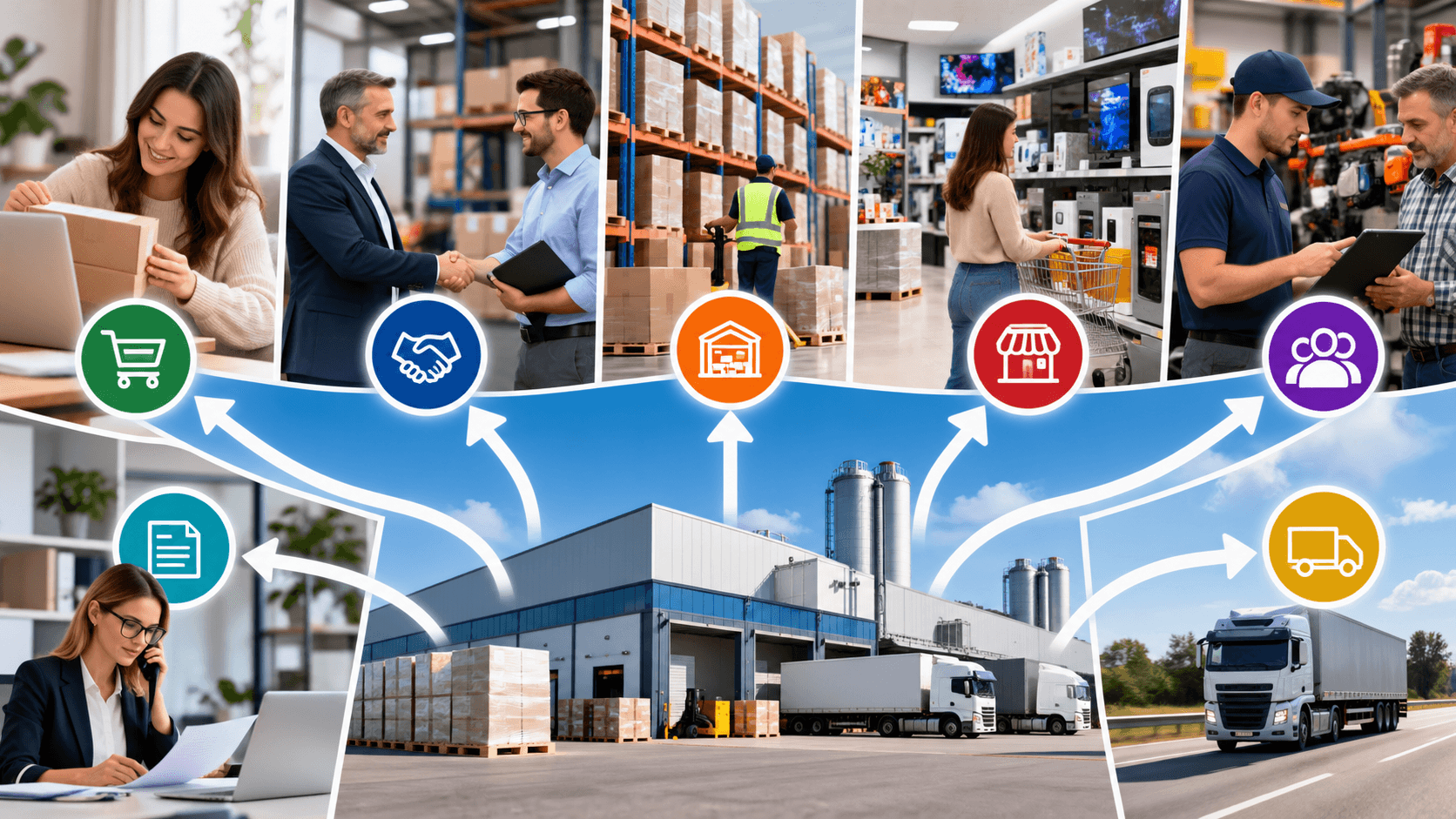
Distribution channels are the commercial paths that products and services follow from the producer to the buyer. A channel can be as short as manufacturer → customer or include retailers, wholesalers, distributors, agents, brokers, dealers, marketplaces, and other intermediaries before the product reaches its final user.
The simplest definition is useful but incomplete. A distribution channel does more than move a box. Channel participants can take ownership of inventory, finance stock, break bulk quantities, combine assortments, generate sales, provide local availability, extend credit, arrange transportation, offer technical support, and handle returns.
OpenStax defines a marketing or distribution channel as the system of organizations and activities that makes a market offering available to customers. It also emphasizes that intermediaries add value by performing functions such as accumulating products, breaking bulk quantities, resolving assortment differences, and providing financing.
Understanding distribution channels therefore means understanding not only the route a product follows, but why each stage exists.
Distribution Channels at a Glance
The seven practical routes below cover the most common consumer and B2B structures. The terminology can vary across industries, and real companies often combine several channels.
These distribution channels should not be interpreted as a ladder where every company starts with direct sales and eventually moves toward longer channels. The right structure depends on customer behavior, order economics, product complexity, geography, service requirements, and the capabilities already available inside the company.
| Distribution channel | Typical path | Intermediaries | Best fit |
| Direct-to-consumer | Producer → Consumer | 0 | Consumer brands, ecommerce, subscriptions |
| Direct B2B | Producer → Business user | 0 | Complex, high-value, custom products |
| One-level retail | Producer → Retailer → Consumer | 1 | Brands with direct retailer access |
| Two-level wholesale | Producer → Wholesaler → Retailer → Consumer | 2 | Fragmented retail markets |
| Agent/broker multi-level | Producer → Agent → Wholesaler/Retailer → Customer | 2–3+ | Markets needing representation |
| Distributor/dealer B2B | Manufacturer → Distributor/Dealer → Business user | 1–2+ | Industrial and technical products |
| Hybrid/multichannel | Producer → Multiple parallel routes | Varies | Companies serving different customer segments |
What Is a Distribution Channel?
A distribution channel is the route connecting a producer with the customer who ultimately purchases or uses the product. The route includes the organizations involved in selling, transferring, or facilitating access to the product.
OpenStax describes distribution channels as the path products or services take from seller to buyer, including any intermediaries involved. Consumer channels can move directly from producer to customer or through retailers, wholesalers, agents, and other intermediaries.
A distribution channel can involve three different flows at the same time:
Product flow – where the physical merchandise travels.
Ownership flow – which company legally owns the merchandise at each stage.
Information and money flow – how orders, payments, customer data, forecasts, and commercial terms move through the system.
These flows do not always follow the same route. A wholesaler can make a sale while the manufacturer drop-ships the product directly to the customer, meaning commercial ownership and physical movement follow different paths.
Channel Level vs Distribution Strategy: Do Not Confuse Them
A channel level describes the number of independent intermediary stages between producer and final buyer.
A distribution strategy describes broader choices about how the company wants to reach the market.
For example:
Zero-level channel: Manufacturer → Consumer
One-level channel: Manufacturer → Retailer → Consumer
Two-level channel: Manufacturer → Wholesaler → Retailer → Consumer
Three-level channel: Manufacturer → Agent → Wholesaler → Retailer → Consumer
These labels describe channel length.
By contrast:
Direct vs indirect describes whether independent intermediaries are used.
Intensive vs selective vs exclusive describes how broadly products are made available.
Hybrid or multichannel describes the use of several routes in parallel.
The concepts overlap, but they are not interchangeable.
1. Direct-to-Consumer Distribution Channel
The direct-to-consumer channel is the shortest consumer route:
Producer → Consumer
No independent wholesaler, distributor, or retailer completes the resale transaction.
The producer might sell through:
- its own ecommerce site;
- company-owned stores;
- subscriptions;
- direct telephone sales;
- social commerce under company control;
- direct-order apps;
- company events or showrooms.
OpenStax classifies this as a direct channel because the producer distributes the market offering directly to the final consumer without an intermediary.
The attraction is customer ownership. The brand can see who purchased, control the product presentation, communicate directly after the sale, test offers, collect customer data, and retain more of the final selling price before paying direct-channel costs.
It also receives feedback without waiting for retailers or distributors to report what happened downstream.
DTC is especially attractive where brand demand already exists or where digital customer acquisition can be performed efficiently.
The brand must perform tasks that an intermediary might otherwise provide. Customer acquisition, payment processing, fulfillment, parcel delivery, returns, customer support, fraud, warehousing, and consumer marketing all become the producer’s responsibility.
That means DTC can have a high gross margin while still producing weak profit if customer acquisition and fulfillment are expensive.
Retail ecommerce nevertheless remains economically significant. U.S. retail ecommerce sales reached $340.2 billion in Q2 2026, representing 17.1% of total retail sales for the quarter and increasing 12.2% from Q2 2025.
Ecommerce growth expands DTC possibilities, but ecommerce itself should not be confused with DTC. Independent online retailers and marketplaces are indirect channels even though the customer orders digitally.
2. Direct B2B Distribution Channel
The second zero-intermediary route is:
Manufacturer → Business or Industrial User
This channel is still direct distribution, but it is not direct-to-consumer.
Direct B2B distribution channels are common when products are expensive, customized, technically complex, or purchased by a relatively small number of large customers. Aircraft, large industrial systems, custom machinery, enterprise equipment, and major engineering solutions can fit this structure.
OpenStax notes that a direct producer-to-business-user channel can make sense where products are complex, expensive, or resource-intensive to move and sell.
Imagine a manufacturer with only 75 realistic customers in the United States, each capable of purchasing millions of dollars of equipment. Building direct relationships with those 75 companies may be economically sensible.
An additional intermediary may contribute little if manufacturer engineers, legal teams, project managers, and executives already need to participate directly in every sale.
The economics are different when the same manufacturer needs to serve 50,000 small contractors. That fragmented customer base can make distributors far more efficient.
3. One-Level Retail Distribution Channel
A one-level consumer channel generally looks like:
Producer → Retailer → Consumer
The retailer is the single independent intermediary between producer and final buyer.
OpenStax specifically identifies producer → retailer → consumer as a common indirect channel. Retailers buy or otherwise source products and make them available to consumers through physical stores, ecommerce sites, or other retail formats.
A manufacturer may be able to supply a large retailer directly when order volumes justify the relationship. The retailer aggregates consumer demand, while the producer avoids another wholesale layer.
This structure can work especially well when:
- retailers purchase large quantities;
- the producer can meet retailer logistics requirements;
- product assortment is manageable;
- the manufacturer has sufficient supply reliability;
- retailers have distribution centers capable of handling inbound inventory.
Large retailers can effectively internalize functions that independent wholesalers perform for smaller stores.
Removing a wholesaler does not eliminate retailer power. In fact, a very large retail account may gain significant negotiating leverage because it controls direct access to a large consumer base.
The manufacturer can become dependent on a small number of retail customers even while technically operating a shorter channel.
Channel length and bargaining power are therefore not the same thing.
4. Two-Level Wholesale Distribution Channel
A classic two-intermediary consumer channel looks like:
Producer → Wholesaler → Retailer → Consumer
This is one of the traditional distribution channels used when a manufacturer needs to reach many smaller retailers efficiently.
Instead of managing thousands of relatively small accounts, the manufacturer can sell larger quantities to wholesalers. The wholesaler breaks those quantities into smaller orders and combines products from many suppliers so retailers can purchase a useful assortment through one relationship.
OpenStax recognizes the manufacturer → wholesaler → retailer → consumer path as a standard consumer marketing channel.
Consider 100 manufacturers and 10,000 small retailers. Requiring every retailer to maintain relationships with every relevant manufacturer would create enormous transaction complexity.
Wholesalers consolidate those relationships. A retailer can purchase products from dozens or hundreds of manufacturers through a smaller number of wholesale accounts.
OpenStax highlights transaction reduction as one of the major reasons intermediaries exist. By connecting producers and buyers through central intermediaries, the market can reduce the number of separate commercial relationships required.
Merchant wholesalers reported $801.3 billion in sales in July 2026 and held $958.9 billion in inventories at the end of that month.
Those numbers do not measure every possible indirect channel, but they demonstrate that wholesale distribution remains a major part of the U.S. economy even as direct ecommerce grows.
5. Agent or Broker Multi-Level Distribution Channel
Some distribution channels include an intermediary that does not purchase the merchandise at all.
A simplified route can look like:
Producer → Agent/Broker → Wholesaler → Retailer → Consumer
or:
Producer → Agent/Broker → Customer
Agents and brokers facilitate commercial relationships rather than functioning exactly like merchant wholesalers. They commonly earn a commission or fee for arranging transactions instead of earning a resale spread from inventory they own.
OpenStax distinguishes agents and brokers from intermediaries that take product ownership. It notes that agents can act as extensions of manufacturers, while brokers connect buyers and sellers.
A smaller manufacturer may produce an excellent product but have no national sales organization. Independent representatives can provide industry contacts and geographic coverage without requiring the company to immediately hire a full internal sales force.
This can reduce fixed sales costs, although the manufacturer still needs sufficient economics to pay commissions and potentially additional channel participants downstream.
Agents are particularly useful when relationship access matters more than physical warehousing.
6. Distributor or Dealer B2B Channel
A common industrial channel looks like:
Manufacturer → Distributor → Business User
More complex versions can include:
Manufacturer → Distributor → Dealer → Business User
Industrial distributors buy products from manufacturers and make them available to businesses that use those products in their operations. OpenStax identifies industrial distributors as independent wholesalers that purchase related product lines from manufacturers and sell them to industrial users.
This route is particularly useful for lower-value products, replacement components, maintenance supplies, technical products, and other goods purchased across a fragmented business market.
A manufacturer might produce only 50 products. A factory maintenance department may need 10,000 different products from hundreds of manufacturers.
The distributor solves an assortment problem by allowing that factory to buy bearings, fasteners, tools, safety products, electrical items, and other supplies through fewer vendors.
Distributors can also provide:
- local inventory;
- emergency delivery;
- trade credit;
- technical sales support;
- product substitution;
- consolidated invoicing;
- regional sales coverage;
- training;
- warranty coordination.
This is one reason distribution channels cannot be evaluated only by counting markups. The distributor can lower transaction and downtime costs even while adding its own gross margin.
7. Hybrid and Multichannel Distribution
Many modern businesses do not rely on one channel.
A hybrid structure might include: Producer → Consumer through owned ecommerce
plus: Producer → Retailer → Consumer
plus: Producer → Distributor → Business Customer
OpenStax defines multichannel distribution as a company setting up multiple distribution channels to reach customers. It distinguishes this from omnichannel systems, which attempt to integrate several purchase, delivery, and return options into a more unified customer experience.
Different customers often require different economics.
Large national accounts may justify direct sales. Smaller commercial customers may be served more efficiently by distributors. Consumers may buy through both an owned ecommerce site and retailers.
A hybrid structure allows the company to assign each segment to the distribution channel that serves it most efficiently.
The challenge is channel conflict. Partners may object when direct teams pursue their accounts or when the manufacturer discounts products online below retailer economics.
Hybrid distribution therefore needs segmentation and rules.
Zero-Level, One-Level, Two-Level, and Three-Level Channels Explained
The level terminology can make distribution channels sound more complicated than they are. The “level” simply counts the number of independent intermediary stages between producer and final customer.
This framework works particularly well for teaching traditional consumer channels, but real-world structures can become more complicated.
A product may pass through a master distributor, regional distributor, dealer, integrator, marketplace, fulfillment provider, or other specialist. Some of these companies own inventory, while others simply provide services.
Channel level is therefore useful for describing length, but it does not fully explain the economics.
| Channel level | Typical route | Number of intermediaries |
| Zero-level | Producer → Customer | 0 |
| One-level | Producer → Retailer → Consumer | 1 |
| Two-level | Producer → Wholesaler → Retailer → Consumer | 2 |
| Three-level | Producer → Agent → Wholesaler → Retailer → Consumer | 3 |
Direct and Zero-Level Do Not Always Mean DTC
A zero-level channel has no independent intermediary between producer and final user.
When the buyer is a consumer: Manufacturer → Consumer this is DTC.
When the buyer is a business: Manufacturer → Industrial User this is direct B2B.
Both are zero-level distribution channels, but only the first is direct-to-consumer.
Keeping these terms separate makes it easier to analyze B2B markets where final users are organizations rather than households.
Distribution Channels for Consumer Products vs B2B Products
Consumer distribution channels are generally designed around convenience, product discovery, retail traffic, merchandising, and efficient delivery to individuals.
B2B channels focus more heavily on specifications, availability, account relationships, payment terms, technical support, predictable replenishment, and consolidated purchasing.
A simplified comparison:
This does not mean B2B lacks marketing or that consumer channels lack operational complexity. It means the channel is optimized around a different buyer.
| Consumer channel priority | B2B channel priority |
| Consumer traffic | Account coverage |
| Merchandising | Product availability |
| Brand presentation | Technical expertise |
| Consumer promotions | Contract pricing |
| Parcel fulfillment | Commercial freight/routes |
| Easy returns | Account service |
| Consumer reviews | Specifications/compliance |
| Immediate payment | Trade credit |
| Individual orders | Repeat commercial orders |
Why Distribution Channels Exist at All
The shortest route is not necessarily the cheapest or strongest route.
Intermediaries exist because specialization can reduce transaction costs. A manufacturer may be excellent at producing equipment but inefficient at calling on 20,000 small customers. A distributor may specialize in exactly that task.
OpenStax identifies several classic intermediary functions:
- accumulating products;
- breaking bulk;
- adjusting assortments;
- providing financing;
- transporting products;
- warehousing inventory;
- reducing the number of transactions.
A channel participant deserves its place when the cost or value of those functions exceeds the margin it requires.
Product Flow and Ownership Flow Can Be Different
One of the most useful advanced concepts in distribution channels is that merchandise does not always physically travel through every company that participates commercially.
Imagine: Manufacturer → Distributor → Customer
The distributor takes the order and owns the commercial sale, but the product ships directly from the manufacturer’s warehouse to the customer.
Commercially, the distributor remains in the channel. Physically, the package never enters the distributor’s warehouse.
This distinction becomes increasingly important with drop shipping, third-party logistics, digital ordering, and outsourced fulfillment.
A modern distribution map should therefore ask two separate questions: Who owns or sells the product? and: Where does the product physically move?
Distribution Channels and Inventory Ownership
Inventory ownership is one of the biggest economic differences between channels.
In DTC, the producer may own finished inventory until a consumer buys it.
In a wholesale model, the wholesaler may purchase and own stock long before the final consumer sale.
In a distributor model, inventory can move from manufacturer ownership into distributor ownership, shifting capital requirements and demand risk downstream.
Agents and brokers are different because they can facilitate transactions without taking title to inventory.
This matters because inventory consumes cash regardless of which company holds it.
U.S. manufacturing and trade inventories totaled an estimated $2.7647 trillion in July 2026 across manufacturers and distributive trade businesses.
Inventory is therefore not just an operational issue. It is a financing decision embedded inside the channel.
Distribution Channels and Pricing
Every independent reseller usually needs enough gross profit to pay for its functions.
Consider a purely illustrative multi-level channel:
This does not imply that these are typical U.S. margins. Real pricing varies enormously by category.
The table simply shows why products often become more expensive downstream. Each company needs economic room for the work it performs and the capital it puts at risk.
The correct question is not “how do we eliminate every margin?” It is which functions can be eliminated or performed more efficiently elsewhere?
| Stage | Purchase price | Selling price |
| Manufacturer → Distributor | – | $40 |
| Distributor → Wholesaler | $40 | $52 |
| Wholesaler → Retailer | $52 | $65 |
| Retailer → Consumer | $65 | $100 |
Distribution Channels and Customer Data
Channel length often affects market visibility.
A DTC seller can see individual customer behavior directly.
A manufacturer selling to distributors may instead see purchase orders from 20 channel partners even though thousands of businesses ultimately use the product.
That gap makes sell-through information valuable. Manufacturers need to know whether distributors are repeatedly replenishing because end customers are buying or merely because inventory is being pushed further downstream.
Digital ordering systems can improve data sharing, but commercial incentives still determine how much information partners provide.
The farther the manufacturer sits from the final buyer, the more deliberately it must build market intelligence into the distribution channel.
Distribution Channels and Working Capital
Channels also determine when a company pays and when it gets paid.
- A consumer retailer often collects at the moment of sale.
- A wholesaler may allow retailers to pay 30 days after delivery.
- A distributor may hold stock for 45 days before selling it.
- The manufacturer may provide the distributor with its own payment terms.
This creates a cash-conversion chain alongside the product channel.
A business can therefore report rapid revenue growth and simultaneously experience a cash shortage because more money is tied up in inventory and receivables.
A strong channel design asks not only: Who earns the margin?
But also: Who finances the inventory and customer until cash is collected?
Short Distribution Channels: Advantages and Risks
Shorter distribution channels can provide:
- stronger customer relationships;
- more customer data;
- fewer independent markups;
- faster feedback;
- greater brand control;
- simpler commercial structure.
But they can also require:
- more internal salespeople;
- more customer acquisition;
- more fulfillment capability;
- more small-account management;
- more customer support;
- greater geographic infrastructure.
A short channel is strongest when the producer can efficiently perform downstream functions.
Long Distribution Channels: Advantages and Risks
Longer channels can provide:
- broad market coverage;
- local inventory;
- specialized sales capability;
- consolidated purchasing;
- access to retailer traffic;
- distributor relationships;
- reduced small-account complexity;
- geographically distributed service.
The disadvantages include:
- less customer data;
- less control;
- multiple margins;
- slower information flow;
- more complicated incentives;
- risk of channel conflict;
- dependence on partners.
A longer channel is strongest when specialization outweighs the added complexity.
Disintermediation: What Happens When a Channel Is Shortened?
Disintermediation means removing an intermediary from the marketing channel. Digital commerce has made this possible in many industries because producers can communicate with and accept orders from customers without needing physical retail distribution. But disintermediation does not eliminate the underlying work.
A manufacturer bypassing a wholesaler may now need to:
- manage thousands of smaller accounts;
- hold a broader range of sale-ready inventory;
- pick and pack smaller orders;
- provide customer credit;
- handle collections;
- arrange more individual deliveries;
- manage returns;
- provide local sales support.
A channel should therefore be shortened only where the remaining participants can absorb these functions more efficiently.
Distribution Channels and Channel Conflict
Conflict appears when channel participants have competing incentives.
A manufacturer may want broad ecommerce availability while local dealers want territorial protection. Two distributors may compete for the same national account. An online retailer may discount aggressively while physical partners invest in demonstrations and service.
FTC guidance notes that manufacturers can impose certain reasonable customer and territory requirements on dealers under federal antitrust standards, while competitive effects and state law can affect how specific practices are evaluated.
The commercial lesson is broader than the legal one. Channel roles should be defined before conflict occurs.
Important rules can include:
- account ownership;
- geographic territory;
- lead allocation;
- ecommerce rights;
- national-account treatment;
- service responsibilities;
- product-line rights;
- inventory expectations;
- promotion rules;
- returns and warranty handling.
How to Choose the Right Distribution Channel
A channel should begin with the customer rather than the company’s preferred organization chart.
Ask:
- Who is the final buyer? Consumer, business, government, institution, dealer, contractor, or another group?
- Where does that buyer already purchase? Changing buying behavior is usually more difficult than joining an established channel.
- How large is the order? Small fragmented orders often favor intermediaries.
- How complex is the product? Technical products may need specialist sales and support.
- How quickly must inventory be available? Local stock can justify regional distribution.
- What does fulfillment cost? Parcel, pallet, refrigerated, hazardous, and oversized freight have very different economics.
- How much control is required? Direct channels usually provide more.
- How valuable is customer data? Some businesses gain major strategic value from direct relationships.
- Who can generate demand most efficiently? Producer, retailer, dealer, marketplace, or distributor?
- Who should finance inventory? Working capital can determine whether a channel is viable.
- How concentrated is channel power? One retailer or distributor can become a major dependency.
- Can several channels coexist? Customer segmentation can make hybrid models stronger.
The right answer may involve several distribution channels, not one.
A Simple Distribution Channel Decision Matrix
The table is a starting point rather than a formula. Product economics and actual customer behavior must still be tested.
| Market situation | Channel likely worth evaluating |
| Strong DTC brand | Direct-to-consumer |
| Few large industrial buyers | Direct B2B |
| Large national retailers | One-level retail |
| Thousands of independent retailers | Wholesale two-level |
| Producer lacks sales organization | Agent/broker |
| Fragmented B2B customer base | Distributor |
| Technical local sale/service | Distributor/dealer |
| Very different customer segments | Hybrid/multichannel |
| Foreign market with limited local knowledge | Local distributor/agent |
| Commodity convenience product | Broad retail/wholesale coverage |
How Distribution Channels Change as a Company Grows
Channel architecture does not need to remain fixed forever.
An early consumer brand may start DTC because direct sales provide customer feedback. Once demand is proven, retail can expand reach.
A small industrial manufacturer may begin with direct founder-led selling, then appoint regional distributors when there are too many smaller accounts to serve internally.
The reverse can also happen. A manufacturer dependent on one large distributor may add direct enterprise sales or additional partners to reduce concentration.
Distribution channels should evolve when customer economics change – not merely because a new channel becomes fashionable.
Metrics for Measuring Distribution Channels
A channel should be measured by more than revenue shipped into it.
Useful metrics include:
- Sell-in – sales into distributors or retailers.
- Sell-through – sales toward final customers.
- Inventory turns – how quickly stock sells and is replenished.
- Days of inventory – how long capital remains in stock.
- Fill rate – share of demand fulfilled immediately.
- On-time delivery – share of orders delivered when promised.
- Gross margin – gross profit relative to sales.
- Contribution margin – economics after relevant variable channel costs.
- Customer acquisition cost – especially important in direct channels.
- Average order value – useful for comparing channel economics.
- Reorder rate – indication of recurring demand.
- Channel concentration – dependence on a small number of partners.
- Returns rate – particularly important in retail and DTC.
- Receivable days – important in B2B channels.
- Revenue per active account – separates meaningful partners from dormant accounts.
A distributor with 2,000 registered accounts but only 250 active buyers has a very different business from one with 2,000 consistently purchasing customers.
Common Distribution Channel Mistakes
A frequent mistake is assuming the shortest channel produces the highest profit. It can, but only if the producer performs downstream functions economically.
Another mistake is assuming more partners automatically mean more reach. Multiple distributors serving the same limited pool of customers can simply divide existing demand and create price competition.
Companies also make errors when they:
- ignore customer buying habits;
- appoint partners without clear territories or account rules;
- confuse sell-in with real demand;
- fail to monitor downstream inventory;
- give exclusivity before performance is demonstrated;
- underestimate working capital;
- depend excessively on one retailer;
- build direct ecommerce that competes destructively with dealers;
- choose channel partners based on size rather than fit;
- add layers that do not perform a valuable function.
A distribution channel should have an economic reason for every stage.
The Best Distribution Channel Is the One That Solves the Customer’s Buying Problem
Distribution is sometimes treated as a logistics problem occurring after marketing has already created demand. In reality, the channel itself can be part of the value proposition.
Immediate local availability creates value. One-account purchasing creates value. Expert dealers create value. Direct ordering creates value. Easy consumer returns create value. Technical distributors create value.
That is why successful distribution channels look different across industries.
A mass-market household product may need intensive retail coverage. An aircraft can be sold directly. Industrial replacement parts may depend on local distributors. A consumer brand may combine DTC with selected retailers.
The strongest channel is not the one with the fewest companies. It is the one that gets the product to the target customer with the best combination of availability, economics, service, control, and working capital.
FAQ
Distribution channels are the commercial routes products and services follow from producers to final customers. They can be direct or use intermediaries such as distributors, wholesalers, retailers, agents, brokers, and dealers.
Channel participants may also provide inventory, logistics, financing, sales, technical support, and other services.
The main structures include direct-to-consumer, direct B2B, producer-to-retailer, producer-to-wholesaler-to-retailer, agent or broker channels, industrial distributor/dealer channels, and hybrid or multichannel systems.
The exact terminology varies by market and whether the final buyer is a consumer or business.
A zero-level channel has no independent intermediary between the producer and final buyer.
Manufacturer → Consumer is zero-level DTC. Manufacturer → Business end user is zero-level direct B2B.
A one-level consumer channel uses one intermediary.
The classic structure is Manufacturer → Retailer → Consumer.
A two-level consumer channel typically uses two intermediaries.
A common example is Manufacturer → Wholesaler → Retailer → Consumer.
A three-level channel contains three intermediary stages. A traditional example is Manufacturer → Agent → Wholesaler → Retailer → Consumer.
Real supply chains can contain different intermediary combinations, so the level describes channel length rather than a mandatory set of businesses.
Yes. DTC is a direct, zero-level consumer distribution channel in which the producer or brand sells directly to the consumer without an independent reseller.
It should not be confused with all direct distribution because direct B2B sales also exist.
Direct channels connect the producer and final customer without an independent reseller. Indirect channels use one or more intermediaries.
Direct channels generally provide stronger customer control and data, while indirect channels can provide faster reach, local inventory, established customer relationships, and specialized capabilities.
Hybrid distribution uses multiple routes to serve different customers. A company might simultaneously sell through its own website, retailers, distributors, and direct enterprise sales.
The model can increase reach but requires clear channel roles to prevent conflict.
Additional intermediaries generally require economic compensation, but they can also reduce other costs by consolidating purchasing, providing local inventory, handling logistics, generating traffic, or serving customers more efficiently.
The correct comparison is the total cost and value of the channel, not simply the number of intermediaries.
The decision should consider customer behavior, order size, geography, product complexity, inventory requirements, service needs, customer-acquisition cost, partner capabilities, working capital, and desired control.
Many businesses ultimately use different channels for different customer segments rather than forcing every buyer through one route.
Frequently Asked Questions
- What are distribution channels?
- Distribution channels are the commercial routes products and services follow from producers to final customers. They can be direct or use intermediaries such as distributors, wholesalers, retailers, agents, brokers, and dealers. Channel participants may also provide inventory, logistics, financing, sales, technical support, and other services.
- What are the main types of distribution channels?
- The main structures include direct-to-consumer, direct B2B, producer-to-retailer, producer-to-wholesaler-to-retailer, agent or broker channels, industrial distributor/dealer channels, and hybrid or multichannel systems. The exact terminology varies by market and whether the final buyer is a consumer or business.
- What is a zero-level distribution channel?
- A zero-level channel has no independent intermediary between the producer and final buyer. Manufacturer → Consumer is zero-level DTC. Manufacturer → Business end user is zero-level direct B2B.
- What is a one-level distribution channel?
- A one-level consumer channel uses one intermediary. The classic structure is Manufacturer → Retailer → Consumer.
- What is a two-level distribution channel?
- A two-level consumer channel typically uses two intermediaries. A common example is Manufacturer → Wholesaler → Retailer → Consumer.
- What is a three-level distribution channel?
- A three-level channel contains three intermediary stages. A traditional example is Manufacturer → Agent → Wholesaler → Retailer → Consumer. Real supply chains can contain different intermediary combinations, so the level describes channel length rather than a mandatory set of businesses.
- Is DTC a distribution channel?
- Yes. DTC is a direct, zero-level consumer distribution channel in which the producer or brand sells directly to the consumer without an independent reseller. It should not be confused with all direct distribution because direct B2B sales also exist.
- What is the difference between direct and indirect distribution channels?
- Direct channels connect the producer and final customer without an independent reseller. Indirect channels use one or more intermediaries. Direct channels generally provide stronger customer control and data, while indirect channels can provide faster reach, local inventory, established customer relationships, and specialized capabilities.
- What is a hybrid distribution channel?
- Hybrid distribution uses multiple routes to serve different customers. A company might simultaneously sell through its own website, retailers, distributors, and direct enterprise sales. The model can increase reach but requires clear channel roles to prevent conflict.
- Do more distribution levels always make products more expensive?
- Additional intermediaries generally require economic compensation, but they can also reduce other costs by consolidating purchasing, providing local inventory, handling logistics, generating traffic, or serving customers more efficiently. The correct comparison is the total cost and value of the channel, not simply the number of intermediaries.
- How does a company choose a distribution channel?
- The decision should consider customer behavior, order size, geography, product complexity, inventory requirements, service needs, customer-acquisition cost, partner capabilities, working capital, and desired control. Many businesses ultimately use different channels for different customer segments rather than forcing every buyer through one route.
Written by

James ColeWholesale distribution operator
James Cole is a wholesale operator who has run distribution P&Ls through first-warehouse launch, inventory turns, trade credit, and EDI-backed accounts.
Published October 18, 2026 · Last reviewed October 14, 2026
