Logistics
Direct Distribution vs Indirect Distribution: Costs, Margins, Control, Reach, and Scalability Compared
Selling directly can preserve customer data and more of the selling price, while indirect distribution can provide reach, logistics, and established buyer relationships. The better model depends on who can perform each channel function more efficiently.
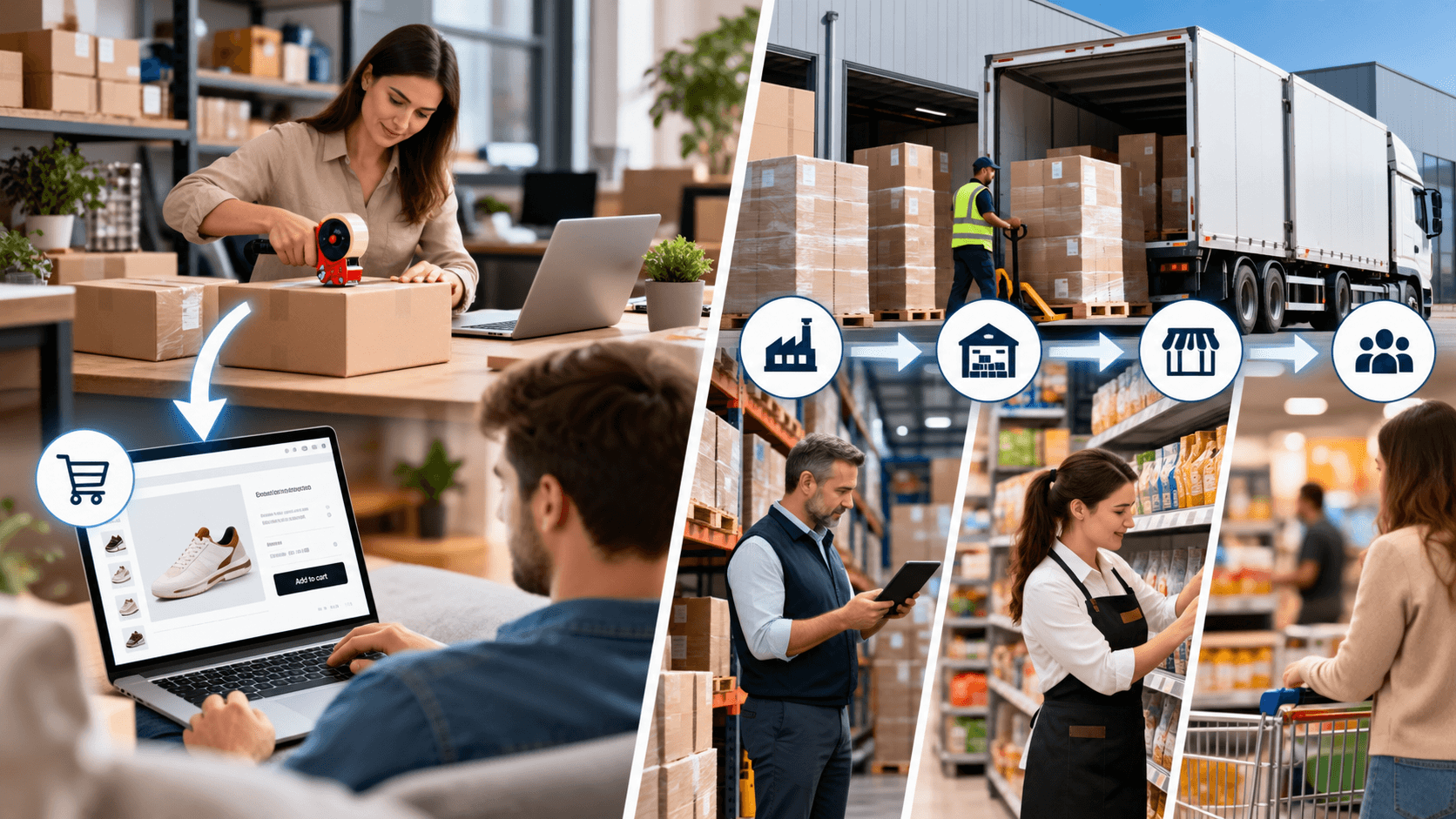
The direct distribution vs indirect distribution decision determines much more than who physically delivers a product. It affects who acquires the customer, who owns the relationship, where inventory sits, who finances working capital, how much control the producer retains, and which company must perform sales, logistics, service, returns, and market development.
Direct distribution means the producer sells to the final customer without an independent intermediary completing the resale transaction. Indirect distribution uses one or more intermediaries – such as distributors, wholesalers, retailers, dealers, agents, or brokers – to move the offer toward the final buyer. OpenStax uses the same fundamental distinction: direct channels connect producer and customer without intermediaries, while indirect channels use one or more intermediaries.
The important point is that removing an intermediary does not remove the functions that intermediary performed. A manufacturer that eliminates a distributor or retailer may retain more revenue from each sale, but it may also inherit customer acquisition, inventory, fulfillment, credit, local sales, returns, customer service, and other costs.
Direct Distribution vs Indirect Distribution: The Difference in 30 Seconds
Direct distribution gives the producer a direct commercial relationship with the customer. That usually provides better visibility into customer behavior, greater control over the brand experience, and the ability to keep more of the final selling price before channel expenses.
Indirect distribution trades part of that control and revenue opportunity for capabilities already built by intermediaries. A distributor can provide local inventory, a retailer can provide consumer traffic, a wholesaler can consolidate purchasing, and a dealer can provide sales and technical service.
Neither side of direct distribution vs indirect distribution is automatically cheaper or more profitable. The stronger model is the one that assigns each required function to the party capable of performing it most efficiently.
| Factor | Direct distribution | Indirect distribution |
| Independent intermediary | No | Yes |
| Customer relationship | Owned directly | Shared or mediated |
| Customer data | Usually strongest | Often less complete |
| Brand control | High | Lower |
| Selling-price retention | Higher before direct-channel costs | Shared across channel |
| Customer acquisition | Producer responsibility | Partner may contribute |
| Logistics | Producer responsibility | Can be shared or transferred |
| Market reach | Must be built | Can use existing network |
| Speed into new markets | Can be slower | Often faster |
| Inventory ownership | Producer may carry longer | Can move downstream |
| Trade credit | Company manages directly in B2B | Intermediary can absorb some customer credit |
| Sales staffing | Internal | Partners can provide coverage |
| Customer service | Internal | Can be shared |
| Scalability | Depends on company infrastructure | Can leverage partner infrastructure |
| Customer insight | High | Can become weaker upstream |
| Channel conflict | Limited in pure direct model | Possible, especially in hybrid models |
What Is Direct Distribution?
Direct distribution is a channel in which the producer sells to the final user without an independent reseller between the two. The customer may be a consumer or another business, which means direct distribution is not synonymous with DTC.
A consumer buying from a brand’s owned ecommerce website is a direct-to-consumer transaction. A manufacturer selling a $500,000 machine directly to a factory is also using direct distribution, but the transaction is B2B rather than DTC.
OpenStax specifically notes that direct channels can exist in both consumer and business markets. Complex, expensive industrial products can make direct manufacturer-to-business relationships particularly practical because intensive technical and sales resources are already required.
Direct distribution can include:
- manufacturer-owned ecommerce;
- company stores;
- direct sales representatives;
- inside sales teams;
- manufacturer sales branches;
- subscription programs owned by the producer;
- direct enterprise accounts;
- direct telephone or catalog sales;
- company-controlled apps or ordering platforms.
The common element is not the technology used to place the order. The defining feature is the absence of an independent reseller in the transaction between producer and final buyer.
What Is Indirect Distribution?
Indirect distribution inserts one or more independent intermediaries into the route to market. Those intermediaries may take ownership of products and resell them, or they may facilitate transactions without owning the goods.
OpenStax identifies wholesalers, distributors, retailers, agents, and brokers among the major types of channel intermediaries. These businesses can accumulate products, break bulk quantities into smaller orders, adjust assortments, provide financing, and perform other functions that reduce the number and complexity of transactions between producers and customers.
An indirect channel might look like:
Manufacturer → Retailer → Consumer
or:
Manufacturer → Wholesaler → Retailer → Consumer
or in B2B:
Manufacturer → Distributor → Industrial Customer
A longer channel is not automatically inefficient. If each intermediary performs a function more effectively than the manufacturer could perform internally, the total route to market can still be economically stronger.
Direct Distribution Does Not Automatically Mean DTC
This distinction matters because direct distribution and DTC are often used as though they were synonyms.
DTC means direct-to-consumer. The final buyer is a consumer purchasing directly from the producer or brand.
Direct distribution is broader. The customer can be a consumer, company, government entity, hospital, contractor, airline, manufacturer, university, or other end user.
A commercial aircraft manufacturer selling directly to an airline is using direct distribution even though no consumer participates in that sale. OpenStax specifically uses large or complex industrial products as examples where a direct B2B channel can make sense.
Therefore:
All true DTC sales are direct distribution. Not all direct distribution is DTC.
How Direct Distribution Makes Money
In a direct model, the producer keeps the revenue that otherwise would have been split with independent channel partners. If a product sells to consumers for $100, a direct seller can theoretically receive the full $100 rather than selling to a distributor or retailer at a lower transfer price.
That does not mean the entire difference becomes profit. The producer now has to perform or purchase the functions that downstream businesses would have provided.
Those can include:
- advertising;
- lead generation;
- salespeople;
- ecommerce;
- payment processing;
- warehouses;
- parcel fulfillment;
- delivery;
- returns;
- customer support;
- fraud prevention;
- consumer credit;
- product demonstrations;
- physical stores;
- after-sales service.
The correct comparison is therefore not retail price versus wholesale price. It is contribution after all channel-specific costs.
How Indirect Distribution Makes Money
Indirect distribution divides economic functions among several companies. The manufacturer sells earlier in the channel at a lower price, while distributors, wholesalers, dealers, or retailers earn their own gross profit as they perform additional work.
A distributor may finance regional inventory. A wholesaler may make hundreds of brands available through one purchasing account. A retailer may invest heavily in stores, consumer traffic, merchandising, parcel fulfillment, and returns.
The intermediary is economically justified when the value or cost savings it creates exceed the margin required to keep it operating.
This is why simply describing intermediary margin as “lost margin” can be misleading. A channel margin frequently pays for a channel function.
Direct vs Indirect Distribution: A Simple Economics Example
Consider a product with a $100 final customer price. The following figures are illustrative and are not U.S. industry averages.
Direct distribution appears stronger at $29 versus $19 per unit in this simplified example. But volume can reverse the strategic conclusion.
If channel partners can sell 100,000 units while the manufacturer can acquire only 20,000 direct customers at the assumed acquisition cost, the lower per-unit contribution may still produce a much larger business. If direct acquisition is exceptionally efficient, the direct model could instead outperform the indirect channel.
This is why direct distribution vs indirect distribution is a contribution × volume decision rather than a gross-margin contest.
| Item | Amount |
| Manufacturer sell-in price | $60 |
| Product cost | $35 |
| Freight/channel support | $6 |
| Contribution before fixed overhead | $19 |
Direct Distribution Usually Gives More Customer Data
One of the strongest arguments for direct distribution is the customer relationship. A company selling through its own website or sales team can see who purchased, what they purchased, how frequently they reorder, which products were returned, which promotions converted, and how purchasing patterns change over time.
That information can influence product development, forecasting, pricing, cross-selling, service, and marketing. It can also reduce dependence on channel partners for market intelligence.
Indirect channels create distance. A manufacturer may know that 10,000 units were shipped to distributors but not immediately know whether final demand is accelerating, slowing, or simply sitting in downstream inventory.
This distinction creates an important metric difference:
Sell-in measures product moving into the channel.
Sell-through measures product moving through the channel toward the final customer.
A manufacturer relying heavily on indirect distribution should understand both.
Indirect Distribution Can Create Reach Much Faster
Customer data has value, but so does an established market.
A regional distributor may already serve thousands of contractors. A national retailer may already have millions of customers. A specialized dealer may be trusted in a technical market where a new manufacturer has no reputation.
Indirect distribution allows the producer to access those relationships without recreating the entire commercial infrastructure internally. This is particularly valuable when customers are geographically dispersed or individually too small for a manufacturer sales team to serve economically.
OpenStax explains that intermediaries can reduce the number of transactions manufacturers must manage and provide functions producers may not perform as efficiently themselves.
The manufacturer gives up part of the economics in exchange for distribution leverage.
Direct Distribution Gives More Brand Control
A direct seller determines how the product is presented, described, demonstrated, bundled, promoted, shipped, and supported. It can control the customer journey from discovery through post-purchase communication.
Indirect distribution introduces independent commercial interests. A retailer might place a competitor beside the product. A distributor may prioritize another supplier. A dealer may decide how aggressively to demonstrate or recommend each brand.
That loss of control is not automatically negative. A strong channel partner can improve the customer experience beyond what a remote manufacturer could provide.
The relevant direct distribution vs indirect distribution question is whether the partner adds enough sales or service capability to justify giving up part of the control.
Inventory Moves Differently in Direct and Indirect Channels
A direct seller can retain inventory ownership until the final customer purchases the product. This gives the company visibility and control but keeps more capital tied up upstream.
In a traditional indirect merchant channel, a distributor or wholesaler may purchase inventory from the manufacturer and take title to it. Some inventory financing and demand risk therefore moves downstream.
This matters at scale. U.S. merchant wholesalers held $958.9 billion in inventories at the end of July 2026, illustrating how much capital can sit inside the intermediary layer of the economy. July merchant wholesale sales were $801.3 billion.
Those national figures are not benchmarks for an individual company, but they illustrate why inventory ownership is central to channel design.
Indirect Distribution Can Improve Local Availability
A manufacturer may operate one national warehouse while a distributor maintains inventory much closer to buyers. That regional presence can reduce delivery time, emergency stockouts, freight expense, and customer uncertainty.
Local availability becomes especially valuable when downtime is expensive. An industrial plant that needs a replacement component today may care much more about regional inventory than about buying directly from the manufacturer.
The same principle applies in consumer markets. Retailers position inventory close to where people already shop rather than requiring every brand to attract each customer independently.
Indirect distribution can therefore win even when it introduces another margin because availability itself creates economic value.
Working Capital Can Favor Either Model
Direct distribution does not automatically require more working capital, and indirect distribution does not automatically require less. Payment structure determines the result.
A DTC company may hold finished inventory for weeks but receive consumer payment immediately when the product sells. A B2B manufacturer selling directly on net-60 terms may hold inventory and then finance another two months of accounts receivable.
In indirect distribution, a distributor may purchase inventory relatively early, shifting stock ownership away from the manufacturer. But the manufacturer may still provide the distributor with commercial credit or rebates that delay cash collection.
A proper direct distribution vs indirect distribution model should calculate:
supplier payment days + inventory days + receivable days – payable days
rather than assuming one channel is automatically cash-light.
Direct Distribution Can Be Harder to Scale Than It Looks
A direct ecommerce store can technically accept orders nationwide within minutes. That does not mean the underlying distribution operation scales as easily.
More direct sales can require more advertising, warehouse capacity, customer support, fraud management, parcel shipments, reverse logistics, returns processing, and technology. CAC can also rise as the company moves beyond its easiest early customers.
Physical direct sales have additional constraints. New stores, sales territories, warehouses, or service locations require capital and management.
The advantage is control. Once the company develops efficient direct systems, those capabilities become internal assets rather than rented access to another company’s customer base.
Indirect Distribution Can Scale Through Other Companies’ Infrastructure
Indirect distribution can expand using capital and capabilities already deployed by channel partners. A manufacturer that appoints five established regional distributors can obtain local warehouses, salespeople, delivery routes, credit relationships, and customer accounts without building all five networks itself.
This is one of the strongest scaling arguments in the direct distribution vs indirect distribution decision.
The limitation is partner attention. A distributor carrying hundreds of brands may have little incentive to prioritize a new supplier unless the product offers attractive economics, strong demand, or strategic value.
Signing a distribution agreement is therefore not equivalent to creating demand.
Customer Acquisition Works Differently
Direct distribution usually requires the producer to acquire the customer. In DTC, that can mean paid search, social advertising, organic search, email, affiliates, stores, influencers, referrals, or other consumer-marketing channels.
Indirect distribution can shift some demand generation toward retailers, dealers, or distributors. A retailer already has shoppers; a dealer already has local prospects; a distributor already calls on relevant business accounts.
But manufacturers often still need to generate underlying product demand. Channel partners can provide access, but they are unlikely to invest heavily behind products customers do not want.
The best indirect model therefore combines manufacturer pull with channel push rather than assuming partners will create the entire market.
E-Commerce Has Not Eliminated Indirect Distribution
U.S. retail ecommerce reached $340.2 billion in Q2 2026, up 12.2% from Q2 2025 and representing 17.1% of total retail sales for the quarter.
This growth makes direct online selling more important, but ecommerce should not be confused with direct distribution. An online transaction can be direct, retail, wholesale, marketplace-based, or distributor-mediated.
A customer buying from a manufacturer’s own website is direct. A customer buying the same product from an independent online retailer is participating in indirect distribution.
Ecommerce describes the ordering environment. Distribution describes the commercial route.
What Direct Distribution Is Best For
Direct distribution tends to become more attractive when the company has a compelling reason to own the customer relationship.
It can work particularly well when:
- the company already generates strong brand demand;
- customers are concentrated and economically attractive to serve directly;
- products need extensive manufacturer involvement;
- order values are high;
- personalization matters;
- customer data has major strategic value;
- the company can acquire customers efficiently;
- fulfillment requirements are manageable;
- direct feedback improves product development;
- downstream partners add limited incremental value.
Large custom B2B products are a good example. Selling through multiple intermediary layers can add little if every customer already requires direct engineering and commercial negotiation with the manufacturer.
What Indirect Distribution Is Best For
Indirect distribution becomes especially attractive when market reach is expensive to build internally.
It can work well when:
- customers are highly fragmented;
- local availability is important;
- purchases occur where customers already shop;
- distributors have strong established accounts;
- products require local dealers or service;
- the manufacturer lacks sales coverage;
- buyers want consolidated purchasing;
- regional warehouses improve delivery;
- entering a new geography directly would be costly;
- partners provide expertise the manufacturer lacks.
A manufacturer of maintenance supplies, for example, may find it uneconomical to call on every small factory directly. An industrial distributor can aggregate thousands of those relationships.
Direct Distribution Risks
More control also means more responsibility.
Major risks include:
- high customer-acquisition cost;
- dependence on one digital acquisition channel;
- fulfillment failures;
- returns expense;
- insufficient local presence;
- high fixed costs from stores or warehouses;
- inventory concentration;
- customer-service requirements;
- inability to reach enough customers efficiently;
- expensive expansion into new territories.
Direct distribution can produce excellent margins on paper while failing because customer acquisition becomes too expensive.
Indirect Distribution Risks
Indirect channels replace some operating risk with dependency risk.
Major issues can include:
- limited customer data;
- loss of price visibility;
- partner underperformance;
- supplier/distributor conflict;
- inventory stuck downstream;
- inconsistent customer experience;
- dependence on one large retailer;
- weak partner motivation;
- overlapping territories;
- channel partners prioritizing competitors.
A manufacturer can appear diversified because it has thousands of end customers while actually being highly concentrated because 60% of its shipments pass through one distributor.
Concentration should therefore be measured at both customer and channel levels.
Channel Conflict Is the Biggest Hybrid Risk
Many companies eventually decide that direct distribution vs indirect distribution does not need to be an either-or choice. They use both.
A manufacturer might sell directly through its website while also supplying retailers. It might keep national B2B accounts direct while distributors serve smaller regional buyers.
The challenge begins when two channels are rewarded for winning the same customer.
Common conflicts include:
- direct prices undercutting retailers;
- manufacturer sales teams pursuing distributor accounts;
- distributors selling outside assigned territories;
- marketplace pricing undermining dealers;
- direct ecommerce promotions unavailable to channel partners;
- disagreement over who owns a lead;
- national accounts bypassing regional channels.
FTC guidance notes that manufacturer-imposed customer and territory restrictions can be lawful under federal antitrust standards when structured appropriately, although competitive effects and state law can matter.
Hybrid distribution therefore needs clear commercial rules, not merely more sales channels.
Direct vs Indirect Distribution Is Not the Same as Intensive vs Selective vs Exclusive
These two concepts answer different questions.
Direct vs indirect distribution asks:Who stands between the producer and final customer?
Intensive vs selective vs exclusive distribution asks:How broadly will the product be distributed through the chosen route?
A manufacturer can use indirect distribution intensively by supplying thousands of retailers. It can use indirect distribution selectively through a limited group of authorized dealers or exclusively through one distributor in a territory.
A company can also operate direct distribution with broad or narrow coverage. The concepts interact, but they should not be treated as interchangeable categories.
Can a Company Use Direct and Indirect Distribution Together?
Yes. This is commonly described as multichannel or hybrid distribution.
OpenStax defines a multichannel distribution system as a company establishing multiple channels to reach customers. The approach can combine owned stores, ecommerce, independent retail, distributors, marketplaces, and other routes.
A hybrid model can be particularly effective when customer segments have very different economics.
For example:
Large enterprise accounts → direct sales
Mid-sized regional accounts → distributors
Small buyers → ecommerce
Each channel is assigned to the customers it can serve most efficiently.
The mistake is not using multiple channels. The mistake is allowing every channel to fight for every customer without clear rules.
Direct Distribution vs Indirect Distribution: Which Is Better for a New Business?
A new company often benefits from direct customer contact early because direct selling produces information. The founder learns why buyers purchase, which objections matter, how much customers will pay, which products are reordered, and what generates returns.
Indirect distribution becomes easier to manage once there is evidence that the product genuinely sells. Distributors and retailers are also more likely to prioritize a product with demonstrated demand than one relying entirely on projections.
That does not mean every company should start DTC. A specialized industrial supplier may be able to access its first customers much faster through an established distributor.
The correct starting channel depends on where credible customer access already exists.
How to Choose Between Direct and Indirect Distribution
The decision should be built from customer economics rather than preference for control.
Ask:
- Who is the customer? Consumer, retailer, contractor, hospital, manufacturer, enterprise buyer, or another group?
- How concentrated is demand? Fifty large buyers can be easier to serve directly than 50,000 small ones.
- How is the product normally purchased? Customers may already rely heavily on retailers, distributors, or dealers.
- What does customer acquisition cost? Direct selling is attractive only when customers can be reached economically.
- How complex is fulfillment? Large, fragile, regulated, refrigerated, or hazardous products can change the economics substantially.
- How much service is required? Installation, training, warranty, and technical support may favor specialized channel partners.
- Where should inventory sit? Local availability can be critical.
- Who can finance working capital? Inventory and receivables can consume cash quickly.
- How important is customer data? Direct relationships provide better visibility.
- How quickly must the market expand? Existing intermediaries can accelerate reach.
- Can channels coexist without conflict? Hybrid models require segmentation.
- Which party is genuinely better at each function? This is ultimately the most important question.
The best direct distribution vs indirect distribution decision assigns functions rather than merely choosing labels.
A Practical Channel Decision Matrix
The matrix also shows why some situations have no simple answer. Technical products, for example, may be sold directly by manufacturer engineers or indirectly through highly capable value-added distributors.
| Situation | Direct is more attractive | Indirect is more attractive |
| Few large customers | ✓ | |
| Thousands of fragmented buyers | ✓ | |
| High product complexity | ✓ / specialist partner | ✓ / specialist partner |
| Strong existing consumer brand | ✓ | |
| Weak market awareness | Depends | ✓ if partners have demand access |
| Need national retail presence quickly | ✓ | |
| Customer data is strategically critical | ✓ | |
| Product needs local service | Depends | ✓ |
| Limited internal sales team | ✓ | |
| Strong distributor network already exists | ✓ | |
| Efficient DTC acquisition engine | ✓ | |
| Extremely large MOQ/inventory needs | Depends | ✓ if partner carries stock |
| Need tight brand presentation | ✓ | Selective indirect can work |
| Entering unfamiliar geography | ✓ |
Measure the Channel After Launch
Choosing direct or indirect distribution is only the beginning. The model should be measured using evidence rather than assumptions.
Useful metrics include:
- customer acquisition cost;
- contribution margin;
- inventory turns;
- days of inventory;
- fill rate;
- reorder rate;
- average order value;
- customer lifetime value;
- return rate;
- sales per account;
- sell-in versus sell-through;
- channel concentration;
- receivable days;
- order-to-delivery time;
- partner activation rate;
- revenue per salesperson.
A company should also compare incremental channel sales. If a new distributor merely takes orders that previously came through another distributor, reported revenue may stay healthy while channel complexity increases.
The Better Channel Is the One That Performs the Work More Efficiently
The direct distribution vs indirect distribution decision should not be reduced to “keep the middleman” versus “cut out the middleman.” That language assumes the intermediary contributes nothing except another markup.
In reality, channel partners can provide inventory, reach, traffic, credit, salespeople, logistics, market knowledge, technical expertise, assortment, returns handling, and service. Direct distribution can perform those functions internally and create much stronger control when the company has the systems and economics to do so.
Direct distribution wins when owning the customer relationship creates more value than the channel functions cost to build. Indirect distribution wins when intermediaries create more reach, efficiency, or service than their required margin costs.
For many businesses, the strongest answer is ultimately hybrid – but only when every channel has a clearly defined job.
FAQ
Direct distribution connects the producer directly with the final buyer without an independent reseller completing the sale. Indirect distribution uses one or more intermediaries such as distributors, wholesalers, retailers, or dealers.
The economic difference extends beyond ownership. It affects customer acquisition, inventory, market reach, customer data, service, working capital, and control.
Not necessarily. Direct distribution allows the producer to retain more of the final selling price, but the producer also assumes more channel costs.
Advertising, sales, fulfillment, payment processing, returns, support, warehousing, and customer acquisition can absorb much of the additional gross revenue. Profitability should be measured after these costs.
A consumer purchasing from a manufacturer’s owned website is one example. A manufacturer selling industrial equipment directly to a factory is another.
The channel can therefore be B2C or B2B.
A manufacturer selling products to a wholesaler that supplies retailers is using indirect distribution. A manufacturer supplying independent dealers is another example.
The indirect channel can contain one intermediary or several.
DTC is one type of direct distribution. It specifically describes a producer or brand selling directly to consumers.
Direct distribution also includes B2B transactions where a manufacturer sells directly to an industrial or commercial end user.
Major advantages can include stronger customer data, greater brand control, direct feedback, control over the customer experience, and retention of more of the selling price before direct-channel expenses.
The model is strongest when the company can acquire and serve customers efficiently.
Indirect distribution can provide faster market reach, local inventory, established customer relationships, sales expertise, logistics, credit, retail traffic, and technical support without requiring the producer to build every capability itself.
The trade-off is lower control and sharing channel economics with intermediaries.
Yes. Many businesses use hybrid or multichannel distribution.
The model works best when customer segments and channel responsibilities are clearly defined so direct teams and partners are not constantly competing for the same business.
Frequently Asked Questions
- What is the main difference between direct and indirect distribution?
- Direct distribution connects the producer directly with the final buyer without an independent reseller completing the sale. Indirect distribution uses one or more intermediaries such as distributors, wholesalers, retailers, or dealers. The economic difference extends beyond ownership. It affects customer acquisition, inventory, market reach, customer data, service, working capital, and control.
- Is direct distribution more profitable?
- Not necessarily. Direct distribution allows the producer to retain more of the final selling price, but the producer also assumes more channel costs. Advertising, sales, fulfillment, payment processing, returns, support, warehousing, and customer acquisition can absorb much of the additional gross revenue. Profitability should be measured after these costs.
- What is an example of direct distribution?
- A consumer purchasing from a manufacturer’s owned website is one example. A manufacturer selling industrial equipment directly to a factory is another. The channel can therefore be B2C or B2B.
- What is an example of indirect distribution?
- A manufacturer selling products to a wholesaler that supplies retailers is using indirect distribution. A manufacturer supplying independent dealers is another example. The indirect channel can contain one intermediary or several.
- Is DTC the same as direct distribution?
- DTC is one type of direct distribution. It specifically describes a producer or brand selling directly to consumers. Direct distribution also includes B2B transactions where a manufacturer sells directly to an industrial or commercial end user.
- What are the advantages of direct distribution?
- Major advantages can include stronger customer data, greater brand control, direct feedback, control over the customer experience, and retention of more of the selling price before direct-channel expenses. The model is strongest when the company can acquire and serve customers efficiently.
- What are the advantages of indirect distribution?
- Indirect distribution can provide faster market reach, local inventory, established customer relationships, sales expertise, logistics, credit, retail traffic, and technical support without requiring the producer to build every capability itself. The trade-off is lower control and sharing channel economics with intermediaries.
- Can a company use direct and indirect distribution at the same time?
- Yes. Many businesses use hybrid or multichannel distribution. The model works best when customer segments and channel responsibilities are clearly defined so direct teams and partners are not constantly competing for the same business.
Written by

James ColeWholesale distribution operator
James Cole is a wholesale operator who has run distribution P&Ls through first-warehouse launch, inventory turns, trade credit, and EDI-backed accounts.
Published October 17, 2026 · Last reviewed October 5, 2026
