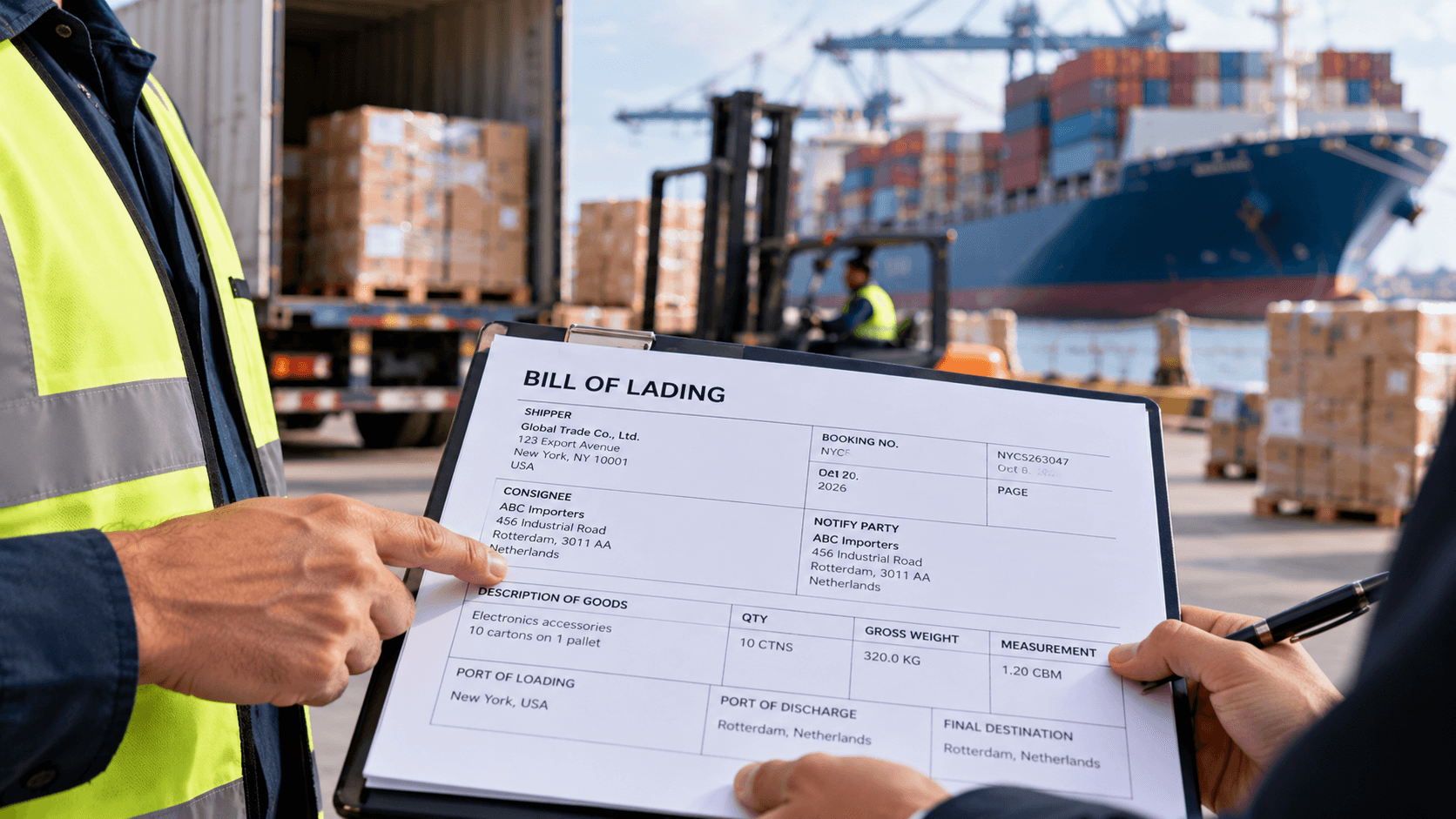
Consignee meaning in shipping refers to the person or organization designated to receive a shipment at its destination. The consignee is identified in transportation documents so the carrier knows to whom the goods are to be delivered. A consignee may be a retailer, distributor, importer, warehouse operator, or another authorized recipient, depending on the shipment and contractual arrangements.
Understanding the meaning of consignee is important because the organization receiving freight is not necessarily the same party that purchased, paid for, or legally owns it. In international trade, a shipment can involve a manufacturer, overseas seller, freight forwarder, importer, consignee, customs broker, and final warehouse. Each participant performs different responsibilities, and inaccurate documentation can delay delivery or create disputes.
For wholesale distributors, correctly identifying the consignee is a basic part of reliable transportation management. The consignee's name and delivery details help connect supplier purchase orders with freight bookings, warehouse receiving, proof of delivery, and inventory records. The role becomes particularly important when freight is routed through third-party logistics providers or delivered directly to customers.
What Is a Consignee?
A consignee is the named recipient of goods transported by a carrier. The Federal Motor Carrier Safety Administration defines the consignee as the person to whom a shipment is to be delivered. This transport-related definition describes the delivery role rather than automatically establishing legal ownership or payment responsibility.
A consignee can be an individual or a business organization. In commercial distribution, the consignee is frequently a warehouse, retail chain, industrial purchaser, or importing company. The designated recipient should have the ability to accept delivery according to the transportation instructions and applicable contractual terms.
Consider a distributor purchasing 400 cartons of merchandise from a supplier. The supplier arranges transportation to the distributor's distribution center, which is listed as the consignee. The carrier delivers the shipment to the specified facility, and the receiving team checks the quantity and condition against the delivery paperwork.
Consignee Meaning in Simple Terms
The consignee is the party the shipment is intended to reach. If a manufacturer ships goods to a retailer, the retailer may be the consignee. If the retailer uses an outside warehouse, that warehouse operator or another party may be named depending on the shipping arrangement.
The consignee does not always pay the carrier or supplier directly. Payment and ownership are determined by separate commercial agreements, transportation documents, and applicable law. This distinction matters when a shipment arrives before the purchaser has completed payment or when goods are handled on behalf of another company.
Consignee vs. Consignor: What Is the Difference?
The consignee is the designated recipient of a shipment, while the consignor is the party sending or tendering goods for transportation. The consignor is often the supplier or shipper at the origin, whereas the consignee is the named delivery recipient. Their responsibilities differ because one initiates the movement of goods and the other receives them.
Suppose a Chicago manufacturer sends replacement parts to a distributor in Denver. The manufacturer is the consignor, and the designated Denver recipient is the consignee. If the freight is damaged, the parties' duties concerning inspection, claims, and risk depend on the carrier contract and the sale agreement, not merely on their names.
The two roles are sometimes confused with consignment inventory. Consignor and consignee are also used in consignment sales, but that arrangement concerns goods held or sold on another party's behalf. Transportation documents do not automatically establish a consignment-sale relationship.
| Feature | Consignor | Consignee |
|---|---|---|
| Main role | Sends or tenders freight | Receives designated freight |
| Typical location | Shipping origin | Delivery destination |
| Example | Product manufacturer | Distribution warehouse |
| Shipping documents | Identified as sending party | Identified as receiving party |
| Operational responsibilities | Prepare goods and shipping instructions | Coordinate receipt and delivery acceptance |
| Ownership | Not automatically determined by role | Not automatically determined by role |
| Freight payment | Depends on agreement | Depends on agreement |
Who Is the Consignee on a Bill of Lading?
The consignee on a bill of lading is the party designated to receive the transported goods, subject to the form and terms of that document. A bill of lading records transportation information and may function as evidence of a carriage contract, a receipt, and, in appropriate cases, a document of title. Its exact legal effect depends on the type of bill and applicable rules.
Typical bill of lading fields include the shipper, consignee, notify party where relevant, origin, destination, freight description, package count, weight, and shipment references. Accurate consignee information helps the carrier identify the delivery instructions and match freight with the correct recipient. Incorrect addresses or legal names can delay release or require formal amendments.
Example: Consignee on a Shipping Document
All names and shipment information are hypothetical.
In this example, the shipper sends the goods and the consignee receives them. The consignee's receiving team should reconcile the physical delivery against the purchase order and carrier records. Shortages, visible damage, or missing packages should be documented according to applicable procedures and contractual deadlines.
A distributor can connect this process to its existing order fulfillment workflow, which covers the movement from purchase orders and warehouse activity through delivery confirmation.
| Bill of lading field | Illustrative entry |
|---|---|
| Shipper / consignor | Midwest Components Manufacturing LLC |
| Consignee | Western Parts Distribution Inc. |
| Delivery address | Denver distribution center |
| Notify party | Western Parts import operations |
| Commodity | Packaged industrial components |
| Package quantity | 20 pallets |
| Purchase order | PO-10482 |
| Carrier | Example Freight Lines |
Consignee vs. Notify Party
A consignee is designated to receive the cargo, while a notify party is listed to receive communications concerning shipment arrival or availability. In international shipping, the notify party may be the consignee itself, a customs broker, a freight forwarder, or another logistics contact. The roles can overlap but are not interchangeable.
For example, an importer may be named as consignee while its customs broker is listed as notify party. The carrier or shipping line may send arrival information to the notify party so clearance and delivery arrangements can begin. Notification alone does not necessarily authorize the notify party to take delivery of the goods.
The distinction becomes especially important when shipping containers internationally. A notify party might coordinate customs paperwork while the consignee receives the shipment at its warehouse. Both parties should have accurate contact information, but their instructions must reflect the actual shipment structure.
| Feature | Consignee | Notify party |
|---|---|---|
| Primary purpose | Designated cargo recipient | Receives shipment notifications |
| Can be importer? | Yes | Yes |
| Can be customs broker? | Depending on arrangement | Commonly |
| Automatically owns cargo? | No | No |
| Automatically authorized to take delivery? | Governed by documents and release conditions | No |
Is the Consignee the Buyer?
The consignee can be the buyer, but the buyer and consignee are not always the same organization. The buyer is identified by the underlying purchase transaction, whereas the consignee is identified by the shipment's delivery arrangements. A company may purchase goods and direct the supplier to ship them to another destination.
For instance, a wholesaler may buy merchandise from a manufacturer and instruct the supplier to deliver it directly to the wholesaler's retail customer. The retail customer or receiving location may be named as consignee even though the wholesaler purchased the goods. This is a common possibility in supplier-direct fulfillment and drop-shipping arrangements.
A three-party shipment therefore requires particular care. The supplier invoice, customer order, transportation document, and delivery instructions may identify different entities. Matching these documents helps avoid releasing goods to an unintended recipient or billing the wrong organization.
Is the Consignee the Owner of the Goods?
Being named as consignee does not by itself prove ownership of the goods. Ownership and the passage of legal title depend on the sales agreement, applicable law, and transaction structure. Transportation documents may have implications for rights to the goods, but the consignee field alone is not a universal ownership determination.
For example, a third-party warehouse can receive merchandise belonging to a distributor. The warehouse may appear as the delivery recipient but hold the goods solely as a service provider. Its job is to receive, store, and release inventory according to the customer's instructions.
In another situation, a retailer may receive goods under a consignment inventory agreement in which the supplier retains ownership until a defined event occurs. The retailer's status as receiver does not settle the title question. Businesses should review their actual agreement rather than infer ownership from delivery instructions.
Consignee Responsibilities in Shipping
The consignee's operational responsibilities typically include preparing to receive freight, checking the delivery, documenting discrepancies, and completing applicable receiving procedures. Specific legal and contractual obligations depend on the transaction and carrier terms. A consignee should not assume every charge or loss belongs to the sender.
Confirm the Delivery Appointment
The consignee should provide accurate receiving hours, dock instructions, equipment requirements, and appointment procedures. Large distribution centers may require advance shipment notices or scheduled delivery windows. Missing information can lead to waiting charges, failed delivery attempts, or rescheduling.
A facility receiving palletized goods should confirm that it has appropriate unloading equipment and personnel. Special products may require temperature control, security procedures, or other handling capabilities. These requirements should be communicated before the freight arrives.
Inspect Shipment Quantity and Condition
Upon arrival, receiving personnel should check accessible package counts and visible condition as permitted by the receiving process. Discrepancies should be documented promptly with appropriate freight records and supporting photographs. Signing delivery paperwork without recording visible problems can complicate later claims.
A complete inspection may require opening cartons or conducting a warehouse quality check after unloading. Concealed damage and shortages should be reported within applicable contractual or carrier time limits. Internal receiving procedures should clearly assign responsibility for reporting discrepancies.
Record Proof of Delivery
Proof of delivery documents that freight reached the designated location under the recorded circumstances. It may include recipient identification, time, package count, signature, and exceptions. The exact documentation depends on the carrier and shipment type.
Proof of delivery supports dispute resolution, customer service, and invoice reconciliation. However, delivery confirmation does not necessarily prove that every product passed quality inspection or that ownership transferred. Businesses should keep receiving confirmation and detailed quality acceptance as separate records where appropriate.
Coordinate Claims and Exceptions
If goods arrive damaged, incomplete, or late, the consignee may need to inform the shipper, carrier, insurer, or purchasing department. Claim responsibility depends on contracts, applicable transportation rules, and evidence. The consignee should preserve documents, photographs, package labels, and other relevant information.
Wholesale distributors benefit from a documented exception process. The receiving team should know when to quarantine damaged merchandise and who decides whether an order can be partially accepted. These controls connect transportation activity with inventory accuracy and supplier performance.
Consignee Meaning in International Shipping
Consignee meaning in international shipping refers to the designated cargo recipient identified in transportation documents, although importing, customs, and payment roles may belong to different parties. Cross-border shipments involve more documentation and potentially several service providers. The consignee must be identified consistently with the agreed transportation and import arrangements.
An overseas shipment may involve an exporter, foreign manufacturer, carrier, freight forwarder, customs broker, importer of record, notify party, and consignee. One organization may perform several of these roles, but they should not be assumed to be identical. Import regulations determine who can act as importer of record and what obligations apply.
For example, a U.S. distribution company might purchase goods from a manufacturer in Asia and use a customs broker to handle entry procedures. The U.S. distributor may be the consignee, while the broker is listed as a notify party or authorized customs representative. The exact documentation should follow the parties' actual arrangements.
The International Shipping Guide for Distributors explains related issues such as shipping terms, customs coordination, and landed-cost management.
Consignee vs. Importer of Record
The consignee is the designated receiver of a shipment, while the importer of record is the party responsible for the applicable customs entry obligations. The two roles can be performed by the same business, but they are not synonymous. Importer-of-record status is determined under customs rules rather than simply by the consignee field.
An importer of record may be responsible for entry documentation, the accuracy of declarations, and applicable duties and other customs requirements. The consignee's operational role focuses on receiving the cargo. Businesses importing into the United States should confirm who has the legal authority and responsibility to make entry.
A warehouse may receive imported goods without acting as importer of record. Similarly, the importer of record may arrange onward delivery to another consignee. Confusing these functions can delay customs clearance and create compliance exposure.
Consignee vs. Carrier and Freight Forwarder
The consignee receives the shipment, while a carrier transports it and a freight forwarder may arrange transportation and associated logistics services. Each party contributes to moving goods from origin to destination. Their responsibilities depend on the services contracted and the applicable transportation documents.
A carrier may operate a truck, aircraft, vessel, or other transportation service. A freight forwarder may coordinate bookings, consolidation, documents, and handoffs across carriers. The consignee is normally the designated endpoint for the relevant shipment.
A freight forwarder can sometimes appear as consignee in a particular transportation document, such as a master bill of lading in a consolidated shipping arrangement. The ultimate customer may then appear on a separate house bill of lading. Businesses must examine the specific documents to understand who has cargo-release authority.
What Happens When Consignee Details Are Incorrect?
Incorrect consignee details can prevent delivery, delay cargo release, or require amendments to transportation documents. Common errors include misspelled legal names, incomplete addresses, outdated receiving locations, and incorrect contact numbers. International shipments may face additional problems when details conflict across customs and transportation records.
A carrier may require instructions from the authorized shipper or document holder before changing the delivery recipient. The process can involve additional verification, administrative charges, or revised shipping documents. For certain negotiable bills of lading, cargo release can involve further document requirements.
Before shipping, businesses should verify the complete consignee name, delivery address, country, contact details, and any required identification numbers. They should also confirm the notify party and customs roles where relevant. Preventing an error is generally easier than redirecting freight already in transit.
How Distributors Should Verify Consignee Information
Distributors should verify consignee information against approved customer records, purchase orders, shipping instructions, and delivery requirements before releasing merchandise. This reduces the risk of misdirected freight and receiving disputes. A consistent workflow becomes increasingly important as order volume grows.
A practical verification process includes:
- Confirm the correct legal or trading name.
- Match the delivery address against the approved order.
- Verify warehouse hours and appointment requirements.
- Check receiving contact information.
- Confirm special unloading or handling instructions.
- Review the designated notify party where applicable.
- Reconcile the consignee details with the bill of lading and shipment booking.
- Record authorized changes before dispatch.
These steps can be incorporated into order-management or transportation-management systems. Automated validation can identify incomplete records, but it cannot replace approval of unusual delivery changes. High-value shipments may require additional controls against unauthorized address changes.
Final Takeaway
Consignee meaning is straightforward: the consignee is the designated recipient of a shipment. The practical implications become more complex when buyers, warehouse operators, customs parties, and cargo owners are different organizations. Correct consignee information helps ensure that freight reaches the intended facility and that transportation documents support a traceable delivery process.
For wholesale distributors, consignee management should be treated as part of shipping accuracy and inventory control. Accurate documents, clear receiving responsibilities, and timely exception reporting reduce delays and disputes. The most important rule is to distinguish the shipment recipient from the buyer, cargo owner, and importer of record whenever those roles differ.
Frequently Asked Questions
- What does consignee mean in simple words?
- A consignee is the person or business designated to receive a shipment. The carrier uses the shipping documents to identify the intended delivery recipient. Being the consignee does not automatically mean owning the goods.
- Is the consignee the same as the receiver?
- In many shipping contexts, consignee and receiver describe the same designated delivery role. However, a warehouse employee may physically accept freight on behalf of an organization named as consignee. The transportation document determines the named recipient.
- Who is the consignor and who is the consignee?
- The consignor is the party sending or tendering goods for transportation, and the consignee is the party designated to receive them. In a conventional manufacturer-to-distributor shipment, the manufacturer may be the consignor and the distribution center the consignee.
- Does the consignee pay shipping charges?
- Not necessarily. Freight payment depends on the transportation contract, sales terms, and agreed billing instructions. A consignee can receive goods without being responsible for paying the carrier directly.
- Can the consignee be different from the buyer?
- Yes. A wholesale buyer can instruct a supplier to ship directly to its customer or a third-party warehouse. In those situations, the buyer and consignee may be different organizations.
- What is consignee meaning on a bill of lading?
- The consignee field identifies the intended shipment recipient under the relevant transportation document. Cargo-release requirements depend on the bill of lading type and applicable terms. The field alone should not be used to determine ownership or customs responsibility.
- Is a consignee the same as an importer of record?
- No. A consignee is the designated recipient, whereas the importer of record is responsible for applicable customs entry obligations. The same company can perform both functions, but the roles are legally distinct.