Logistics
Best Warehouse Management Software for Distributors in 2026 – 7 WMS Platforms Compared
Inventory software tells a distributor what it owns. A WMS controls what warehouse teams actually do with that inventory - from receiving and put-away to replenishment, picking, packing, shipping, returns, and automation. These seven platforms target very different levels of warehouse complexity.
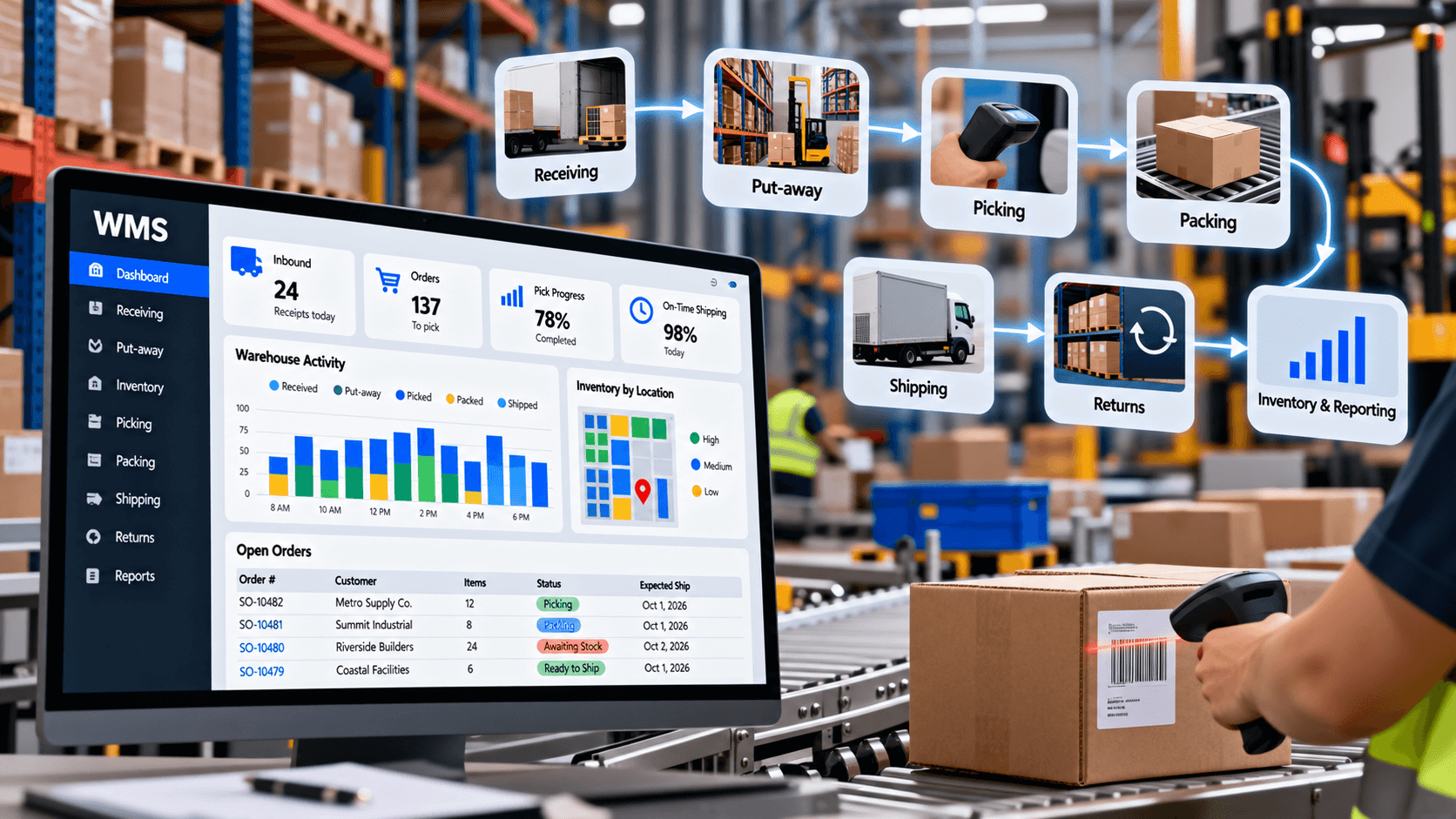
The best warehouse management software for distributors does not simply maintain another inventory count. It directs how merchandise moves through the warehouse – where an inbound pallet should go, which bin needs replenishment, what a picker should collect next, how an order should be packed, and when completed shipments should leave the building.
That distinction matters because a distributor can have accurate inventory totals and still operate an inefficient warehouse. Workers may travel too far, fast-moving items may be stored in poor locations, pickers may select the wrong unit of measure, replenishment may happen too late, and supervisors may have no clear picture of which orders are at risk of missing the carrier cutoff.
WMS becomes valuable when the problem is no longer “Do we have it?” but “How do we move it through the building accurately and efficiently?”
Best Warehouse Management Software for Distributors: Quick Comparison
The seven WMS platforms below serve very different environments. Manhattan, Blue Yonder, Infor and Oracle target sophisticated warehouse operations, Körber covers a particularly broad range of complexity, Dynamics 365 is attractive inside Microsoft-centered environments, while Acumatica offers a more accessible native WMS inside a distribution ERP.
The platform with the most warehouse sophistication is not automatically the right purchase. A 25-person warehouse using carts and barcode scanners does not need the same software architecture as a million-square-foot automated distribution center.
| WMS | Best fit | Warehouse depth | Labor / orchestration | Automation support | Pricing |
| Manhattan Active Warehouse Management | Large, complex DC networks | Very high | Very high | Very strong | Quote |
| Blue Yonder Warehouse Management | High-volume and optimization-driven warehouses | Very high | Very high | Very strong | Quote |
| Infor WMS | Complex distributors needing warehousing + labor + 3D visibility | Very high | Strong | Strong | Quote |
| Oracle Warehouse Management | Enterprise and global distribution networks | Very high | Strong | Very strong | Quote |
| Körber WMS | Small-to-enterprise warehouses and automation-heavy operations | Broad range | Strong | Very strong | Quote |
| Dynamics 365 Supply Chain Management WMS | Microsoft-centered distributors | High | Strong | Strong | $210/user/month SCM base |
| Acumatica WMS | Mid-market distributors wanting ERP-native warehouse execution | Moderate–high | Moderate | Integration dependent | ERP/package pricing |
What Is Warehouse Management Software?
Warehouse management software controls the operational execution of inventory inside a warehouse or distribution center. While inventory-management software focuses heavily on quantities, costing, purchasing and availability, WMS goes deeper into receiving, put-away, bin movements, replenishment, picking, packing, shipping and worker execution.
A typical WMS can determine where incoming inventory should be placed, release tasks to workers, prioritize orders, track containers or license plates, direct picking routes and update stock positions as work happens. Advanced platforms can also coordinate labor, yards, slotting, automation systems, robotics and real-time execution.
The WMS is therefore the execution layer between inventory demand and physical warehouse work.
Inventory Management Software vs WMS
These systems overlap, but the difference becomes obvious when the warehouse gets busy.
A smaller distributor can operate successfully with inventory software and relatively simple warehouse processes. WMS becomes increasingly useful as warehouse execution itself becomes a meaningful source of labor cost, errors or customer-service risk.
| Inventory management asks | WMS asks |
| How many units are available? | Where exactly should the worker find them? |
| What needs to be reordered? | Which bin needs replenishment before picking starts? |
| What did the item cost? | Which pallet, lot or container should be picked? |
| Which warehouse owns the stock? | Where inside the warehouse is the stock? |
| What is allocated to orders? | In what sequence should those orders be picked? |
| What stock transferred between sites? | How should that transfer be received and put away? |
| What is on backorder? | Which released tasks should warehouse labor prioritize? |
What We Looked for in Warehouse Management Software for Distributors
Distributor warehouses have different priorities from manufacturing plants and pure ecommerce fulfillment centers. A strong WMS should accommodate both high-volume routine orders and exceptional B2B workflows without forcing supervisors to manage every unusual transaction outside the system.
The most important evaluation areas are:
A WMS demonstration should show warehouse work, not dashboards. If the vendor cannot take a purchase order through receiving, put-away, replenishment, picking and shipping, the comparison remains theoretical.
| Capability | Why distributors need it |
| Receiving | Purchase orders may arrive partially or across several shipments |
| Directed put-away | Inventory needs the correct storage location |
| Bin/location control | Warehouse quantity alone is not enough |
| Replenishment | Pick faces need stock before orders stall |
| Barcode/RF/mobile scanning | Reduces manual identification and movement errors |
| Wave/batch/zone picking | Different order profiles need different picking strategies |
| Units of measure | Pallets, cases and eaches must remain accurate |
| Lot/serial tracking | Required in many regulated or service-heavy industries |
| Packing | Orders need correct cartons, labels and documentation |
| Shipping integration | Completed warehouse work must become an outbound shipment |
| Returns | Returned stock needs inspection and disposition |
| Labor visibility | Management needs workload and productivity data |
| Slotting | High-velocity products should occupy efficient locations |
| Automation integration | Conveyors, AMRs, sorters and other equipment need coordination |
| ERP integration | Inventory and financial systems must receive accurate results |
1. Manhattan Active Warehouse Management – Best for Complex Distribution Centers
Manhattan Associates’ current warehouse platform, ActiveWarehouse, is designed around unified inventory, labor, automation and yard execution. The company now offers three warehouse-management editions, allowing organizations to match functionality more closely to operational complexity rather than treating every facility as the same type of WMS implementation.
At the advanced end, Manhattan focuses heavily on continuous optimization rather than simply executing predefined tasks. Warehouse activity, labor, slotting, yard operations and transportation can operate within a connected supply-chain execution environment, which is particularly relevant for large distributors managing several high-volume facilities.
The 26.2 release expanded this approach with AI-driven functionality for receiving, planning and transportation, along with improvements to picking, exception handling, yard visibility, labor planning and slotting.
Large distribution centers constantly trade one priority against another. An urgent order can consume labor planned for another wave, an inbound truck can change available stock, replenishment can compete with picking for equipment, and automation can create bottlenecks downstream when work is released poorly.
Manhattan’s value proposition is built around coordinating these dependencies rather than optimizing each warehouse activity in isolation. That makes it most relevant when execution complexity itself is a strategic problem.
For a distributor operating smaller manual warehouses, that sophistication can be more than necessary. Implementation, integration, process design and change management need to justify the operational gain.
Manhattan does not publish simple standard subscription pricing for ActiveWarehouse. Enterprise implementations require a direct commercial proposal based on facilities, modules and requirements.
The platform belongs on the shortlist for large distributors, complex DC networks, automation-heavy facilities and organizations where labor and fulfillment orchestration have major financial impact.
2. Blue Yonder Warehouse Management – Best for Intelligent Warehouse Orchestration
Blue Yonder Warehouse Management combines core WMS execution with labor intelligence, predictive analytics, slotting and AI-driven orchestration. Its 2026.2 release emphasizes real-time workload and resource decisions rather than treating WMS as a static set of receiving and picking rules.
The platform covers inbound processing, inventory management, resource management and outbound execution. Current functionality includes directed put-away, quality checks, cross-docking, inventory visibility and tools designed to coordinate work across warehouse resources.
Blue Yonder has also added visual slotting analytics and shift-level workload visibility. These capabilities become more valuable as warehouse managers need to optimize not just whether work is completed, but where inventory should sit and how available labor should be deployed against constantly changing demand.
A high-throughput warehouse may have thousands of possible tasks available at any moment. Releasing work based only on simple FIFO rules can leave labor idle in one area while another part of the warehouse becomes overloaded.
Blue Yonder’s current architecture is aimed at this orchestration problem. Predictive and real-time intelligence helps warehouses prioritize work, resources and slotting decisions as conditions change.
This depth is valuable in large distribution operations but should be justified by real process complexity. A modest distributor that primarily needs scanning, bins and accurate picking can achieve strong results with a less demanding system.
Blue Yonder pricing is quote-based. Implementation cost depends on facility complexity, modules, integrations, labor and automation requirements.
The strongest fit is high-volume distribution where labor productivity, slotting, fulfillment performance and dynamic execution are large enough to justify advanced optimization.
3. Infor WMS – Best for Distribution-Specific Warehouse Depth
Infor WMS is a cloud-based warehouse platform designed for complex operations across multiple industries. Its current product combines advanced warehousing with labor, task and inventory management and includes 3D visualization as part of the broader WMS environment.
For distributors already considering Infor CloudSuite Distribution, the WMS has an additional architectural advantage: warehouse execution can operate within a broader ecosystem that also includes ERP, supply planning, order management, ecommerce and analytics.
This can reduce the number of integration boundaries a complex distributor has to manage. That matters when order changes, purchasing, inventory, warehouse operations and financial records all need to remain aligned.
Infor targets configurable operations rather than one standardized warehouse design. This is useful for distributors with combinations of pallets, cases, each picking, value-added services, multiple facilities and industry-specific processes.
The platform’s current direction also includes generative and agentic AI and analytics alongside core WMS functionality.
A distributor should still evaluate the WMS independently from the ERP brand. Using Infor ERP can improve architectural fit, but the warehouse team should prove that receiving, replenishment, picking and exception workflows genuinely match the operation.
Infor does not publish standard WMS pricing. The product requires a quote based on implementation scope and broader system architecture.
Infor is particularly relevant to mid-market and enterprise distributors with complex facilities, specialized vertical requirements or an existing Infor technology strategy.
4. Oracle Warehouse Management – Best for Global and Multi-Site Fulfillment
Oracle Warehouse Management is a cloud-native, multi-tenant WMS designed to support warehouses across a wide range of operational complexity. Current Oracle documentation positions the platform across distribution, retail, manufacturing and 3PL environments and includes real-time warehouse execution, visibility and automation support.
For wholesale distribution specifically, Oracle supports complex inbound and outbound operations, cross-docking, flow-through allocation, value-added services such as labeling and kitting, inventory visibility and both B2B and B2C fulfillment.
The platform can also connect with material-handling equipment including autonomous mobile robots, automated guided vehicles, conveyors, sortation systems, carousels and scales.
Oracle’s architecture supports multiple warehouse locations within a single environment and is designed for complex fulfillment networks. Its 3PL capabilities also allow multiple clients and locations to be managed within one instance, although a traditional distributor may not need that part of the platform.
The broader Oracle Logistics environment connects warehousing with transportation and global-trade capabilities. For an international distributor, warehouse execution may therefore become part of a wider logistics architecture rather than a standalone WMS project.
Oracle Warehouse Management uses quote-based enterprise pricing. Implementation scope can vary substantially according to locations, integrations, automation and broader Oracle modules.
The platform deserves consideration for large multi-site distributors, global operations, sophisticated fulfillment networks and warehouses with significant automation requirements.
5. Körber WMS – Best for a Wide Range of Warehouse Complexity
Körber takes a broader portfolio approach than vendors designed primarily for the highest end of the WMS market. Its warehouse-management solutions are positioned for operations ranging from small and medium warehouses with manual or forklift processes to RF, voice-directed and highly automated distribution centers.
This range is useful because warehouse complexity does not always track company revenue neatly. A distributor may be large but operate straightforward facilities, while a smaller specialty business can have demanding lot control, automation or high-frequency piece picking.
Körber’s WMS portfolio emphasizes barcode and RF workflows, voice, automation and the ability to adapt to different warehouse processes. The company reports more than 1,600 warehouse-management customers across its global installed base.
A distributor should avoid choosing WMS only for the warehouse it operates today. New product categories, ecommerce, automation, additional facilities or acquisitions can change warehouse requirements much faster than ERP requirements.
At the same time, buying enterprise-scale complexity years before it is needed can make the warehouse less agile rather than more capable. Körber’s range makes it worth evaluating where the company wants a WMS path that can span different facility sizes and automation levels.
Körber uses custom pricing rather than a public standard WMS subscription. Implementation scope depends on which product and level of warehouse functionality are selected.
It is especially relevant for distributors that want a dedicated warehouse technology provider capable of supporting both conventional facilities and more automated operations over time.
6. Dynamics 365 Supply Chain Management WMS – Best for Microsoft-Centered Distributors
Dynamics 365 Supply Chain Management contains a substantial warehouse-management environment covering complex warehouse layouts and operational scenarios. Microsoft also supports a warehouse management only mode, allowing organizations to use the WMS with external ERP systems instead of requiring every financial and order process to run in Dynamics 365.
That architecture is important. A company can use the Dynamics warehouse engine for logistics operations while another ERP remains responsible for orders and financial processing, with integration messages and inventory updates moving between the systems.
This makes Dynamics more interesting as a WMS than simply saying “it comes with Microsoft ERP.” The warehouse-only architecture gives companies additional options when replacing the entire ERP would make the project too large.
For distributors already using Dynamics 365, Power Platform, Azure and Microsoft analytics, the WMS can fit naturally into the wider environment. Workflow extensions, reporting and integrations can remain within a familiar technical ecosystem.
However, familiarity should not replace warehouse validation. A Microsoft-centered company still needs to test picking strategy, replenishment, scanning, inbound receiving, packing and integration against the actual facility.
Dynamics 365 Supply Chain Management currently lists at $210 per user per month, paid yearly, while the Premium edition is $300 per user per month. Exact warehouse licensing and user requirements should be confirmed for the intended architecture.
Dynamics 365 WMS is especially relevant for mid-market and enterprise distributors using Microsoft business systems or organizations that want to deploy warehouse execution while retaining another ERP.
7. Acumatica WMS – Best for Mid-Market ERP-Connected Distribution
Acumatica’s native WMS sits inside its broader cloud ERP and Distribution Edition rather than operating primarily as a standalone enterprise warehouse platform. It manages receiving, put-away, inventory movements, picking, packing and shipping while using mobile scanning and real-time inventory updates.
This integrated approach can be a major advantage for a mid-market distributor. Warehouse transactions can remain closely connected to sales orders, purchasing, inventory and financial data without building a separate best-of-breed WMS integration.
For many distributors, simpler architecture is worth more than advanced functionality they will never use. If the warehouse needs solid barcode-driven execution but not sophisticated robotics orchestration or large-scale labor optimization, ERP-native WMS can be the cleaner choice.
Acumatica supports barcode and mobile workflows across receiving, put-away, movement, picking, packing and shipment. Inventory activity is updated in real time, allowing operations, customer service and other teams to work from the same underlying ERP information.
Because the warehouse functionality is part of the wider Acumatica environment, companies evaluating it should compare the complete ERP/WMS architecture, not attempt to price it as though it were a standalone scanner application.
Acumatica uses package and usage-based ERP pricing rather than a simple WMS-per-user list. Exact WMS availability and cost depend on the Acumatica edition and implementation configuration.
It is a strong candidate for growing distributors already considering Acumatica ERP or companies that want capable warehouse execution without creating a separate enterprise WMS project.
Which Warehouse Management Software Fits Which Distributor?
Warehouse size alone is a poor selection criterion. Order profile, SKU velocity, automation, units of measure, number of shifts and fulfillment complexity can make two warehouses of identical square footage require completely different systems.
The table narrows the field, but the final shortlist should be based on transaction testing inside the warehouse.
| Warehouse situation | Platforms to evaluate first |
| Large automated distribution center | Manhattan, Blue Yonder, Oracle, Körber |
| Complex enterprise warehouse network | Manhattan, Blue Yonder, Infor, Oracle |
| Existing Infor distribution environment | Infor WMS |
| Global Oracle supply-chain environment | Oracle WMS |
| Microsoft-centered operations | Dynamics 365 SCM WMS |
| External ERP but interested in Microsoft WMS | Dynamics 365 warehouse-only mode |
| Mid-market ERP + warehouse replacement together | Acumatica |
| Need a WMS portfolio across different facility complexity | Körber |
Receiving Is Where WMS Accuracy Starts
Warehouse accuracy is often discussed as a picking problem, but bad inventory can enter the system before the product ever reaches a storage location. A receiver may process the wrong quantity, wrong unit of measure, wrong lot or wrong purchase-order line and create an error that travels through every downstream process.
The WMS should therefore control what is expected, what actually arrived, which container or pallet received it, whether inspection is required, and where the merchandise should go next.
A distributor should test partial receipts during every WMS evaluation. Suppliers rarely behave as cleanly as sample data where one purchase order arrives complete in one truck.
Put-Away Should Be a Decision, Not Just a Scan
A simple warehouse can use fixed bin locations, but more sophisticated operations need directed put-away. The system can consider product characteristics, available capacity, velocity, zones and operational rules before instructing a worker where to store inbound goods.
Poor put-away decisions create costs later. Fast-moving products placed far from packing areas increase travel, oversized products consume inappropriate locations, and random overflow creates search time.
Advanced WMS platforms such as Manhattan, Blue Yonder, Oracle and others increasingly connect put-away and slotting decisions with broader execution data rather than treating storage locations as static.
Replenishment Can Stop Picking Before the Picker Starts
A warehouse may have 5,000 units of a product but only 10 units in the forward pick location. If an order wave needs 300, somebody has to replenish that location before or during picking.
Without WMS logic, replenishment can become reactive. Pickers arrive at empty locations, supervisors search for reserve stock, and urgent replenishment tasks interrupt planned work.
A strong WMS predicts the operational need before the pick face becomes empty. This is one reason warehouse management goes beyond simply knowing total stock by warehouse.
Picking Strategy Should Match the Order Profile
There is no universally best picking method. A distributor shipping 20 large B2B orders per day needs a different workflow from a company processing 8,000 small ecommerce lines across the same facility.
Common WMS strategies can include:
discrete order picking;
batch picking;
wave picking;
zone picking;
cluster picking;
case picking;
pallet picking;
voice-directed picking;
automated goods-to-person workflows.
Rather than creating a long feature checklist, ask vendors to process the company’s three most common order profiles. The WMS should fit the actual mix of orders, not force the operation into the workflow that looks best in a demonstration.
Units of Measure Can Create Expensive Warehouse Errors
Distributors commonly purchase, store and sell the same product in different units. One pallet can contain 40 cases and each case may contain 12 individual items, while different customers are allowed to order at different levels.
A warehouse worker scanning a case when the system expects an each can create an inventory discrepancy large enough to cause multiple failed orders. WMS should therefore understand product packaging and direct workers using the correct unit at each stage.
This is especially important when B2B and ecommerce orders are fulfilled from the same warehouse. The same SKU can move by pallet in the morning and by individual unit in the afternoon.
WMS and Automation Need to Be Evaluated Together
Automation can include conveyors, sorters, automated storage systems, pick-to-light, autonomous mobile robots, robotic picking and other material-handling systems. The WMS does not necessarily control every machine directly, but it must exchange enough information with warehouse-control or automation systems to keep work coordinated.
Oracle explicitly supports connections with several categories of material-handling equipment, while Manhattan, Blue Yonder and Körber all position automation orchestration as an important part of modern warehouse execution.
A distributor planning automation should therefore evaluate the WMS before equipment decisions become irreversible. Buying robots first and deciding later how the software will coordinate them is the wrong sequence.
WMS Should Connect to ERP Without Creating Two Inventory Truths
ERP usually remains authoritative for purchasing, customer orders, inventory valuation and finance. WMS manages the detailed physical execution required to make those transactions happen inside the facility.
That creates a critical integration boundary. When the WMS receives 100 units, moves stock, ships an order or processes a return, ERP eventually needs accurate information about what occurred.
A weak integration creates the worst possible architecture: warehouse workers trust the WMS, finance trusts ERP, and the two systems disagree about inventory. This risk is one reason Acumatica’s native WMS or Dynamics warehouse execution inside a broader Microsoft environment can be attractive to companies that value architectural simplicity.
When Does a Distributor Actually Need WMS?
Not every warehouse needs a dedicated WMS. A distributor operating one modest facility with fixed product locations, simple orders and low error rates can often run effectively with good inventory software and barcode scanning.
A WMS becomes more compelling when several warning signs appear together:
The goal of WMS is not digitizing every warehouse action. It is reducing the number of important execution decisions that depend entirely on memory, paper and supervisor intervention.
| Warning sign | Why WMS may help |
| Frequent picking errors | System-directed work and scanning reduce manual decisions |
| Workers cannot find stock | Better location and movement control is needed |
| Replenishment constantly interrupts picking | WMS can create proactive replenishment tasks |
| Too much walking | Slotting and picking methods may be inefficient |
| Several shifts compete for work | Labor and workload visibility becomes important |
| Multiple order types use one warehouse | Different execution strategies are needed |
| Warehouse relies on tribal knowledge | Processes need to become system-directed |
| Automation is being introduced | A stronger execution layer is required |
| Inventory by bin is unreliable | Physical movements need tighter control |
| Order volume grows faster than headcount | Productivity becomes a scaling constraint |
How to Demo Warehouse Management Software
The evaluation should happen around real orders and real warehouse exceptions. Give each vendor the same scenario rather than allowing every salesperson to choose the workflow that makes their platform look strongest.
Ask the system to:
Receive a partially delivered purchase order.
Scan products using the real units of measure.
Capture a lot or serial number.
Direct put-away to appropriate locations.
Move some inventory into a pick face.
Trigger replenishment for an upcoming order.
Release one pallet order and several small piece orders.
Pick using the intended mobile/RF workflow.
Handle a short pick.
Substitute or reroute inventory if the business permits it.
Pack and label the shipment.
Confirm shipping.
Process a customer return.
Show the resulting ERP inventory.
Show a supervisor which work remains at risk.
A WMS that cannot make this sequence intuitive during a controlled demonstration will not become simpler at 4:30 p.m. during the warehouse’s busiest shipping hour.
How Much Does Warehouse Management Software Cost?
Most enterprise WMS vendors use custom pricing because cost depends heavily on facilities, users, transaction volume, modules, automation, integrations and implementation. The software subscription itself can therefore represent only one portion of the project.
A realistic WMS budget can include:
software;
implementation;
ERP integration;
mobile devices;
scanners;
labels and printers;
Wi-Fi improvements;
data cleanup;
location redesign;
process mapping;
testing;
employee training;
automation integration;
support;
future facility rollouts.
The business case should be based on warehouse economics rather than license cost alone. Reduced errors, higher throughput, fewer rush shipments, better labor utilization and delayed warehouse expansion can all have much larger financial impact than the monthly software fee.
FAQ
There is no single best WMS for every distributor. Manhattan and Blue Yonder are particularly strong for sophisticated execution and optimization, Infor and Oracle suit complex enterprise distribution networks, Körber covers a broad range of warehouse types, Dynamics fits Microsoft-centered environments, and Acumatica is attractive for mid-market distributors wanting WMS integrated with ERP.
Warehouse complexity, automation, order profile and integration architecture should determine the shortlist.
Inventory software primarily tracks stock, purchasing, availability, costing and replenishment at a business level. WMS goes deeper into the physical execution of receiving, put-away, bin movement, replenishment, picking, packing and shipping.
The systems overlap, but WMS becomes more valuable as the warehouse itself becomes operationally complex.
Not necessarily. A smaller warehouse can operate very effectively with good inventory software, clear locations and reliable barcode processes.
WMS becomes useful when picking errors, warehouse travel, replenishment, multiple zones, high order volume or complicated fulfillment begin creating meaningful cost and service problems.
Yes. Best-of-breed WMS platforms are commonly integrated with external ERP systems.
Microsoft explicitly offers a warehouse-management-only architecture that can operate with an external ERP, while other enterprise WMS products also rely on integration to receive orders and return warehouse execution results.
Typical WMS processes include receiving, put-away, bin and location management, replenishment, picking, packing, shipping, transfers, cycle counts, lot and serial tracking and returns.
More advanced systems can also manage labor, slotting, yards, cross-docking, value-added services and warehouse automation.
No. Barcode scanning is one technology used within warehouse processes.
A WMS decides what work should happen and records the resulting warehouse transaction, while barcode or mobile scanning helps workers identify products, locations and tasks accurately.
A dedicated WMS becomes worth evaluating when standard ERP functionality can no longer support the required picking methods, labor orchestration, automation, replenishment, slotting or warehouse scale.
The decision should be based on operational gaps rather than an assumption that a separate WMS is automatically more advanced or better.
Frequently Asked Questions
- What is the best warehouse management software for distributors?
- There is no single best WMS for every distributor. Manhattan and Blue Yonder are particularly strong for sophisticated execution and optimization, Infor and Oracle suit complex enterprise distribution networks, Körber covers a broad range of warehouse types, Dynamics fits Microsoft-centered environments, and Acumatica is attractive for mid-market distributors wanting WMS integrated with ERP. Warehouse complexity, automation, order profile and integration architecture should determine the shortlist.
- What is the difference between WMS and inventory management software?
- Inventory software primarily tracks stock, purchasing, availability, costing and replenishment at a business level. WMS goes deeper into the physical execution of receiving, put-away, bin movement, replenishment, picking, packing and shipping. The systems overlap, but WMS becomes more valuable as the warehouse itself becomes operationally complex.
- Does a small distributor need WMS?
- Not necessarily. A smaller warehouse can operate very effectively with good inventory software, clear locations and reliable barcode processes. WMS becomes useful when picking errors, warehouse travel, replenishment, multiple zones, high order volume or complicated fulfillment begin creating meaningful cost and service problems.
- Can WMS work with a different ERP?
- Yes. Best-of-breed WMS platforms are commonly integrated with external ERP systems. Microsoft explicitly offers a warehouse-management-only architecture that can operate with an external ERP, while other enterprise WMS products also rely on integration to receive orders and return warehouse execution results.
- What warehouse processes should WMS manage?
- Typical WMS processes include receiving, put-away, bin and location management, replenishment, picking, packing, shipping, transfers, cycle counts, lot and serial tracking and returns. More advanced systems can also manage labor, slotting, yards, cross-docking, value-added services and warehouse automation.
- Is barcode software the same as WMS?
- No. Barcode scanning is one technology used within warehouse processes. A WMS decides what work should happen and records the resulting warehouse transaction, while barcode or mobile scanning helps workers identify products, locations and tasks accurately.
- When should a distributor replace ERP warehouse functionality with a dedicated WMS?
- A dedicated WMS becomes worth evaluating when standard ERP functionality can no longer support the required picking methods, labor orchestration, automation, replenishment, slotting or warehouse scale. The decision should be based on operational gaps rather than an assumption that a separate WMS is automatically more advanced or better.
Written by

James ColeWholesale distribution operator
James Cole is a wholesale operator who has run distribution P&Ls through first-warehouse launch, inventory turns, trade credit, and EDI-backed accounts.
Published October 12, 2026 · Last reviewed October 5, 2026
