Software
Best B2B Ecommerce Software for Distributors in 2026 – Pricing, ERP Integration, Reorders, and Buyer Accounts Compared
Best B2B Ecommerce Software for Distributors in 2026 – Pricing, ERP Integration, Reorders, and Buyer Accounts Compared
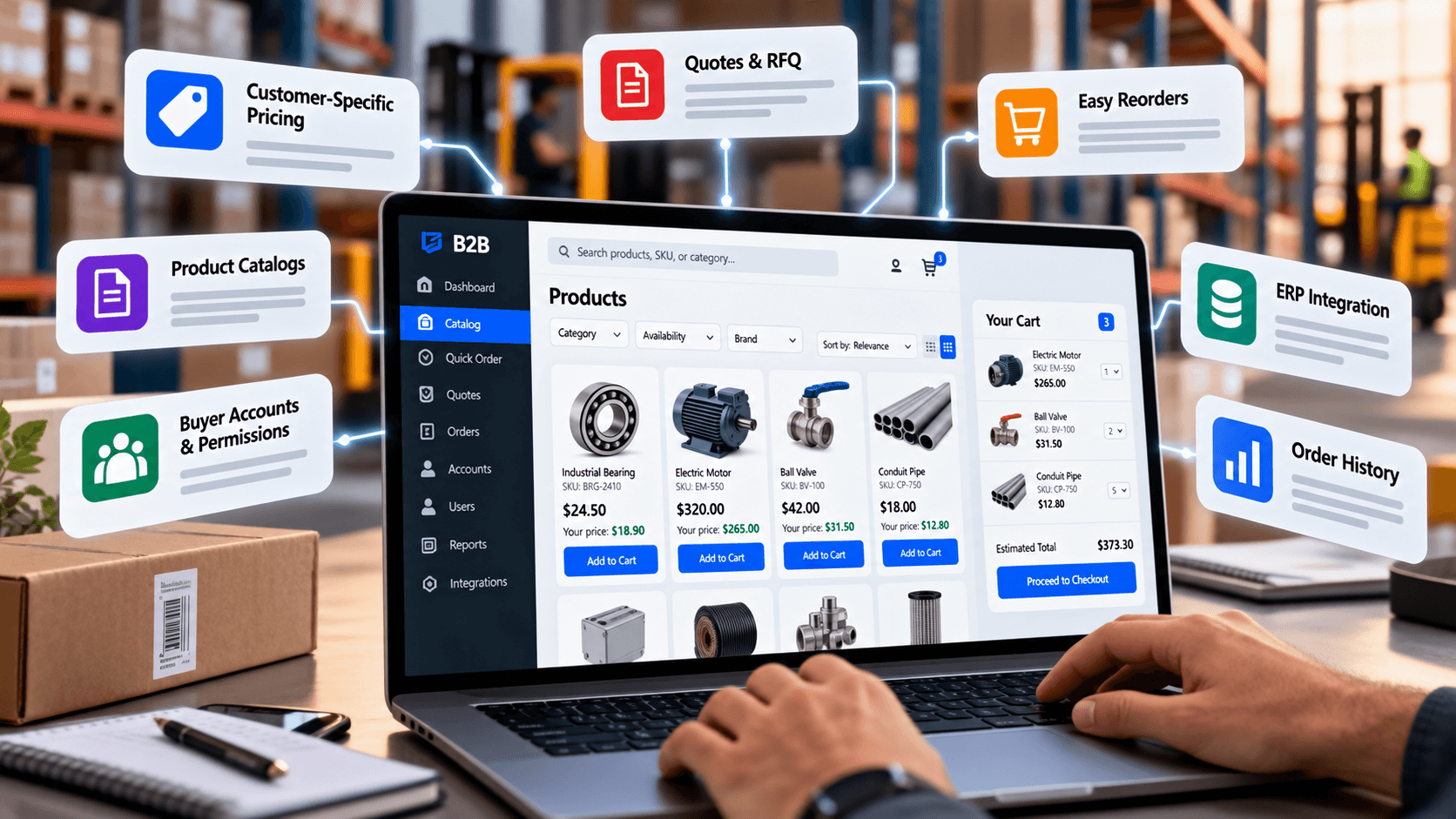
The best B2B ecommerce software for distributors should allow an existing customer to log in and immediately see the business relationship that already exists offline. That means the correct product assortment, negotiated pricing, credit or payment terms, shipping options, order history, available inventory, company locations, purchasing permissions, and a fast way to place the next order.
A standard consumer ecommerce platform does not automatically provide that experience. Distribution customers may buy the same 100 SKUs every month, submit purchase orders, request quotes, operate several branches under one corporate account, require approval before an order is released, or expect an online order to follow exactly the same pricing rules that a salesperson sees in ERP.
The real purpose of B2B ecommerce is not to replace the distributor’s sales team. It is to make routine purchasing easier while keeping pricing, inventory, customer accounts, and order data synchronized with the systems already running the business.
Best B2B Ecommerce Software for Distributors: Quick Comparison
The six platforms below approach B2B commerce from different directions. OroCommerce and Optimizely are B2B-oriented enterprise platforms, Sana is built around deep ERP integration, Adobe Commerce provides extensive B2B functionality inside a highly customizable commerce environment, while Shopify and BigCommerce make sophisticated B2B selling accessible within broader ecommerce ecosystems.
The table should be used to decide which architecture deserves a deeper evaluation, not to identify a universal winner. A distributor running SAP S/4HANA with complex pricing has a very different starting point from a company selling both wholesale and DTC through Shopify.
| Platform | Best fit | Customer-specific pricing | Company accounts | Quotes / RFQ | ERP approach | Public platform price |
| OroCommerce | Complex B2B distributors | Strong | Very strong | Strong | Broad integrations | Quote |
| BigCommerce B2B Edition | Mid-market/enterprise distributors wanting flexible commerce | Strong | Strong | Yes | APIs/integrations | Quote |
| Shopify B2B | Distributors wanting B2B + DTC simplicity | Strong, plan dependent | Strong | More limited than dedicated B2B platforms | Apps/APIs/integrations | Plan dependent; Plus from $2,500/month |
| Adobe Commerce B2B | Large, highly customized commerce programs | Very strong | Very strong | Strong | Extensive integration architecture | Quote |
| Sana Commerce Cloud | SAP or Microsoft Dynamics distributors | ERP-native | Strong | Yes | Native real-time ERP integration | Quote |
| Optimizely Configured Commerce | Complex product catalogs and B2B digital experiences | Strong | Strong | B2B workflows | Integration-oriented | Quote |
What B2B Ecommerce Software for Distributors Actually Needs to Do
A distributor storefront should not force customers to learn a completely new purchasing process just because the order moved online. The strongest platforms reproduce existing B2B relationships digitally while removing work that previously required emails, phone calls, PDFs, and manual order entry.
At minimum, the buying experience should answer four questions correctly: What can this customer buy? What price do they pay? What can actually be shipped? What commercial rules apply to this account? If the ecommerce platform cannot answer those questions consistently with ERP, online ordering can create more customer-service work rather than less.
The feature set therefore looks very different from ordinary B2C ecommerce.
A distributor should test these workflows before it evaluates themes, page builders, or AI merchandising. The storefront is valuable only if the commercial transaction behind it is correct.
| Distributor requirement | Why it matters |
| Company accounts | One customer may have many buyers and locations |
| Roles and permissions | Not every employee can approve or place orders |
| Customer-specific catalogs | Buyers may have access to different product ranges |
| Contract pricing | Every customer does not pay the same price |
| Quantity rules | Cases, packs, minimums and increments matter |
| Quick order | Repeat buyers often know the SKU already |
| Reorder tools | Many B2B purchases repeat |
| Quotes / RFQs | Some orders require negotiation |
| PO and net terms | Card checkout is not the only payment model |
| Order history | Buyers need previous transactions and documents |
| ERP integration | Pricing, inventory and order data must stay aligned |
| Multiple ship-to locations | Corporate accounts often buy for several sites |
| Punchout | Larger buyers may order through procurement systems |
| Sales-rep access | Reps still need to assist customers |
| B2B and DTC support | Many distributors now serve both channels |
1. OroCommerce – Best for Complex B2B Distribution Workflows
OroCommerce is one of the most B2B-native products in this comparison. Its current platform supports corporate account hierarchies, granular buyer roles and permissions, multiple price lists, customer-specific catalogs, RFQs, quick ordering, reorders, invoicing, payments, quote workflows, CRM functionality, and multi-organization commerce from the same broader system.
That depth matters for distributors because B2B complexity usually exists around the account rather than only around the product. A customer may have a corporate headquarters, ten branches, several purchasers, one person authorized to approve expensive orders, another employee who can only create shopping lists, and different pricing or catalogs for different business units.
OroCommerce is designed to model that type of structure instead of treating every buyer as an independent consumer account. Its roles and permissions engine can restrict actions and data across customer groups, business units and organizational hierarchies, while workflow tools can enforce approval and commercial processes around orders and quotes.
Oro supports separate price books and entitlements, customer-specific catalogs, RFQ workflows, quick orders, reorders, customer dashboards, invoices, and purchase history. It also includes a built-in CRM and can integrate with external systems such as Salesforce as part of a broader B2B commercial workflow.
This is particularly useful where online ordering cannot be reduced to a public catalog with a percentage discount. A distributor can have thousands of customers with distinct commercial relationships and still needs the storefront to understand which products and prices apply when each buyer signs in.
Oro’s 2026 roadmap also shows where enterprise B2B commerce is moving. Current and planned functionality includes customer part numbers, recurring orders, warehouse-level inventory visibility, field-sales quoting and AI tools capable of interpreting POs and helping sales teams work with account and order information.
Oro positions the commerce platform as an engagement layer connecting inventory, invoicing, orders, quotes, returns, customers and service rather than as a disconnected online store. The platform supports integrations with systems including NetSuite, JD Edwards, SAP, Microsoft Dynamics and Infor.
That does not mean an Oro implementation is simple. Its strength is the ability to model complicated B2B organizations and workflows, and that same flexibility means implementation scope needs to be controlled carefully.
OroCommerce does not publish a simple standard subscription price for an enterprise implementation. Companies need to request pricing based on their requirements, architecture and deployment.
It belongs high on the shortlist when a distributor has complicated company structures, approval rules, quotes, negotiated pricing, multiple sites or organizations, and a need to digitize processes that ordinary ecommerce platforms struggle to represent.
2. BigCommerce B2B Edition – Best for Flexible B2B Self-Service
BigCommerce B2B Edition combines the company’s broader ecommerce platform with a dedicated B2B account and buyer environment. Current B2B functionality includes company accounts, buyer roles, quotes, invoice management, purchase-order workflows, sales-representative access, shopping lists and a dedicated Buyer Portal.
For distributors, the Buyer Portal is particularly important because it gives customers a self-service area rather than treating the account page as little more than an order-history screen. Buyers can manage B2B purchasing workflows, request quotes, review orders and handle invoices within an environment designed around company accounts.
This is the point where ecommerce starts reducing routine account-management work. A customer who can independently retrieve documents, repeat an order, request a quote or pay an invoice does not need to contact inside sales for every administrative transaction.
BigCommerce B2B Edition supports multiple users inside a company account and includes default Junior Buyer, Senior Buyer and Admin roles. Companies can also create custom roles with different permissions, which is useful when customer organizations have formal purchasing controls.
The platform also supports parent-child company hierarchies. Current documentation allows up to five hierarchy layers and as many as 500 companies inside one hierarchy, making the architecture relevant to customers such as chains, franchises and multi-location corporations.
Company accounts can be connected with customer groups that control products and pricing. This provides a framework for giving different B2B customers different storefront experiences rather than exposing one public catalog to every buyer.
BigCommerce supports sales quotes and invoice management, including purchase orders paid on net terms. Sales representatives can also be assigned to company accounts and work with customer activity through the B2B environment.
This makes B2B Edition attractive for a distributor that wants a capable digital buyer portal without building every corporate-account workflow from scratch. The main implementation question becomes how deeply pricing, inventory, order status and credit need to integrate with ERP.
BigCommerce uses custom enterprise pricing for B2B Edition rather than publishing one universal B2B subscription price. Integration, storefront architecture and implementation therefore need to be included in the total-cost comparison.
BigCommerce is particularly worth evaluating for mid-market and enterprise distributors that want strong B2B self-service with a modern ecommerce front end, while retaining architectural flexibility around ERP and other back-office systems.
3. Shopify B2B – Best for Distributors Combining Wholesale and DTC
Shopify changed its B2B positioning significantly in April 2026. Core B2B features were expanded beyond Shopify Plus to Basic, Grow and Advanced plans, giving merchants access to company profiles, B2B catalogs, payment terms, volume pricing and quantity rules without requiring Plus for every implementation.
That change makes Shopify more relevant to smaller and mid-sized distributors than it was previously. A business can now begin native wholesale selling within the same platform it uses for DTC rather than relying entirely on wholesale apps or immediately moving to an enterprise plan.
However, the plans are not equivalent. Shopify Plus remains the stronger option for complex distributor relationships, because it supports unlimited B2B market catalogs, direct catalogs assigned to individual companies or company locations, advanced payment capabilities such as deposits and partial payments, and additional customization.
Shopify’s strongest argument is operational simplicity when a business sells through both wholesale and consumer channels. Companies, customer-specific catalogs, quantity rules, payment terms and B2B buyer functionality can coexist with the broader Shopify storefront and ecosystem.
This is attractive for brands or distributors that do not want completely separate B2B and DTC technology stacks. A buyer can receive B2B pricing and purchasing rules while the company still uses the same broader commerce environment for consumer sales.
The trade-off is B2B depth. A company with highly complex account hierarchies, RFQ workflows, ERP-driven pricing or distributor-specific approval structures should test Shopify against its hardest transactions rather than assuming native B2B features cover every enterprise requirement.
Shopify Plus currently starts at $2,500 per month on a one-year term or $2,300 per month on a three-year term, with variable platform fees possible for more complex structures.
Because core B2B functionality is now also available on lower Shopify plans, smaller wholesalers have a lower entry point. However, direct company-specific catalog assignment and several advanced B2B capabilities still require Plus, so the appropriate price comparison depends on the commercial model rather than simply the number of online orders.
Shopify is strongest where ease of commerce operation and combined B2B/DTC selling matter more than highly specialized distribution workflows. It can be particularly effective for branded products, consumer-goods distributors and growing wholesalers whose B2B requirements are substantial but not deeply customized around legacy ERP processes.
4. Adobe Commerce B2B – Best for Highly Customized Enterprise Commerce
Adobe Commerce B2B provides a broad collection of enterprise buying capabilities layered into Adobe Commerce. Current functionality includes company accounts, company hierarchies, buyer roles and permissions, shared catalogs, customer-specific pricing, quick ordering, requisition lists, negotiable quotes, purchase orders and company credit.
Shared catalogs are particularly important for distributors. Adobe allows companies to maintain private catalogs containing products and pricing visible only to specific customer accounts, making it possible to reproduce negotiated B2B relationships digitally rather than relying on a universal storefront price.
Company accounts can contain multiple users and organizational structures with different permissions. Buyers can therefore be given authority to create orders, approve purchases or access particular company functions based on their role.
Adobe Commerce B2B includes Quick Order functionality that lets customers order by product name or SKU without browsing the entire catalog. Requisition lists provide another route for repeat buyers by allowing commonly purchased products to be stored and reused.
These features matter more in distribution than elaborate consumer merchandising. An experienced B2B buyer often already knows exactly what is needed and wants to complete a 40-line repeat order as quickly as possible.
Adobe also supports negotiable quotes, allowing buyers and sellers to work through product quantities, pricing and discounts until commercial terms are agreed. This is important in industries where the online storefront needs to support sales negotiation rather than force every transaction directly through standard checkout.
Adobe Commerce is highly extensible but should not be approached as a lightweight ecommerce deployment. Complex catalog, ERP, PIM, pricing, tax and fulfillment integrations can make implementation substantial, especially when the company already has highly customized back-office processes.
Pricing is quote-based. Adobe Commerce B2B makes the most sense for larger organizations that need extensive control and customization and have the technical or implementation resources required to support it.
5. Sana Commerce Cloud – Best for SAP and Microsoft Dynamics Distributors
Sana Commerce Cloud takes a fundamentally different architectural approach from many ecommerce platforms. Instead of copying ERP information into a separate commerce database and trying to keep both synchronized, Sana uses the ERP as the foundation for products, customers, pricing and order calculations.
That approach is especially relevant to distributors running SAP or Microsoft Dynamics because customer-specific prices, discounts, addresses, tax settings, credit information and product assortments can remain managed in ERP and be used by the online store.
For a distributor whose pricing logic already works correctly in ERP, this can eliminate one of the most dangerous ecommerce problems: maintaining a second version of the pricing rules online.
Sana uses ERP pricing logic rather than recalculating B2B prices independently. Changes to negotiated rates or other pricing conditions in ERP can therefore flow through to the webstore without maintaining a second pricing engine.
Current Sana functionality includes real-time stock information, volume pricing, customer assortments, B2B account management, sales documents, backorder lines, quote-to-order conversion, RMAs, on-account payments, sales agreements and multi-account hierarchies depending on plan.
This makes the platform particularly strong where ecommerce is primarily a digital window into an established ERP-driven distribution business rather than a new independent sales system.
The same focus creates the platform’s clearest limitation. Sana’s native architecture is centered on supported SAP and Microsoft Dynamics products, including SAP Business One, SAP ECC, SAP S/4HANA and several Dynamics ERP environments.
A distributor on another ERP should therefore not choose Sana first and hope to work around the architecture later. ERP fit should be established at the beginning of the shortlist.
Sana Commerce Cloud is offered in Essential, Pro and Advanced plans, but prices are provided on request. The plans differ in supported ERPs, integrations, account capabilities, multi-store requirements, RMA functionality, analytics, security and customization.
For a SAP or Dynamics distributor, Sana deserves serious consideration when ERP data accuracy matters more than maintaining a completely independent commerce layer.
6. Optimizely Configured Commerce – Best for Content-Rich B2B Product Discovery
Optimizely Configured Commerce is designed specifically around B2B digital commerce and can be paired with Optimizely CMS when a distributor needs a richer content experience around complex product catalogs. Current architecture allows Configured Commerce to manage products, users and commerce capabilities while CMS provides a broader content layer.
The platform supports complex product pricing structures, including customer- and product-specific price logic and quantity breaks. Its pricing architecture can also work with ERP-driven pricing services rather than requiring every rule to live directly inside the commerce platform.
This is particularly relevant for distributors whose online catalog is not simply a collection of straightforward consumer products. Industrial, electrical, building-material and equipment businesses often need technical content, attributes, product discovery and configuration alongside account-specific commercial terms.
Optimizely introduced Commerce Search v3 with functionality designed around complex B2B product discovery. The current search architecture uses AI and machine-learning capabilities to interpret buyer intent, improve ranking and return relevant products even when queries are broad or imprecise.
Search quality matters disproportionately for distributors with tens or hundreds of thousands of SKUs. A buyer who cannot find the right replacement part because the storefront expects an exact marketing name will simply call customer service or return to offline ordering.
Configured Commerce also supports configurable products and B2B-specific product structures, making it relevant where customers need more than a simple SKU grid.
Optimizely uses custom enterprise pricing rather than a simple public subscription rate for Configured Commerce. Implementation cost depends heavily on commerce architecture, integrations, CMS requirements and customization.
It deserves a place on the shortlist for distributors that combine large or technically complex product catalogs with content-heavy B2B buying journeys, especially when product discovery is as important as order entry.
Which B2B Ecommerce Platform Fits Which Distributor?
A shortlist becomes much easier when it starts from the existing architecture and customer buying process rather than from vendor popularity.
ERP should heavily influence the shortlist. A technically excellent ecommerce platform can become the wrong choice if every price, inventory update and order requires complicated middleware to stay synchronized.
| Distributor situation | Platforms to evaluate first |
| Very complex B2B accounts, workflows and quotes | OroCommerce, Adobe Commerce |
| Strong B2B self-service without extreme customization | BigCommerce B2B Edition |
| Wholesale + DTC in one simple commerce environment | Shopify B2B |
| SAP / Dynamics pricing and inventory must remain authoritative | Sana Commerce Cloud |
| Large technical catalog and strong content/search requirements | Optimizely Configured Commerce |
| Complex multi-org or B2B2X structures | OroCommerce |
| Highly customized enterprise digital-commerce program | Adobe Commerce |
Customer-Specific Pricing Is the First Workflow to Test
Pricing is often the fastest way to discover whether a B2B ecommerce platform truly fits a distributor. A demo should not show one public price with a simple 10% customer-group discount if the actual business uses contract prices, quantity breaks, branch pricing, customer-item agreements and salesperson exceptions.
Give every vendor the same test. Customer A should see one price, Customer B another, and Customer C should have a specific negotiated price for one product while using a general price schedule for everything else.
Then change the authoritative price in ERP and ask how quickly and through what process that change appears online. The answer reveals whether the storefront is genuinely connected to the distribution business or merely sitting beside it.
Quick Ordering Is More Important Than a Beautiful Homepage
Consumer ecommerce invests heavily in discovery because shoppers often do not know exactly what they want. Many B2B buyers already know the part number, SKU, quantity or previous order they need.
A distributor storefront should therefore provide efficient routes such as quick order by SKU, CSV upload, shopping lists, saved carts, reorder from history and customer part numbers where relevant. Oro, Adobe, BigCommerce, Sana and other dedicated B2B platforms provide various combinations of these functions, while Shopify has continued expanding its native B2B purchasing capabilities during 2026.
The best B2B storefront often feels less like shopping and more like efficient procurement. Reducing five minutes from a repeat order can matter more to a purchasing manager than adding another homepage carousel.
Should B2B Ecommerce Replace Sales Reps?
Usually, no. The strongest model moves routine transactions online while allowing representatives to spend more time on complex sales, new accounts, category expansion and customer relationships.
A buyer should not need to call a rep to download an invoice, check an order, reorder standard products or see an agreed price. At the same time, a large quote, new project or technical product may still require active sales involvement.
Several platforms reflect this hybrid model directly. BigCommerce provides sales-rep access to company accounts, Oro combines ecommerce with CRM and quote workflows, Sana includes sales-agent capabilities on higher plans, and Adobe allows seller-driven quote processes.
B2B ecommerce should remove administrative selling, not relationship selling.
How to Demo B2B Ecommerce Software for Distributors
Do not let the vendor demonstrate a generic storefront with three sample products. Create one realistic business account and make the platform handle the actual commercial rules of the distribution company.
Ask the vendor to demonstrate:
A parent customer with three locations and five users.
Different buyer and approver permissions.
Customer-specific product access.
A negotiated price coming from the real pricing source.
Quantity breaks and order increments.
Real-time or synchronized inventory.
A 30-line quick order.
A reorder from historical purchases.
A quote requiring internal approval.
Purchase-order checkout and net terms.
A partial backorder.
Order and invoice history.
A sales rep ordering on behalf of the customer.
A customer-service user seeing exactly what the buyer sees.
The order appearing correctly in ERP without manual re-entry.
If the platform needs custom development for most of this basic scenario, that should be understood before the contract is signed.
What B2B Ecommerce Really Costs
Platform subscription is only one part of the investment. For distributors, integration can represent a significant portion of total ownership cost because ecommerce needs reliable connections with ERP, PIM, CRM, payment, tax, shipping, EDI and sometimes WMS.
A realistic budget can include platform fees, implementation, storefront design, ERP integration, product-data cleanup, customer-account migration, pricing configuration, PIM, search, payments, tax, punchout, SSO, training and ongoing development.
The cheapest platform can become expensive when every B2B requirement requires a custom workaround. The most expensive enterprise product can also be wasteful if a straightforward distributor only needs company accounts, contract pricing and simple repeat ordering.
FAQ
There is no single best platform for every distributor. OroCommerce is particularly strong for complex B2B workflows, BigCommerce B2B Edition offers strong self-service, Shopify is attractive for combined B2B and DTC, Adobe provides extensive enterprise customization, Sana excels with supported SAP and Dynamics ERP environments, and Optimizely is strong for complex B2B product discovery.
The right choice depends heavily on ERP, customer pricing, account hierarchy, catalog complexity and the amount of customization required.
At minimum, the platform should support company accounts, buyer roles, customer-specific pricing, account-specific catalogs, quick ordering, order history, reordering, payment terms and reliable ERP integration. More complex distributors may also need RFQs, approval workflows, punchout, account hierarchies, customer part numbers, multi-site functionality and advanced search.
The goal is to reproduce the real commercial relationship online rather than force B2B customers into a consumer checkout model.
Yes. Shopify expanded native B2B capabilities to more plans in 2026, including companies, catalogs, quantity rules, payment terms and wholesale pricing. Shopify Plus retains more advanced functionality such as unlimited B2B market catalogs, direct company catalog assignment, deposits and partial payments.
Shopify is especially attractive when a distributor also operates DTC. More complicated ERP pricing and B2B workflows should still be tested carefully.
A customer portal may provide account information, invoices and order status without supporting a complete online purchasing journey. B2B ecommerce normally adds product discovery, customer pricing, cart and order entry, quotes, reordering, payment and additional commercial workflows.
Many modern B2B platforms combine both functions so buyers can purchase products and manage the account from the same environment.
For simple pricing, either architecture can work. When a distributor already maintains complex customer-specific pricing inside ERP, keeping ERP authoritative often reduces duplication and pricing errors.
Sana is an especially clear example of this architecture because it uses ERP pricing logic directly rather than creating a second independent pricing model in the storefront.
No. Smaller distributors can benefit significantly when repeat customers currently submit orders through email, phone or spreadsheets. Even modest online adoption can reduce order-entry work and give customers 24/7 access to routine purchasing.
The software should still match complexity. A small distributor does not automatically need an enterprise implementation designed for multinational corporate hierarchies.
Frequently Asked Questions
- What is the best B2B ecommerce software for distributors?
- There is no single best platform for every distributor. OroCommerce is particularly strong for complex B2B workflows, BigCommerce B2B Edition offers strong self-service, Shopify is attractive for combined B2B and DTC, Adobe provides extensive enterprise customization, Sana excels with supported SAP and Dynamics ERP environments, and Optimizely is strong for complex B2B product discovery. The right choice depends heavily on ERP, customer pricing, account hierarchy, catalog complexity and the amount of customization required.
- What features should B2B ecommerce software for distributors have?
- At minimum, the platform should support company accounts, buyer roles, customer-specific pricing, account-specific catalogs, quick ordering, order history, reordering, payment terms and reliable ERP integration. More complex distributors may also need RFQs, approval workflows, punchout, account hierarchies, customer part numbers, multi-site functionality and advanced search. The goal is to reproduce the real commercial relationship online rather than force B2B customers into a consumer checkout model.
- Can Shopify handle B2B distribution?
- Yes. Shopify expanded native B2B capabilities to more plans in 2026, including companies, catalogs, quantity rules, payment terms and wholesale pricing. Shopify Plus retains more advanced functionality such as unlimited B2B market catalogs, direct company catalog assignment, deposits and partial payments. Shopify is especially attractive when a distributor also operates DTC. More complicated ERP pricing and B2B workflows should still be tested carefully.
- What is the difference between B2B ecommerce and a customer portal?
- A customer portal may provide account information, invoices and order status without supporting a complete online purchasing journey. B2B ecommerce normally adds product discovery, customer pricing, cart and order entry, quotes, reordering, payment and additional commercial workflows. Many modern B2B platforms combine both functions so buyers can purchase products and manage the account from the same environment.
- Should pricing come from ERP or the ecommerce platform?
- For simple pricing, either architecture can work. When a distributor already maintains complex customer-specific pricing inside ERP, keeping ERP authoritative often reduces duplication and pricing errors. Sana is an especially clear example of this architecture because it uses ERP pricing logic directly rather than creating a second independent pricing model in the storefront.
- Is B2B ecommerce only for large distributors?
- No. Smaller distributors can benefit significantly when repeat customers currently submit orders through email, phone or spreadsheets. Even modest online adoption can reduce order-entry work and give customers 24/7 access to routine purchasing. The software should still match complexity. A small distributor does not automatically need an enterprise implementation designed for multinational corporate hierarchies.
Written by

Noah Keller
Noah Keller is a former BI analyst who reviews the research, spreadsheet, dashboard, and meeting tools operations teams actually trust.
Published October 11, 2026
